10 Key Logistics & Supply Chain Stories for Executives


Welcome to today’s essential press review. Our print media monitoring tracks news on logistics freight supply chain developments, distilling ten critical shifts shaping Indian trade right now. This media intelligence report pulls verified data from leading national dailies to help CFOs, logistics directors, and trade executives navigate rising freight costs and new capital inflows. Stay ahead with our daily print media monitoring insights.
1. Record Tanker Freight Rates Surge
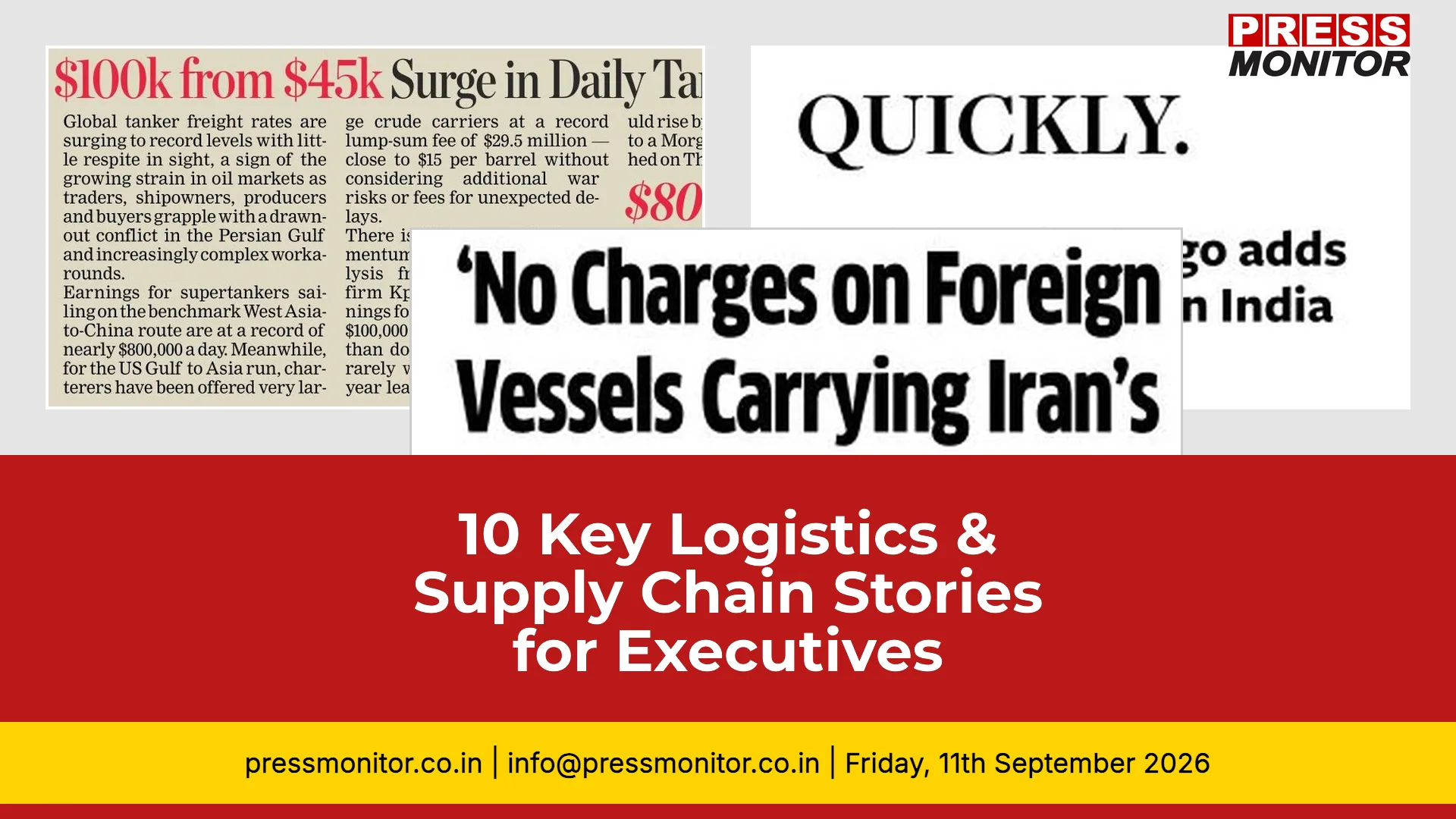
A front-page report in Economic Times says global tanker freight rates are surging to record levels as traders, shipowners, producers and buyers grapple with a drawn-out conflict in the Persian Gulf and increasingly complex workarounds. Earnings for supertankers sailing on the benchmark West Asia to China route are at a record of nearly eighty lakh rupees a day, while charterers on the US Gulf to Asia run face a record lump-sum fee of twenty nine point five million dollars.
Why it matters: Global shipping costs are hitting unprecedented peaks, directly impacting fuel distribution and import budgets.
Key detail: Supertanker earnings on the West Asia to China benchmark route have climbed to nearly eighty lakh rupees daily, while US Gulf to Asia charters face a record twenty nine point five million dollar lump-sum fee.
Source: Economic Times
Next step: Audit current charter contracts and hedge against peak season volatility.
2. Emirates SkyCargo Expands Air Freight Network
A front-page report in Business Line says Emirates SkyCargo has launched new weekly freighter services to Bengaluru, Chennai, and Hyderabad, increasing its total freighter flights to India to seven per week to support export growth. In FY26, the carrier transported over 153,000 tonnes of goods from India, including pharmaceuticals, perishables, electronics, and automotive components.
Why it matters: Enhanced air connectivity lowers transit times for high-value exports, boosting competitiveness in global markets.
Key detail: The carrier now operates seven weekly freighter flights to India, having moved over 153,000 tonnes of pharmaceuticals, electronics, and automotive parts in FY26.
Source: Business Line
Next step: Evaluate air cargo slots for time-sensitive export shipments.
3. Iran Halts 10 Percent Freight Surcharge
A front-page report in Economic Times says Iran has temporarily suspended a 10 per cent charge on freight fees for foreign vessels carrying oil, gas, and petroleum products. This decision aims to mitigate disruptions to seaborne exports following a United States naval blockade. The presidential legal deputy halted the collection pending official government approval and publication of the applicable product list.
Why it matters: Policy shifts in key maritime corridors can instantly alter routing costs and insurance premiums for Middle East-bound vessels.
Key detail: Tehran temporarily suspended a ten percent charge on foreign vessels carrying petroleum products to mitigate export disruptions following naval tensions.
Source: Economic Times & Business Line
Next step: Review vessel routing agreements and update compliance protocols.
4. BRICS Summit Targets Energy Security & Local Currencies
A front-page report in Business Standard says the BRICS summit in New Delhi on 10 September is expected to call for an end to hostilities in West Asia and discuss long-term energy supply agreements amid regional security concerns. Experts note India and China, the world's largest oil importers, are particularly vulnerable to disruption in the Strait of Hormuz, while talks may also cover using local currencies for cross-border payments and strengthening critical mineral supply chains. The summit will additionally build consensus on transportation issues including urban mobility, logistics cooperation, and transport decarbonisation.
Why it matters: Multilateral trade frameworks are evolving to reduce dependency on traditional payment systems and secure critical energy flows.
Key detail: Delegates are pushing for local currency settlements, strengthening critical mineral supply chains, and establishing long-term energy supply agreements amid regional security concerns.
Source: Business Standard
Next step: Align treasury strategies with emerging cross-border settlement mechanisms.
5. Corporate Sector Anticipates BRICS Trade Expansion
A front-page report in Business Standard says businesses and economists expect the 18th Brics summit in New Delhi to deliver tangible gains in trade, investment, supply-chain integration, and cross-border payments beyond strategic dialogue. Key expectations include easier market access, lower regulatory barriers, greater use of local currencies, and stronger payment linkages for Indian businesses. The eleven-member grouping accounts for around 26 per cent of global trade, with India's trade heavily import-biased from China, the United Arab Emirates, and Russia.
Why it matters: Regulatory easing and payment linkages within the bloc promise faster market access for Indian exporters and manufacturers.
Key detail: Economists project tangible gains in supply-chain integration, noting that the eleven-member grouping already commands roughly twenty-six percent of global trade volume.
Source: Business Standard
Next step: Engage trade associations to leverage upcoming bilateral facilitation measures.
6. Major Packaging Investments Land in Uttar Pradesh
A front-page report in Statesman says senior delegations from Ball Corporation and Crown Holdings met Chief Minister Yogi Adityanath in Lucknow on 10 September as both companies advance manufacturing plans in Uttar Pradesh. Ball Corporation proposed an investment of Rs 2,913 crore for a facility at the Integrated Manufacturing & Logistics Cluster in Meerut, while Crown Holdings broke ground on a Rs 2,078.44 crore plant at IMLC Unnao spanning nearly 40 acres.
Why it matters: Domestic manufacturing capacity for packaging materials reduces reliance on imports and stabilizes downstream supply chains.
Key detail: Ball Corporation and Crown Holdings are committing over fifty thousand crore rupees combined for aluminium can facilities in Meerut and Unnao, creating thousands of jobs.
Source: Statesman
Next step: Partner with local suppliers to integrate into next-generation packaging ecosystems.
7. Uttar Pradesh Secures Ninety Thousand Crore in Foreign Capital
A front-page report in Economic Times says Uttar Pradesh Chief Minister Yogi Adityanath secured Memorandums of Understanding worth 90,000 crore rupees during his delegation visit to Tokyo and Yamanashi Prefecture in February 2026. Overall investment proposals reached 1.5 lakh crore, covering sectors like automotive manufacturing, infrastructure, logistics, and green hydrogen. Additionally, IIT Kanpur was designated as a centre of excellence for clean energy innovation and skill training to strengthen Indo-Japanese cooperation.
Why it matters: Large-scale infrastructure and green hydrogen deals are transforming northern India into a premier logistics and manufacturing hub.
Key detail: MoUs signed during the Tokyo delegation visit span automotive, logistics, and clean energy sectors, bolstered by an IIT Kanpur centre of excellence for skill training.
Source: Economic Times
Next step: Explore joint venture opportunities in state-backed industrial clusters.
8. Quick Commerce Startup Swish Closes Series B Funding
A front-page report in Mint says Swish raised a Series B round from Bertelsmann India Investments, with existing investors Accel, Bain Capital Ventures, and Hara Global also participating. The Bengaluru-based startup, co-founded by Aniket Shah, plans to use the funds to expand its kitchen network across India over a three-to-five-year period. The fundraise comes as competitors like Blinkit and Zepto have scaled back or slowed their operations.
Why it matters: Consolidation in last-mile delivery platforms signals maturation in urban logistics technology and fulfillment networks.
Key detail: Backed by Bertelsmann India Investments and existing VC firms, the Bengaluru-based firm plans to scale its kitchen network nationwide over the next three to five years.
Source: Mint
Next step: Assess partnership models with expanding quick-commerce aggregators.
9. PepsiCo Commits Five Thousand Seven Hundred Crore for Expansion
A front-page report in Financial Express says PepsiCo aims to join its top ten global markets within the coming years, driven by robust expansion plans and significant investments across India. The company has committed to investing approximately Rs 5,700 crore by 2030 to boost production capacity and regional supply chains. This growth strategy was highlighted during the inauguration of PepsiCo's new manufacturing facility in Assam.
Why it matters: Aggressive capex by multinational FMCG giants underscores confidence in India’s domestic consumption and distribution reach.
Key detail: The beverage and snack leader is ramping up production capacity and regional supply chains, recently inaugurating a new facility in Assam to target top-tier global market status.
Source: Financial Express
Next step: Benchmark distribution efficiency against industry-leading cold chain standards.
10. Oilmeal Export Volumes Contract Amid Shipping Headwinds
A front-page report in Millennium Post says India’s oilmeal exports fell thirteen per cent to nine point five seven lakh tonnes during April to June twenty twenty six, primarily driven by a sharp decline in soyabean meal shipments. The Solvent Extractors Association of India attributed the downturn to intense global pricing pressures from South American suppliers, elevated domestic costs, and higher freight charges caused by Red Sea shipping disruptions. China, Bangladesh, and Vietnam served as the key importing markets throughout the quarter.
Why it matters: Commodity trade flows remain highly sensitive to global pricing arbitrage and Red Sea maritime disruptions.
Key detail: Soybean meal shipments dropped thirteen percent to 9.57 lakh tonnes quarter-on-quarter, pressured by South American competition and elevated freight charges.
Source: Millennium Post
Next step: Diversify sourcing channels and lock in forward freight agreements.
Which of these supply chain shifts will impact your operational budget the most this quarter? Share your perspective below. Tracked by Press Monitor.