10 Key Pharmaceutical and Life Sciences Stories for Industry Leaders


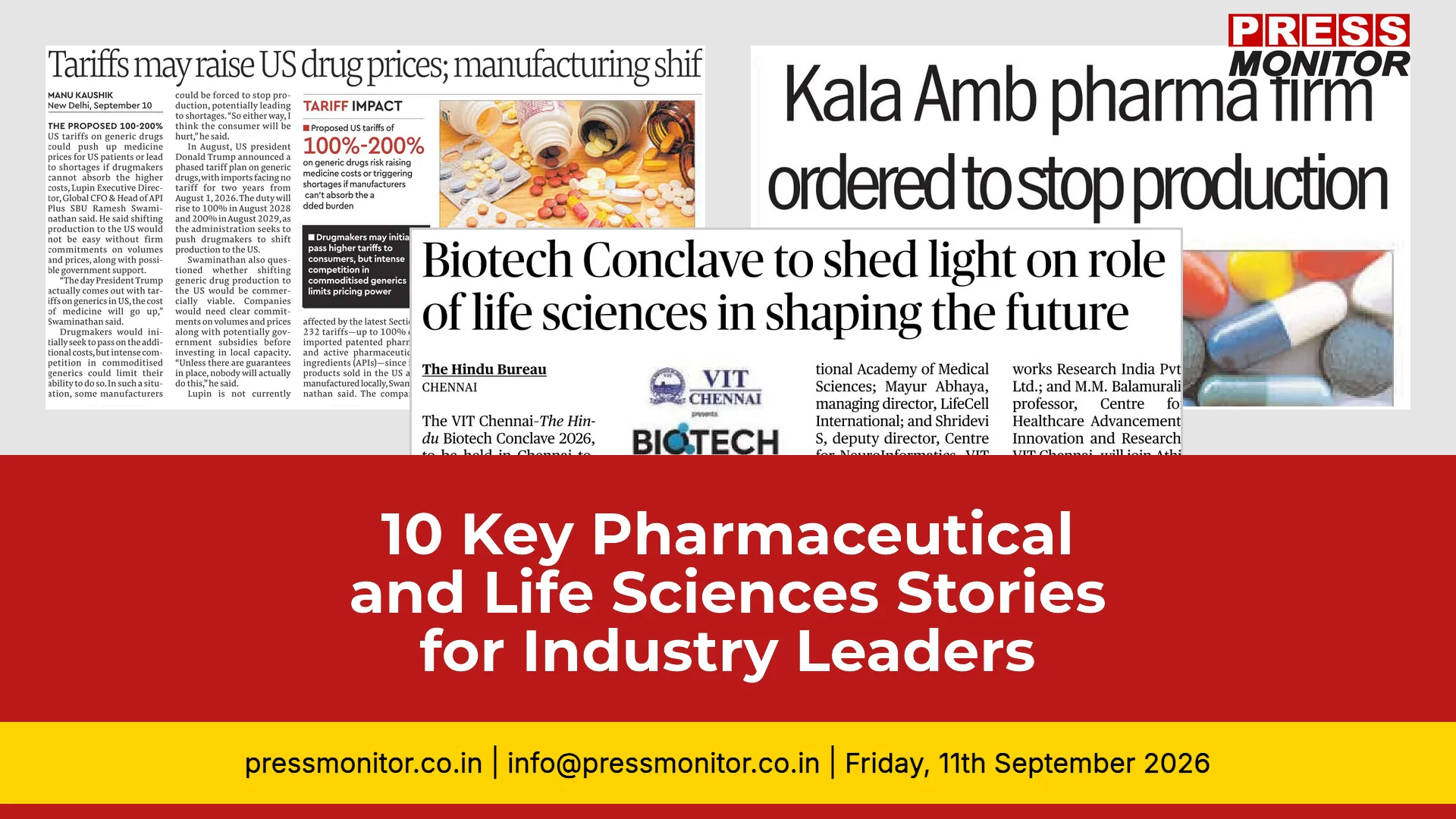
Welcome to today’s essential media monitoring briefing. According to Press Monitor's tracking of Indian publications, the pharmaceutical and life sciences sector is navigating a complex landscape of regulatory shifts, market expansions, and supply chain challenges. This press review distills the most critical news on pharmaceuticals shaping executive decisions today.
1. US Tariffs Threaten Generic Drug Pricing
A front-page report in Financial Express says that the United States has proposed tariffs of up to twenty percent on generic drugs, which could raise medicine prices and cause shortages if manufacturers cannot absorb the cost. Ramesh Swaminathan, the global chief financial officer of Lupin, warned that shifting production to the United States would not be easy without firm commitments on volumes, prices, and potential government support. The company highlighted its limited exposure to the latest Section 232 tariffs and its long‑term focus on the GLP‑1 segment, partnering with Zydus Lifesciences and a Chinese firm to market semaglutide and Bofanglutide.
Why it matters: Global trade policies directly impact domestic manufacturing strategies and patient affordability.
Key detail: A front-page report in Financial Express highlights proposed US tariffs of up to twenty percent on generic drugs. Ramesh Swaminathan, global CFO of Lupin, cautioned that shifting production without volume commitments could strain margins, while the company maintains focus on the GLP‑1 segment.
Source: Financial Express
Next step: Monitor tariff implementations and assess export diversification strategies.
2. Production Halted at Welcure Remedies
A front-page report in Tribune says state drug authorities halted all production at Kala Amb-based M/s Welcure Remedies following serious deficiencies found during a joint inspection. A cardiac emergency injection produced by the firm was declared spurious in an export consignment and was exported in violation of regulatory norms. The company was prohibited from manufacturing drugs under Section 18(c) of the Drugs and Cosmetics Act before appealing the stop-production order.
Why it matters: Regulatory enforcement remains critical for maintaining public trust and supply chain integrity.
Key detail: Tribune reports that state authorities suspended all production at Kala Amb-based Welcure Remedies after a joint inspection revealed serious deficiencies. A cardiac emergency injection was flagged as spurious in an export consignment, triggering action under Section 18(c) of the Drugs and Cosmetics Act.
Source: Tribune
Next step: Track appeal outcomes and strengthen internal quality audits.
3. VIT Chennai Launches Biotech Conclave 2026
A front-page report in The Hindu says the VIT Chennai-The Hindu Biotech Conclave 2026 convened in Chennai today to explore biotechnology's growing impact on society and industry. Student-focused and presided over by VIT Chancellor G. Viswanathan and inaugurated by Bharat Biotech co-founder Suchitra Ella, the event features expert discussions on genetic-based therapies, India’s biopharmaceutical sector, and research funding. Organisers aim to inspire students to view biotechnology as a pathway to innovation and meaningful service.
Why it matters: Academic-industry convergence accelerates commercialization of genetic therapies and biopharmaceuticals.
Key detail: The Hindu covers the VIT Chennai-The Hindu Biotech Conclave 2026, inaugurated by Bharat Biotech co-founder Suchitra Ella. Discussions focused on research funding, genetic-based therapies, and pathways for student-led innovation in India’s biopharma ecosystem.
Source: The Hindu
Next step: Engage with academic partnerships and track emerging talent pipelines.
4. Domestic GLP-1 Market Projected to Quadruple
A front-page report in Financial Express says the domestic GLP-1 market for obesity and diabetes drugs is projected to grow nearly fourfold to Rs 1,50,000 crore by FY32. Generic medicines are expected to account for the lion's share of future growth, with the market concentrated among seven identified drugmakers including Sun Pharma and Lupin.
Why it matters: Obesity and diabetes therapeutics represent a high-growth revenue corridor for generic manufacturers.
Key detail: Financial Express projects the domestic GLP-1 market to reach Rs 1,50,000 crore by FY32. Generic formulations will dominate growth, with Sun Pharma and Lupin leading among seven identified manufacturers.
Source: Financial Express
Next step: Align R&D portfolios with scale-up capabilities for metabolic disease treatments.
5. Central Licensing Proposed After Sterile Drug Failures
A front-page report in Mint says the Indian government plans to implement a central licensing system for sterile drugs after roughly 240 injection samples tested substandard in fiscal 2026. The proposal transfers oversight from state authorities to the Central License Approving Authority to enforce uniform manufacturing standards and mitigate microbial contamination risks nationwide.
Why it matters: Uniform oversight standards will reduce microbial contamination risks and harmonize compliance.
Key detail: Mint reports that roughly 240 injection samples tested substandard in FY26, prompting the government to propose transferring sterile drug oversight from state authorities to a Central License Approving Authority.
Source: Mint
Next step: Prepare facility upgrades for centralized compliance frameworks.
6. Kerala Medical Corporation Issues MS Drug Tender
A front-page report in Times of India says online bids are invited from manufacturers and direct importers for the procurement of Drugs for Multiple Sclerosis under the State Insurance Division of Kerala Medical Services Corporation Ltd for the year 2026-2027. The tender notice was issued by the Department of Health, Government of Kerala, with the last date for online uploading of tenders on 22 September 2026. The technical bids will be opened on 24 September 2026 at the head office in Thiruvananthapuram.
Why it matters: State procurement cycles dictate immediate demand signals for specialty injectables.
Key detail: Times of India outlines e-tender requirements for Multiple Sclerosis drugs under the Kerala State Insurance Department. Submissions close 22 September 2026, with technical evaluations scheduled for 24 September at Thiruvananthapuram.
Source: Times of India
Next step: Verify manufacturer credentials and align logistics for Q4 delivery windows.
7. Malladi Specialities Files Composite Scheme
A front-page report in New Indian Express says Malladi Specialities Limited, Tantech Agro Chemicals Limited, Malladi Drugs and Pharmaceuticals Limited, and MLN Estates Private Limited have filed a joint petition under Sections 230 to 242 of the Companies Act, 2013, seeking approval of a Composite Scheme of Arrangement. The petition was presented on 3 September 2026 and has been listed for hearing before the National Company Law Tribunal, Chennai Bench, on 14 October 2026.
Why it matters: Corporate restructuring within mid-tier pharma firms optimizes capital allocation and operational synergies.
Key detail: New Indian Express reports that Malladi Specialities Limited and affiliated entities filed a joint petition under Sections 230–242 of the Companies Act, seeking NCLT approval for a composite arrangement hearing on 14 October 2026.
Source: New Indian Express
Next step: Review tribunal proceedings for potential M&A activity signals.
8. Nutrition Experts Challenge Protein Supplement Fads
A front-page report in The Hindu says nutrition experts warn against social media-driven protein fads during National Nutrition Week, emphasising that a varied, calorie-sufficient diet provides all necessary amino acids without strict meal combinations. Physicians Association for Nutrition India highlights that excessive focus on grams and marketing claims overlooks individual health needs, recommending whole foods over supplements for most adults. Qualified dietitians stress consulting professionals to avoid risks like electrolyte imbalances, particularly for patients on dialysis or weight-loss medications.
Why it matters: Consumer wellness trends increasingly intersect with clinical nutrition guidelines and supplement regulation.
Key detail: The Hindu highlights a PAN-India white paper warning against social media-driven protein consumption. Physicians Association for Nutrition India emphasizes whole-food diets over isolated supplements, cautioning against electrolyte imbalances in vulnerable populations.
Source: The Hindu
Next step: Adjust consumer education campaigns and reformulate wellness product lines.
9. Bengaluru Introduces NGS MRD Cancer Test
A front-page report in Deccan Herald says that a next-generation sequencing‑based molecular residual disease test has been launched in Bengaluru to help oncologists detect cancer recurrence earlier.
Why it matters: Molecular diagnostics are reshaping oncology follow-ups and early recurrence detection protocols.
Key detail: Deccan Herald announces the launch of a next-generation sequencing-based molecular residual disease test in Bengaluru, enabling oncologists to monitor treatment efficacy and detect minimal residual disease earlier than conventional methods.
Source: Deccan Herald
Next step: Evaluate diagnostic integration pathways and partner with regional oncology centers.
10. India and Russia Target $100 Billion Bilateral Trade
A front-page report in Millennium Post says India and Russia are fast-tracking negotiations for a new bilateral investment treaty and a Eurasian Economic Union free trade agreement. Speaking in New Delhi on September tenth, Commerce Minister Piyush Goyal called for accelerated economic partnership to reach a target of one hundred billion dollars in bilateral trade and fifty billion dollars in two-way investment by twenty thirty. Both sides agreed to prioritise local currency settlements and expand non-energy exports across pharmaceuticals, artificial intelligence, and engineering sectors.
Why it matters: Cross-border investment treaties expand market access for pharmaceutical exports and technology transfer.
Key detail: Hindustan Times reports Commerce Minister Piyush Goyal outlined accelerated negotiations for a bilateral investment treaty and Eurasian Economic Union free trade agreement, prioritizing local currency settlements and non-energy exports including pharmaceuticals.
Source: Hindustan Times
Next step: Map export corridors and leverage diplomatic trade facilitation channels.
This print media monitoring synthesis delivers actionable intelligence from India’s leading publications. How will your organization adapt to shifting tariff landscapes and centralized quality mandates? Share your strategic priorities below.