10 Pivotal Agricultural Commodity Stories for Indian Professionals


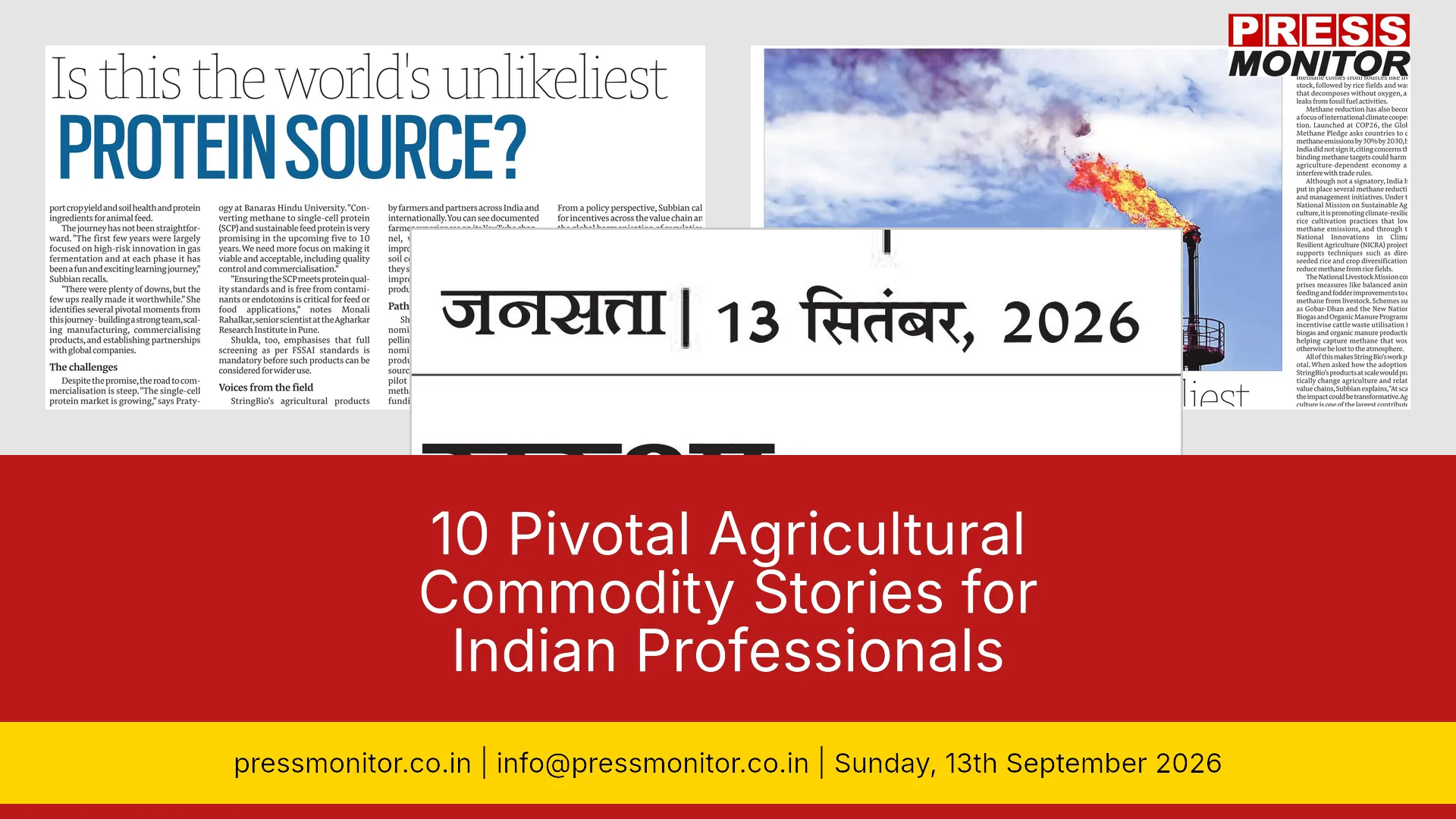
Welcome to today's media monitoring digest. According to Press Monitor's tracking of Indian publications, the agricultural landscape is shifting rapidly across policy, technology, and market dynamics. Here are the 10 essential stories shaping the sector right now.
1. Punjab Procurement Scandal Demands Probe
A front-page report in Financial Express says StringBio is converting methane into single-cell protein for sustainable animal feed and agricultural products. The company highlights improved crop yields and soil health after field trials across India and internationally. Experts note that while the technology shows promise over the next five to ten years, achieving viable quality standards, regulatory approval under FSSAI guidelines, and clear economic modelling remains critical for widespread commercialisation.
Why it matters: Transparency in agricultural procurement is critical for farmer trust and national food security.
Key detail: A formal complaint alleges Rs 34,000 crore in irregularities, prompting calls for a CBI investigation and CAG audit of the Food and Supply Department.
Source: Pioneer
Next step: Tag @GurpreetSingh_Official or relevant oversight bodies to amplify accountability efforts.
2. StringBio Converts Methane to Protein
A front-page report in Financial Express says Indian biotech firm String Bio is commercialising single-cell protein products that convert methane into sustainable animal feed ingredients. Founder Ashwini Subbian highlights field tests showing improved crop yields and soil health, while experts at Banaras Hindu University and Agharkar Research Institute stress the need for FSSAI screening and economic viability. The article also notes India's methane reduction initiatives like the National Mission on Sustainable Agriculture and the Global Methane Pledge context ahead of COP26.
Why it matters: Biotech innovation is turning greenhouse gas emissions into sustainable feed, aligning with global climate goals.
Key detail: Field tests show improved crop yields and soil health, though FSSAI screening and economic viability remain key hurdles.
Source: Financial Express
Next step: Follow @AshwiniSubbian for updates on commercial scaling.
3. Greater Noida Farmer Protest Continues
A front-page report in Jansatta says the Indian government is considering a new seed bill to replace the outdated 966 law, aiming to curb market irregularities and impose QR code transparency on products. The proposed regulations have deepened confusion among farmers, who fear that patented seeds and terminator technology will force them to depend on a handful of companies and pay hefty prices every season. The article argues that community seed banks and traditional crops like kodo-kutki remain vital strengths because true biodiversity can better withstand climate change, raising the question of whether farming direction will be set by a few companies or by farmers themselves.
Why it matters: Land rights and compensation frameworks are at the center of ongoing agrarian negotiations.
Key detail: Union president Ramesh Verma outlines demands for 10% land allocation and ₹20,000 per sq meter compensation ahead of a major Mahapanchayat.
Source: Jansatta
Next step: Share this update with policymakers and @RameshVerma_Kisan to keep the dialogue active.
4. India Ethanol Supply Hits 895 Crore Litres
A front-page report in Millennium Post says India's ethanol supply reached 895 crore litres by August-end, with grain-based feedstocks accounting for nearly 70 per cent of cumulative supplies under Ethanol Supply Year 2025-26. Maize was the largest grain contributor at 345 crore litres, followed by surplus Food Corporation of India rice. The All India Distillers Association said the expansion requires adequate utilisation avenues beyond the existing blending framework towards wider adoption of Flex Fuel Vehicles and other applications.
Why it matters: Renewable energy integration into agriculture is accelerating, boosting rural economies.
Key detail: Grain-based feedstocks account for 70% of supplies, with maize leading at 345 crore litres. Industry leaders call for flex-fuel vehicle expansion.
Source: Millennium Post
Next step: Connect with @AllIndiaDistillersAssoc to explore investment avenues.
5. Agra Potato Farmers Get Storage Subsidy
A front-page report in Pioneer says a two-day potato buyer-seller convention began on Saturday at Hotel Grand Meridian on Faizabad Road in Agra, inaugurated by Uttar Pradesh Minister of State for Gardens, Agricultural Marketing and Agricultural Exports Dinesh Pratap Singh. The Yogi government has implemented the Bhama Shah Price Stability Fund scheme with a 4,000 crore rupee price difference fund to compensate potato farmers if market prices fall below production cost, and is providing a 400 rupee per quintal subsidy on potatoes stored in private cold storage, sent directly via DBT to farmers' Aadhaar-linked bank accounts. Singh also announced that an international potato research centre, a branch of Peru's Lima centre, will soon be inaugurated in Agra by Prime Minister Narendra Modi.
Why it matters: Direct benefit transfers and cold-chain infrastructure are stabilizing farmer incomes.
Key detail: The state provides ₹400 per quintal for private cold storage, plus a ₹4,000 crore price stability fund, with an international potato research centre slated for Agra.
Source: Pioneer
Next step: Tag @DineshPratapSingh_UP to highlight successful policy implementation.
6. New Seed Bill Sparks Farmer Anxiety
A front-page report in Jansatta says the Indian government is considering a new seed bill to replace the outdated 966 law, aiming to curb market irregularities and impose QR code transparency on products. The proposed regulations have deepened confusion among farmers, who fear that patented seeds and terminator technology will force them to depend on a handful of companies and pay hefty prices every season. The article argues that community seed banks and traditional crops like kodo-kutki remain vital strengths because true biodiversity can better withstand climate change, raising the question of whether farming direction will be set by a few companies or by farmers themselves.
Why it matters: Regulatory shifts could reshape seed sovereignty and biodiversity conservation.
Key detail: Proposed QR transparency aims to curb irregularities, but fears persist around patented seeds and corporate dependency. Community seed banks remain a resilient alternative.
Source: Jansatta
Next step: Discuss with @SeedSovereignty advocates to balance innovation and tradition.
7. BRICS Chairship Drives India Startup And Climate Growth
A front-page report in Economic Times says that during its two thousand twenty-six chairmanship, India is steering the multilateral grouping toward a people-centric model focused on practical multipolarity rather than rigid bloc politics. The government has organised over four hundred engagements across nearly thirty cities, emphasising digital agriculture, startup incubation networks, and climate-resilient infrastructure financing through the New Development Bank. Prime Minister Narendra Modi underscores that the coalition’s lasting legitimacy depends on measurable improvements in ordinary citizen livelihoods, employment prospects, and cross-border market access.
Why it matters: Multilateral leadership is channeling capital into digital agriculture and climate-resilient infrastructure.
Key detail: Over 400 engagements across 30 cities emphasize startup incubation and New Development Bank financing, with PM Narendra Modi stressing livelihood improvements.
Source: Economic Times
Next step: Follow @PMOIndia for policy rollouts and startup partnerships.
8. BRICS New Delhi Declaration Strengthens Global Trade
A front-page report in The Pioneer says BRICS adopted the New Delhi Declaration at its 20-year mark, positioning the bloc as a platform for developing countries to demand greater representation in the International Monetary Fund and World Bank. The declaration also reaffirmed support for a rules-based multilateral trading system with the World Trade Organization at its core and condemned unilateral coercive measures as contrary to international law.
Why it matters: Developing nations are pushing for equitable representation in IMF and World Bank governance.
Key detail: The declaration reinforces WTO-centric multilateral trade while condemning unilateral coercive measures.
Source: The Pioneer
Next step: Engage with @WTOofficial and @IMFNews on trade equity frameworks.
9. Telangana Minister Vows Vijaya Dairy Support
A front-page report in Statesman says Telangana Animal Husbandry, Dairy Development and Fisheries Minister Vakiti Srihari on Saturday said the State government was taking steps to strengthen Vijaya Dairy and improve the welfare of dairy farmers. The Minister said the recent decline in procurement was temporary and mainly due to the prolonged lean season, and clarified that there were no outstanding dues to dairy farmers towards milk procurement payments.
Why it matters: Regional dairy cooperatives are vital for rural employment and milk procurement stability.
Key detail: Minister Vakiti Srihari clarifies no outstanding dues exist, attributing recent procurement dips to seasonal lean periods.
Source: Statesman
Next step: Tag @VijayaDairyOfficial to celebrate cooperative resilience.
10. UP Districts to Go AI-Enabled by 2034
A front-page report in Hindustan says the state government has formed the UP Advisory Board under Prof. Abhay Karandikar to make all 75 districts AI-enabled with 2000 crore rupees by 2034. The board includes representatives from NITI Aayog, IIT Kanpur, Microsoft, IBM, and other technical institutions. Governor Anandiben Patel stressed at AI Manthan 2.0 that technology must be farmer-centric to deliver real benefits.
Why it matters: Technology integration promises precision farming and streamlined governance across 75 districts.
Key detail: A ₹2,000 crore initiative led by Prof. Abhay Karandikar includes NITI Aayog and IIT Kanpur, with Governor Anandiben Patel emphasizing farmer-centric design.
Source: Hindustan
Next step: Follow @IITKanpur and @NITIAayog for tech-agri convergence updates.
What do you think is the biggest opportunity for Indian agriculture this quarter? Share your insights below. Stay updated on news on agricultural commodities across India. This print media monitoring and media intelligence roundup keeps you ahead of market shifts.

11 Critical Women Issues Stories for Indian Professionals

2 Pivotal Media Monitoring & Real Estate Stories for Indian Professionals

5 Pivotal Petroleum Stories for Indian Professionals

2 Key Dairy Industry Stories for Indian Professionals