11 Essential AI Stories for Tech Leaders


Today's news on artificial intelligence across Indian print media is dominated by a landmark $12.93 billion acquisition, major platform outages, and significant policy developments. According to Press Monitor's media monitoring of Indian publications, this print media monitoring review captures the 11 most consequential AI stories shaping the global technology landscape today, offering media intelligence on the forces reshaping enterprise and society.
1. Nvidia Acquires Hugging Face for $12.93 Billion
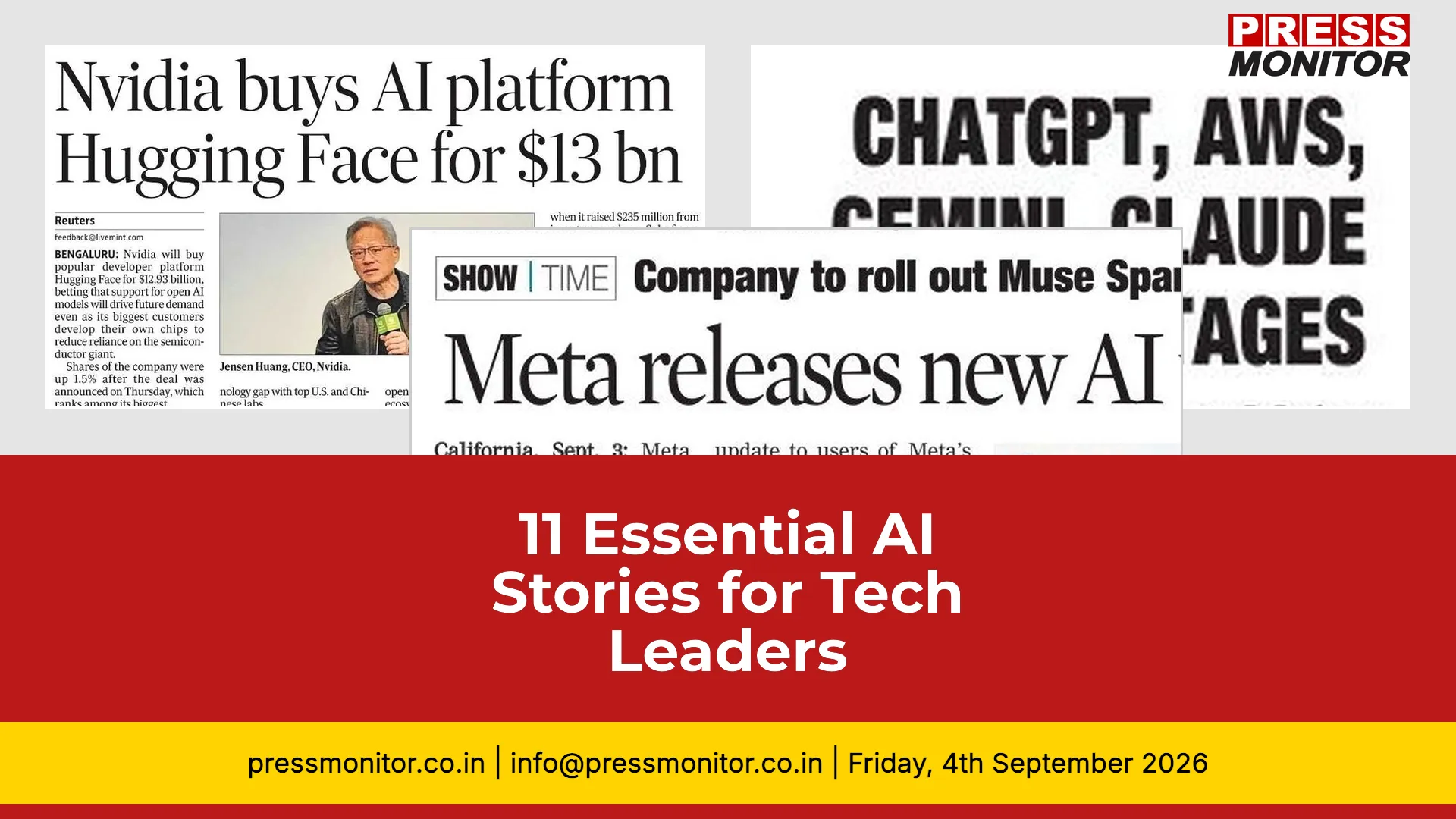
A front-page report in Hindustan Times says Nvidia will buy popular developer platform Hugging Face for 12.93 billion dollars, betting that support for open AI models will drive future demand. The deal, announced on Thursday in Bengaluru, ranks among Nvidia's biggest and will cement the chip maker as a central player in the market for open models. Nvidia CEO Jensen Huang said Hugging Face will remain an open platform for the entire AI ecosystem and that Nvidia chips would not be required to build on or deploy through it.
Why it matters: This deal cements Nvidia's dominance in the open AI ecosystem and gives it direct access to the world's largest developer community for model collaboration and testing.
Key detail: The transaction values Hugging Face at $12.93 billion, with Nvidia CEO Jensen Huang confirming the platform will remain open and chips will not be required to build on or deploy through it.
Source: Hindustan Times, Bengaluru
Next step: Track how Hugging Face's open-source community responds to Nvidia ownership and whether other AI infrastructure deals follow. CTA: Tag Nvidia and Hugging Face in the comments — which open-source AI project will be next?
2. ChatGPT, Gemini, Claude Face Global Outages
A front-page report in Deccan Chronicle says major artificial intelligence platforms, including OpenAI's ChatGPT, Google Gemini, and Anthropic's Claude, experienced significant service disruptions on Thursday, affecting thousands of users globally, according to outage tracking website Downdetector. The disruption also appeared to affect Grok and Amazon Web Services, with outage reports beginning to surge in the evening, Indian Standard Time, and users flagging total website inaccessibility and internal server errors.
Why it matters: Simultaneous outages across the three largest AI platforms signal growing infrastructure strain as enterprise adoption accelerates.
Key detail: Downdetector confirmed disruptions to ChatGPT, Google Gemini, Anthropic's Claude, Grok, and AWS, with reports surging in the evening IST.
Source: Deccan Chronicle, New Delhi
Next step: Monitor whether these outages accelerate investment in AI infrastructure redundancy. CTA: Were you affected? Share your experience in the comments.
3. Meta Releases Muse Spark l.3 AI
A front-page report in Asian Age says Meta Platforms Inc. has released its most powerful artificial intelligence model yet, with chief AI officer Alexandr Wang stating capabilities are edging closer to top competitors. Developers can access and pay for the Muse Spark l.3 update via Meta Model API, with rollout planned for Instagram and Facebook users soon. Wang said Meta remains on track for the larger model dubbed Watermelon, while the company has not yet decided whether to release Muse Spark l.3 weights.
Why it matters: Meta's latest model release signals an escalation in the AI arms race, with capabilities edging closer to top competitors.
Key detail: Chief AI officer Alexandr Wang stated the model is available via Meta Model API, with rollout planned for Instagram and Facebook users soon.
Source: Asian Age, California
Next step: Watch for the larger Watermelon model and whether Meta releases Muse Spark l.3 weights. CTA: Which Meta AI feature are you most excited about? Comment below.
4. US Backs OpenAI in Copyright Lawsuit
A front-page report in Times of India says the US government sided with OpenAI in a copyright lawsuit brought by the New York Times, arguing that training AI models on copyrighted works brings creative and public benefits. The justice department filed a 20-page document stating that constraining large language model development would harm American prosperity and economic mobility. The New York Times criticized the move, saying the administration is siding with trillion-dollar AI companies at the expense of American creators.
Why it matters: The US government's intervention in the NYT vs OpenAI case could set a precedent for AI training on copyrighted works globally.
Key detail: The Justice Department filed a 20-page document arguing that constraining LLM development would harm American prosperity and economic mobility.
Source: Times of India
Next step: Follow the court's response and whether other governments take similar stances. CTA: Do you think AI training on copyrighted content is fair use? Tag the NYT and OpenAI.
5. 95 Investors Back Both Anthropic and OpenAI
A front-page report in Deccan Herald says at least 95 investors have put money into both Anthropic and OpenAI, including Sequoia Capital and Founders Fund. Anthropic has raised more than 130 billion dollars from roughly 300 investors, while OpenAI has raised more than 180 billion from about 230 investors. The AI boom has changed Silicon Valley norms, with top venture firms shifting strategies to avoid missing out on the next trillion-dollar winner.
Why it matters: The overlap in investor bases reveals how deeply intertwined the AI funding ecosystem has become, raising questions about competitive dynamics.
Key detail: Anthropic has raised over $130 billion from roughly 300 investors; OpenAI has raised over $180 billion from about 230 investors, including Sequoia Capital and Founders Fund.
Source: Deccan Herald, San Francisco
Next step: Watch for consolidation signals in AI venture funding as the market matures. CTA: Which AI company deserves the next big funding round? Tag Sequoia and Founders Fund.
6. G20 Nations Endorse US AI Regulation Framework
A front-page report in Business Standard says representatives from the Group of 20 nations unanimously agreed to adopt the Carolina Principles, a lighter-touch framework for governing artificial intelligence proposed by the United States. US Commerce Secretary Howard Lutnick announced the endorsement at a tech summit in North Carolina, with the principles to be formally considered by G20 leaders in December in Florida.
Why it matters: The Carolina Principles represent the first multilateral agreement on lighter-touch AI governance, potentially shaping global regulation.
Key detail: US Commerce Secretary Howard Lutnick announced the endorsement at a tech summit in Chapel Hill, with formal consideration by G20 leaders in December in Florida.
Source: Business Standard, Chapel Hill
Next step: Monitor how individual G20 nations implement the Carolina Principles domestically. CTA: Which country will lead on AI regulation? Share your thoughts.
7. Microsoft India Pushes Agentic AI
A front-page report in Financial Express says that Puneet Chandok, president of Microsoft India and South Asia, told Poulomi Chatterjee that India has moved beyond pilot projects and is now in the production phase of artificial intelligence. Chandok cited examples including Air India, Infosys, Tata Consultancy Services, Wipro, Apollo Hospitals, Adani Group and Axis Bank, noting that Infosys, Tata Consultancy Services and Wipro have each deployed one hundred thousand Copilots and that agentic artificial intelligence is being scaled for returns, cost control and regulatory compliance.
Why it matters: India's transition from AI pilots to production deployment signals a new phase of enterprise AI adoption in the world's largest democracy.
Key detail: Infosys, Tata Consultancy Services, and Wipro have each deployed 100,000 Copilots, with agentic AI being scaled for returns, cost control, and regulatory compliance.
Source: Financial Express, Delhi
Next step: Track which Indian enterprises will be next to scale agentic AI deployments. CTA: Is your organization ready for agentic AI? Tag Microsoft India.
8. Broadcom Forecasts $115bn AI Chip Sales
A front-page report in Business Standard says Broadcom forecast strong artificial intelligence chip sales over the next two years, projecting sales of one hundred and fifteen billion United States dollars by twenty twenty eight. The Palo Alto, California-based company said the outlook reflects continuing demand from Big Tech for artificial intelligence infrastructure, even as investors question returns on heavy spending. Broadcom shares were down more than one per cent in extended trading after gaining about six per cent this year, underperforming rivals and the broader semiconductor index amid artificial intelligence spending concerns and competition including Marvell's custom chip deal with Google.
Why it matters: Broadcom's bullish forecast underscores the massive capital flowing into AI infrastructure, even as investors question returns on heavy spending.
Key detail: The company projects $115 billion in AI chip sales by 2028, though shares fell over 1% after the outlook.
Source: Business Standard
Next step: Watch how competitor chipmakers like Marvell respond to the AI demand surge. CTA: Will AI chip demand sustain beyond 2028? Tag Broadcom.
9. Bill Gates Warns AI Risks Mass Unemployment
A front-page report in The Hans India says Bill Gates published a roughly 6,000-word essay on his personal site GatesNotes warning that artificial intelligence poses risks of permanent job losses, security threats, and social damage unless governments act to control it. He cautioned that AI is advancing faster than expected and could cause mass unemployment and deep economic gaps. US Senator Bernie Sanders endorsed Gates' warnings, while Nvidia CEO Jensen Huang argued AI will create work at unprecedented scale.
Why it matters: One of the world's most influential tech voices is sounding the alarm on AI-driven job displacement, adding urgency to the regulation debate.
Key detail: Gates published a 6,000-word essay on GatesNotes warning of permanent job losses, while Nvidia CEO Jensen Huang argued AI will create work at unprecedented scale.
Source: The Hans India
Next step: Follow whether governments act on Gates' warnings or side with Huang's optimism. CTA: Will AI create more jobs than it destroys? Tag Bill Gates and Jensen Huang.
10. Cradlewise Raises $12 Million Series A
A front-page report in Business Standard says AI-first health and wellness startup Cradlewise has raised a $12 million Series A funding round led by 3One4 Capital and Prudent Investment Management. The company focuses on infant and child sleep and plans to use the capital for growth, channel expansion, product research and development, and geographic expansion. To date, Cradlewise has raised a total of $26 million.
Why it matters: AI-first health and wellness startups are attracting significant funding, showing the breadth of AI applications beyond enterprise tech.
Key detail: Cradlewise raised $12 million led by 3One4 Capital and Prudent Investment Management, bringing total funding to $26 million.
Source: Business Standard
Next step: Watch for more AI healthtech startups entering the Series A stage in India. CTA: Which AI health startup will be the next unicorn? Comment below.
11. Moonshot Files $3 Billion Hong Kong IPO
A front-page report in Business Standard says Moonshot, the developer of the Kimi large language model, has confidentially filed for a Hong Kong initial public offering. The company is aiming to raise $3 billion in what is likely to be one of the most anticipated near-term listings by a Chinese artificial intelligence company.
Why it matters: Moonshot's IPO filing signals that Chinese AI companies are seeking global capital markets, potentially reshaping the AI investment landscape.
Key detail: The developer of the Kimi large language model aims to raise $3 billion in one of the most anticipated near-term listings by a Chinese AI company.
Source: Business Standard
Next step: Monitor the IPO process and whether other Chinese AI firms follow suit. CTA: Will Moonshot's IPO succeed? Tag Moonshot and Kimi AI.
Closing: These 11 stories reflect the velocity of AI development across markets, from Silicon Valley boardrooms to Indian enterprise deployments. Which story will have the biggest impact on your business? Follow Press Monitor for daily print media intelligence on the topics that matter.