11 Essential Education Stories for Indian Stakeholders


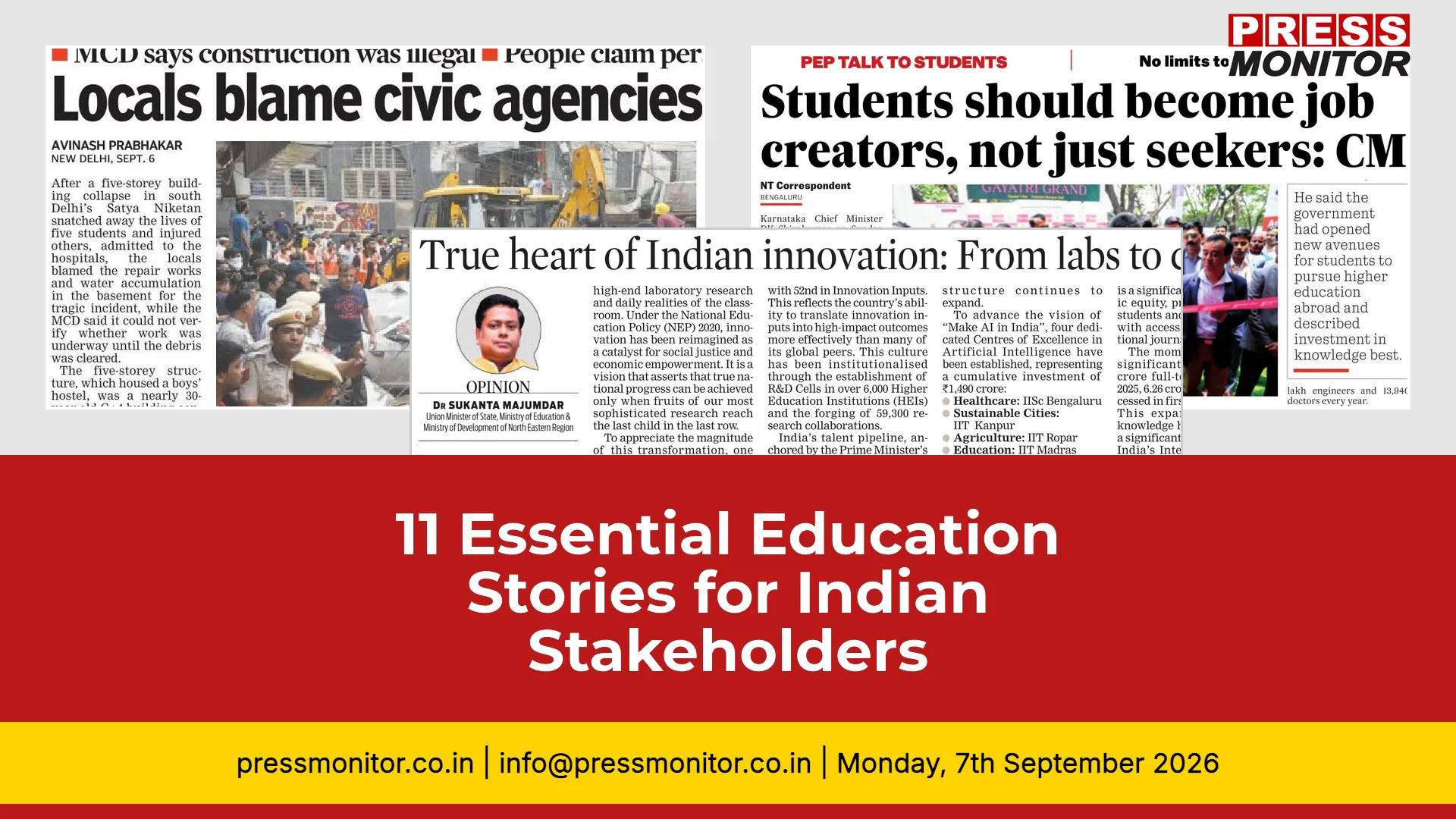
According to Press Monitor's tracking of Indian publications, today's print media delivers news on education spanning policy debates, safety crises, and innovation milestones. This print media monitoring review highlights 11 essential stories that every stakeholder in India's education ecosystem must track. From the Delhi building collapse that has put student safety under the microscope to Karnataka's ambitious Study Abroad 2026 programme, these developments reflect the pulse of Indian education. Media monitoring of print sources reveals that assessment reform, industry readiness, and inclusive innovation remain central themes. As the nation pursues Viksit Bharat 2047, media intelligence from today's newspapers offers actionable insight for policymakers, educators, and industry leaders alike.
1. Delhi Building Collapse Kills Five Students
A front-page report in Asian Age says the collapse of a nearly thirty-year-old five-storey boys' hostel in south Delhi's Satya Niketan killed five students and injured several others on Sunday afternoon. Locals blamed water accumulation in the basement and ongoing repair works for the disaster, while the Municipal Corporation of Delhi noted the structure violated building norms as it was only permitted for ground plus one floor. Residents and students formed human chains to clear debris with bare hands before official rescue teams arrived.
A five-storey boys' hostel in Satya Niketan, south Delhi, collapsed on Sunday afternoon, killing five students and injuring several others. The nearly thirty-year-old structure violated building norms, being permitted only for ground plus one floor. Residents and students formed human chains to clear debris before official rescue teams arrived. The Municipal Corporation of Delhi acknowledged it could not verify work underway until debris was cleared. This tragedy underscores the urgent need for structural safety audits across student accommodations nationwide.
Why it matters: student safety is a fundamental right, and repeated failures demand immediate regulatory action.
Key detail: the building was nearly three decades old and structurally non-compliant.
Source: Asian Age, New Delhi, Sept. 6.
Next step: authorities must order comprehensive safety audits of all student housing in Delhi.
2. Karnataka Launches Study Abroad 2026 Programme
A front-page report in Free Press Journal says Karnataka Chief Minister DK Shivakumar launched the Study Abroad 2O26 programme at Palace Grounds in Bengaluru on Sunday. Over 8O universities offered opportunities in 3OO disciplines, with 3,145 students selected to study at foreign universities including Queensland University.
Karnataka Chief Minister DK Shivakumar launched the Study Abroad 2026 programme at Palace Grounds in Bengaluru, offering opportunities at over 80 foreign universities across 300 disciplines. 3,145 students were selected, including those heading to Queensland University. The initiative positions Karnataka as a leader in global educational mobility.
Why it matters: study abroad programmes create job creators, not just job seekers.
Key detail: over 80 universities and 300 subjects available.
Source: Free Press Journal, Bengaluru.
Next step: students should monitor eligibility criteria and application deadlines for their chosen universities.
3. Indian Teachers Drive Viksit Bharat 2047 Innovation
A front-page report in Morning Standard says Union Minister of State Dr Sukanta Majumdar highlights how teacher-led innovation and bridge-building between high-end research and inclusive classrooms are central to India's vision of Viksit Bharat. Under the National Education Policy 2020, India has institutionalised Research and Development cells in over six thousand higher education institutions, established four Centres of Excellence in Artificial Intelligence with a cumulative investment of Rs 11,490 crore, and launched initiatives like the One Nation One Subscription programme providing access to thirteen thousand international journals for 1.8 crore students and faculty. Domestic patent filings have surged by 158 percent to 110,375, while phygital tools such as the PRASHAST app and Kitab Ek Padhein Anek textbooks ensure accessibility for students with disabilities, making teachers the true architects of the nation's innovation-led progress.
Union Minister of State Dr Sukanta Majumdar highlighted how teacher-led innovation bridges high-end research and inclusive classrooms under the National Education Policy 2020. India has institutionalised R&D cells in over 6,000 higher education institutions, established four Centres of Excellence in AI with Rs 11,490 crore investment, and launched the One Nation One Subscription programme providing access to 13,000 international journals for 1.8 crore students and faculty. Domestic patent filings surged 158% to 110,375.
Why it matters: teachers are the true architects of India's innovation-led progress.
Key detail: 158% increase in domestic patent filings.
Source: Morning Standard, New Delhi.
Next step: institutions should scale phygital accessibility tools like the PRASHAST app.
4. NEP 2020 Bridges Labs and Classrooms
A front-page report in Morning Standard says Union Minister of State Dr Sukanta Majumdar highlights how the National Education Policy 2020 bridges high-end laboratory research with daily classroom realities to foster innovation. The article notes India's rise in the Global Innovation Index from 76th in 2014 to 38th in 2025 and the establishment of four Centres of Excellence in Artificial Intelligence with a cumulative investment of Rs 11,490 crore. Emphasis is placed on inclusive education through tools like the PRASHAST app and Kitab Ek, Padhein Anek initiative, positioning teachers as the true heart of India's innovation story.
Dr Sukanta Majumdar emphasized how the National Education Policy 2020 connects high-end laboratory research with daily classroom realities. India rose from 76th to 38th in the Global Innovation Index between 2014 and 2025. Four Centres of Excellence in AI have been established with Rs 11,490 crore in cumulative investment. Inclusive education tools like the PRASHAST app and Kitab Ek, Padhein Anek initiative ensure accessibility for students with disabilities.
Why it matters: bridging the research-classroom gap is essential for equitable innovation.
Key detail: India's Global Innovation Index ranking improved from 76th to 38th.
Source: Morning Standard, New Delhi.
Next step: more institutions should adopt inclusive education technologies.
5. 6 Percent GDP Education Debate
A front-page report in Free Press Journal says that despite significant expenditure and the Right to Education Act, learning outcomes in Indian school education have declined over the past two decades. The article highlights that only about 20 percent of children passing class X have grade-level competency, and more than half of youth aged 14 to 18 cannot calculate time or apply discounts. The author argues that the central failure lies in assessment and examinations, and calls for meaningful definitions of success and competent measurement to improve real learning.
Despite significant expenditure and the Right to Education Act, learning outcomes in Indian school education have declined over the past two decades. Only about 20 percent of children passing class X have grade-level competency, and more than half of youth aged 14 to 18 cannot calculate time or apply discounts. The central failure lies in assessment and examinations, argues the author, who calls for meaningful definitions of success and competent measurement.
Why it matters: spending alone does not improve learning without reforming how success is measured.
Key detail: only 20% of class X passers have grade-level competency.
Source: Free Press Journal, Mumbai, by Jayaprakash Narayan.
Next step: policymakers must redefine assessment frameworks to prioritize real learning outcomes.
6. CPI D Raja Questions PM Modi Over Education Budget Cut
A front-page report in The Pioneer says CPI general secretary D Raja on Sunday questioned Prime Minister Narendra Modi over a fall in the Union Government's education budget during his tenure, and criticised Modi's political attacks during his Teachers' Day address at Delhi University's Shri Ram College of Commerce. Raja accused the Government of manipulating economic data and branding critics as 'dimagi naxals', while Modi had highlighted India's economic growth and transition from the 'Fragile Five' to the fastest-growing major economy.
CPI general secretary D Raja questioned Prime Minister Narendra Modi over the fall in the Union Government's education budget during his tenure, criticising Modi's political attacks during his Teachers' Day address at Delhi University's Shri Ram College of Commerce. Raja accused the Government of manipulating economic data and branding critics as 'dimagi naxals'.
Why it matters: education budget allocation is a critical indicator of policy priority.
Key detail: opposition leaders are framing education spending as a political issue.
Source: The Pioneer, New Delhi.
Next step: citizens should track budget allocations to hold leaders accountable.
7. 75% of Indian Institutions Not Industry-Ready
A front-page report in Financial Express says India's higher education system must shift from credit accumulation to capability demonstration. TeamLease EdTech research shows 75% of Indian institutions are not fully industry-ready and only 16.67% achieved placement rates above 75% within six months of graduation. The article argues that employability must be embedded into education design rather than treated as a post-graduation outcome.
TeamLease EdTech research shows 75% of Indian institutions are not fully industry-ready and only 16.67% achieved placement rates above 75% within six months of graduation. The article argues that employability must be embedded into education design rather than treated as a post-graduation outcome.
Why it matters: India's higher education system must shift from credit accumulation to capability demonstration.
Key detail: only 16.67% of institutions achieve above 75% placement rates.
Source: Financial Express, by Shantanu Rooj.
Next step: institutions should redesign curricula around industry needs and skill demonstration.
8. Students Protest India Welfare Economy
A front-page report in Mint says student protests at Jantar Mantar in Delhi have forced the resignation of former education minister Dharmendra Pradhan and highlighted the contradiction between India's fast-growing economy and its bulging army of educated unemployed youth. Unconditional cash transfers are rising across most states as politicians resort to welfare schemes instead of fixing structural flaws, but these are unlikely to compensate for weak job prospects. The article argues that India's restless youth will not quietly accept cash transfers as a replacement for opportunities for life improvement and jobs.
Student protests at Jantar Mantar in Delhi forced the resignation of former education minister Dharmendra Pradhan, highlighting the contradiction between India's fast-growing economy and its bulging army of educated unemployed youth. Unconditional cash transfers are rising across most states as politicians resort to welfare schemes instead of fixing structural flaws.
Why it matters: India's restless youth will not quietly accept cash transfers as a replacement for real opportunities.
Key detail: former education minister Dharmendra Pradhan resigned amid student protests.
Source: Mint, Delhi, by Rajrishi Singhal.
Next step: policymakers must address structural employment gaps rather than relying on welfare transfers.
9. Student Housing Audit Demanded After Delhi Collapse
A front-page report in Asian Age says students' and teachers' organisations demanded a comprehensive audit of student housing across New Delhi following a building collapse in Satya Niketan on Sunday. The National Democratic Teachers' Front, ABVP, NSUI and Students' Federation of India called for thorough investigations and action against those responsible for safety lapses, while ABVP members protested outside the MCD office demanding the commissioner's resignation.
Students' and teachers' organisations demanded a comprehensive audit of student housing across New Delhi following the building collapse in Satya Niketan. The National Democratic Teachers' Front, ABVP, NSUI, and Students' Federation of India called for thorough investigations and action against those responsible for safety lapses. ABVP members protested outside the MCD office demanding the commissioner's resignation.
Why it matters: institutional accountability requires transparent audits of student accommodation.
Key detail: four major student and teachers' organisations jointly demanded the audit.
Source: Asian Age, New Delhi.
Next step: the MCD should commission an independent audit of all student housing.
10. 436 EMRS Students Clear NEET-UG 2026
A front-page report in Hindustan Times says that 436 students from Eklavya Model Residential Schools (EMRS) cleared the NEET-UG 2026 examination, marking a 26.7 percent increase from the 344 qualifiers last year. The improvement is a national phenomenon, with Gujarat producing the most qualifiers at 117, followed by Chhattisgarh with 90. At least 27 candidates have already secured medical college seats, including Bijay Kisku of EMRS Bangriposi who secured admission to AIIMS Raipur.
436 students from Eklavya Model Residential Schools cleared the NEET-UG 2026 examination, marking a 26.7% increase from 344 qualifiers last year. Gujarat produced the most qualifiers at 117, followed by Chhattisgarh with 90. At least 27 candidates have secured medical college seats, including Bijay Kisku of EMRS Bangriposi who secured admission to AIIMS Raipur.
Why it matters: tribal students are achieving remarkable success in competitive medical entrance exams.
Key detail: 26.7% increase in EMRS qualifiers year-over-year.
Source: Hindustan Times, New Delhi.
Next step: more investment in EMRS infrastructure could replicate this success across other underserved regions.
11. Jharkhand Minister Sudivya Kumar Sonu Dies
A front-page report in The Indian Express says Jharkhand Higher and Technical Education Minister Sudivya Kumar Sonu died of a heart attack in Giridih late on Saturday. The fifty-six year old Jharkhand Mukti Morcha MLA was a key negotiator in recent talks with student protesters over alleged recruitment exam irregularities. Chief Minister Hemant Soren paid tribute describing Sonu as an elder brother who left a profound void.
Jharkhand Higher and Technical Education Minister Sudivya Kumar Sonu died of a heart attack in Giridih at age 56. The Jharkhand Mukti Morcha MLA was a key negotiator in recent talks with student protesters over alleged recruitment exam irregularities. Chief Minister Hemant Soren paid tribute, describing Sonu as an elder brother who left a profound void.
Why it matters: the loss of a key education policymaker during active student negotiations creates a leadership vacuum.
Key detail: Sonu was negotiating with student protesters over recruitment exam irregularities at the time of his death.
Source: The Indian Express, Ranchi, by Shubham Tigga.
Next step: the Jharkhand government should ensure continuity in the student protest negotiations.
Closing question: With student safety, employability, and policy accountability all in the spotlight today, which story will drive the most meaningful change in Indian education?