11 Essential Election Stories for Political Strategists


India's electoral machinery is under intense scrutiny this week. This media monitoring roundup, drawn from Press Monitor's tracking of Indian publications, covers the 11 stories shaping the news on elections today.
1. Stalin's Kolathur Petition Dismissed
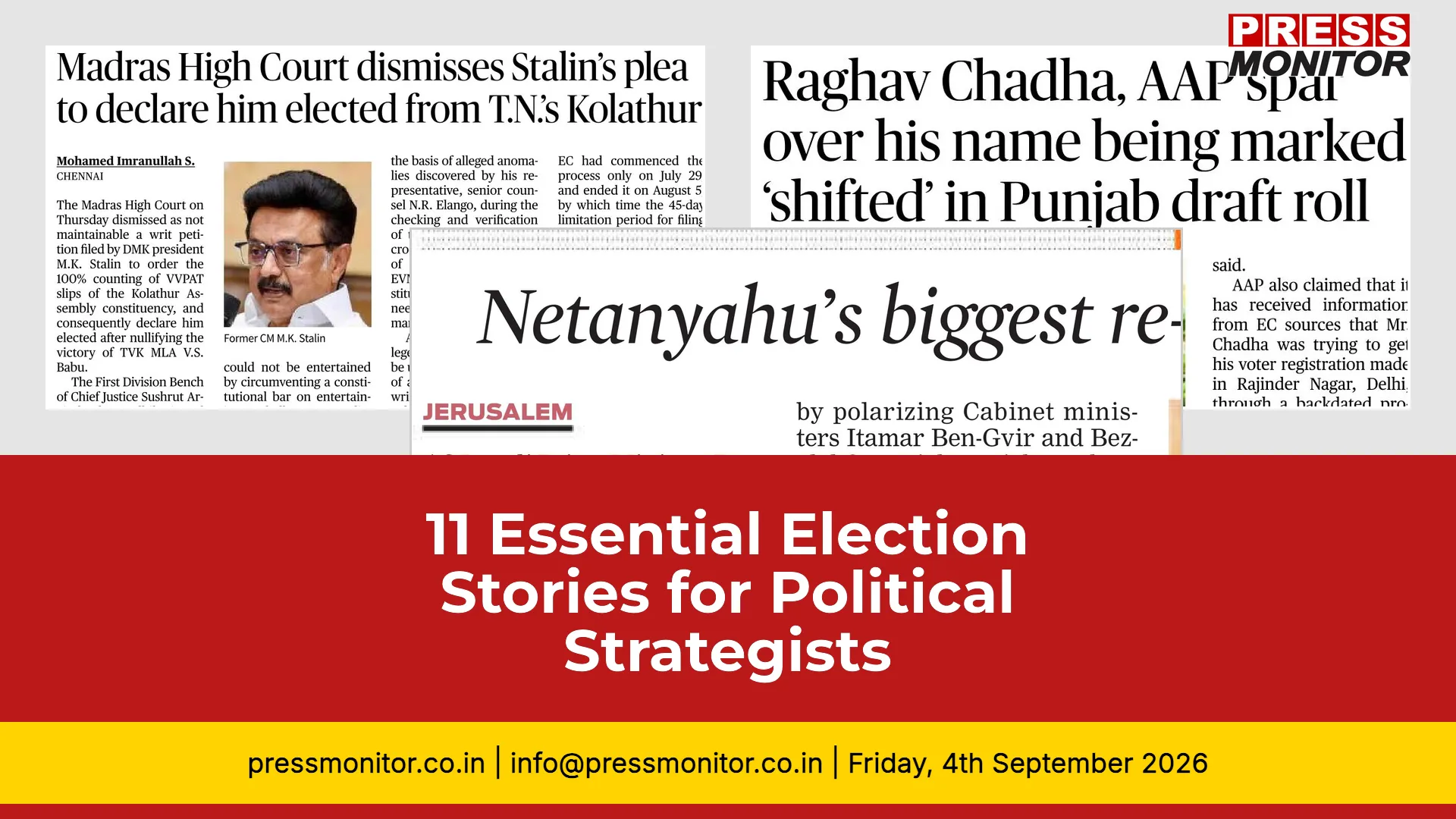
A front-page report in The Hindu says the Madras High Court dismissed M.K. Stalin's writ petition seeking 100% counting of VVPAT slips in the Kolathur Assembly constituency to declare him elected. The court agreed with the Election Commission that the constitutional bar under Article 329(b) cannot be circumvented, but granted Stalin liberty to file an election petition with a request to condone the delay. The Madras High Court dismissed M.K. Stalin's writ petition seeking 100% VVPAT slip counting in Kolathur, ruling the constitutional bar under Article 329(b) cannot be circumvented. The court granted Stalin liberty to file an election petition with a request to condone delay. Why it matters: This ruling closes one legal avenue for challenging the Kolathur result but leaves open the election petition path. Key detail: The bench's decision affirms the Election Commission's authority over recount procedures. Source: The Hindu, Delhi, 18 July 2026. Next step: Watch for Stalin's election petition filing timeline.
2. Chadha's Name Deleted From Punjab Rolls
A front-page report in Business Line says Raghav Chadha, a Rajya Sabha member for Punjab who joined the Bharatiya Janata Party in April after winning the twenty twenty two election on an Aam Aadmi Party ticket, accused the Punjab government of political vendetta after his name was marked as shifted in the draft electoral roll under the Election Commission's special intensive revision process. AAP Delhi president Saurabh Bharadwaj responded on Thursday that Chadha could lose his Rajya Sabha seat if his vote was deleted in SIR and said Chadha appears to live in Delhi, while AAP said the Election Commission, not the Punjab government, manages electoral rolls and raised concerns about possible backdated voter registration attempts in Rajinder Nagar, Delhi. Under Election Commission rules, ordinary residence requires at least six months, and SIR guidelines require certain already identified categories to be automatically carried into the draft roll. Rajya Sabha MP Raghav Chadha accused the Punjab government of political vendetta after his name was marked as shifted in draft electoral rolls under the SIR process. The AAP countered with allegations of backdated voter registration attempts in Delhi. Why it matters: The dispute highlights tensions between state governments and the Election Commission over voter roll integrity. Key detail: Under SIR guidelines, certain categories must be automatically carried into the draft roll. Source: Business Line, Delhi. Next step: Monitor Election Commission's response to Chadha's allegations.
3. Netanyahu Re-election Peril From Allies
A front-page report in Morning Standard says Israeli Prime Minister Benjamin Netanyahu faces a re-election risk from small pro-Netanyahu parties, including hard-line blocs led by Cabinet ministers Itamar Ben-Gvir and Bezalel Smotrich, splitting his base ahead of the Oct. 27 vote. These parties, including Smotrich's Religious Zionism and Ben-Gvir's Jewish Power, rejected calls to merge, risking vote fragmentation in a referendum on Netanyahu's 17-year rule amid protests, Hamas attacks, and war. Israeli PM Benjamin Netanyahu faces re-election risk from small pro-Netanyahu parties splitting his base ahead of the October 27 vote, including Religious Zionism and Jewish Power blocs led by Cabinet ministers Itamar Ben-Gvir and Bezalel Smotrich. Why it matters: Vote fragmentation in a referendum on Netanyahu's 17-year rule could reshape Israeli politics. Key detail: The parties rejected calls to merge, risking a split in the pro-Netanyahu vote amid protests, Hamas attacks, and war. Source: Morning Standard, New Delhi. Next step: Monitor whether coalition talks emerge before the October deadline.
4. 49,000 BLAs File Claims in Telangana
A front-page report in Deccan Chronicle says that the Election Commission of India has empowered booth-level agents of political parties to file claims and objections against names in the draft electoral roll. Over 49,000 BLAs across Telangana can submit up to fifty forms per day, with parties such as Congress, BJP, BRS, AIMIM, TD, CPM, and BSP registering varying numbers of agents. The system allows each BLA to file Form 6 for new voters and Form 7 for claims and objections. The Election Commission empowered booth-level agents across Telangana to file claims and objections against names in the draft electoral roll, with over 49,000 BLAs registered. Why it matters: This massive grassroots verification effort could reshape voter lists ahead of upcoming elections. Key detail: Each BLA can file up to 50 forms per day, including Form 6 for new voters and Form 7 for claims and objections. Source: Deccan Chronicle, Hyderabad. Next step: Track which parties are most active in BLA-led challenges.
5. One Crore Voters Excluded in Karnataka SIR
A front-page report in Deccan Herald says that one in five voters, or 1.08 crore names, have been excluded from the draft electoral roll for Karnataka under the Election Commission's Special Intensive Revision exercise. The truncated list, which covers Bengaluru Urban district and other parts of the state, has raised questions about procedural rigour, with 75 percent of the exclusions falling under the Absent and Shifted categories. Chief Minister D K Shivakumar has sought more time from the Commission to ensure all eligible voters are included in the final roll. One in five voters, or 1.08 crore names, were excluded from Karnataka's draft electoral roll under the SIR exercise, with 75% falling under Absent and Shifted categories. Why it matters: Such large-scale exclusions raise questions about whether eligible voters are being disenfranchised. Key detail: Chief Minister D.K. Shivakumar has sought more time from the Commission to ensure all eligible voters are included. Source: Deccan Herald, Bengaluru. Next step: Observe whether the Commission extends the revision deadline.
6. India's Electoral Process Audited
A front-page report in State Times says that Chief Election Commissioner Kumar announced that India's electoral process is being audited concurrently by candidates and parties, with polling and counting being observed by booth-level agents during a press conference in Margao on 18 July 2026. The programme also involved children who were given a chance to see how polling and counting take place. Chief Election Commissioner Kumar announced that India's electoral process is being audited concurrently by candidates and parties, with booth-level agents observing polling and counting. Why it matters: Transparency in the electoral process builds public trust in democratic outcomes. Key detail: The programme even involved children observing how polling and counting take place. Source: State Times, Jammu, 18 July 2026. Next step: Assess whether audit findings lead to procedural reforms.
7. SIR Deletions Raise Voter Enfranchisement Questions
A front-page report in Hindustan Times says the first part of a series examined key numbers from the Special Intensive Revision results, while this concluding part explores what drives those results. Analysis indicates higher deletions in larger urban centres like Delhi, Bengaluru, and Mumbai support theories of duplicate entries where migrant workers retained native place registrations. Comparisons with census data show pre-SIR elector counts were already lower than adult population projections, leaving open the possibility that India's adult population may be lower than believed. Hindustan Times analysis reveals higher deletions in larger urban centres like Delhi, Bengaluru, and Mumbai, supporting theories of duplicate entries where migrant workers retained native place registrations. Why it matters: The data suggests India's adult population may be lower than previously believed. Key detail: Pre-SIR elector counts were already lower than adult population projections, leaving open the possibility of systemic gaps. Source: Hindustan Times, Delhi. Next step: Cross-reference with census data for demographic insights.
8. 36 Lakh Voters Removed From Mumbai
A front-page report in Free Press Journal says the BMC has appealed to political parties to help voters complete documentation for inclusion in electoral rolls under the Special Intensive Revision 2026. The appeal follows the removal of thirty-six lakh voter names from Mumbai electoral rolls during the ongoing revision process. Municipal Commissioner Ashwini Bhide convened a meeting with political party representatives at BMC headquarters and urged cooperation for a transparent and effective revision. The BMC appealed to political parties to help voters complete documentation after thirty-six lakh names were removed from Mumbai electoral rolls during the SIR process. Why it matters: Mumbai's massive voter deletion could affect electoral outcomes in key constituencies. Key detail: Municipal Commissioner Ashwini Bhide convened a meeting with political party representatives at BMC headquarters. Source: Free Press Journal, Mumbai. Next step: Check whether political parties are actively assisting voters with documentation.
9. Bhajan Lal Sharma Leads BJP Campaign
A front-page report in First India says Chief Minister Bhajan Lal Sharma is personally leading BJP efforts ahead of the Urban Local Body General Elections-2026 in Jaipur district. The electoral picture has taken shape after scrutiny of nomination papers, with 2,644 candidates now in the fray across 19 urban local bodies following withdrawals and unopposed elections. Chief Minister Bhajan Lal Sharma is personally leading BJP efforts ahead of Urban Local Body General Elections-2026 in Jaipur district, with 2,644 candidates in the fray across 19 urban local bodies. Why it matters: The electoral picture is taking shape after nomination paper scrutiny, with withdrawals and unopposed elections narrowing the field. Key detail: The CM's hands-on approach signals the BJP's priority on local body victories. Source: First India, Jaipur, 18 July 2026. Next step: Watch for campaign momentum shifts as local body elections approach.
10. IAS Officer Suspended Over Recruitment Corruption
A front-page report in Hindustan Times says the Karnataka government has suspended IAS officer Gyanendra Kumar Gangwar following his August 29 arrest in a corruption case involving recruitment by the Karnataka Public Service Commission. Officials allege Gangwar played a key role in manipulating the process by accessing exam questions beforehand and interfering with candidates' OMR sheets. Chief Minister DK Shivakumar has alleged connections between the irregularities and BJP and NDA leaders, promising to disclose information gathered by the Home Department. Karnataka suspended IAS officer Gyanendra Kumar Gangwar following his arrest in a corruption case involving KPSC recruitment manipulation, with allegations of accessing exam questions and interfering with candidates' OMR sheets. Why it matters: The scandal implicates higher-level political connections, with CM Shivakumar promising to disclose information about BJP and NDA links. Key detail: Gangwar's arrest on August 29 triggered the suspension. Source: Hindustan Times, Bengaluru, 18 July 2026. Next step: Monitor whether the Home Department disclosure leads to further arrests.
11. Delhi Roll Cuts Spark Scrutiny
A front-page report in Statesman says that as the Special Intensive Revision of electoral rolls begins, large-scale deletions are being revealed across India's major cities, including Bengaluru, Chennai, Hyderabad, Gurugram, Surat, Ahmedabad, Lucknow and Delhi. The Election Commission is under scrutiny after Delhi's draft roll excluded nearly a third of its previous electorate, raising concerns about voter verification, migration and safeguards for eligible citizens. The Special Intensive Revision revealed that Delhi's draft roll excluded nearly a third of its previous electorate, raising concerns about voter verification, migration, and safeguards for eligible citizens. Why it matters: Delhi's exclusion rate is among the highest nationally, fueling debates about electoral integrity. Key detail: Large-scale deletions were also revealed in Bengaluru, Chennai, Hyderabad, Gurugram, Surat, Ahmedabad, and Lucknow. Source: Statesman, Delhi. Next step: Track the Election Commission's response to urban voter exclusion concerns.
Which of these stories will have the biggest impact on India's democratic process? For daily print media monitoring and media intelligence on elections and governance, follow Press Monitor's curated tracking of Indian publications.