11 Essential Environment and Conservation Stories for Policy Leaders


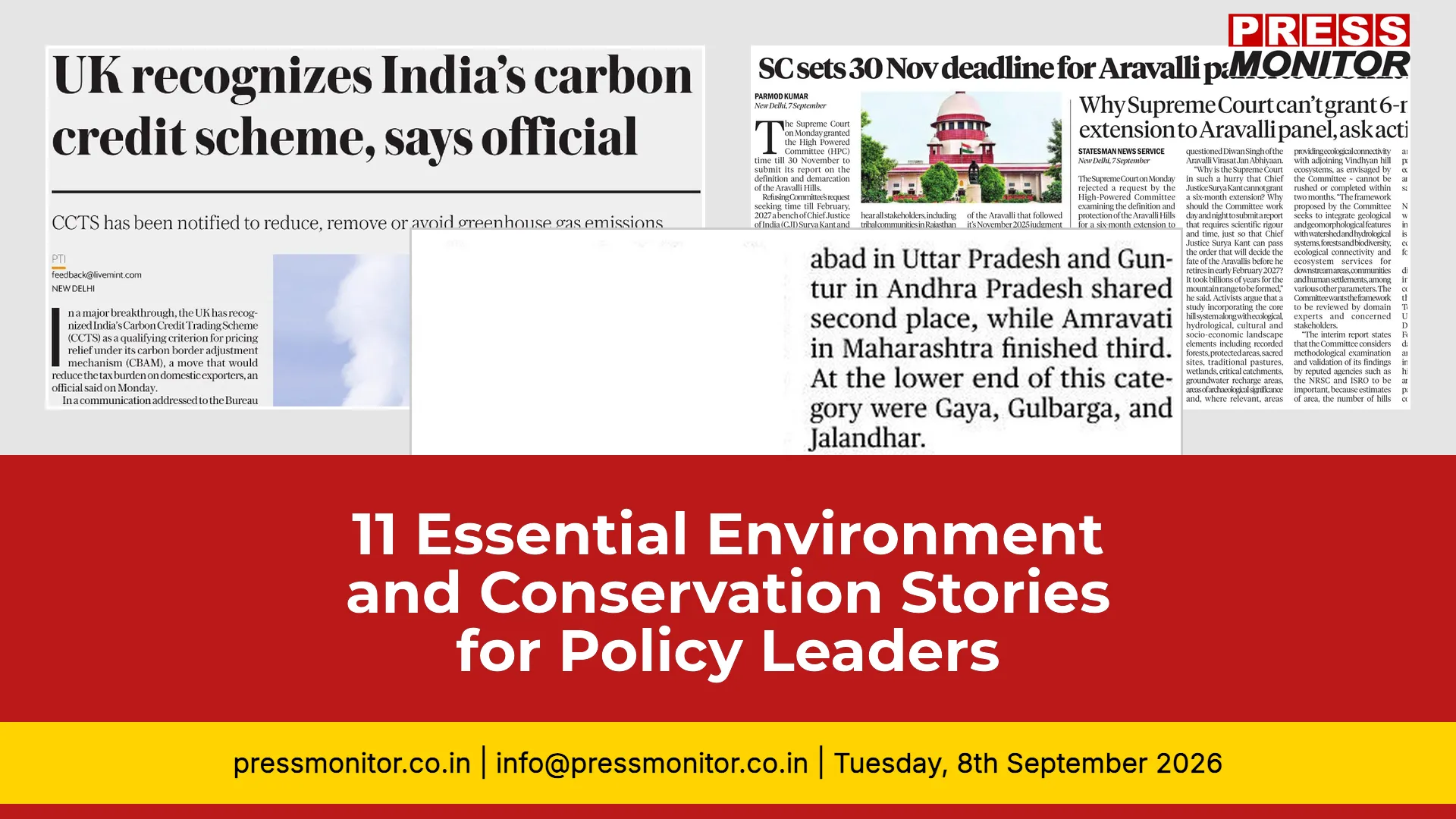
From carbon credit breakthroughs to Supreme Court conservation orders, today's print media monitoring reveals how Indian environmental policy is reshaping trade, urban planning, and corporate compliance. According to Press Monitor's tracking of Indian publications, here are the 11 essential environment and conservation stories that matter for news on environment and conservation.
1. UK Recognises India Carbon Credit Scheme for CBAM Relief
A front-page report in Mint says that in a major breakthrough, the UK has recognised India's Carbon Credit Trading Scheme (CCTS) as a qualifying criterion for pricing relief under its carbon border adjustment mechanism (CBAM), a move that would reduce the tax burden on domestic exporters. UK importers of eligible Indian goods covered under CBAM will be able to seek carbon price relief corresponding to the effective carbon price borne by those goods under CCTS, subject to satisfying evidence and verification requirements prescribed under UK law. The recognition follows sustained technical-level engagement between the two governments on the design and implementation of CCTS and reflects the UK CBAM's core principle of avoiding double taxation on goods that have already borne an eligible carbon price in their country of origin.
Why it matters: This media intelligence breakthrough means Indian exporters of steel, aluminium, and cement could see reduced carbon-tax burdens on goods shipped to the UK. The recognition follows sustained technical-level engagement between the two governments and reflects the UK CBAM's core principle of avoiding double taxation on goods that have already borne an eligible carbon price in their country of origin.
Key detail: UK importers of eligible Indian goods covered under CBAM will be able to seek carbon price relief corresponding to the effective carbon price borne by those goods under CCTS, subject to satisfying evidence and verification requirements prescribed under UK law.
Source: Mint, front-page report.
Next step: Monitor whether the European Union follows the UK's lead in recognising India's carbon credit scheme.
2. Supreme Court Sets November 30 Deadline for Aravalli Panel
A front-page report in Statesman says the Supreme Court granted the High Powered Committee time until thirty O November to submit its report on the definition and demarcation of the Aravalli Hills, rejecting a request for a six-month extension until February two thousand twenty-seven. Chief Justice Surya Kant remarked that the Committee asked for an adjournment with an eye on his retirement, directing the panel to work day and night to complete the task. The matter will next be heard on two December, while activists question the rushed timeline needed for scientific rigour.
Why it matters: The Aravalli Hills are one of India's oldest mountain ranges and a critical ecological barrier for Delhi and Rajasthan. The court's firm deadline raises urgent questions about whether scientific rigour can be maintained under compressed timelines for conservation of the ancient mountain range.
Key detail: Chief Justice Surya Kant directed the panel to work day and night, with the matter next heard on December 2. The court rejected a six-month extension request, insisting the report must be filed by November 30.
Source: Statesman, front-page report by Paramod Kumar.
Next step: Watch for interim reports on urgent matters as the panel races to complete its work.
3. Lucknow Tops Swachh Vayu Sarvekshan 2026 Rankings
A front-page report in Millennium Post says Lucknow secured the top position among Indian cities with populations above ten lakh in the Centre's Swachh Vayu Sarvekshan 2026, released by the Union Environment Ministry on Monday. Delhi climbed to the twenty-first position, ahead of Bengaluru, Srinagar, Mumbai, Chennai, and Kolkata, but its Air Quality Index frequently crosses four hundred during winter. The survey assessed one hundred and thirty NCAP cities on pollution control measures such as road dust control rather than current air quality levels.
Why it matters: India's clean-air rankings reveal which cities are making measurable progress on pollution control measures, offering a blueprint for others. The shift from measuring current air quality to assessing improvement measures signals a policy pivot toward actionable governance.
Key detail: 108 out of 130 NCAP-covered cities showed improvement in PM10 levels between 2017-18 and 2025-26. Delhi climbed to the twenty-first position, ahead of Bengaluru, Srinagar, Mumbai, Chennai, and Kolkata.
Source: Millennium Post, front-page report by MPOST BUREAU.
Next step: Cities ranked lower should study Lucknow's pollution control measures for replication.
4. Karnataka Rejects Kasturirangan Report on Western Ghats
A front-page report in The Pioneer says Karnataka Minister Madhu Bangarappa declared on Monday that the state Government would not allow implementation of the Kasturirangan report on the Western Ghats under any circumstances. The minister assured people in the Malnad region that their land, agriculture, and livelihoods would be protected during a Congress padayatra and protest in Thirthahalli. The Kasturirangan Committee had recommended declaring thirty-seven per cent of the Western Ghats, covering around sixty thousand square kilometres across six states, as an Eco-Sensitive Area, but the Congress party has consistently opposed the report since it was first rejected during Siddaramaiah's tenure as chief minister.
Why it matters: The Western Ghats are a UNESCO World Heritage site and biodiversity hotspot. Karnataka's firm rejection of the Kasturirangan report has national implications for how eco-sensitive zones are designated and enforced across six states.
Key detail: The Kasturirangan Committee had recommended declaring 37% of the Western Ghats, covering around 60,000 square kilometres, as an Eco-Sensitive Area. Minister Madhu Bangarappa assured people in the Malnad region that their land, agriculture, and livelihoods would be protected.
Source: The Pioneer, front-page report by PRESS TRUST OF INDIA.
Next step: Track whether other states follow Karnataka's stance or pursue independent eco-sensitive zone designations.
5. UNEP Report Warns Clean Air Delays Are Costly
A front-page report in Morning Standard says delaying clean-air progress in Delhi could increase health risks and economic losses, according to a UNEP and CCAC study. The report warns that postponing air-quality improvements by eight years could halve the reduction in PM2.5 exposure by 2040, while each year of inaction forfeits over one point five trillion dollars annually.
Why it matters: The economic case for clean air action has never been stronger. Each year of inaction forfeits over 1.5 trillion dollars annually, making pollution control not just an environmental imperative but an economic one.
Key detail: Delaying clean-air progress in Delhi could halve the reduction in PM2.5 exposure by 2040, according to a UNEP and CCAC study.
Source: Morning Standard, front-page report by JITENDRA CHOUBEY.
Next step: Use this data to accelerate municipal clean-air action plans in Delhi and other Tier-1 cities.
6. Delhi Observes Clean Air Day with Enforcement Drive
A front-page report in Millennium Post says Delhi municipal bodies and environmental departments observed the International Day of Clean Air for Blue Skies at a Subhash Nagar primary school to curb construction dust and biomass burning. Simultaneously, enforcement teams destroyed more than two thousand eight hundred kilograms of abandoned and adulterated dairy products across several major city markets ahead of the festive season. Officials emphasised coordinated efforts to improve urban air quality and ensure strict compliance with public health standards.
Why it matters: The International Day of Clean Air for Blue Skies saw coordinated action across Delhi's municipal bodies, pollution control committees, and environmental departments, demonstrating multi-agency governance in practice.
Key detail: Enforcement teams destroyed more than 2,800 kilograms of abandoned and adulterated dairy products across several major city markets ahead of the festive season, alongside dust and biomass burning curbing efforts.
Source: Millennium Post, front-page report.
Next step: Assess whether the dual focus on air quality and food safety can be sustained as a model for urban governance.
7. Tamil Nadu Launches Rs 2 Crore City Biodiversity Index
A front-page report in New Indian Express says the Tamil Nadu government will introduce a City Biodiversity Index across all 24 municipal corporations at a cost of Rs 2 crore to strengthen urban biodiversity conservation and improve climate resilience. Minister for Environment and Climate Change VK Rajeev announced the initiative in the Assembly on Monday. The government also plans to expand air-quality monitoring to 80 locations and convert 200 schools and five colleges into Blue Green Campuses annually.
Why it matters: Urban biodiversity conservation is gaining traction as a policy priority. Tamil Nadu's City Biodiversity Index across all 24 municipal corporations could become a replicable model for other states.
Key detail: The initiative includes expanding air-quality monitoring to 80 locations and converting 200 schools and five colleges into Blue Green Campuses annually, alongside the Rs 2 crore biodiversity index.
Source: New Indian Express, front-page report by EXPRESS NEWS SERVICE.
Next step: Other states should evaluate adopting similar urban biodiversity frameworks.
8. CREDAI Workshop Seeks Faster Environmental Clearances
A front-page report in Asian Age says the Confederation of real estate developers' associations of India (CREDAI) collaborated with the ministry of environment, forest and climate change and the Central pollution control board to organize a workshop discussing measures to improve the ease of doing business while expediting environmental clearances for real estate projects. President CREDAI Shekhar Patel emphasized that CREDAI seeks only a reduction in timelines for obtaining Environmental Clearance approvals, not any relaxation in compliance requirements. The ministry informed that a quarterly review meeting is held with the state expert appraisal committees to monitor the progress of applications.
Why it matters: The real estate sector's push for expedited environmental clearances highlights the tension between development speed and regulatory rigour. CREDAI's position that it seeks reduced timelines, not relaxed compliance, is a nuanced stance worth monitoring.
Key detail: The workshop was organised in collaboration with the Ministry of Environment, Forest and Climate Change and the Central Pollution Control Board. Quarterly reviews with state expert appraisal committees are already in place to track application progress.
Source: Asian Age, front-page report.
Next step: Watch for policy outcomes from the quarterly review meetings and any changes to clearance timelines.
9. 108 Indian Cities Show Improvement in Air Pollution Levels
A front-page report in Millennium Post says over one hundred Indian cities have successfully reduced particulate matter levels compared to earlier baselines, with Odisha towns leading clean air rankings. The publication highlights the National Film Award recipients announced at Ekta Nagar, while noting the Supreme Court's firm February two thousand and twenty-seven deadline for its Aravalli Hill conservation committee. Meanwhile, Jaguar Land Rover outlines management restructuring affecting United Kingdom staff alongside a fifteen to eighteen billion pound technology investment strategy.
Why it matters: Over 100 cities reducing particulate matter levels is a significant achievement for the National Clean Air Programme. Odisha towns leading the rankings suggests that regional governance models can drive measurable air quality improvements.
Key detail: The Supreme Court's firm deadline for its Aravalli Hill conservation committee remains a key environmental policy milestone alongside these clean-air gains.
Source: Millennium Post, front-page report.
Next step: Identify the specific policies Odisha towns implemented and assess their scalability to other states.
10. Tamil Nadu Forest Department Announces 10.72 Crore Revamp Plan
A front-page report in New Indian Express says the Tamil Nadu forest department will revamp its forest force at a cost of ten point seven two crore rupees over the next five years, while launching a sixty point five eight crore rupee forest‑fire management programme. The plan also includes developing twenty‑five nature parks at ten crore rupees, modernising research facilities at five crore rupees, and engaging forty‑three intern naturalists at four point two crore rupees for biodiversity surveys.
Why it matters: A five-year forest force revamp at Rs 10.72 crore, paired with a Rs 60.58 crore forest-fire management programme, signals serious investment in conservation infrastructure. The engagement of 43 intern naturalists for biodiversity surveys builds institutional capacity.
Key detail: The plan includes developing 25 nature parks at Rs 10 crore and modernising research facilities at Rs 5 crore.
Source: New Indian Express, front-page report.
Next step: Track the deployment timeline for the forest force revamp and nature park development.
11. Malaysia Lifts Sarawak Haze Emergency Amid Ongoing Concerns
A front-page report in Morning Standard says Malaysia has officially terminated its haze emergency declaration in Sarawak state on Borneo island. Authorities lifted the alert on Monday following royal approval from King Sultan Ibrahim after critical air quality measurements were recorded in Serian. Officials caution that hazardous pollution levels persist due to ongoing forest fires across the border in Indonesia.
Why it matters: The cross-border nature of haze pollution underscores that environmental challenges in Southeast Asia require regional cooperation. Malaysia's lifting of the emergency declaration is a positive step, but persistent hazards from Indonesian forest fires demand continued attention.
Key detail: Authorities lifted the haze emergency following royal approval from King Sultan Ibrahim after critical air quality measurements were recorded in Serian. Officials caution that hazardous pollution levels persist due to ongoing forest fires across the border in Indonesia.
Source: Morning Standard, front-page report.
Next step: Monitor Indonesia's fire mitigation efforts and regional haze agreement enforcement.
Which of these environment and conservation developments will have the most lasting impact on Indian policy and business? The print media monitoring data from Press Monitor suggests the carbon credit recognition and Aravalli conservation orders are the two stories to watch closely.