11 Essential Geopolitics Stories for Policy Leaders


According to Press Monitor's tracking of Indian publications, today's print media monitoring reveals a rapidly shifting geopolitical landscape where diplomacy, sanctions, and defence strategy dominate the front pages. This press review delivers essential media intelligence on news on geopolitics and international relations that policy leaders and corporate strategists need to act on today.
1. Putin Sees Chance of Ukraine Peace Pact
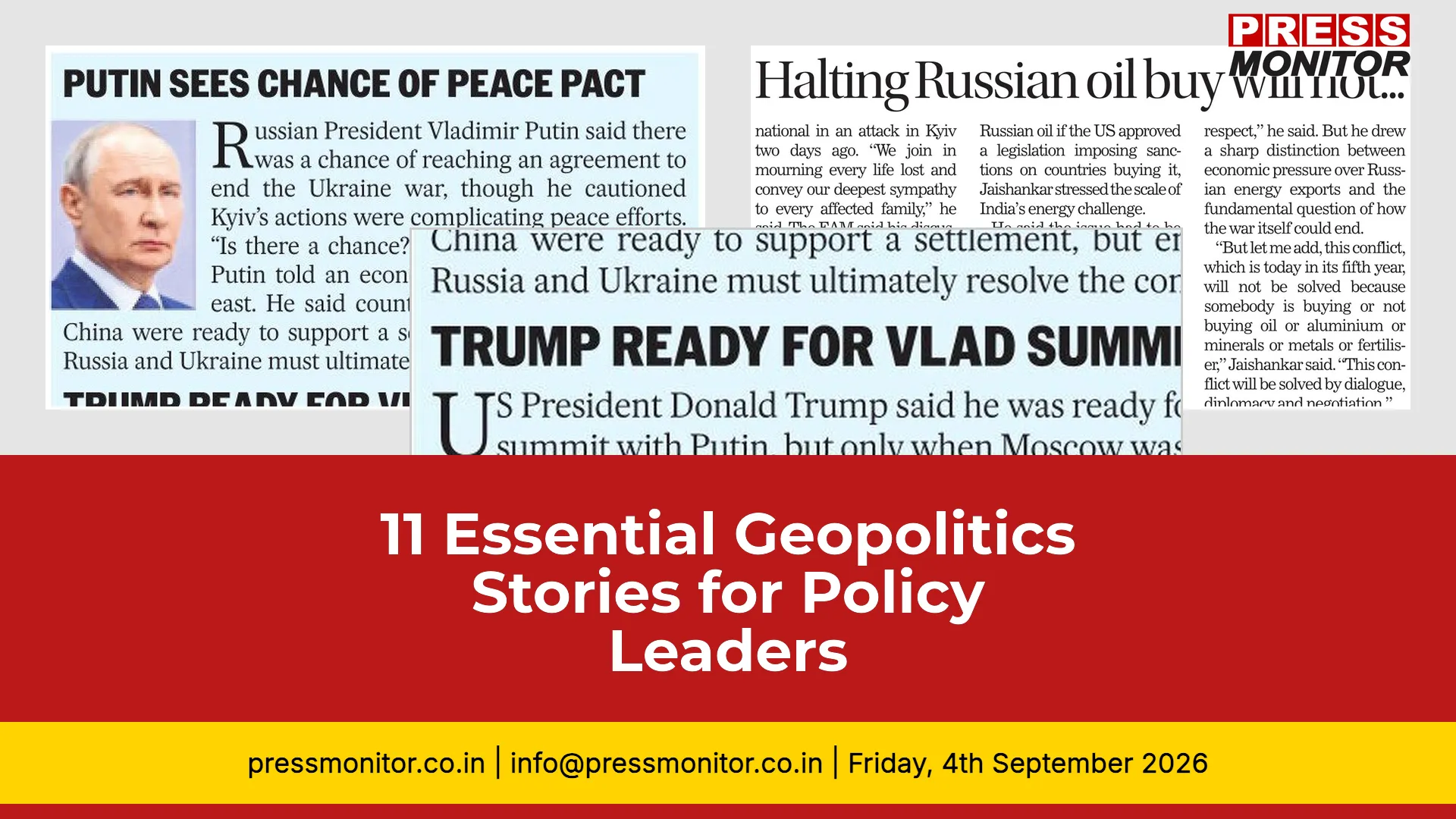
A front-page report in Free Press Journal says Russian President Vladimir Putin stated there is a chance of reaching an agreement to end the Ukraine war, while cautioning that Kyiv's actions are complicating peace efforts. He noted that countries including the US and China are ready to support a settlement, but emphasised that Russia and Ukraine must ultimately resolve the conflict. Separately, US President Donald Trump said he is ready for another summit with Putin, but only when Moscow is prepared to work towards a peace deal. Russian President Vladimir Putin has acknowledged a possible path to ending the Ukraine war, telling an economic forum in Vladivostok that the United States and China are ready to support a settlement. However, he cautioned that Kyiv's actions are complicating peace efforts. Why it matters: Any breakthrough in the Russia-Ukraine conflict would reshape global energy markets, grain supply chains, and Western sanctions regimes. Key detail: Putin stressed Russia and Ukraine must ultimately resolve the conflict themselves. Source: Free Press Journal, front page. Next step: Monitor whether Moscow and Kyiv reciprocate the diplomatic opening. Tracked by Press Monitor across five Indian publications.
2. Jaishankar's Kyiv Push for Dialogue
A front-page report in Tribune says External Affairs Minister S Jaishankar stated that halting Russian oil purchases will not resolve the five-year conflict in Ukraine. During discussions with Ukrainian Foreign Minister Sybiha in Kyiv, Jaishankar emphasised that the war will be solved by dialogue, diplomacy and negotiation rather than economic pressure on energy exports. He highlighted India's energy challenge in providing power to 1.4 billion people amid a difficult global energy situation. External Affairs Minister S Jaishankar told Ukrainian officials in Kyiv that halting Russian oil purchases will not resolve the five-year conflict. He emphasised that dialogue, diplomacy, and negotiation — not economic pressure on energy exports — are the path to peace, while highlighting India's energy challenge of powering 1.4 billion people. Why it matters: India's balancing act between energy security and geopolitical alignment is under intense scrutiny from both Western and Russian capitals. Key detail: Jaishankar referenced PM Modi's recent call for an end to the war during his meeting with Putin in Bishkek. Source: Tribune, Kyiv dispatch. Next step: Watch for India's role as a potential mediator in multilateral peace frameworks. Tracked by Press Monitor.
3. Trump Eyes Putin Summit Near War End
A front-page report in Free Press Journal says US President Donald Trump stated he is ready for another summit with Vladimir Putin, but only when Moscow is prepared to work towards a peace deal to end the Ukraine war. Trump told reporters at the Oval Office that another meeting could be arranged immediately, though he preferred to wait until the war was nearing an end, adding that the US wants good relations with both Russia and Ukraine. US President Donald Trump stated he is ready for another summit with Vladimir Putin, but only when Moscow is prepared to work towards a peace deal. Trump told reporters at the Oval Office that he preferred to wait until the war was nearing an end, while expressing a desire for good relations with both Russia and Ukraine. Why it matters: A Trump-Putin meeting could accelerate or derail peace negotiations and impact global commodity markets. Key detail: Trump said another meeting could be arranged immediately if Moscow shows readiness. Source: Free Press Journal, front page. Next step: Track US-Russia diplomatic channels for summit scheduling signals. Tracked by Press Monitor.
4. Modi-Pezeshkian Meeting Draws US Scrutiny
A front-page report in Times of India says PM Modi met Iranian President Pezeshkian on the SCO summit sidelines, drawing US scrutiny. External Affairs Minister emphasised that peace in Ukraine hinges on diplomacy. A warning was issued that nations should not help Tehran create mechanisms to generate revenue that could finance terror or its nuclear programme. Prime Minister Modi met Iranian President Pezeshkian on the SCO summit sidelines, drawing US scrutiny. External Affairs Minister emphasised that peace in Ukraine hinges on diplomacy, while a warning was issued that nations should not help Tehran create mechanisms to finance terror or its nuclear programme. Why it matters: India's engagement with Iran amid US sanctions pressure tests the limits of strategic autonomy. Key detail: The meeting occurred ahead of the SCO Summit in Bishkek. Source: Times of India, New Delhi. Next step: Assess how US-Iran tensions may affect India's bilateral trade and energy imports. Tracked by Press Monitor.
5. Rubio Warns India Against Iran Trade Ties
A front-page report in Deccan Chronicle says United States Secretary of State Marco Rubio warned India on Thursday against maintaining any trade ties with Iran and threatened sanctions against any country helping Iran generate revenue. This statement came just days after Prime Minister Narendra Modi met Iranian President Dr Masoud Pezeshkian in Bishkek ahead of the SCO Summit earlier this week. US Secretary of State Marco Rubio warned India against maintaining any trade ties with Iran and threatened sanctions against any country helping Iran generate revenue. This came days after Modi met Pezeshkian in Bishkek ahead of the SCO Summit. Why it matters: The warning signals escalating US pressure on India's energy diplomacy and could affect bilateral trade negotiations. Key detail: Rubio's statement directly links India-Iran trade to potential sanctions. Source: Deccan Chronicle, New Delhi. Next step: Monitor whether India adjusts its energy import strategy in response. Tracked by Press Monitor.
6. Sanctioning Russia Act Faces Congressional Deadlock
A front-page report in Hindustan Times says the Sanctioning Russia Act faces a political deadlock in Washington despite intense lobbying by Ukraine. Congressman Gregory Meeks opposes the bill, arguing it grants too much tariff authority to President Trump, while Senate Democrats urge its passage with tariff provisions intact. The Sanctioning Russia Act faces political deadlock in Washington despite intense lobbying by Ukraine. Congressman Gregory Meeks opposes the bill, arguing it grants too much tariff authority to President Trump, while Senate Democrats urge its passage with tariff provisions intact. Why it matters: The outcome will determine the scope of US tariff power in foreign sanctions policy and affect India's trade calculations. Key detail: The bill has divided along party lines in Congress. Source: Hindustan Times, Washington. Next step: Watch for compromise amendments that could break the deadlock. Tracked by Press Monitor.
7. Russia Shuts German Cultural Centres
A front-page report in Statesman says Russia will close German cultural centres across the country as Moscow and Europe spar over Ukraine. This tit-for-tat measure reflects soured relations and deepening tensions following Germany's decision to shut the Russian Consulate in Bonn and the Russian House cultural centre in Berlin after blaming Moscow for an attempted attack at Leipzig/Halle Airport. Russia will close German cultural centres across the country as Moscow and Europe spar over Ukraine. The tit-for-tat measure follows Germany's decision to shut the Russian Consulate in Bonn and the Russian House cultural centre in Berlin after blaming Moscow for an attempted attack at Leipzig/Halle Airport. Why it matters: The cultural diplomacy rupture signals deepening Russia-Europe tensions with implications for trade and travel. Key detail: The expulsions mark a significant escalation in Russia-Germany relations. Source: Statesman, Warsaw. Next step: Track whether other European nations follow Germany's lead. Tracked by Press Monitor.
8. Netanyahu Says Iran Regime Toppling Near
A front-page report in Deccan Herald says Israeli Prime Minister Benjamin Netanyahu voiced confidence on Thursday that Iran's Islamic republic could soon fall, describing the regime as weaker than ever and fighting for its survival. The United States has resumed attacks on Iran after a brief truce in April, leading Iran to fire back at US allies in the Gulf, Jordan, and Iraq's Kurdistan region, though not Israel. Netanyahu stated that the central task of removing the Iranian threat is close and not impossible. Israeli Prime Minister Benjamin Netanyahu voiced confidence that Iran's Islamic republic could soon fall, describing the regime as weaker than ever and fighting for its survival. The United States has resumed attacks on Iran after a brief truce in April, leading Tehran to fire back at US allies in the Gulf, Jordan, and Iraq's Kurdistan region. Why it matters: A regime change in Iran would dramatically alter Middle East power dynamics and energy markets. Key detail: Netanyahu stated the central task of removing the Iranian threat is close and not impossible. Source: Deccan Herald, Jerusalem. Next step: Monitor Gulf state preparedness for potential regional instability. Tracked by Press Monitor.
9. Iran Strikes Kuwait, Gulf Tensions Rise
A front-page report in Morning Standard says Iranian forces fired missiles and drones at Kuwait in retaliation for recent United States aerial bombardments, escalating regional tensions across the Gulf. Meanwhile, the Sultan of Oman travels to the United Kingdom for a diplomatic state visit as shipping through the strategically vital Strait of Hormuz drops significantly amid ongoing hostilities and security threats. Concurrently, international observers criticise new Iranian legislation targeting foreign communications, while humanitarian efforts continue with the release of detained civilians and investigations into civilian casualty events. Iranian forces fired missiles and drones at Kuwait in retaliation for US aerial bombardments, escalating regional tensions across the Gulf. Meanwhile, the Sultan of Oman travels to the United Kingdom for a diplomatic state visit as shipping through the strategically vital Strait of Hormuz drops significantly amid ongoing hostilities. Why it matters: Gulf stability is critical for global energy supply chains and India's energy security. Key detail: Maritime traffic through the Strait of Hormuz has declined significantly. Source: Morning Standard, New Delhi. Next step: Assess impact on global oil prices and India's energy import costs. Tracked by Press Monitor.
10. India-Belgium Sign Defence Deals
A front-page report in Times of India says India and Belgium signed deals to deepen defence and clean-energy ties and agreed to double bilateral trade within five years. PM Modi held talks with Belgian PM Bart De Wever, the first Belgian PM to visit India in nearly two decades, at Hyderabad House in New Delhi. Modi pitched India's seven point eight percent growth as an opportunity for the world. India and Belgium signed deals to deepen defence and clean-energy ties and agreed to double bilateral trade within five years. PM Modi held talks with Belgian PM Bart De Wever, the first Belgian PM to visit India in nearly two decades, at Hyderabad House in New Delhi. Why it matters: The defence cooperation signals India's expanding strategic partnerships beyond traditional partners. Key detail: Modi pitched India's seven point eight percent growth as an opportunity for the world. Source: Times of India, New Delhi. Next step: Track implementation timelines for the defence and energy agreements. Tracked by Press Monitor.
11. India Unveils Raksha Defence Diplomacy Roadmap
A front-page report in Hindustan Times says Defence Minister Rajnath Singh released the Raksha document, a ten-year strategic roadmap for India's defence diplomacy, in New Delhi on Thursday. The blueprint outlines a shift in strategic engagement to align national security objectives with proactive global cooperation, focusing on strategic partnerships, capacity building, exports, and maritime security. India aims to reach 250,000 crore rupees in defence exports by 2029-30, having already recorded a record 338,424 crore rupees in 2025-26, up 63 percent from the previous financial year. Defence Minister Rajnath Singh released the Raksha document, a ten-year strategic roadmap for India's defence diplomacy. The blueprint outlines a shift in strategic engagement focusing on partnerships, capacity building, exports, and maritime security. India aims to reach 250,000 crore rupees in defence exports by 2029-30, having already recorded a record 338,424 crore rupees in 2025-26, up 63 percent from the previous financial year. Why it matters: India's defence export ambition positions it as a major global arms supplier and shifts geopolitical alliances. Key detail: The Raksha roadmap represents a paradigm shift from defensive to proactive strategic engagement. Source: Hindustan Times, New Delhi. Next step: Monitor which countries emerge as top recipients of Indian defence exports. Tracked by Press Monitor.
Which of these developments will have the most immediate impact on your sector? Stay informed with Press Monitor's print media intelligence.