11 Essential Geopolitics Stories for Strategy Leaders


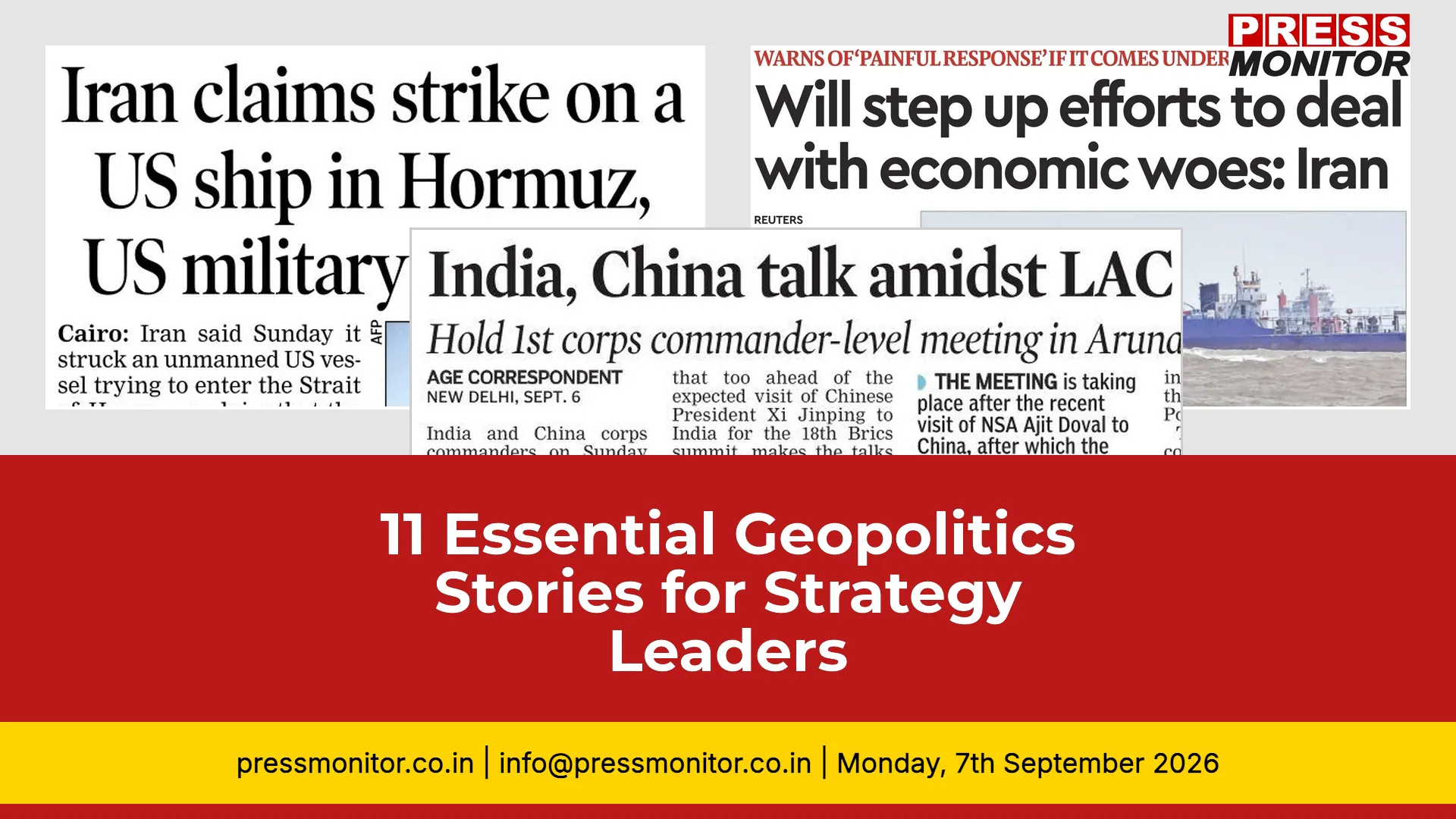
Geopolitical tensions are reshaping the global order at breakneck speed. From the Strait of Hormuz to the BRICS summit table, today's developments demand immediate attention from decision-makers. This media monitoring press review, grounded in print media monitoring and media intelligence from Press Monitor's tracking of Indian publications, covers the news on geopolitics you need to know.
1. Iran Claims Strike on US Ship in Hormuz
A front-page report in Times of India says Iran claimed it struck an unmanned US vessel attempting to enter the Strait of Hormuz on Sunday, a claim the US military dismissed as a total lie. The purported attack followed US strikes on three Iranian oil tankers and marked a resumption of fighting after a month of relative calm, with at least five people killed earlier in the week. Over one hundred forty combatants were killed in separate clashes between Yemeni government forces and Iran-backed Houthi rebels in southwest Yemen.
Why it matters: The Strait of Hormuz carries a fifth of global oil and LNG trade. Any military escalation here ripples through energy markets worldwide.
Key detail: The US military dismissed Iran's claim as a total lie, while the purported attack followed US strikes on three Iranian oil tankers and marked a resumption of fighting after a month of relative calm.
Source: Times of India, Cairo
Next step: Monitor US military confirmation and any retaliatory moves from Tehran.
2. Iran Warns Painful Response to Further Attacks
A front-page report in Financial Express says Iran will step up efforts to tackle problems created by US sanctions crippling its economy, while a senior Iranian official warned of a painful response if the country comes under further attack. Six months after US-Israeli strikes against Iran, the war appears at a stalemate with a preliminary ceasefire accord unraveling and little progress in diplomatic efforts. Following tit-for-tat strikes between the US and Iran, Iran's Parliament Speaker Mohammad Bager Qalibaf said the US should understand that the rules of the game in the war against Iran have changed before it is too late.
Why it matters: Iran's Parliament Speaker has declared the rules of engagement have changed, signaling a potential shift from calibrated to all-out retaliation.
Key detail: Six months after US-Israeli strikes, the war appears at a stalemate with a preliminary ceasefire accord unraveling and little progress in diplomatic efforts.
Source: Financial Express, Dubai
Next step: Watch for diplomatic channels to reopen or harden further.
3. India China Corps Commanders Meet Amid LAC Tension
A front-page report in Asian Age says India and China held their first corps commander-level meeting at the Wacha-Damai border meeting point in Arunachal Pradesh on Sunday. The talks took place amid recent tension at the Taksing area of the Upper Subansiri district and ahead of the expected visit of Chinese President Xi Jinping for the 18th Brics summit. India was represented by 3 Corps Commander Lt Gen Girish Kalia, leading a 12-member delegation that included personnel from the Indo-Tibetan Border Police.
Why it matters: The first corps-level dialogue at Wacha-Damai signals de-escalation intent ahead of Xi Jinping's expected BRICS visit.
Key detail: India's 3 Corps Commander Lt Gen Girish Kalia led a 12-member delegation including Indo-Tibetan Border Police personnel, amid recent tension at the Taksing area.
Source: Asian Age, New Delhi
Next step: Track whether the meeting yields concrete border confidence-building measures.
4. Zelensky, US Envoys Join Talks in Kyiv
A front-page report in Times of India says European allies joined President Zelensky and US envoys Jared Kushner and Steve Witkoff in Kyiv for talks on Ukraine's war. The meeting, attended by national security chiefs from the United Kingdom, France and Germany, followed earlier US talks in Moscow and focused on a post‑war prosperity plan and territorial issues. Zelensky noted progress in Moscow and said the talks were a step toward a negotiated settlement.
Why it matters: European allies joining Kushner and Witkoff in Kyiv expands the diplomatic coalition for a post-war Ukraine plan.
Key detail: National security chiefs from the UK, France, and Germany attended, focusing on territorial issues and a post-war prosperity plan.
Source: Times of India
Next step: Follow up on whether territorial concessions are on the table.
5. Tran Warns US Of Intense Force After Strikes
A front-page report in Asian Age says Iran's top negotiator threatened a more forceful response to any further US attacks after Tehran targeted American warships. Iran's Parliament Speaker Mohammad Bagher Ghalibaf warned that the era of proportionate responses has ended, promising faster and more intense retaliation against aggression against Tran's interests. Washington continues to seek choking Iran's economy through sanctions on entities with financial links to the Islamic republic while maintaining a counter-blockade of Iranian ports.
Why it matters: Iran's top negotiator threatened a more forceful response, raising the stakes for any further US military action.
Key detail: Parliament Speaker Ghalibaf declared the era of proportionate responses has ended, promising faster and more intense retaliation.
Source: Asian Age, Tehran
Next step: Assess whether the threat translates into actual military action.
6. Iran's Strait Leverage Wanes Amid US Economic Squeeze
A front-page report in Hindustan Times says Iran is facing an unprecedented economic offensive from Washington, with a US naval blockade and tougher sanctions curbing oil exports and restricting access to foreign currency. Six months after a conflict that rattled markets, the balance of power has tilted against Iran as mounting economic pressure exposes growing strains in the economy. The campaign has led US and regional officials to wager that the pressure can force Iran to allow free passage through the Strait of Hormuz, which carries a fifth of global oil and LNG.
Why it matters: A US naval blockade and tougher sanctions are curbing Iran's oil exports and restricting foreign currency access.
Key detail: The balance of power has tilted against Iran as mounting economic pressure exposes growing strains in the economy.
Source: Hindustan Times, Istanbul
Next step: Watch for Iran's economic countermeasures and potential concessions.
7. India Pushes BRICS Summit Success
A front-page report in Tribune says that India is preparing to host the BRICS summit in New Delhi at the end of the week, with the Modi government pulling out all stops to ensure its success, and the country leveraging the New Development Bank and other BRICS tools to advance its interests. The summit also focuses on digital public infrastructure, central bank digital currencies, and de‑dollarisation efforts to strengthen the Global South's financial autonomy. India’s approach balances multilateral cooperation with a pragmatic stance toward the United States and Western sanctions.
Why it matters: India is leveraging the New Development Bank and BRICS tools to advance Global South financial autonomy.
Key detail: The summit focuses on digital public infrastructure, central bank digital currencies, and de-dollarisation efforts.
Source: Tribune, New Delhi
Next step: Monitor outcomes on de-dollarisation and digital currency frameworks.
8. India Buys Russian Oil For National Security
A front-page report in Millennium Post says Russian Ambassador to India Denis Alipov reiterated that New Delhi purchases Russian oil for its own energy security and national development, not to help Moscow fund the Ukraine war. The statement comes amid intense scrutiny in Washington and other Western capitals over India's sharply increased imports of discounted Russian crude since the conflict began in 2022. External Affairs Minister S Jaishankar, visiting Kyiv, pushed back on Western pressure, stating that curtailing oil purchases will not stop the war and that dialogue, diplomacy, and negotiation are the only path to resolution.
Why it matters: Russia's ambassador insists Delhi's oil purchases are for energy security, not to fund the Ukraine war.
Key detail: External Affairs Minister Jaishankar pushed back on Western pressure in Kyiv, stating that curtailing oil purchases will not stop the war.
Source: Millennium Post
Next step: Track whether Washington escalates sanctions pressure on India.
9. Putin Trapped In War Stalemate
A front-page report in Statesman says Russian President Vladimir Putin faces a dilemma where stopping the war in Ukraine may become harder than continuing it. After more than four years of full-scale invasion, neither side has won a decisive military breakthrough, and Russia remains powerful enough to fight but unable to secure strategic victory. The Kremlin's reliance on personalised rule means compromise grows harder over time, incentivising calibrated escalation against Ukraine and below-the-threshold pressure on European allies.
Why it matters: After four years of invasion, neither side has achieved a decisive breakthrough, and Russia's personalised rule makes compromise harder.
Key detail: The Kremlin is incentivising calibrated escalation against Ukraine and below-the-threshold pressure on European allies.
Source: Statesman
Next step: Assess whether the stalemate leads to renewed peace talks.
10. Putin Trump Xi Consider Meeting
A front-page report in Deccan Herald says a Moscow official has not ruled out a trilateral meeting between the presidents of Russia, the United States and China. The meeting could take place at the Asia Pacific Economic Cooperation summit in Shenzhen, China in November, according to Kremlin aide Yuri Ushakov. Russian Foreign Minister Sergei Ryabkov noted that the agenda and substance of such a meeting would need to be clarified.
Why it matters: A trilateral summit at APEC Shenzhen in November could reshape the geopolitical axis.
Key detail: Kremlin aide Yuri Ushakov has not ruled out the meeting, but Ryabkov says agenda and substance need clarification.
Source: Deccan Herald, Bangaluru
Next step: Watch for official confirmation from all three capitals.
11. US Strikes Iranian Oil Tankers in Hormuz
A front-page report in Free Press Journal says Iran claimed it struck an unmanned US vessel attempting to enter the Strait of Hormuz on Sunday, while the US military dismissed the claim as false following earlier American attacks on three Iranian oil tankers. Iranian Parliament Speaker Mohammad Bager Ghalibaf warned that attacks on Iran's interests would now receive a faster and more painful response, even as the economy minister insisted sanctions would not change the country's decisions. The escalation comes after negotiations collapsed following a June ceasefire announcement, with both sides inflicting military and economic pain.
Why it matters: The US military's strikes on Iranian oil tankers represent a significant escalation in the Hormuz conflict.
Key detail: The attacks came in response to ballistic missiles targeting Navy warships, marking a new phase of tit-for-tat fighting.
Source: Free Press Journal, Mumbai
Next step: Monitor Iran's response and any impact on global oil prices.
Which of these developments will have the most lasting impact on the global order? The Strait of Hormuz, the BRICS summit, or the Ukraine peace talks?
