11 Essential Geopolitics Stories for Strategy Leaders


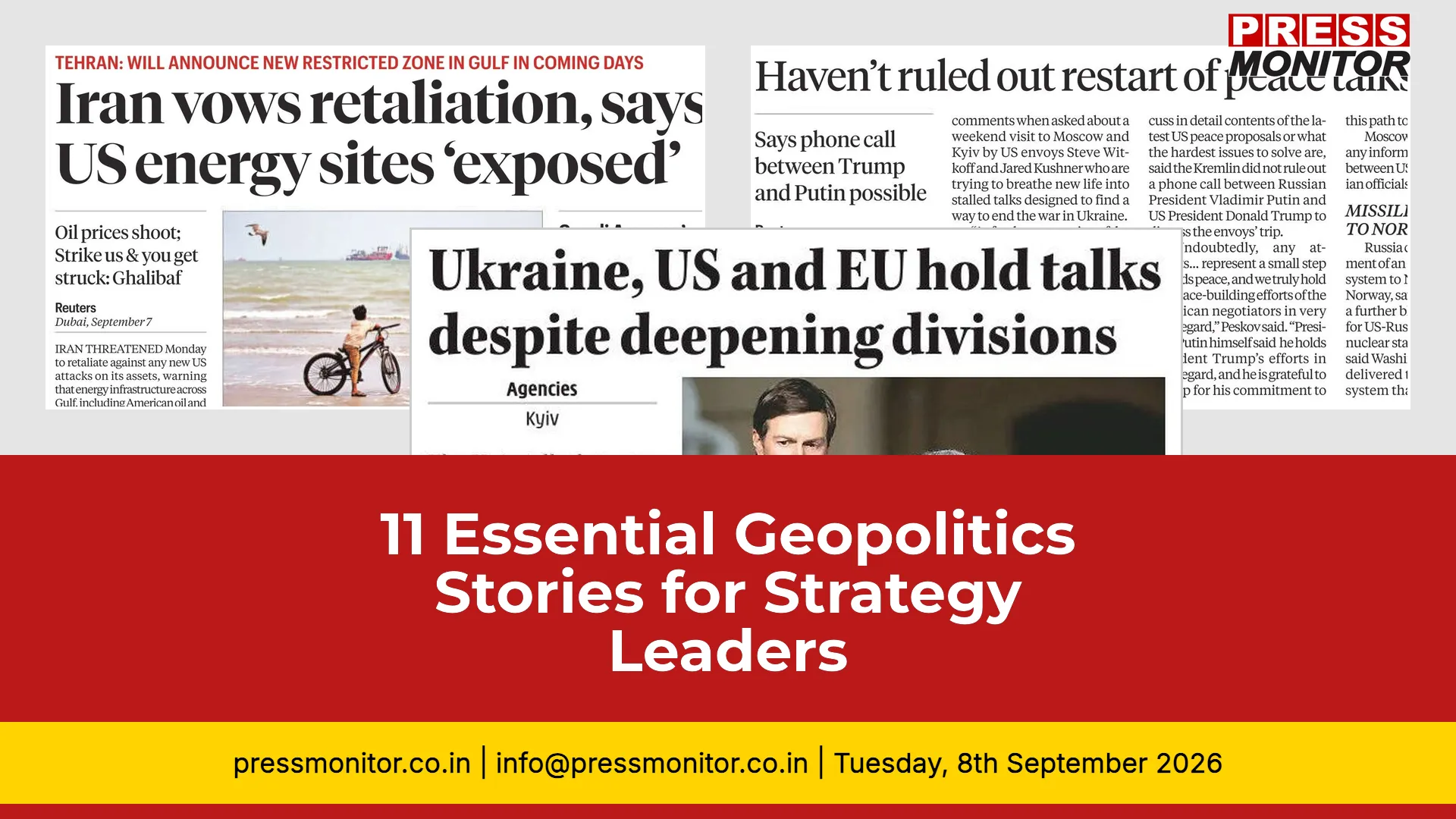
Today's media monitoring of Indian print publications reveals a world in flux — from Ukraine peace talks to Iran's Gulf escalation and the upcoming BRICS Summit in New Delhi. This press review, grounded in print media monitoring and media intelligence, covers the 11 essential geopolitics stories you need to know.
1. Iran's Gulf Restricted Zone Escalation
A front-page report in Indian Express says Tehran will soon announce a new restricted zone in the Gulf amid escalating tensions with the United States. The Iranian parliament speaker Mohammad Bagher Ghalibaf warned that striking Iranian energy assets would provoke retaliation, while security official Mohsen Rezaei said the zone would extend from the start of the US blockade into parts of the Gulf, with vessels entering subject to sanctions. The story also notes recent US attacks on Iranian oil tankers and international reactions, including Israeli strikes in Lebanon that killed twelve people. Iran is set to announce a new restricted zone in the Gulf and a shipping corridor through the Strait of Hormuz, with Tehran threatening retaliation against any new US attacks on its energy assets. Supreme National Security Council head Mohsen Rezaei stated that vessels entering the zone would face Iranian sanctions, while Parliament Speaker Mohammad Bagher Ghalibaf warned that energy infrastructure across the Gulf — including American oil and gas interests — was exposed. Israeli strikes in Lebanon that killed twelve people further complicated the regional picture. Why it matters: Any disruption to Gulf energy flows would ripple through global markets and supply chains. Tracked by Press Monitor.
2. Kremlin Not Ruling Out Peace Talks Restart
A front-page report in Indian Express says the Kremlin did not rule out resumption of trilateral peace talks between Russia, Ukraine and the US, though it is too early to speak of venue and dates. Kremlin spokesman Dmitry Peskov also did not rule out a phone call between President Vladimir Putin and President Donald Trump, and Moscow criticised the deployment of an advanced US missile system to Norway as a blow to strategic stability talks. Russia also announced the closure of the German consulate in St Petersburg following an attempted drone attack in Leipzig. The Kremlin did not rule out resumption of trilateral peace talks between Russia, Ukraine and the United States, with a possible phone call between President Vladimir Putin and President Donald Trump over the weekend. Kremlin spokesman Dmitry Peskov also did not rule out the call, while Moscow criticised the deployment of an advanced US missile system to Norway as a blow to strategic stability talks. Russia also announced the closure of the German consulate in St Petersburg following an attempted drone attack in Leipzig. Why it matters: A resumption of talks could shift the trajectory of the war, but deep divisions remain. Tracked by Press Monitor.
3. Ukraine US EU Talks Despite Divisions
A front-page report in First India says Ukraine, the United States and the European Union held talks in Kyiv despite deep divisions, with US envoys Steve Witkoff and Jared Kushner arriving by train and meeting President Volodymyr Zelensky at Saint Sophia Cathedral. The discussions lasted several hours and included European national security advisers such as Jonathan Powell, and participants expressed hope for reviving trilateral talks, though no major breakthrough was announced. Zelenskyy stated the war with Russia is expected to continue through winter, while Putin claimed Russia was making tangible battlefield advances despite Ukraine's assessment of gains. US envoys Steve Witkoff and Jared Kushner arrived in Kyiv by train and met President Volodymyr Zelensky at Saint Sophia Cathedral, joined by European national security advisers including Jonathan Powell. The discussions lasted several hours and participants expressed hope for reviving trilateral talks, though no major breakthrough was announced. Zelensky stated the war with Russia is expected to continue through winter, while Putin claimed Russia was making tangible battlefield advances. Why it matters: The persistence of diplomatic engagement signals that all parties still see a negotiating path, even amid military realities. Tracked by Press Monitor.
4. India May Facilitate Russia-Ukraine Peace Talks
A front-page report in Asian Age says India may have facilitated peace talks between Russia and Ukraine, with Prime Minister Narendra Modi and External Affairs Minister S. Jaishankar engaging key players at the highest level since August. Jaishankar stated India is in continuous touch with both nations and is exploring suggestions to mitigate or end the conflict, while US diplomats subsequently landed in Moscow to advance the talks. Prime Minister Narendra Modi and External Affairs Minister S. Jaishankar have engaged key players at the highest level since August, with India exploring suggestions to mitigate or end the conflict. Jaishankar stated India is in continuous touch with both nations, and US diplomats subsequently landed in Moscow to advance the talks. Why it matters: India's emerging role as a potential mediator positions it as a pivotal voice in the Global South's approach to conflict resolution. Tracked by Press Monitor.
5. 48th BRICS Summit 2026
A front-page report in Hindustan Times says the 48th BRICS Leaders Summit-2026 will be held from 11 to 13 September at Bharat Mandapam in New Delhi. The summit will bring together international heads of state, dignitaries, and global delegates to discuss resilience, innovation, cooperation, and sustainability. Traffic regulations and diversion points have been issued for controlled roads across the New Delhi district and surrounding corridors. The 48th BRICS Leaders Summit-2026 will be held from 11 to 13 September at Bharat Mandapam in New Delhi, bringing together international heads of state, dignitaries, and global delegates to discuss resilience, innovation, cooperation, and sustainability. Traffic regulations and diversion points have been issued for controlled roads across the New Delhi district. Why it matters: The summit will test whether BRICS can present a unified stance on West Asia and other geopolitical flashpoints. Tracked by Press Monitor.
6. India May Link FDI Easing For China To LAC Border Progress
A front-page report in Business Line says India may link further easing of foreign direct investment rules for Chinese investors to a satisfactory resolution of concerns related to long-pending border disputes. Ahead of a proposed bilateral meeting between Chinese President Xi Jinping and Indian Prime Minister Narendra Modi on the sidelines of the BRICS Summit in New Delhi, sources indicate that investment access for Chinese companies may hinge on border progress. The two sides recently produced an eight-point consensus to stabilize the Line of Actual Control. India may link further easing of foreign direct investment rules for Chinese investors to a satisfactory resolution of border disputes. Ahead of a proposed bilateral meeting between Chinese President Xi Jinping and Prime Minister Narendra Modi on the sidelines of the BRICS Summit, sources indicate that investment access for Chinese companies may hinge on border progress. The two sides recently produced an eight-point consensus to stabilize the Line of Actual Control. Why it matters: This linkage signals that economic engagement with China is now explicitly tied to security outcomes. Tracked by Press Monitor.
7. BRICS Sherpas Meet for Delhi Declaration
A front-page report in Economic Times says BRICS Sherpas met in New Delhi on Sunday and Monday to finetune the Delhi Declaration and resolve differences on how the joint statement should refer to the West Asia war. Differences had cropped up between Iran and the UAE during earlier meetings, and Palestine was also discussed. India has pushed for including strong anti-terror measures and reforms of multilateral institutions, including the United Nations, in the BRICS Declaration. BRICS Sherpas met in New Delhi to finetune the Delhi Declaration and resolve differences on how the joint statement should refer to the West Asia war. Differences cropped up between Iran and the UAE during earlier meetings, and Palestine was also discussed. India pushed for including strong anti-terror measures and reforms of multilateral institutions, including the United Nations, in the BRICS Declaration. Why it matters: The Delhi Declaration will set the tone for the summit and signal the bloc's collective position on the world's most pressing conflicts. Tracked by Press Monitor.
8. India-China Military Talks Prompt Border Discussions
A front-page report in Business Standard says high-ranking military officials from India and China met on Sunday to discuss the eastern sector of the Line of Actual Control, prompted by the expected India visit of Chinese President Xi Jinping for the BRICS summit and a ground issue in the summer. The meeting at the Wacha-Damai border point in Arunachal Pradesh was led by Lt Gen Girish Kalia of the Indian Army and an unnamed senior officer of the People's Liberation Army. High-ranking military officials from India and China met at the Wacha-Damai border point in Arunachal Pradesh to discuss the eastern sector of the Line of Actual Control, prompted by the expected India visit of Chinese President Xi Jinping for the BRICS summit. The meeting was led by Lt Gen Girish Kalia of the Indian Army and an unnamed senior officer of the People's Liberation Army. Why it matters: Military-to-military dialogue at this level suggests both sides are managing tensions even as political negotiations continue. Tracked by Press Monitor.
9. BRICS Summit: West Asia Consensus Difficult
A front-page report in Asian Age says South African high commissioner Anil Sooklal told the media on Monday that it is very difficult for any grouping to have a common voice on the West Asia conflict because of the diversity of views. He nevertheless pointed out that the strength of BRICS is that countries involved in the conflict are able to sit and speak to each other, and that leaders could play a positive role in urging them to move towards peace. He predicted India would hold a very fruitful summit reflecting a powerful formation of the Global South. South African high commissioner Anil Sooklal told the media that it is very difficult for any grouping to have a common voice on the West Asia conflict because of the diversity of views. He pointed out that the strength of BRICS is that countries involved in the conflict are able to sit and speak to each other, and predicted India would hold a very fruitful summit reflecting a powerful formation of the Global South. Why it matters: The diversity of views within BRICS mirrors the broader challenge of multilateral consensus on geopolitical crises. Tracked by Press Monitor.
10. India China Boundary Talks Consensus
A front-page report in Deccan Herald says that on 25 August 2026, India and China agreed on an eight-point consensus that shifts boundary negotiation positions. The agreement tasks expert groups with advancing discussions on an early and substantial harvest, raising questions about political and military costs. On 25 August 2026, India and China agreed on an eight-point consensus that shifts boundary negotiation positions. The agreement tasks expert groups with advancing discussions on an early and substantial harvest, raising questions about the political and military costs of the process. Why it matters: The eight-point consensus represents a rare moment of structured progress on one of Asia's most intractable disputes. Tracked by Press Monitor.
11. Gaza Rubble Clearing Risks Erasing Evidence
A front-page report in Economic Times says Francesca Albanese, the United Nations special rapporteur on the Palestinian territories, warned on Monday that large-scale rubble removal in parts of Gaza under Israeli control risked erasing traces of atrocity crimes and preventing the recovery and identification of human remains. The implications of the ongoing removal, crushing and relocation of rubble were described as profound. UN special rapporteur on the Palestinian territories Francesca Albanese warned that large-scale rubble removal in parts of Gaza under Israeli control risked erasing traces of atrocity crimes and preventing the recovery and identification of human remains. The implications of the ongoing removal, crushing and relocation of rubble were described as profound. Why it matters: The destruction of evidence has serious implications for international law, accountability, and the prospects for lasting peace. Tracked by Press Monitor.
Which of these geopolitical shifts will have the most immediate impact on your business? Stay informed with the news on geopolitics from Press Monitor's print media intelligence.