11 Essential Pharma & Life Sciences Stories for Industry Leaders


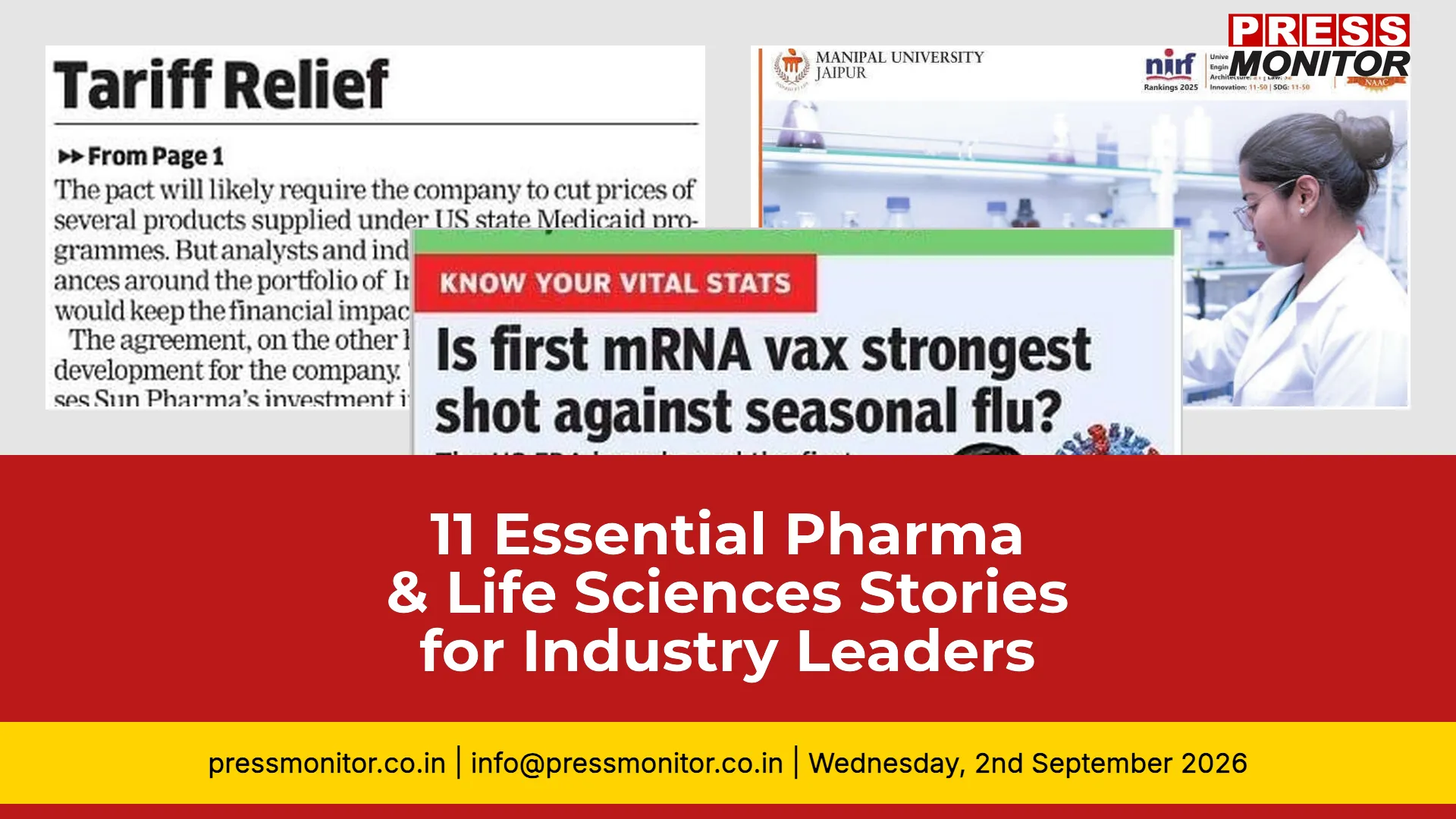
In today's press review, we bring you the most significant developments from India's pharmaceutical and life sciences sector, tracked by Press Monitor's media intelligence. From Sun Pharma's landmark US pricing deal to regulatory shifts in drug labelling, here are 11 stories that matter.
1. Sun Pharma Signs US MFN Pricing Pact
A front-page report in Economic Times says Sun Pharmaceutical Industries has signed the Most Favoured Nation pricing agreement with the US government, committing to offer its prescription and future innovative drugs in America at prices in line with the lowest paid by other developed nations. The pact, signed along with eight other global drugmakers under President Donald Trump's initiative, will likely require price cuts on products supplied under US Medicaid programmes, but analysts estimate the financial impact at just $20-30 million, or around 1%. The agreement, seen as positive, also delays Section 232 tariffs on innovative pharmaceutical products for over two years as Sun pursues its $11.75 billion acquisition of US drugmaker Organon.
Why it matters: Sun Pharma's agreement with the US government under the Most Favoured Nation framework could reshape its US market strategy and impact Indian pharma's global positioning.
Key detail: The pact delays Section 232 tariffs on innovative drugs for over two years, while analysts estimate the financial impact at just $20-30 million. Sun Pharma is also pursuing its $11.75 billion acquisition of Organon.
Source: Economic Times
Next step: Monitor how this affects Sun Pharma's earnings and the broader Indian pharma sector's US pricing strategies.
2. Manipal University Jaipur Launches B.Pharm Programme
A front-page report in Indian Express says Manipal University Jaipur has introduced a Bachelor of Pharmacy (B.Pharm) programme with its first batch starting in 2026-27, drawing on Manipal's 60-year legacy of pharmaceutical sciences education. The university is offering a 20% tuition fee waiver for every B.Pharm student, along with scholarships worth more than Rs 21 crore for meritorious and deserving students across all programmes in 2026-27. The campus is located at Dehmi Kalan on the Jaipur-Ajmer Expressway in Jaipur, Rajasthan.
Why it matters: New pharmacy education programmes signal growing demand for skilled pharmaceutical professionals in India.
Key detail: The first batch starts in 2026-27, with a 20% tuition fee waiver for every B.Pharm student and scholarships worth over Rs 21 crore.
Source: Indian Express
Next step: For aspiring pharmacists, this is a key admission opportunity.
3. US FDA Clears mRNA Flu Vaccine
A front-page report in Times of India says the US FDA has cleared mFlusiva, the first influenza vaccine using mRNA technology, developed by Moderna for adults aged 50 to 64. The shot, not yet approved in India, is seen to be more effective against rapidly changing flu strains as it can be produced in six weeks and updated closer to the season, unlike traditional egg-based vaccines that take at least six months. Experts note that any new vaccine technology must suit India's seasonal patterns, with influenza peaking in winter in the north and during the monsoon in several other regions.
Why it matters: The first mRNA-based flu vaccine could revolutionise influenza prevention, with implications for India's vaccine market.
Key detail: Moderna's mFlusiva is approved for adults 50-64, but not yet in India. It can be produced in six weeks, unlike traditional vaccines.
Source: Times of India
Next step: Watch for India-specific approvals and seasonal adaptation.
4. Columbia's Synthetic Haemoglobin Breakthrough
A front-page report in The Hindu says researchers at Columbia University in New York are close to creating synthetic blood protein, a step that may speed a cure for sickle-cell anaemia and other blood disorders. Dr. Sherman Beychok said scientists there had learned how to take apart a molecule of human haemoglobin and put it back together, removing the major stumbling block to man-made haemoglobin. The findings were to be presented in a report to the American Chemical Society.
Why it matters: Synthetic blood protein could lead to cures for sickle-cell anaemia and other blood disorders.
Key detail: Researchers at Columbia University have learned to reassemble human haemoglobin, removing a major obstacle.
Source: The Hindu
Next step: Track research progress for potential clinical applications.
5. India to Tighten Drug Labelling Rules
A front-page report in Mint says the Centre plans to require pharmaceutical companies to declare whether a drug is synthetically made or biologically derived when applying for a licence and on packaging. The proposed amendments to the Drugs Rules, 1945, aim to end regulatory ambiguity over drugs such as semaglutide, which can be produced chemically or through recombinant DNA technology. India's biologics market is estimated at $13 billion against an overall pharmaceutical market of about $60 billion.
Why it matters: New labelling requirements will clarify whether drugs are synthetic or biological, impacting the biologics market.
Key detail: Proposed amendments to the Drugs Rules, 1945, target drugs like semaglutide. India's biologics market is estimated at $13 billion.
Source: Mint
Next step: Pharma companies must prepare for compliance.
6. What is All the Fuss About Peptides?
A front-page report in Deccan Herald says peptides, initially used by athletes to build muscle, have surged in popularity due to weight-loss drugs like Ozempic and Wegovy. They can regulate metabolism, control pain, enhance skincare, and offer therapeutic benefits.
Why it matters: Peptides are surging in popularity due to weight-loss drugs, but regulatory clarity is needed.
Key detail: Peptides regulate metabolism, control pain, and enhance skincare, but India's regulatory landscape is evolving.
Source: Deccan Herald
Next step: Understand the science and regulatory implications.
7. Telangana HC Seeks MTP Kit Affidavit
A front-page report in Deccan Chronicle says the Telangana High Court has directed the health and medical department to file a detailed affidavit on action taken against the indiscriminate over-the-counter sale of medical termination of pregnancy (MTP) kits without prescriptions. A division bench headed by Chief Justice Aparesh Kumar Singh and Justice G.M. Mohiuddin was hearing a petition filed by registered medical practitioner Dr Prabhu Kumar, who cited Drug Control Administration raids that detected violations in 234 medical shops. The petitioner warned that unregulated consumption of the Schedule H medicines could cause life-threatening complications and endanger women's health.
Why it matters: Over-the-counter sale of MTP kits without prescriptions is a public health concern.
Key detail: The High Court directed the health department to file an affidavit on action taken, following raids that found violations in 234 medical shops.
Source: Deccan Chronicle
Next step: Regulatory enforcement will be key.
8. Medicines, Raw Material Worth Rs 4 Crore Seized
A front-page report in First India says Rajasthan’s Drug Control Department seized medicines and raw material worth Rs 4 crore from an allegedly unlicensed warehouse operated by Strain Health Care. Around 1,500 cartons were recovered, while nine drug samples were collected for quality testing. Officials also seized tapent-adol, pregabalin, cotrimoxazole, packaging material, equipment and expired sildenafil tablets. Authorities in Punjab, Haryana and Himachal Pradesh were alerted.
Why it matters: Unlicensed warehouses pose risks to drug safety and supply chain integrity.
Key detail: Rajasthan's Drug Control Department seized 1,500 cartons from Strain Health Care, including expired sildenafil.
Source: First India
Next step: Authorities in Punjab, Haryana, and Himachal have been alerted.
9. FSDA Stops Bengaluru Peptide Party
A front-page report in Deccan Herald says the Food Safety and Drug Administration (FSDA) stopped an event advertised as Bengaluru's first peptide party after the organisers failed to furnish the required documents. Experts, including Dr Vishal Rao of the cancer prevention committee in Karnataka, say peptides are synthetically made protein chains with proven wellness and health benefits. They argue India's regulatory landscape must evolve to support such new inventions rather than stifle them with lengthy trials.
Why it matters: The wellness industry's peptide trend is clashing with regulatory frameworks.
Key detail: FSDA stopped the event due to missing documents, while experts call for evolving regulations.
Source: Deccan Herald
Next step: Watch for regulatory updates on peptides.
10. PIB Delegation Visits CSIR-IIIM Jammu
A front-page report in State Times says a Press Information Bureau media delegation from Ahmedabad visited the CSIR-Indian Institute of Integrative Medicine in Jammu on Tuesday, where Director Dr Zabeer Ahmed briefed journalists on the institute's drug discovery pipeline, the Aroma Mission and its startup ecosystem. The delegation toured research facilities including the Herbarium and cGMP units before visiting the Suchetgarh Border, where they interacted with Border Security Force personnel and were briefed on border tourism initiatives.
Why it matters: Government outreach highlights drug discovery and the Aroma Mission.
Key detail: Director Dr Zabeer Ahmed briefed journalists on the institute's pipeline and startup ecosystem.
Source: State Times
Next step: Potential collaborations and funding opportunities.
11. Rajasthan Steps Up Seasonal Disease Monitoring
A front-page report in First India says Rajasthan's Health Department has directed districts to keep 24x7 control rooms operational amid heightened surveillance for seasonal diseases, including swine flu, malaria, dengue, chikungunya and scrub typhus. Principal Secretary Gayatri Rathore said rapid response teams should be ready for outbreaks, while Director Public Health Dr Ravi Prakash Sharma ordered medicines to be ensured, door-to-door surveys continued and beds reserved in highly affected areas. Separately, the Drug Control Department seized medicines and raw material worth Rs 4 crore from an allegedly unlicensed warehouse run by Strain Health Care in Bhiwadi.
Why it matters: Heightened surveillance for seasonal diseases is critical for public health.
Key detail: Districts are to keep 24x7 control rooms, with rapid response teams ready.
Source: First India
Next step: Ensure medicine availability and bed reservations.
These stories, curated from India's leading print publications, offer a snapshot of the dynamic pharma landscape. For comprehensive media monitoring and press review, Press Monitor provides real-time intelligence to keep you ahead. What's your take on Sun Pharma's US deal? Share your thoughts below.