11 Essential Space and Aerospace Stories for Industry Leaders


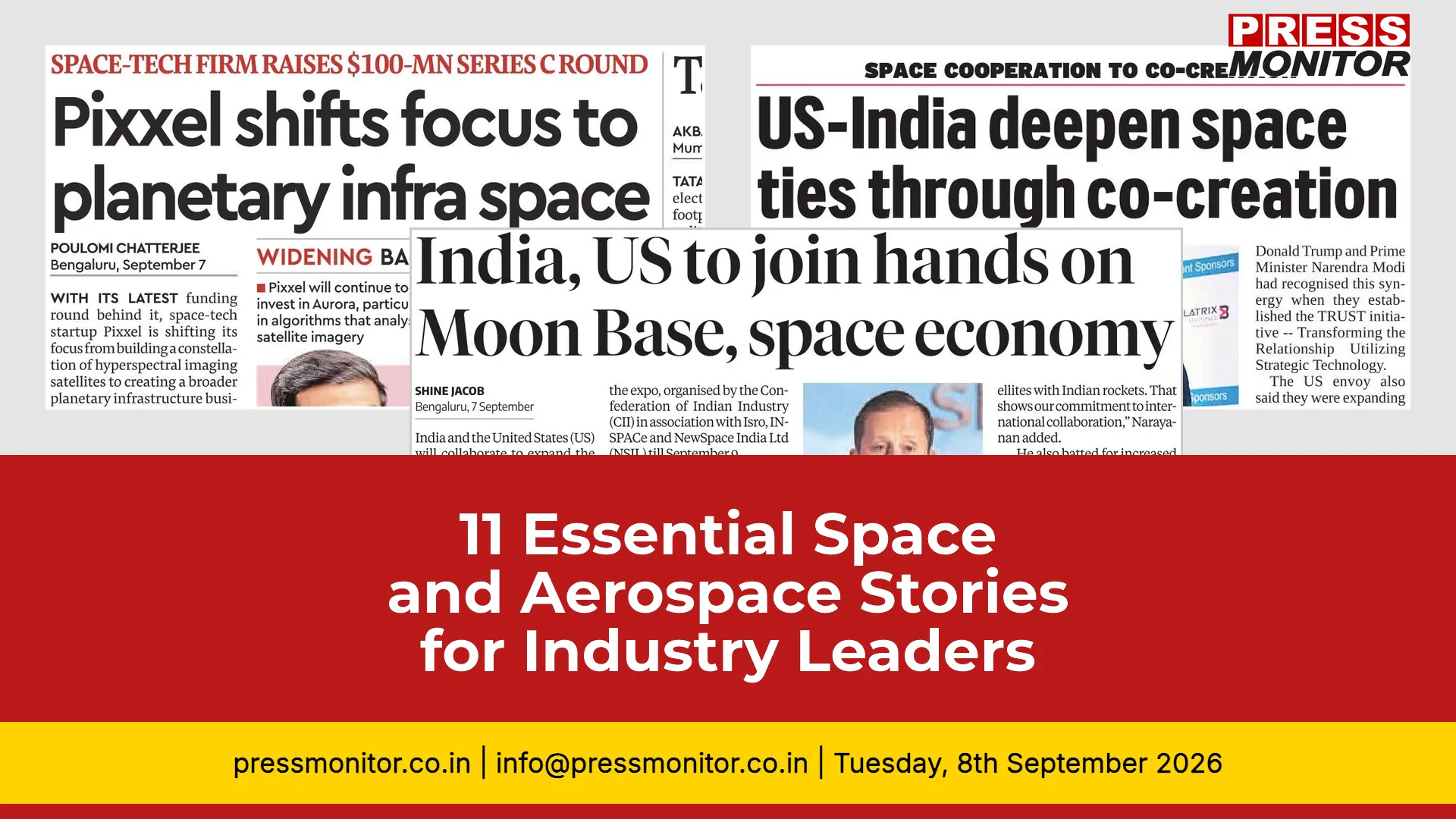
India's space sector is accelerating at an unprecedented pace, from ISRO's shift toward private-sector partnerships to record-breaking startup funding and new US-India co-creation initiatives. According to Press Monitor's tracking of Indian publications, here are the 11 essential stories shaping the space and aerospace landscape today — a vital briefing for anyone tracking news on space and aerospace through media monitoring and print media monitoring.
1. Pixxel Raises $100 Million Series C
A front-page report in Financial Express says space-tech startup Pixxel raised a $100 million Series C funding round on Monday and is shifting focus from building a hyperspectral imaging satellite constellation to a broader planetary infrastructure business spanning sensing, data intelligence, and spacecraft systems. Co-founder Awais Ahmed stated that the fresh capital will improve cash flows and revenue, expand the satellite constellation, scale manufacturing, and unlock additional debt financing using already secured contracts. The Bengaluru-based company plans to continue investing in its Aurora Earth intelligence platform and accelerate satellite manufacturing through its Gigapixxel facility, with India remaining the manufacturing anchor while expanding internationally. Space-tech startup Pixxel has raised $100 million in a Series C round, the single largest funding round by an Indian space technology company. Why it matters: This signals massive investor confidence in India's planetary infrastructure ambitions. Key detail: The round was co-led by Temasek and Seraphim, bringing total funding to $195 million. Co-founder Awais Ahmed plans to expand the Aurora Earth intelligence platform and scale satellite manufacturing at Gigapixxel. Source: Financial Express. Next step: Watch for Pixxel's international expansion and debt financing moves. Which space startup will be next to raise a record round?
2. US and India Shift from Cooperation to Co-Creation in Space
A front-page report in First India says United States Ambassador to India Sergio Gor announced at the ninth Bengaluru Space Expo that Washington and New Delhi are shifting from cooperation to co-creation in the space sector. The envoy spoke at the event organised by the Confederation of Indian Industry in partnership with the Indian Space Research Organisation, IN-SPACe and NewSpace India Limited from September seven to nine at the Bangalore International Exhibition Centre. Gor highlighted that the United States brings private capital and mature commercial ecosystems while India contributes engineering talent and a fearless startup sector, with both nations now co-designing instruments and co-funding startups. US Ambassador Sergio Gor announced at the 9th Bengaluru Space Expo that Washington and New Delhi are now co-designing instruments and co-funding startups. Why it matters: This marks a structural shift in the world's largest space partnership. Key detail: The event was organised by CII in partnership with ISRO, IN-SPACe, and NewSpace India Limited. Source: First India. Next step: Track which joint instruments and startups emerge from this co-creation framework. How will this reshape global space governance?
3. India and US Collaborate on Moon Base and Space Economy
A front-page report in Business Standard says India and the United States will collaborate to expand the space economy and join the Moon Base programme, with US Ambassador Sergio Gor inviting Indian startups to explore opportunities in the American market. NASA has officially invited ISRO to join the Moon Base programme, while India plans to land its first astronauts on the Moon by 2040 and launch up to 300 more satellites in the next seven years. ISRO Chairman V Narayanan highlighted the need for more foreign tie-ups and private-sector participation to increase India's share in the global space economy from the current 2 percent, noting that ISRO is targeting six more missions this year including the first uncrewed Gaganyaan flight. NASA has officially invited ISRO to join the Moon Base programme, while India plans to land its first astronauts on the Moon by 2040 and launch up to 300 more satellites in the next seven years. Why it matters: India's share of the global space economy is currently just 2 percent, and these partnerships could change that dramatically. Key detail: ISRO Chairman V Narayanan highlighted the need for more foreign tie-ups and private-sector participation. Source: Business Standard. Next step: Monitor ISRO's six planned missions this year, including the first uncrewed Gaganyaan flight. Is India on track to become a top-three space economy?
4. EOS-05 Satellite Completes Final Orbit Maneuver
A front-page report in Hindustan Times says ISRO's EOS-05 Earth observation satellite completed its third and final orbit-raising manoeuvre on September 7, 2026, reaching its planned orbit. The 2,367-kg satellite was launched aboard the GSLV-F17 rocket and will monitor India from approximately 36,000 km above Earth. ISRO chairman V Narayanan stated the satellite's lifespan could exceed its assured seven years. ISRO's EOS-05 Earth observation satellite completed its third and final orbit-raising manoeuvre, reaching its planned orbit at approximately 36,000 km above Earth. Why it matters: This is India's first Earth observation satellite in a slightly elliptical geosynchronous orbit, a technical first. Key detail: The 2,367-kg satellite was launched aboard GSLV-F17 and its lifespan could exceed seven years. Source: Hindustan Times. Next step: Track the operational data EOS-05 delivers for defence and civilian applications. What new capabilities will this orbit enable?
5. ISRO Turns to Industry for Scale
A front-page report in Business Line says India's space ambitions are outgrowing ISRO capacity, prompting the agency to increasingly rely on industry, start-ups and academia with nearly 80 per cent of the budget invested by Indian industry and around 450 companies working with ISRO. ISRO Chairman V Narayanan announced six missions planned, including the country's first uncrewed human spaceflight mission, while government targets a 44 billion dollar space economy by 2033. Nearly 80 percent of India's space budget is now invested by Indian industry, with around 450 companies working with ISRO. Why it matters: ISRO's ambitions are outgrowing its capacity, forcing a fundamental shift in how India builds and launches. Key detail: ISRO Chairman V Narayanan announced six missions planned, including the first uncrewed human spaceflight mission, while the government targets a 44 billion dollar space economy by 2033. Source: Business Line. Next step: Follow the Bengaluru Space Expo outcomes for new industry partnerships. Can India's private sector deliver on this scale?
6. ISRO Shifts Rocket Production to Private Sector
A front-page report in Economic Times says Indian Space Research Organisation (Isro) is shifting production of mature rockets and routine satellites to private players while focusing its resources on new technologies and complex missions. Industry stakeholders said it is important for Isro to move from being primarily a builder to becoming an enabler of a much larger space ecosystem targeting a 44 billion dollar space economy by 2033. Nine employee associations wrote to the Department of Space seeking clarity on reports that production of rockets SSLV, PSLV and LVM8 could eventually move to the private sector. ISRO is moving production of mature rockets and routine satellites to private players while focusing on new technologies and complex missions. Why it matters: This redefines ISRO's role from builder to enabler of a much larger space ecosystem. Key detail: Nine employee associations wrote to the Department of Space seeking clarity on reports that SSLV, PSLV, and LVM8 production could move to the private sector. Source: Economic Times. Next step: Watch for the Department of Space's official response to the employee associations' letter. How will this affect ISRO's workforce and morale?
7. ISRO Head Dismisses Privatization Rumors
A front-page report in Deccan Chronicle says Indian Space Research Organisation chairman V Narayanan dismissed concerns regarding the potential privatization of the space agency, clarifying that it remains a government organisation while collaborating with private firms and startups to grow India's space ecosystem. His comments addressed a September 4 letter from nine employee associations requesting official clarification on transferring manufacturing and operational roles to private entities. Speaking at the Bengaluru Space Expo, Narayanan highlighted that the country's space programme is now over sixty four years old and currently utilises fifty six active satellites orbiting Earth. ISRO Chairman V Narayanan clarified that the agency remains a government organisation while collaborating with private firms and startups. Why it matters: With employee concerns mounting, this public denial is a critical signal about ISRO's future structure. Key detail: Narayanan addressed a September 4 letter from nine employee associations and highlighted that India's space programme is now over 64 years old with 56 active satellites. Source: Deccan Chronicle. Next step: Monitor whether the employee associations accept this clarification or escalate demands. Will ISRO's hybrid model satisfy both reformers and traditionalists?
8. Jio Plans Satellite Connectivity by 2028
A front-page report in Economic Times says Reliance Jio has received approval from the Indian National Space Promotion and Authorisation Centre for its satellite broadband plan. The company intends to launch 90 to 100 minimum coverage satellites over the next two to three quarters after a test launch, aiming to provide connectivity in India by 2028. The constellation will operate at an altitude of 650 kilometres with a capacity of up to 150 gigabits per second per satellite, focussing initially on underserved regions across India. Reliance Jio has received approval from IN-SPACe for its satellite broadband plan, intending to launch 90 to 100 minimum coverage satellites. Why it matters: This could dramatically expand broadband access in underserved India through LEO satellite technology. Key detail: The constellation will operate at 650 km altitude with up to 150 Gbps per satellite, focussing initially on underserved regions. Source: Economic Times. Next step: Track Jio's test launch timeline and partnerships with satellite manufacturers. Can Jio compete with existing broadband providers through space?
9. Agnikul Opens Two Units for Reusable Rockets
A front-page report in Business Standard says Agnikul Cosmos inaugurated two new units at its Chennai facility to test reusable rocket stages and manufacture launch vehicle components in-house. The stage testing and inspection facility and the Pressurant Tank Realization, Overwrapping and Outfitting Facility were inaugurated in the presence of Gaganyaan astronaut Group Captain Shubhanshu Shukla. Agnikul is now the only Indian private space company with in-house post-flight requalification infrastructure. Agnikul Cosmos inaugurated two new units at its Chennai facility for testing reusable rocket stages and manufacturing launch vehicle components. Why it matters: Agnikul is now the only Indian private space company with in-house post-flight requalification infrastructure. Key detail: The facilities were inaugurated in the presence of Gaganyaan astronaut Group Captain Shubhanshu Shukla. Source: Business Standard. Next step: Follow Agnikul's progress toward its first commercial reusable launch. Will India's private sector lead the reusable rocket race?
10. GalaxEye Wins US Patent for OptoSAR
A front-page report in Business Standard says GalaxEye, an Indian space technology company, has been granted a US patent for its OptoSAR imaging technology, making it the first Indian startup to receive a US patent for satellite imaging. The patent covers the core invention for aligning and synchronising optical and microwave sensors for simultaneous data acquisition. The company plans to scale towards a 30-satellite constellation over the next five years. GalaxEye became the first Indian startup to receive a US patent for satellite imaging, covering its OptoSAR technology for aligning optical and microwave sensors. Why it matters: This patent validates India's growing capabilities in advanced satellite imaging and opens doors for defence and commercial applications. Key detail: The company plans to scale towards a 30-satellite constellation over the next five years. Source: Business Standard. Next step: Watch for GalaxEye's constellation deployment timeline and international partnerships. Could GalaxEye become India's next space unicorn?
11. ISRO Faces Employee Concerns Over Space Sector Reforms
A front-page report in The Hindu says that on the day of ISRO’s successful launch of its first geosynchronous imaging satellite, employee organisations wrote a letter to the chairman demanding clarity on staff strength, recruitment and outsourcing. The letter calls out plans that could lead to job losses, while ISRO asserts it will not be privatised or reduced. The agency faces a debate over whether its vision of space as a tool for social development can coexist with expanding private participation and a global space‑startup boom. Employee organisations wrote to ISRO chairman demanding clarity on staff strength, recruitment, and outsourcing, raising concerns about potential job losses. Why it matters: The debate over whether ISRO's vision of space as a tool for social development can coexist with expanding private participation is reaching a critical point. Key detail: The letter was issued on the day of ISRO's successful launch of its first geosynchronous imaging satellite. Source: The Hindu. Next step: Monitor the Department of Space's response and any upcoming ISRO reform announcements. How will ISRO balance its social mission with commercial pressures?
Closing: These 11 stories reveal a space sector in transformation — from ISRO's evolving role to India's rising global footprint. Which story will have the biggest impact on your business? Share your thoughts in the comments and tag the entities shaping this space. For the latest news on space and aerospace, media intelligence from Press Monitor's curated tracking of Indian print publications.