11 Essential Trade Policy Stories for Business Leaders


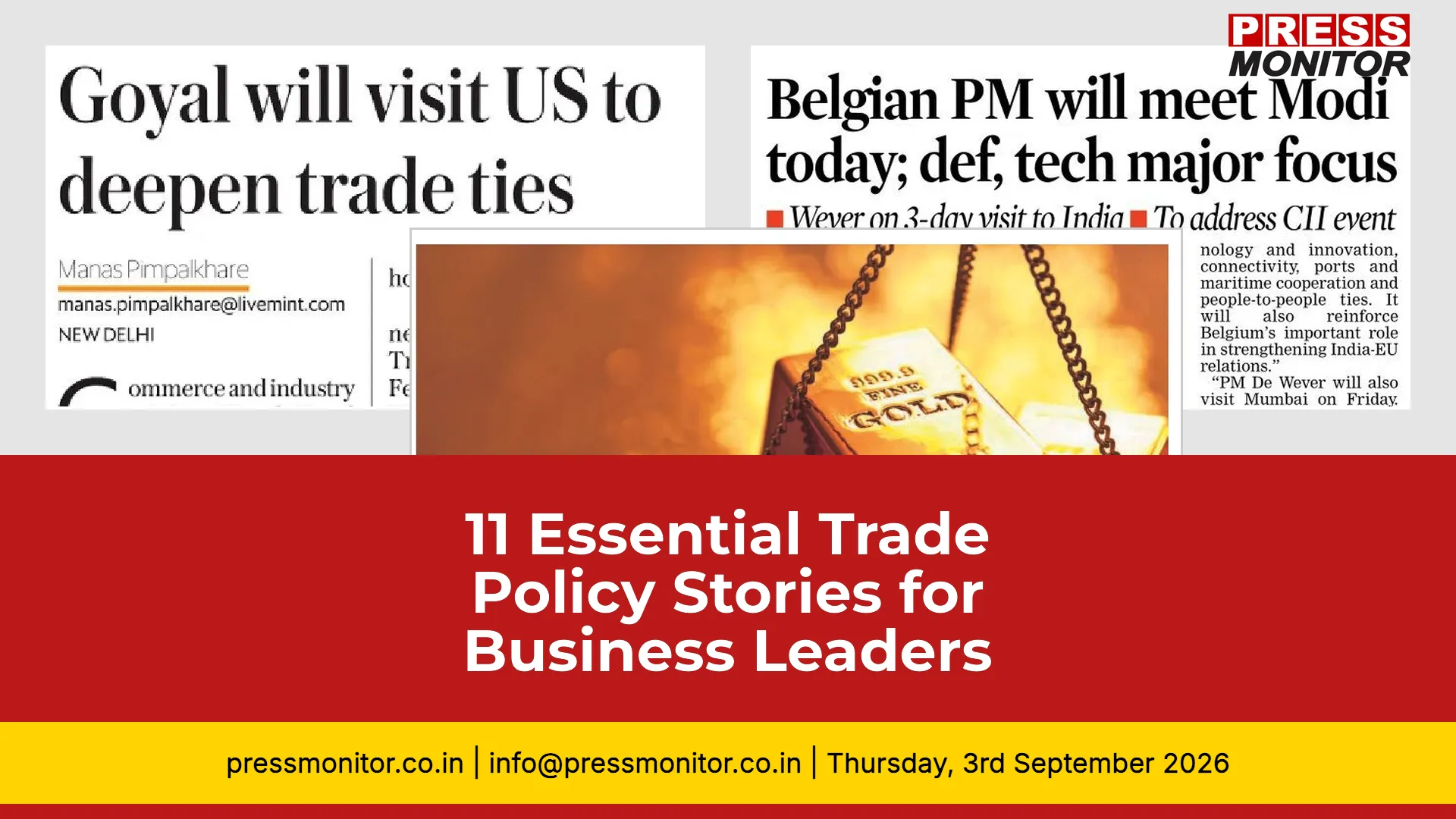
Media monitoring of India's trade landscape reveals rapid evolution, from bilateral agreements with the US and EU to shifting global supply chains and emerging market dynamics. This press review, powered by Press Monitor's print media monitoring of Indian publications, delivers the 11 essential stories every trade professional needs to know today. These news on trade developments shape the global economy and demand immediate attention.
1. US-India Bilateral Trade Agreement Gains Momentum
A front-page report in Mint says India and the US launched negotiations for a Bilateral Trade Agreement in February 2025, when Prime Minister Narendra Modi and President Donald Trump formally announced the talks, with bilateral trade standing at $140.76 billion in fiscal year 2026. Speaking at an event organised by the Automotive Component Manufacturers' Association of India, Gor said the two nations are working together on critical minerals and technology and have signed the Pax Silica declaration, a pro-innovation regulatory framework easing cross-border investment. Minister Goyal will travel to the United States at the end of the month to continue the engagement.
Why it matters: The bilateral trade agreement between the world's two largest democracies could reshape global supply chains and market access for millions of businesses.
Key detail/stat: Bilateral trade stands at $140.76 billion in FY26, with three rounds of in-person talks completed since the framework was agreed in February 2025.
Source: Mint, front-page report
Next step: Watch for Commerce Minister Piyush Goyal's trip to the US for the G20 Trade Ministers' meeting at the end of this month.
2. Belgian PM Bart De Wever Begins Three-Day India Visit
A front-page report in Asian Age says Belgian Prime Minister Bart De Wever is beginning a three-day visit to India and will hold talks with Prime Minister Narendra Modi on Thursday. He is accompanied by Belgian defence and foreign trade minister Theo Francken and a high-level delegation of officials and business leaders, and will deliver a keynote address at a Confederation of Indian Industry event in the context of the India-EU Free Trade Agreement. The visit focuses on trade and investment, defence and security, technology and innovation, connectivity, ports and maritime cooperation, and includes a trip to Mumbai's Bharat Diamond Bourse.
Why it matters: The India-EU Free Trade Agreement negotiations could be accelerated by high-level diplomatic engagement between Belgium and India.
Key detail/stat: Belgian PM Bart De Wever leads a high-level delegation including defence and foreign trade minister Theo Francken, with a stop at Mumbai's Bharat Diamond Bourse.
Source: Asian Age, front-page report
Next step: Track the outcomes of the CII keynote address and bilateral talks with Prime Minister Narendra Modi.
3. Gold Imports and Current Account Deficit: A Decade of Data
A front-page report in Business Standard says that there is a correlation between gold imports and the current account deficit in India from FY2007 to FY2026. The analysis shows the impact of foreign direct investment inflows and repatriation on the current account balance.
Why it matters: Understanding the correlation between gold imports and the current account deficit is essential for investors and policymakers assessing India's external sector vulnerability.
Key detail/stat: Analysis covers FY2007 to FY2026, showing the impact of foreign direct investment inflows and repatriation on the current account balance.
Source: Business Standard, front-page report
Next step: Monitor whether gold import trends signal broader shifts in India's trade balance.
4. China Derails Consensus at G20 Finance Track
A front-page report in Hindustan Times says Treasury Secretary Scott Bessent made his comments at the end of a two-day meeting with finance ministers and central bankers where he tried to focus on growth. He made it clear that the country with the world’s largest and unsustainable current account over imbalance spat: US.
Why it matters: The breakdown of consensus on global trade imbalances signals rising friction in international economic coordination, with ripple effects for Indian exporters.
Key detail/stat: Treasury Secretary Scott Bessent highlighted US concerns about the world's largest and unsustainable current account imbalance at a two-day meeting of finance ministers and central bankers.
Source: Hindustan Times, front-page report
Next step: Follow how India navigates the growing US-China trade friction while protecting its own interests.
5. Mundra Port Disruption Deepens Trade Strain
A fresh disruption has emerged at Mundra, the country’s busiest private port, escalating trade strain amid the West Asia crisis. An operational issue has led to a strike by empty container yard operators, risking 5,000 containers a day and adding to an already strained export-import supply chain.
Why it matters: Mundra is India's busiest private port, and any disruption directly impacts export competitiveness and import costs for businesses nationwide.
Key detail/stat: A strike by empty container yard operators threatens 5,000 containers a day, adding to an already strained supply chain amid the West Asia crisis.
Source: Financial Express, front-page report by NANDINI OZA
Next step: Businesses should assess alternative routing options and inventory buffers.
6. Russia-India Trade Reaches Record High
A front-page report in Mint says Russia and India have built a functioning payments infrastructure using roubles and rupees, which now account for 96% of bilateral trade. Russia’s trade with India reached a record $70 billion in 2024, tripling since the start of the conflict in Ukraine in 2022.
Why it matters: The deepening Russia-India trade relationship, built on a unique rouble-rupee payments infrastructure, demonstrates how sanctions-era trade can create new corridors.
Key detail/stat: Russia's trade with India reached a record $70 billion in 2024, tripling since the start of the conflict in Ukraine in 2022, with 96% of bilateral trade now using roubles and rupees.
Source: Mint, front-page report
Next step: Watch for how this payment infrastructure influences India's broader trade diversification strategy.
7. India Gold Imports: UAE Versus the Rest of the World
A front-page report in Financial Express says India's gold imports from the UAE remain far smaller than purchases from the rest of the world, according to Global Trade Research Initiative data. The figures show quarterly imports falling from $175.24 million in April-June 2025 to $124.83 million in April-June 2026, while UAE shipments in June dropped from $17.72 million to $7.03 million year-on-year.
Why it matters: Shifts in gold import sourcing affect India's trade balance, precious metals market dynamics, and relationships with key Gulf trading partners.
Key detail/stat: India's gold imports from the UAE fell from $175.24 million in April-June 2025 to $124.83 million in April-June 2026, while UAE shipments in June dropped from $17.72 million to $7.03 million year-on-year.
Source: Financial Express, front-page report
Next step: Track whether the decline in UAE gold imports reflects broader trade pattern shifts.
8. Record $112 Billion India-China Trade Deficit
A front-page report in Business Line says India is likely to send a high-level delegation to China, possibly led by Commerce Secretary Rajesh Agrawal, on September 7-8 to advance pending trade and investment talks. The visit comes ahead of President Xi Jinping's expected trip to New Delhi for the BRICS Summit on September 12-13, his first to India in seven years. India will flag its record trade deficit of $112.16 billion with China in FY26 and seek greater market access, while Beijing is expected to push for easier approvals for Chinese investments in India.
Why it matters: India's record trade deficit with China is a top economic concern, and upcoming high-level talks could reshape market access for both economies.
Key detail/stat: India's trade deficit with China reached $112.16 billion in FY26, with a high-level delegation possibly led by Commerce Secretary Rajesh Agrawal visiting China on September 7-8 ahead of the BRICS Summit.
Source: Business Line, front-page report by Amiti Sen
Next step: Monitor the outcomes of the September trade talks and the BRICS Summit for policy shifts.
9. US Considers New Tariffs on Imported Semiconductors
A front-page report in Economic Times says the Trump administration is considering new tariffs on imported semiconductors, aiming to encourage more manufacturing in the US. Commerce Secretary Howard Lutnick indicated that these tariffs could be paired with tariff relief for companies that invest in domestic manufacturing. This approach echoes the strategy used in the pharmaceutical industry. Lutnick emphasized the importance of building chips in America to avoid tariffs, highlighting over $12 trillion in commitments for semiconductor investments in the US.
Why it matters: New semiconductor tariffs could reshape global chip supply chains and affect Indian companies that supply components to the US market.
Key detail/stat: Commerce Secretary Howard Lutnick indicated tariffs could be paired with relief for companies investing in domestic manufacturing, with over $12 trillion in semiconductor investment commitments in the US.
Source: Economic Times, front-page report
Next step: Assess how US semiconductor policy affects Indian exporters and domestic chip ambitions.
10. India's Strong Base for Global Wheat Supply
A front-page report in Business Line says India has a strong base to become a reliable global wheat supplier. This could unlock an export opportunity of more than $1.5 billion for India. A study by the Assocham Global Research and Strategy Centre found conditions favourable for India to expand wheat exports.
Why it matters: India's potential as a reliable global wheat supplier could unlock over $1.5 billion in export opportunities, positioning the country as a key player in global food security.
Key detail/stat: A study by the Assocham Global Research and Strategy Centre found conditions favourable for India to expand wheat exports significantly.
Source: Business Line, front-page report
Next step: Watch for policy announcements that could accelerate India's wheat export growth.
11. India Backs Proposal on Global Imbalances at G20 Finance Track
A front-page report in Business Standard says India backed a proposal at the G2O Finance Track calling on countries with excessive and persistent external surpluses to address domestic distortions that constrain consumption and fuel an overreliance on exports for growth. However, G2O members failed to reach a joint statement after China opposed the proposal.
Why it matters: India's stance on global trade imbalances signals its commitment to a more equitable international economic order, but the failure to reach consensus highlights deep divisions.
Key detail/stat: India backed a proposal calling on countries with excessive external surpluses to address domestic distortions, but China opposed it, preventing a joint G20 statement.
Source: Business Standard, front-page report
Next step: Track how India continues to advocate for balanced global trade rules at upcoming forums.
Which of these trade developments will have the most impact on your business in the coming quarter? The media intelligence from Press Monitor's curated review of Indian print publications helps you stay ahead.