11 Pivotal Manufacturing Stories for Industry Leaders


Industrials & Manufacturing news on industrials & manufacturing shifts demands sharp print media monitoring. This press review distills today's most critical developments into actionable media intelligence for executives navigating capital cycles, policy reforms, and global trade dynamics. Here are 11 pivotal stories shaping the sector.
1. India Needs 10% Manufacturing Surge
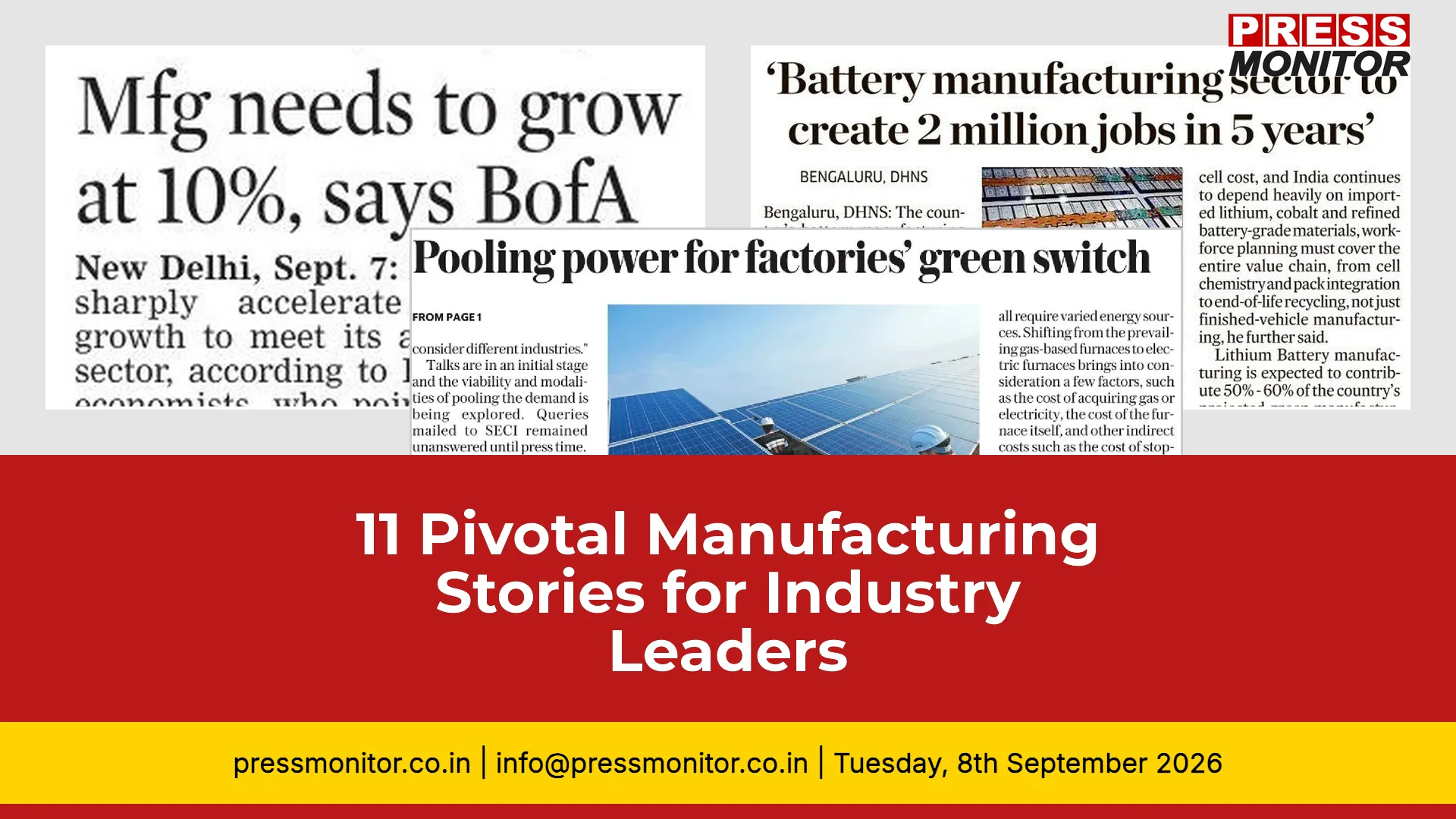
A front-page report in Deccan Chronicle says Bank of America economists led by Rahul Bajoria estimate India will need to accelerate manufacturing growth at a rate of at least ten per cent annually for the next fifteen years to bring its share of the economy up to twenty five per cent, assuming overall gross domestic product growth of about seven per cent a year. India's manufacturing sector grew at an average annual pace of four point three per cent in dollar terms in the past fifteen years, and services have become the main growth engine, leaving many still dependent on agriculture.
Why it matters: Sets the macro benchmark for factory expansion and foreign direct investment targeting.
Key detail: Bank of America economists project annual manufacturing growth must hit at least 10% over the next 15 years to reach a 25% GDP share, assuming 7% overall economic growth.
Source: Deccan Chronicle
Next step: Align capex forecasts with this 10% threshold for mid-to-long term planning.
2. 2 Million Jobs Projected By 2030 Battery
A front-page report in Deccan Herald says India's battery manufacturing sector is projected to generate 1.5 to 2 million jobs by 2030, with hiring growing 25 to 30 percent year-on-year. Under the PLI Scheme for Advanced Chemistry Cells, the Government of India has committed Rs 18,100 crore to develop 50 GWh of domestic manufacturing capacity. The sector is also building a full industrial ecosystem across Gujarat, Karnataka, Haryana, and Telangana.
Why it matters: Signals massive hiring waves and supply chain localization opportunities in clean tech.
Key detail: The battery sector is projected to create 1.5–2 million jobs by 2030, backed by an ₹18,100 crore PLI scheme targeting 50 GWh of domestic capacity across Gujarat, Karnataka, Haryana, and Telangana.
Source: Deccan Herald
Next step: Evaluate talent acquisition strategies and supplier partnerships in advanced chemistry cells.
3. SECI Plans Pooling For Factory Heat
A front-page report in Mint says SECI is working on a plan to map and aggregate demand from small and medium factories using gas for industrial heat, enabling their shift to electric furnaces. The plan aims to pool demand across industries and float tenders for renewable power at lower prices, helping businesses cut costs and secure stable supply. The initiative comes amid pressure on India's gas supplies from the West Asia war and about forty gigawatt of unsigned green power agreements.
Why it matters: Reduces operational costs and decarbonizes heavy industry amid tightening gas supplies.
Key detail: SECI is aggregating demand from small and medium factories to pool renewable power procurement, enabling a shift from gas-fired furnaces to electric alternatives while addressing West Asia supply pressures.
Source: Mint
Next step: Assess eligibility for pooled green power tenders and model electrification ROI.
4. India Belgium Double Trade, Sign Defence Deal
A front-page report in The Hindu says Belgian Prime Minister Bart De Wever visited Delhi to meet Indian counterparts, where both nations signed a letter of intent on defence cooperation and agreed to double bilateral trade, currently valued at approximately one lakh eight thousand crore rupees, within five years. Talks focused on opportunities following the India-European Union free trade agreement, including renewable energy and food processing, alongside co-development of military hardware. The visit underscores deepening strategic ties and mutual focus on strategic autonomy, occurring as India prepares for the BRICS summit.
Why it matters: Expands export corridors and deepens strategic technology transfer frameworks.
Key detail: New Delhi and Brussels signed a defence cooperation letter of intent and pledged to double bilateral trade (currently ₹1.8 lakh crore) within five years, focusing on renewable energy, food processing, and co-developed military hardware.
Source: The Hindu
Next step: Map compliance requirements for EU FTA pathways and defence procurement pipelines.
5. Amit Shah Labels Western Region WEST Engine
A front-page report in Morning Standard says Home Minister Amit Shah described the Western Region as the WEST Engine of India's economic growth during the twenty-eighth meeting of the Western Zonal Council in Panaji, Goa on Monday. He stated the region, comprising Gujarat, Maharashtra, Goa and the Union Territories of Dadra and Nagar Haveli and Daman and Diu, is the country's largest economic, industrial and financial centre, contributing to India's seventy-eight percent growth rate.
Why it matters: Highlights regional policy prioritization and infrastructure funding flows.
Key detail: Home Minister Amit Shah designated the Western Zonal Council states as the WEST Engine of economic growth, noting the region contributes significantly to national industrial output and financial activity.
Source: Morning Standard
Next step: Align regional expansion plans with zonal council incentives and logistics upgrades.
6. ISRO Faces Employee Concerns
A front-page report in The Hindu says that on the day of ISRO’s successful launch of its first geosynchronous imaging satellite, employee organisations wrote a letter to the chairman demanding clarity on staff strength, recruitment and outsourcing. The letter calls out plans that could lead to job losses, while ISRO asserts it will not be privatised or reduced. The agency faces a debate over whether its vision of space as a tool for social development can coexist with expanding private participation and a global space‑startup boom.
Why it matters: Reflects broader tensions between public space development and private sector integration.
Key detail: Employee organizations demanded clarity on recruitment and outsourcing following a successful geosynchronous imaging satellite launch, warning against potential job losses amid rising private space participation.
Source: The Hindu
Next step: Monitor policy adjustments around public-private space partnerships and workforce planning.
7. MP Power Tendrs Rs 3.68 Crore Contracts
A front-page report in The Pioneer says M.P. Power Generating Company Limited has issued three tenders for operations and maintenance work at the Shree Singaji Thermal Power Project in Dongalia, Khandwa. The contracts cover chemistry services for a water treatment plant, preventive maintenance of coal mills and burners, and maintenance of boiler non-pressure parts, with a combined estimated value of approximately Rs 8.68 crore. Bidders must submit proposals online by the closing dates in September 2026 through the Government of Madhya Pradesh e-portal.
Why it matters: Indicates ongoing thermal infrastructure maintenance and localized procurement cycles.
Key detail: M.P. Power Generating Company issued three O&M tenders for water treatment, coal mill maintenance, and boiler parts at the Shree Singaji Thermal Power Project, with proposals due via the state e-portal in September 2026.
Source: The Pioneer
Next step: Register on government procurement portals and track tender deadlines for service contracts.
8. LAPP Sees India As Top Market
A front-page report in Free Press Journal says India has become LAPP's largest market outside Germany, driven by industrial capex, infrastructure creation and energy transition. The family-owned group operates three manufacturing facilities with over five hundred workers, anchored by an expanded Bhopal plant that is the largest in its global network, and CEO Matthias Lapp says localisation remains central to the strategy as the business spans industrial automation, railways, renewable energy and e-mobility.
Why it matters: Validates sustained foreign industrial capex and localization commitments.
Key detail: German engineering group LAPP named India its largest market outside Germany, expanding its Bhopal facility to anchor operations in industrial automation, railways, renewables, and e-mobility.
Source: Free Press Journal
Next step: Explore joint venture or distribution alignment with established multinational manufacturing footprints.
9. Jindal Stainless Signs JFE Steel Pact
A front-page report in Free Press Journal, from New Delhi, says Jindal Stainless signed a pact with Japan's JFE Steel Corporation on Monday to strengthen manufacturing capabilities for selected ferritic stainless steel grades. The technical assistance agreement will focus on improving product quality and manufacturing practices, with Jindal Stainless Managing Director Abhyuday Jindal saying the partnership will build capabilities that create greater value for customers.
Why it matters: Strengthens domestic high-grade steel production and quality benchmarks.
Key detail: Jindal Stainless partnered with Japan's JFE Steel for technical assistance on ferritic stainless steel grades, aiming to elevate product quality and manufacturing practices for downstream customers.
Source: Free Press Journal
Next step: Benchmark internal quality control systems against new international standards.
10. Nasscom Vice-Chairperson Kishor Patil Urges AI Shift
A front-page report in Business Standard says National Association of Software and Service Companies Vice-Chairperson Kishor Patil advocates that Indian engineering research and development companies shift business models toward product-based and outcome-based revenue to counter artificial intelligence disruption. Patil highlighted significant growth in the engineering research and development segment exports and noted that global automotive spending will increasingly be artificial intelligence-based, requiring readiness in platforms and products.
Why it matters: Drives strategic pivots in engineering R&D and automotive software spending.
Key detail: Patil urged Indian engineering firms to transition toward product-based and outcome-driven revenue models, citing surging AI integration in global automotive platforms and export markets.
Source: Business Standard
Next step: Audit current R&D monetization structures and accelerate software-defined product roadmaps.
11. 31 Lakh Unit Power Shortage In Punjab
A front-page report in Tribune says rolling mills in Mandi Gobindgarh, a plywood unit near Ludhiana, and farmers in Bathinda are facing frequent power cuts causing losses. The disruptions come as electricity demand remains high due to a weak monsoon and low coal stocks, with unscheduled outages of three to four hours daily. Industry representatives met Power Minister Tarunpreet Singh Sond on Saturday and raised concerns over the power shortage.
Why it matters: Exposes grid vulnerabilities impacting rolling mills, plywood units, and agricultural processing.
Key detail: Frequent 3–4 hour unscheduled outages are disrupting industrial operations and farming, driven by weak monsoon patterns and constrained coal inventories, prompting urgent meetings with state leadership.
Source: Tribune
Next step: Stress-test backup power infrastructure and negotiate priority supply agreements where available.
Navigating these shifts demands reliable print media monitoring to separate signal from noise. Which of these developments will reshape your Q4 strategy? Share your take below.