11 Pivotal Supply Chain & Procurement Stories for Executives


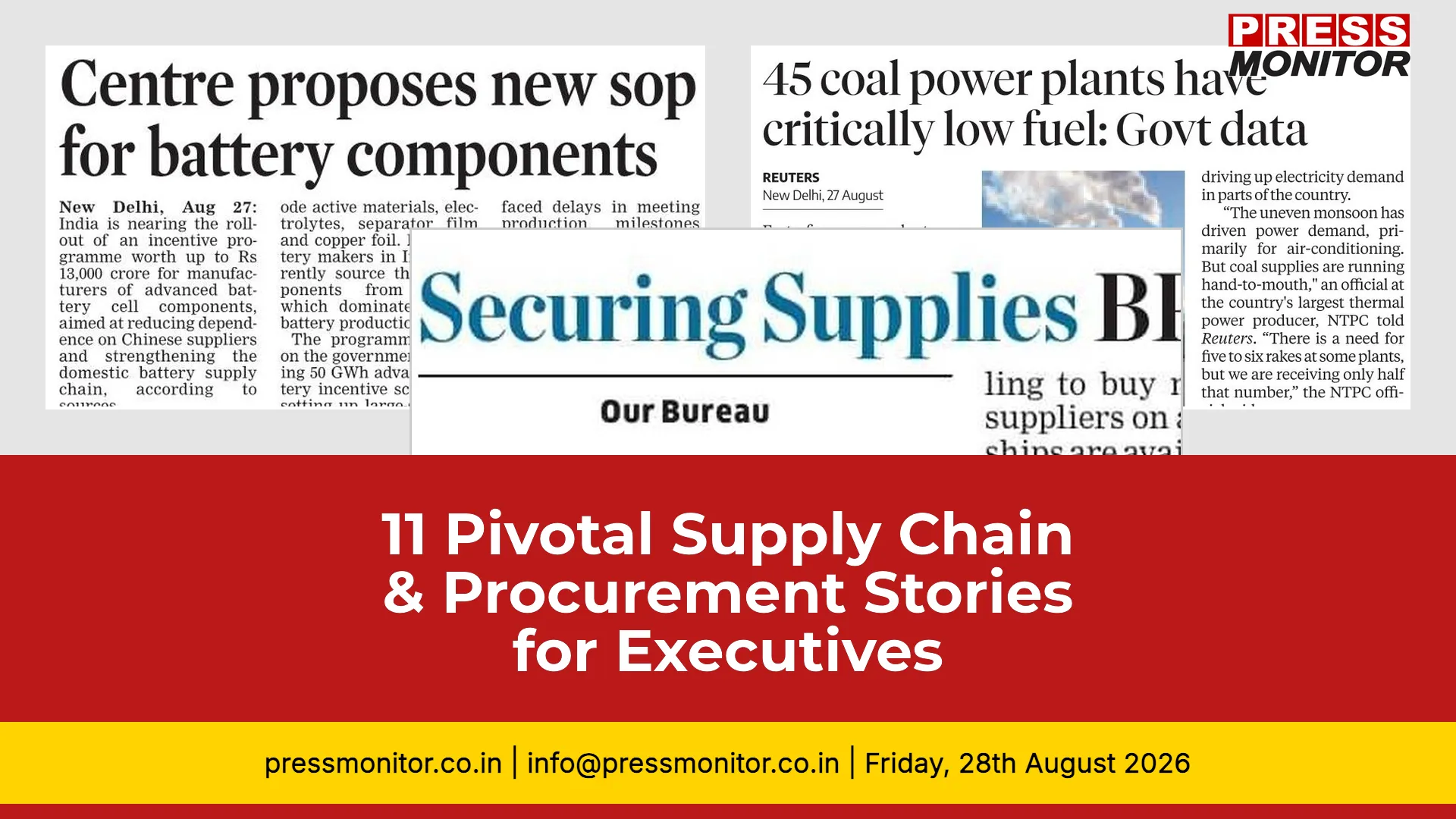
Tracking news on Supply Chain & Procurement requires precise print media monitoring. This press review distills today’s most critical developments into actionable media intelligence for supply chain leaders. According to Press Monitor's tracking of Indian publications, here are 11 pivotal stories shaping logistics, energy security, and industrial sourcing this week.
1. Centre Proposes New SOP for Battery Components
A front-page report in Deccan Chronicle says India is nearing the rollout of an incentive programme worth up to Rs 13,000 crore for manufacturers of advanced battery cell components, aimed at reducing dependence on Chinese suppliers and strengthening the domestic battery supply chain.
Why it matters: Directly impacts domestic manufacturing and reduces reliance on foreign suppliers.
Key detail: A Rs 13,000 crore incentive programme targets advanced battery cell components, aiming to localize assembly and strengthen India’s green energy supply chain.
Source: Deccan Chronicle
Next step: Evaluate tender eligibility for component manufacturers and align production timelines with government rollout schedules.
2. India's Power Plants Face Coal Shortage
A front-page report in Business Standard says that forty-five power plants are operating with critically low coal inventories. Monsoon rains disrupt supplies and electricity demand rises amid hotter-than-usual weather linked to El Niño.
Why it matters: Energy availability dictates manufacturing uptime and freight logistics costs.
Key detail: Forty-five thermal plants operate with critically low inventories below 25%, driven by monsoon disruptions and El Niño-linked demand spikes.
Source: Business Standard
Next step: Stress-test fuel procurement contracts and activate alternative transport routes for emergency stock replenishment.
3. BPCL Turns to Iraq Crude Amid Iran War
A front-page report in Economic Times says, State-run Bharat Petroleum Corp (BPCL) on Thursday said it will receive its first Iraqi crude cargo in the next few days as it looks for alternative ways to secure supplies amid continued disruption in the key oil shipping route, the Strait of Hormuz.
Why it matters: Geopolitical friction directly alters crude sourcing strategies and shipping insurance premiums.
Key detail: State-run BPCL secures its first Iraqi cargo while navigating Strait of Hormuz disruptions, signaling a broader industry pivot toward Middle Eastern alternatives.
Source: Economic Times
Next step: Review vendor diversification plans and hedge against volatile freight rates in the Persian Gulf corridor.
4. US Investigation on Singapore-Based Logistics for AI Chip Smuggling
A front-page report in Business Standard says the US government is investigating Singapore-based Apex Logistics for its suspected role in smuggling Nvidia artificial intelligence (AI) chips to China in violation of US export restrictions.
Why it matters: Export control enforcement is reshaping high-tech procurement and cross-border compliance frameworks.
Key detail: Authorities probe Apex Logistics for allegedly routing restricted Nvidia AI chips to China, highlighting tightening semiconductor trade barriers.
Source: Business Standard
Next step: Audit dual-use goods classification protocols and update vendor screening checklists for electronics sourcing.
5. Palm Oil Prices Expected to Surge to MYR 6,000/Tonne
A front-page report in Business Line says global palm oil prices are set to rise sharply under tight supply-demand conditions, increasing biodiesel mandates in Indonesia, and recurring El Nino weather disruptions. Supply is forecast to remain almost flat despite 2.7% global consumption growth, largely driven by Indonesia’s compulsory biodiesel program to blend 50% palm oil into fuel as of July 1, 2026. Researchers like BMI and Rabobank anticipate prices to reach $1,500/tonne by mid-2027, benefitting producers amid anticipated production declines and export diversions caused by biofuel policies.
Why it matters: Commodity volatility impacts food packaging, biofuels, and agricultural input costs.
Key detail: Indonesia’s mandatory B50 biodiesel blend and El Niño-driven yield drops push forecasts toward $1,500/tonne by mid-2027.
Source: Business Line
Next step: Lock in forward contracts for oleochemical derivatives and assess sustainable sourcing certifications.
6. Defense Minister Emphasizes Self-Reliance in Defense Supply Chain
A front-page report in Focus News says that Defense Minister Rajnath Singh emphasized the importance of a robust supply chain, strong industrial capabilities, and rapid innovation in addressing long-term conflicts. Highlighting the evolving nature of warfare, he assured the development of indigenous defense capabilities.
Why it matters: Public sector procurement mandates are accelerating indigenous vendor integration.
Key detail: Rajnath Singh stresses rapid innovation and robust industrial capabilities to secure long-term defense readiness.
Source: Focus News
Next step: Align capability statements with Make-in-India defense tenders and fast-track MSME partnerships.
7. India's Strategic Fuel Plan Aims to Secure Energy Reserves
The Hindu front-page report says: India's proposed strategic-fuel programme targets 28 million tonnes crude oil, 9 million tonnes LNG and 4 million tonnes LPG reserves. The plan addresses vulnerabilities in fuel storage and transport infrastructure, but requires coordination across maritime logistics pipelines and governance structures according to a 10-year strategy under consideration.
Why it matters: National reserve policies dictate bulk fuel allocation and emergency logistics planning.
Key detail: Proposed targets include 28 million tonnes of crude oil, 9 million tonnes of LNG, and 4 million tonnes of LPG to fortify storage infrastructure.
Source: The Hindu
Next step: Coordinate with state logistics agencies on pipeline scheduling and terminal capacity upgrades.
8. India's Oil Imports from Russia Dip in August
A front-page report in Business Standard says India’s imports of crude oil from Russia are expected to turn out to be around 2.1 million barrels per day (mbpd) in August, down sharply from the record levels of around 2.6 mbpd seen in July and June this year.
Why it matters: Shifting trade flows require agile payment routing and alternative vessel chartering.
Key detail: Crude volumes drop to approximately 2.1 million barrels per day from recent peaks near 2.6 mbpd.
Source: Business Standard
Next step: Diversify counterparty exposure and renegotiate Incoterms to mitigate sanction-related clearance delays.
9. GAIL to Double Jamnagar-Loni Pipeline Capacity
A front-page report in New Indian Express says state-run GAIL (India) Ltd will expand the capacity of its Jamnagar-Loni LPG pipeline from 3.25 to 6.5 MMTPA. The company is also developing three new pipelines covering 1,775 km to strengthen India's LPG supply chain.
Why it matters: Expanded gas infrastructure lowers transportation bottlenecks for industrial clusters.
Key detail: Capacity rises from 3.25 to 6.5 MMTPA, accompanied by three new 1,775 km pipelines strengthening national LPG distribution.
Source: New Indian Express
Next step: Map facility locations against new pipeline corridors to optimize last-mile delivery networks.
10. JNPA Ranks 21st Globally in Container Port Throughput
"Selon Business Standard, le Jawaharlal Nehru Port Authority (JNPA), le plus grand port de conteneurs de l’Inde, a atteint la 21e position au niveau mondial pour la première moitié de l’année calendrier 2026 (HliCY26), contre la 28e position en 2025, selon le rapport d’Alphaliner des principaux 30 ports de conteneurs dans le monde. Alphaliner est un fournisseur mondial de données et d’intelligence sur le transport maritime de conteneurs et suit les performances des ports de conteneurs en fonction du volume de marchandises transportées. Selon un communiqué de presse de la porte du port publié jeudi, l’augmentation de sept places reflète le focus continu de la JNPA sur l’efficacité opérationnelle, une évacuation plus rapide des marchandises, une gestion améliorée des navires et une connectivité multimodale renforcée au cours de la dernière année."
Why it matters: Port efficiency directly influences inventory turnover and export lead times.
Key detail: Jawaharlal Nehru Port Authority climbs seven spots globally, driven by multimodal connectivity and faster cargo evacuation amid West Asia rerouting.
Source: Business Standard
Next step: Negotiate priority berthing slots and integrate real-time tracking APIs for inbound/outbound shipments.
11. KPTCL Invites Bids for 220kV Battery Storage System
A front-page report in Deccan Herald says KPTCL invites electronic tenders through its portal for constructing a 220kV terminal bay battery storage system at Mundargi sub-station. The EMD of ₹9.19 crore is required, with the portal opening on 28 August for submissions. Bidding documents follow the KPP Tender Portal guidelines.
Why it matters: Grid-scale storage investments stabilize renewable integration and reduce diesel dependency.
Key detail: Karnataka Power Transmission Corporation seeks bids for a Mundargi sub-station system with a ₹9.19 crore EMD requirement.
Source: Deccan Herald
Next step: Submit technical proposals aligned with KPP Tender Portal guidelines and verify grid interconnection standards.
Which of these supply chain shifts demands immediate action in your procurement roadmap? Share your take below. Tracked by Press Monitor.