13 Defining Geopolitics Stories for Policy Leaders


Geopolitics and international relations dominate today's headlines, and media monitoring of Indian print media monitoring reveals 13 pivotal stories shaping the global order. This press review delivers media intelligence on the diplomatic flashpoints, military escalations, and strategic realignments that define the day's news on geopolitics. According to Press Monitor's tracking of Indian publications, here is what matters most.
1. Ukraine Proposes Ceasefire During US Talks
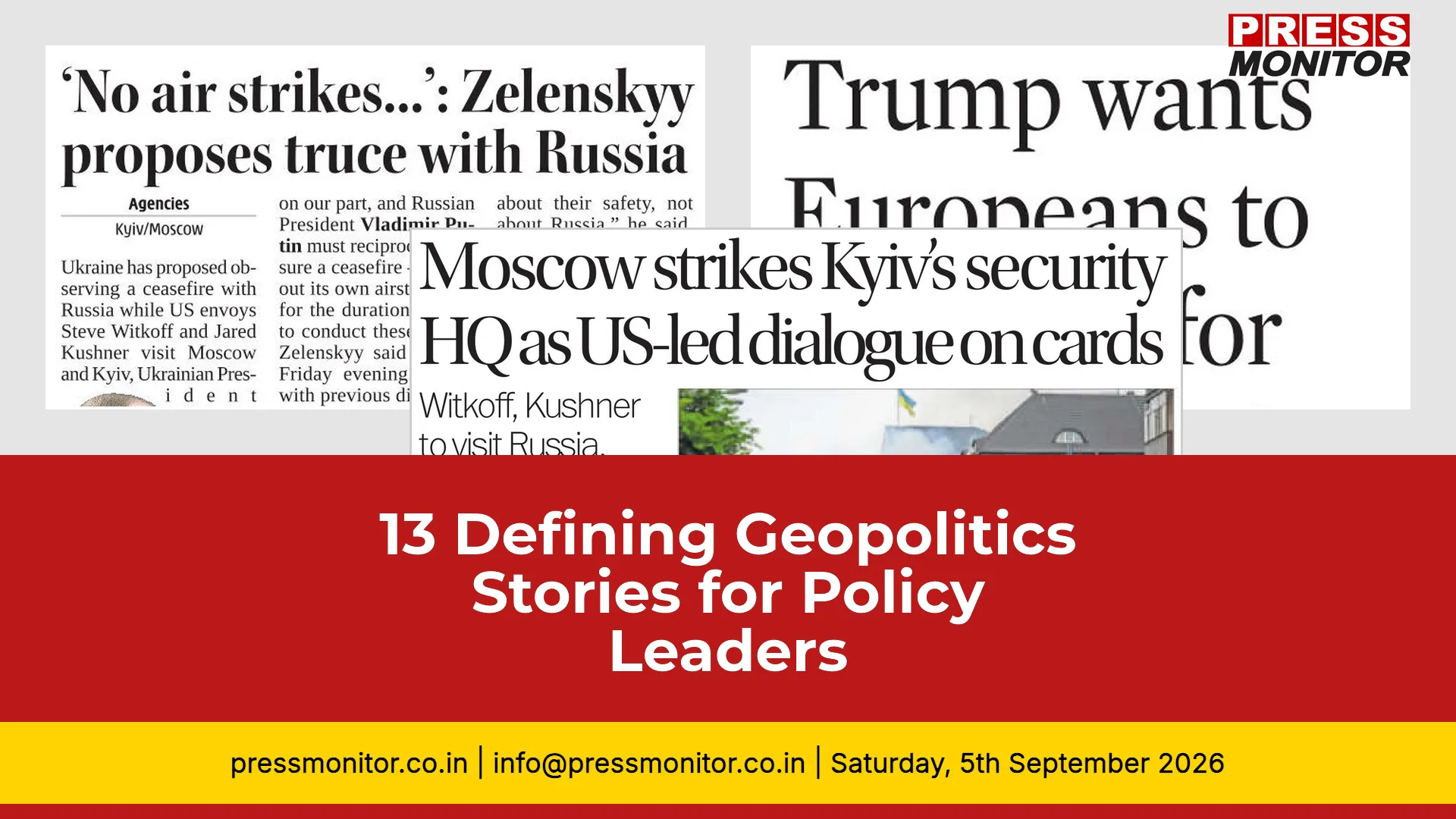
A front-page report in First India says Ukraine has proposed observing a ceasefire with Russia while US envoys Steve Witkoff and Jared Kushner visit Moscow. President Volodymyr Zelenskyy said on Friday that there would be no airstrikes on their part and Russian President Vladimir Putin must reciprocally ensure a ceasefire without its own airstrikes for the duration needed to conduct these talks. Zelenskyy also stated that Ukraine will ensure the normal functioning of Russian airspace so that the negotiators can arrive safely and expressed concern about media safety rather than Russia.
Why it matters: A ceasefire proposal could mark the first serious diplomatic off-ramp in the Russia-Ukraine war as US envoys prepare to shuttle between Moscow and Kyiv.
Key detail: President Zelenskyy pledged no airstrikes on Ukraine's part and demanded Russia reciprocate, while also ensuring normal functioning of Russian airspace for negotiator safety.
Source: First India
Next step: Watch for reciprocal commitments from Moscow as the envoy visit unfolds.
2. Trump Demands Europe Repay Ukraine Aid
A front-page report in Morning Standard says US President Donald Trump demanded Europeans repay the hundreds of billions of dollars in American aid given to Ukraine and NATO. Trump also rejected reports that the US military was running low on munitions in its conflict with Iran, stating that stockpiles are being built up at levels never seen before. Separately, a Russian drone struck Ukraine's SBU security headquarters in Kyiv, as President Volodymyr Zelensky accused Moscow of targeting the SBU chief's office two days before a visit by Trump's special envoy Steve Witkoff and son-in-law Jared Kushner.
Why it matters: The demand for European repayment of hundreds of billions in US aid signals a fundamental shift in alliance burden-sharing and could reshape NATO's financial architecture.
Key detail: Trump also rejected claims that US military munitions are depleted, stating stockpiles are being built up at levels never seen before.
Source: Morning Standard
Next step: Monitor European reactions and potential NATO budget renegotiations.
3. Russia Strikes Kyiv Security Headquarters
A front-page report in Tribune says a Russian drone struck the headquarters of Ukraine’s security service in central Kyiv on Friday, before diplomatic talks with United States officials on ending the war. President Volodymyr Zelenskyy said he spoke with acting security chief Oleksandr Poklad after the strike, and local authorities said nine people were wounded; United States negotiators Steve Witkoff and Jared Kushner were set to visit Russia and Ukraine that weekend. The air war has intensified as the conflict approaches five years since Russia’s invasion of Ukraine.
Why it matters: The deliberate drone strike on Ukraine's SBU headquarters in central Kyiv, wounding nine, underscores the intensifying air war ahead of diplomatic talks.
Key detail: President Zelenskyy spoke with acting security chief Oleksandr Poklad after the strike, as the conflict approaches five years since Russia's invasion.
Source: Tribune
Next step: Track the impact on Ukraine's security infrastructure ahead of peace talks.
4. Vance: All Options Against Iran on Table
A front-page report in Tribune says US Vice-President JD Vance asserted that the Trump administration has a range of economic, military, diplomatic, and covert options to deal with Iran as tensions escalate amid the conflict in West Asia. Vance rejected describing the struggle as war and claimed China is willing to cooperate with Washington on isolating Iran economically.
Why it matters: JD Vance's assertion that economic, military, diplomatic, and covert options are all on the table signals potential escalation in the West Asia conflict.
Key detail: Vance rejected describing the struggle as war and claimed China is willing to cooperate with Washington on isolating Iran economically.
Source: Tribune
Next step: Watch for escalation or de-escalation signals from Tehran and Washington.
5. Trump Confronting Intransigent Iran Government
A front-page report in Millennium Post says President Donald Trump has settled on a dual-pronged approach combining economic pressure with potential devastating escalation against an intransigent Iranian government. The Trump administration launched Operation Economic Outcast last week to isolate Iran from global trade partners and resumed strikes, prompting Iranian retaliation that renewed concerns of an all-out regional war. Tehran has dug in its heels despite rising energy prices and roiling global economy, leaving the administration struggling to wind down the conflict ahead of November's midterm congressional elections.
Why it matters: The Trump administration's dual-pronged approach combining Operation Economic Outcast with potential military escalation against Iran raises the stakes for global energy markets.
Key detail: Tehran has dug in its heels despite rising energy prices and roiling the global economy, leaving the administration struggling to wind down the conflict ahead of November's midterm elections.
Source: Millennium Post
Next step: Monitor Operation Economic Outcast's impact on global energy markets.
6. Quad Sherpas Meet in New Delhi
A front-page report in Economic Times says foreign secretary Vikram Misri hosted a meeting of Quad Sherpas in New Delhi to prepare for the grouping's foreign ministers' meeting in Australia in October. The discussions covered maritime security, emerging technologies, and humanitarian assistance, with Sherpas reaffirming the importance of concrete initiatives following the May six meeting in New Delhi. Meanwhile, Prime Minister Narendra Modi congratulated Italian Prime Minister Giorgia Meloni on becoming Italy's longest-serving postwar prime minister, and Meloni thanked Modi, stating that the relationship between Italy and India is stronger than ever.
Why it matters: The Quad Sherpa meeting in New Delhi to prepare for October's foreign ministers' gathering in Australia signals deepening coordination on maritime security and emerging technologies.
Key detail: Sherpas reaffirmed the importance of concrete initiatives following the May six meeting in New Delhi, while PM Modi congratulated Italy's PM Meloni on becoming Italy's longest-serving postwar prime minister.
Source: Economic Times
Next step: Watch for concrete initiatives announced at the October foreign ministers' meeting.
7. India China Corps Commander Talks
A front-page report in Indian Express says India and China are likely to hold Corps Commander-level talks in the coming days amid reports of tension in the Taksing area of the Upper Subansiri district in Arunachal Pradesh. Lt General Girish Kalia, commander of the Army's III Corps, also called the Spear Corps, will hold talks with his Chinese counterpart. This follows boundary talks between National Security Advisor Ajit Doval and Chinese Foreign Minister Wang Yi in Beijing on August 25.
Why it matters: Corps Commander-level talks between India and China amid tensions in the Taksing area of Arunachal Pradesh represent a critical de-escalation channel after NSA Doval and FM Wang Yi met in Beijing.
Key detail: Lt General Girish Kalia, commander of the Army's III Corps (Spear Corps), will hold talks with his Chinese counterpart.
Source: Indian Express
Next step: Monitor boundary negotiations and de-escalation in the Taksing area.
8. SCO Bishkek Summit United Stance
A front-page report in Deccan Herald says the Shanghai Cooperation Organisation's two-day summit in Bishkek, Kyrgyzstan, concluded with a united declaration condemning the United States-Israel war on Iran. Members criticised Western sanctions violating the United Nations Charter and affirmed rights to peaceful nuclear programmes. Prime Minister Narendra Modi joined other leaders in calling for dismantling terror infrastructure, while President Xi Jinping urged support for multilateralism and reform of global governance.
Why it matters: The SCO's united declaration condemning the US-Israel war on Iran and criticising Western sanctions violating the UN Charter signals a coordinated Global South pushback.
Key detail: PM Modi joined other leaders in calling for dismantling terror infrastructure, while President Xi Jinping urged support for multilateralism and reform of global governance.
Source: Deccan Herald
Next step: Watch for how the Global South positions itself on Iran and Western sanctions.
9. India Hosts BRICS Summit in Delhi
A front-page report in Free Press Journal says the Delhi BRICS Summit will bring together a large grouping of member and partner countries to advance cooperation on financial reform, local currencies, and trade. The agenda covers issues from artificial intelligence to climate change as India seeks to demonstrate its convening power amid divergent interests among members. Washington is expected to watch the gathering cautiously while New Delhi reassures its strategic partnership with the United States.
Why it matters: The Delhi BRICS Summit bringing together member and partner countries to advance financial reform, local currencies, and trade positions India as a convening power amid divergent interests.
Key detail: The agenda covers issues from artificial intelligence to climate change, while Washington is expected to watch the gathering cautiously.
Source: Free Press Journal
Next step: Monitor Delhi's convening power and de-dollarisation proposals.
10. US Downplays Iran Conflict as War
A front-page report in Economic Times says US Vice President JD Vance downplayed the scope of the conflict in Iran, stating it is not a war as major combat operations ended months ago. The Trump administration imposed sanctions on a Turkish financial institution to cut off Iranian financial lifelines and plans to report Iran to the UN Security Council. Eighteen US service members have died and more than 3,500 Iranians have been killed since the conflict began in late February.
Why it matters: VP Vance downplaying the Iran conflict as not a war, while imposing sanctions on a Turkish financial institution and planning to report Iran to the UN Security Council, reveals the administration's framing strategy.
Key detail: Eighteen US service members have died and more than 3,500 Iranians have been killed since the conflict began in late February.
Source: Economic Times
Next step: Watch for UN Security Council action on Iran.
11. Trump Threatens Trade Halt Over Rates
A front-page report in Economic Times says United States President Donald Trump demanded that the Federal Reserve lower interest rates, warning of trade restrictions against countries with which America runs a deficit. Additionally, he stated that European nations should repay American financial aid previously given to Ukraine and denied claims that United States military munitions are depleted during ongoing geopolitical tensions.
Why it matters: Trump's demand that the Federal Reserve lower interest rates, coupled with threats of trade restrictions against deficit-running countries, links monetary policy directly to geopolitical leverage.
Key detail: Trump also denied claims that US military munitions are depleted during ongoing geopolitical tensions.
Source: Economic Times
Next step: Monitor Federal Reserve response and global market reactions.
12. Diplomacy, Not Oil Bans, Key To Ending War
A front-page report in Hindustan Times says External Affairs Minister S Jaishankar stated in Warsaw on Friday that the Russia-Ukraine conflict can only be resolved through dialogue and diplomacy. He held talks with Polish counterpart Radostaw Sikorski, who is also the deputy prime minister, after concluding a visit to Ukraine. Jaishankar reiterated that India has a responsibility to meet its energy security needs and that ending the purchase of commodities will not stop the war.
Why it matters: External Affairs Minister S Jaishankar's statement in Warsaw that dialogue and diplomacy are the only path to resolving the Russia-Ukraine conflict reinforces India's independent foreign policy stance.
Key detail: Jaishankar reiterated that India has a responsibility to meet its energy security needs and that ending the purchase of commodities will not stop the war.
Source: Hindustan Times
Next step: Watch for India's energy security stance in the Russia-Ukraine context.
13. Russia Kills Three in Ukraine as US Envoys Near
A front-page report in Statesman says Russian attacks overnight killed at least three people in Ukraine on Friday, as President Volodymyr Zelenskyy announced US envoys are expected to visit Kyiv within the coming days for renewed diplomatic efforts. The air war has intensified as the conflict enters its fifth year, with attacks shifting from night to daytime strikes on civilian areas, while preliminary dates have been set for meetings in both Moscow and Kyiv. American negotiators Steve Witkoff and Jared Kushner are reported by Russian state news agency TASS to visit Moscow first then Kyiv on 5-6 September, though presidential spokesperson Dmitry Peskov declined to confirm the reports.
Why it matters: Russian attacks killing at least three people in Ukraine on Friday, as the air war intensifies with daytime strikes on civilian areas, complicate the diplomatic push ahead of envoy visits.
Key detail: The conflict enters its fifth year with attacks shifting from night to daytime strikes on civilian areas, while preliminary dates have been set for meetings in both Moscow and Kyiv.
Source: Statesman
Next step: Monitor the impact on ceasefire negotiations as envoys approach.
Which of these developments will reshape the geopolitical order? Follow Press Monitor for continuous media monitoring of Indian print coverage on geopolitics and international relations.