13 Defining Trade Policy Stories for Business Leaders


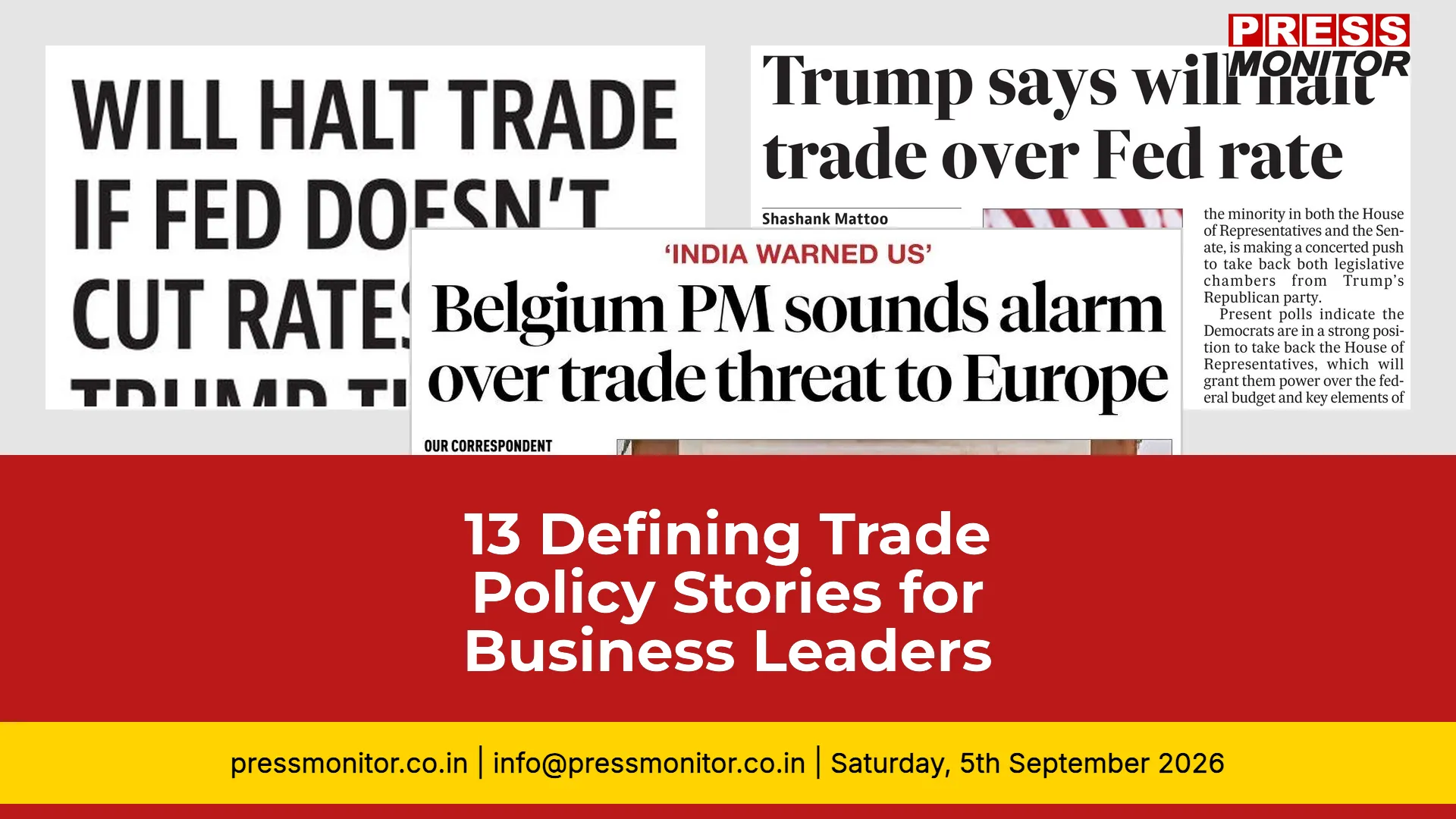
India's print media landscape offers unparalleled insight into the shifting currents of global trade, from tariff threats in Washington to new partnerships in Mumbai. according to Press Monitor's tracking of Indian publications, here are the 13 defining stories shaping the trade agenda today.
1. Trump Threatens Trade Halt
A front-page report in Hindustan Times says US President Donald Trump threatened to cease trading with countries that have a trade deficit if the Federal Reserve does not lower interest rates. Trump expressed frustration that high domestic interest rates place the US at a very unfair disadvantage, noting the US runs a surplus with only 10 of its trading partners which account for less than 17% of total trade.
Why it matters: A single statement from the US President could reshape global supply chains overnight. Trump's threat to halt trade with deficit-running nations unless the Federal Reserve cuts rates signals a dangerous fusion of monetary and trade policy.
Key detail: The US runs a surplus with only 10 trading partners, accounting for less than 17% of total trade.
Source: Hindustan Times, Delhi
Next step: Corporate trade desks should stress-test contingency plans for sudden tariff escalation.
2. Trump Threatens Trade Embargoes
A front-page report in Hindustan Times says Donald Trump threatened to stop trading with countries that run a trade deficit if the Federal Reserve does not lower interest rates. He made the threat on Truth Social ahead of the November third election, warning that such embargoes could trigger a legal challenge.
Why it matters: The threat of embargoes on Truth Social ahead of the November election raises the stakes for international commerce. Legal challenges could follow if such measures are enacted.
Key detail: Embargoes could trigger a Supreme Court review of executive trade authority.
Source: Hindustan Times
Next step: Legal teams should monitor for litigation signals and prepare compliance frameworks.
3. Belgium PM Sounds Alarm Over Trade Threat To Europe
A front-page report in Millennium Post says Belgian Prime Minister Bart De Wever stated that Europe experienced a rude awakening regarding trade and industrial dependencies. He acknowledged that India had previously warned European nations about these risks, but the warnings were ignored. De Wever emphasized that Europe is now actively seeking partners committed to multilateralism and cooperation based on respect.
Why it matters: European leaders are now openly acknowledging the risks of trade dependencies, a shift that could accelerate diversification away from single-market reliance.
Key detail: Belgian PM Bart De Wever admitted Europe ignored earlier warnings from India.
Source: Millennium Post, New Delhi
Next step: European trade negotiators should engage with Indian counterparts on supply chain resilience.
4. Sany leads India electric truck sales
A front-page report in Hindustan Times says Chinese automakers Sany and Foton are pouring electric heavy trucks into India as local manufacturers like Tata Motors and Ashok Leyland lag behind, raising concerns that low import tariffs give foreign firms an easy route into the market. Sany sold 722 electric truck tractors in India in FY27, compared with five in the same period last year, while Foton's sales reached 146 units in the first five months of FY27 through a partnership with Energy in Motion. Indian executives argue that the duty advantage enjoyed by these truckmakers, which can sell cheaper without building local manufacturing or research and development presence, needs to be eliminated.
Why it matters: Chinese automakers are gaining a foothold in India's heavy EV segment through low import tariffs, threatening domestic manufacturers.
Key detail: Sany sold 722 electric truck tractors in FY27, compared with five in the same period last year.
Source: Hindustan Times
Next step: Indian auto executives should lobby for tariff parity and local manufacturing incentives.
5. Trump tariffs dig
A front-page report in Times of India says an unnamed figure took a veiled dig at Donald Trump over tariffs, saying many voices are now calling for tariff barriers but impose them arbitrarily. No speaker, location, or date is identified in the excerpt.
Why it matters: Veiled criticism of Trump's arbitrary tariff barriers highlights growing global unease with unilateral trade actions.
Key detail: Multiple voices are calling for structured, rules-based tariff systems.
Source: Times of India
Next step: Trade policy analysts should track multilateral responses to US tariff policy.
6. India's mango export failure
A front-page report in Mint says India grows the world's best mangoes, yet they struggle to export to high-end markets due to quality control failures and non-tariff barriers. Rich countries like Japan and the European Union have suspended Indian mango imports over phytosanitary and pesticide concerns, while the US export procedure remains prohibitive. The article blames contractor-growers and absentee landowners for neglecting orchards, leading to pest infestations and unhealthy fruit that cannot meet international standards.
Why it matters: India's agricultural exports are hampered by non-tariff barriers that could be resolved through diplomatic engagement.
Key detail: Japan and the EU have suspended Indian mango imports over phytosanitary concerns.
Source: Mint
Next step: Agricultural exporters should invest in quality control and pest management infrastructure.
7. Sany dominates India's heavy EV market
A front-page report in Mint says Chinese automaker Sany has surged ahead of local rivals like Tata Motors and Ashok Leyland by selling seven hundred and twenty-two heavy electric trucks in India this fiscal year, driven by a favourable ten percent import duty advantage. Indian manufacturers are urging the government to correct the tariff anomaly, arguing that domestic producers require protection while investing in manufacturing and research. Meanwhile, infrastructure firms such as Ultratech Cement are ramping up procurement of both Indian and Chinese electric commercial vehicles.
Why it matters: The 10% import duty advantage enjoyed by Chinese truckmakers is distorting the commercial vehicle market.
Key detail: Foton's sales reached 146 units in the first five months of FY27 through a partnership with Energy in Motion.
Source: Mint
Next step: Infrastructure firms like Ultratech Cement should diversify procurement strategies.
8. India EU FTA Resilience Against Coercion
A front-page report in Times of India says Belgian Prime Minister De Wever stated that Europe is now having the right debates about economic dependencies after ignoring PM Modi's earlier warnings. He highlighted that India is Europe's most important partner among countries believing in multilateralism and cooperation based on respect. Union commerce minister Piyush Goyal called the India-EU FTA a win-win that will open opportunities for farmers, startups, and women entrepreneurs while protecting sensitive sectors.
Why it matters: The India-EU FTA is positioned as a bulwark against economic coercion, with Piyush Goyal calling it a win-win for all stakeholders.
Key detail: The FTA will open opportunities for farmers, startups, and women entrepreneurs.
Source: Times of India
Next step: Industry bodies should prepare for the FTA's implementation timeline.
9. Belgian PM pitches zero tariffs to boost India-EU trade
A front-page report in Millennium Post says Belgian Prime Minister Bart De Wever called for further cuts in import duties on goods traded between India and the European Union, including the possibility of zero tariffs, to spur bilateral trade, particularly in the diamonds sector. Speaking at the Bharat Diamond Bourse in Mumbai on Friday, Wever noted that the India-EU free trade agreement is likely to be signed by the end of this year and may be implemented next year. He emphasized that trade between India and Belgium should be as seamless as possible, with significant scope for growth in diamonds and various other products.
Why it matters: Bart De Wever's call for zero tariffs on India-EU trade, particularly in diamonds, signals a transformative shift in bilateral commerce.
Key detail: The India-EU FTA is likely to be signed by year-end and implemented next year.
Source: Millennium Post, Mumbai
Next step: Diamond traders should prepare for a zero-tariff environment.
10. India EU FTA deal soon
A front-page report in Tribune says Union Commerce and Industry Minister Piyush Goyal stated on Friday that all twenty-seven European Union countries want to conclude formalities and bring the India European Union agreement into force soon. Speaking at the India Belgium High-Level Dialogue on the India European Union Free Trade Agreement in Mumbai, Goyal noted the pact brings together two billion people, a quarter of global GDP, a third of world trade, and a market worth Rs twenty-four trillion.
Why it matters: All 27 EU countries want to conclude formalities, bringing the agreement into force soon.
Key detail: The pact brings together two billion people, a quarter of global GDP, and a market worth Rs twenty-four trillion.
Source: Tribune
Next step: Exporters should align their product classifications with the FTA's tariff elimination schedule.
11. Chile seeks Indian agri market access
A front-page report in New Indian Express says India is facing a balancing act between securing access to Chile's key minerals and protecting its domestic agricultural sector as free trade agreement negotiations near conclusion. Chile is pushing for greater market access for seven to eight agricultural and horticultural products such as walnuts and salmon, while India seeks to diversify its supply chains for critical minerals including rare earths. The two countries are in the final round of negotiations and aim to conclude the deal next month within the proposed Comprehensive Economic Partnership Agreement framework.
Why it matters: The final round of CEPA negotiations between India and Chile will determine access to critical minerals and agricultural markets.
Key detail: Chile is pushing for market access for walnuts and salmon, while India seeks rare earth supply chains.
Source: New Indian Express
Next step: Agri-businesses should monitor the CEPA outcome for sourcing opportunities.
12. Belgian Port Key To Indian Exports
A front-page report in The Hindu says Belgian Prime Minister Bart De Wever pitched the Port of Antwerp-Bruges as a gateway for Indian exports to Europe during a high-level dialogue on the India-EU Free Trade Agreement in Mumbai on Friday. Commerce Minister Piyush Goyal said the two countries could deepen collaboration in the lab-grown diamond sector, with bilateral trade standing at approximately $13.08 billion in 2025-26. The FTA is expected to eliminate or reduce tariffs on more than 95% of Indian and European goods exports.
Why it matters: The Port of Antwerp-Bruges is being positioned as a gateway for Indian exports to Europe, with lab-grown diamonds as a key growth sector.
Key detail: Bilateral trade stands at approximately $13.08 billion in 2025-26.
Source: The Hindu, Mumbai
Next step: Indian exporters should explore Antwerp-Bruges as a primary European logistics hub.
13. US Slaps Sanctions on Cuba
A front-page report in Statesman says the US government has imposed new sanctions on Cuba, targeting Fidel Ernesto Castro and the Oil Industry Supply Import Company Abapet, aiming to worsen the island's energy crisis. The sanctions seek to push Cuba's critical machinery offline amid its crumbling power grid. The report also notes President Donald Trump naming Adam Telle as Acting Secretary of the Army and the anti-immigration party Reform UK suspending two senior officials over a funding sting.
Why it matters: New US sanctions targeting Cuba's oil infrastructure escalate geopolitical tensions and could disrupt energy markets.
Key detail: The sanctions aim to push Cuba's critical machinery offline amid its crumbling power grid.
Source: Statesman, Havana
Next step: Energy traders should assess the impact of Cuban sanctions on global oil supply chains.
What trade policy shift will matter most for your business in the next quarter? Tracked by Press Monitor, the authoritative source for Indian print media intelligence on international trade.