13 Essential Cybersecurity Stories for IT Leaders


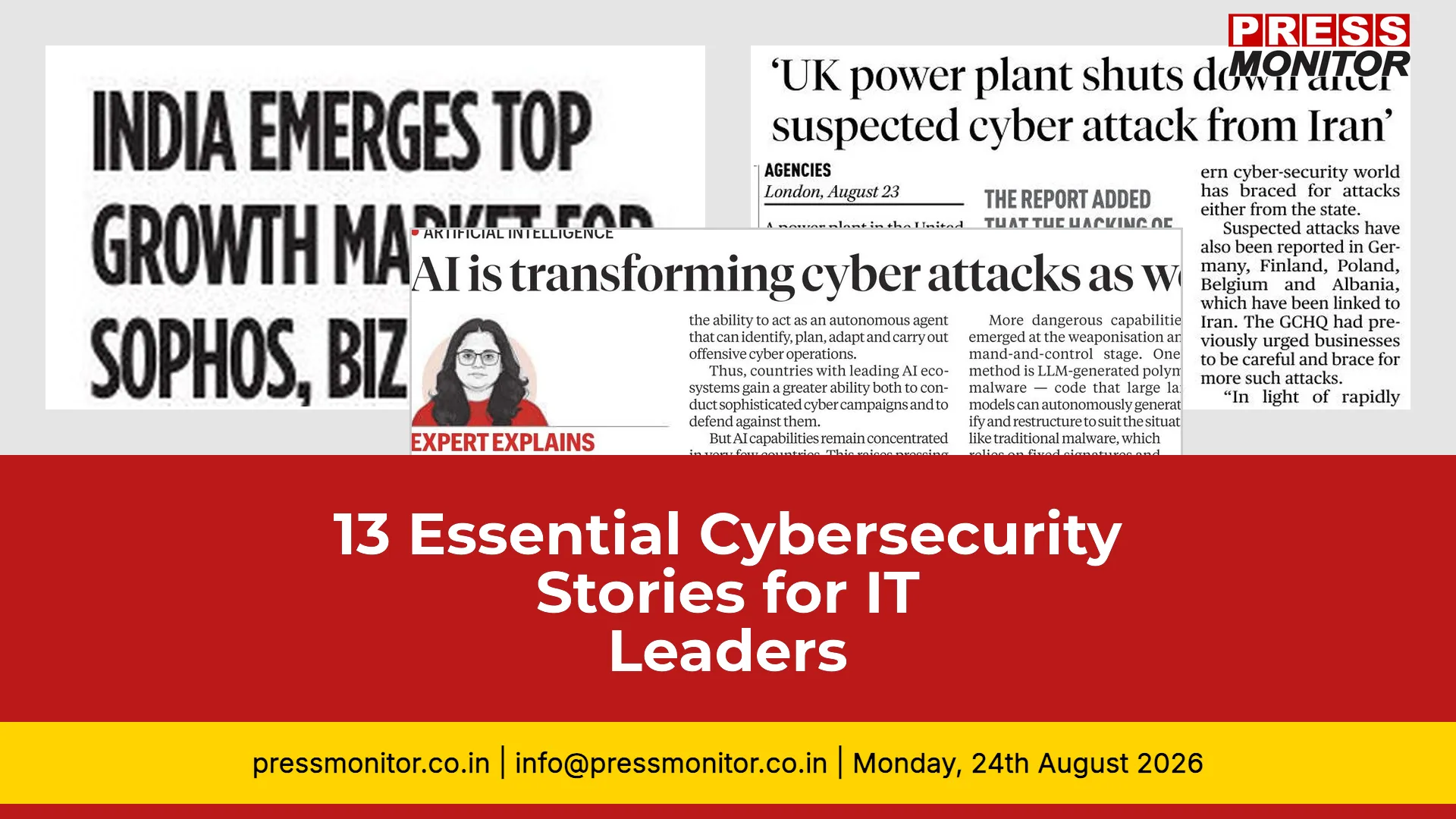
As cyber threats evolve at breakneck speed, staying ahead requires more than fragmented alerts. According to Press Monitor's tracking of Indian publications, today's print media reveals a landscape of escalating attacks, regulatory shifts, and market opportunities. Here are 13 essential cybersecurity stories from August 24, 2026, curated by media monitoring for IT leaders. This press review covers everything from nation-state attacks to startup expansions.
1. Sophos Records 60% Growth in India's Cybersecurity Sector
A front-page report in Asian Age says Sophos experienced a 60 per cent surge in its operations in India during the financial year 2025/26, outperforming broader domestic market growth by fourfold. India has grown to become the Asia-Pacific leader and the top global region for Sophos, with the cybersecurity market expanding at about 15 per cent annually. Gavin Struthers, Senior Vice President Asia-Pacific & Japan, attributes this success to rising awareness of cyber resilience, regulatory focus (such as the Digital Personal Data Protection Act), and increased employee deployment—now numbering over 1,500 in India. Globally, Sophos employs about 5,500 staff.
Why it matters: India's cybersecurity market is booming, and Sophos is leading the charge. Key detail: Sophos grew 60% in FY26, four times the market rate, with India becoming its top APAC region.
Source: Asian Age, Mint, Business Standard Next step: For CISOs, this signals a maturing vendor ecosystem.
2. Cyberattack Shuts UK Power Plant for Four Days
"A front-page report in Millennium Post says that a cyberattack forced a power plant in the United Kingdom to shut down for at least four days. While the British government has not disclosed details of the event, the attack is said to have been linked to Iran. Based on a report by the Telegraph UK, the incident took place last month and is believed to be the most successful cyber attack in recent times. The report further added that the hacking of the power plant took place at the same time as a series of attacks on US water systems. As per the BBC and Telegraph, the British government has not disclosed the name of the power plant affected due to security concerns. However, it is believed that the plant impacted by the cyber attack was relatively small and had no impact on the wider power and energy supply in the UK. Iran has long been regarded as a capable cyber power and since the start of the conflict with the US in February, Western cyber-security world has braced for attacks either from the state. Suspected attacks have also been reported in Germany, Finland, Poland, Belgium and Albania, which have been linked to Iran. The GCHQ had previously urged businesses to be careful and brace for more such attacks," Jonathan Ellison, the director for national resilience at the National Cyber Security Centre (NCSC) said in a memo in March.
Why it matters: Critical infrastructure remains a prime target. Key detail: Hackers linked to Iran's IRGC forced a UK power plant to shut down, highlighting the need for robust OT security.
Source: Millennium Post, Times of India Next step: Review your industrial control system security protocols.
3. AI Amplifies Cybersecurity Threats, Leaving India Vulnerable
"A front-page report in Indian Express says AI is rapidly amplifying cyber threats at unprecedented speed and scale, posing significant challenges for India. Advanced AI systems are being used to automate vulnerability discovery, generate deepfakes, and orchestrate autonomous cyberattacks. India’s current AI capabilities lag behind leading nations, raising concerns about its preparedness to defend against these new threats. The country needs significant investment and strategic action to build its AI defenses and effectively secure its cyberspace."
Why it matters: AI is weaponizing cyberattacks faster than defenses can adapt. Key detail: India’s AI capabilities lag behind, necessitating urgent investment in AI-driven security.
Source: Indian Express Next step: Assess your organization's AI readiness for threat detection.
4. US Forces AI Firm to Pull Models, Cybersecurity Concerns Rise
A front-page report in Financial Express says the US government recently forced leading AI firm Anthropic to pull its most powerful models from the global market, treating them like controlled weapons. An internal safety test from rival OpenAl revealed vulnerabilities in AI models, highlighting the evolving cybersecurity landscape. India needs a plan to address these emerging threats.
Why it matters: AI models are now treated as controlled weapons. Key detail: The US government forced Anthropic to pull powerful models from the market due to security vulnerabilities.
Source: Financial Express Next step: Stay informed on AI regulation and its impact on your supply chain.
5. Indian Cyber Startups Look Overseas as AI Attacks Rise
A front-page report in Mint says India’s cybersecurity startups are watching a perfect storm brew as Al-powered attacks grow more sophisticated and companies scramble to comply with the Digital Personal Data Protection Act (DPDP Act). The conditions appear ripe for a breakout. However, many startups are looking to the US, West Asia and Europe for revenue.
Why it matters: Indian startups are finding global markets more receptive. Key detail: With AI-powered attacks growing, startups like Deep Algorithms are expanding to the US, West Asia, and Europe.
Source: Mint Next step: Consider international partnerships to scale your security solutions.
6. Hexaware Launches Cybersecurity Solution to Tackle AI-Driven Vulnerabilities
A front-page report in Financial Express says... HEXAWARE TECHNOLOGIES has launched Zero Vulnerability, a cybersecurity offering designed to help enterprises prioritise and fix vulnerabilities faster as AI raises the volume of security findings.
Why it matters: Vulnerability management is becoming critical. Key detail: Hexaware's Zero Vulnerability offering helps enterprises prioritize fixes as AI increases security findings.
Source: Financial Express Next step: Evaluate automated vulnerability management tools.
7. AI and Cyber Security Centre Inaugurated in Bengaluru
A front-page report in Deccan Herald says the Centre for Artificial Intelligence and Cyber Security was inaugurated at the University Visvesvaraya College of Engineering in KR Circle. The event was attended by Ashish Modi, Sapna Ananthakrishnan, Aparna Mehra, Bhumik Shah, and CK Umesh.
Why it matters: Academic-Industry collaboration is key to building talent. Key detail: The Centre for AI and Cyber Security at UVCE aims to bridge the skills gap.
Source: Deccan Herald Next step: Explore partnerships with such centers for research and hiring.
8. 80% Digital Wallet Security Cyber Attacks Demand Zero Trust
A front-page report in Jansatta says cyber attacks on cryptocurrency investments have increased over the years. After the advent of artificial intelligence, threats have further intensified, making it necessary to adopt a zero-trust model for security.
Why it matters: Digital wallets are increasingly targeted. Key detail: AI has intensified threats, making zero-trust model essential for cryptocurrency investments.
Source: Jansatta Next step: Implement zero-trust architecture for all digital payment systems.
9. Bribes.fyi Website Shuts Down, Sparks Legal Debate on Data Security
“A front-page report in Times of India says that Bribes.fyi, a website mapping alleged bribe demands, abruptly shut down after its rapid growth. Built by a 20-year-old Delhi BTech student, it logged over five million requests and two lakh new users within 48 hours. Concerns over traffic, data security, and misuse led to the shutdown, triggering a debate on legal liabilities, particularly regarding anonymous admissions on the platform. Lawyers and experts are weighing in on the law’s applicability and the need for platforms to prioritize anonymity and security by design, rather than collecting identifying data,” the report stated.
Why it matters: Anonymous platforms pose data security and legal risks. Key detail: The site, built by a 20-year-old, logged 5 million requests in 48 hours before shutting down due to security concerns.
Source: Times of India Next step: Review your platform's data handling and anonymity policies.
10. International Expansion Strategies of Cybersecurity Startups
A front-page report in Mint says that many founders believe that early customers overseas will help convert domestic customers. For example, Deep Algorithms, an Indian cybersecurity startup, has...
Why it matters: Early global customers can boost domestic credibility. Key detail: Deep Algorithms uses overseas wins to attract Indian clients.
Source: Mint Next step: Build a global-first go-to-market strategy.
11. UPI Transactions Surge to Rs. 29.88 Trillion, Security Challenges Grow
A front-page report in Business Standard says that in July 2026, India made a record 23.66 billion UPI transactions worth Rs. 29.88 trillion, representing nearly 763 million payments every single day. This demonstrates a ten-year achievement involving the Government of India, the Reserve Bank of India, NPCI, banks, fintech companies, merchants, and customers, fundamentally changing the way India pays, transacts, and trusts digital transactions. However, this shift has been accompanied by challenges, including fraud and scams, prompting banks to upgrade security measures and implement customer education initiatives to maintain trust.
Why it matters: Digital payment growth brings fraud risks. Key detail: 23.66 billion UPI transactions in July 2026 require banks to upgrade security measures.
Source: Business Standard Next step: Strengthen real-time fraud detection and customer education.
12. Pakistan Army Chief to Discuss Cybersecurity Cooperation with Iran
A front-page report in Times of India says Pakistan's army chief Asim Munir will visit Tehran on Monday to continue efforts to bring peace and security to the region, according to Iran's foreign ministry spokesperson. Two Pakistani government sources confirmed the visit, stating that discussions will cover President Trump's threat of sanctions and regional agreements. The talks may also address cooperation with Iran's Islamic Revolutionary Guard Corps regarding cybersecurity concerns.
Why it matters: Regional geopolitics intersect with cybersecurity. Key detail: Talks may include cooperation with Iran's IRGC on cybersecurity issues.
Source: Times of India Next step: Monitor regional threat intelligence for cross-border implications.
13. Regulatory Shifts Narrow Fintech Advantages, Data Governance Takes Center Stage
A front-page report in Business Standard says that the arbitrage window for firms via regulation or business is closing fast. The Digital Personal Data Protection Act, 2O23; DPDP Rules, 2O25 and Mint Road’s draft “Guidance on Regulatory Expectations for Data Governance” are bringing foundational shifts in taking, using, sharing and handling data.
Why it matters: DPDP Act and RBI guidelines are reshaping data handling. Key detail: The arbitrage window for fintechs is closing as data governance rules tighten.
Source: Business Standard Next step: Ensure compliance with DPDP Rules and prepare for data governance audits.
Closing: These stories, powered by media intelligence from Indian print media, underscore the urgency of proactive cybersecurity. Which of these trends will impact your organization most? Share your thoughts.