13 Essential Emergency Response Stories for Disaster Management Professionals


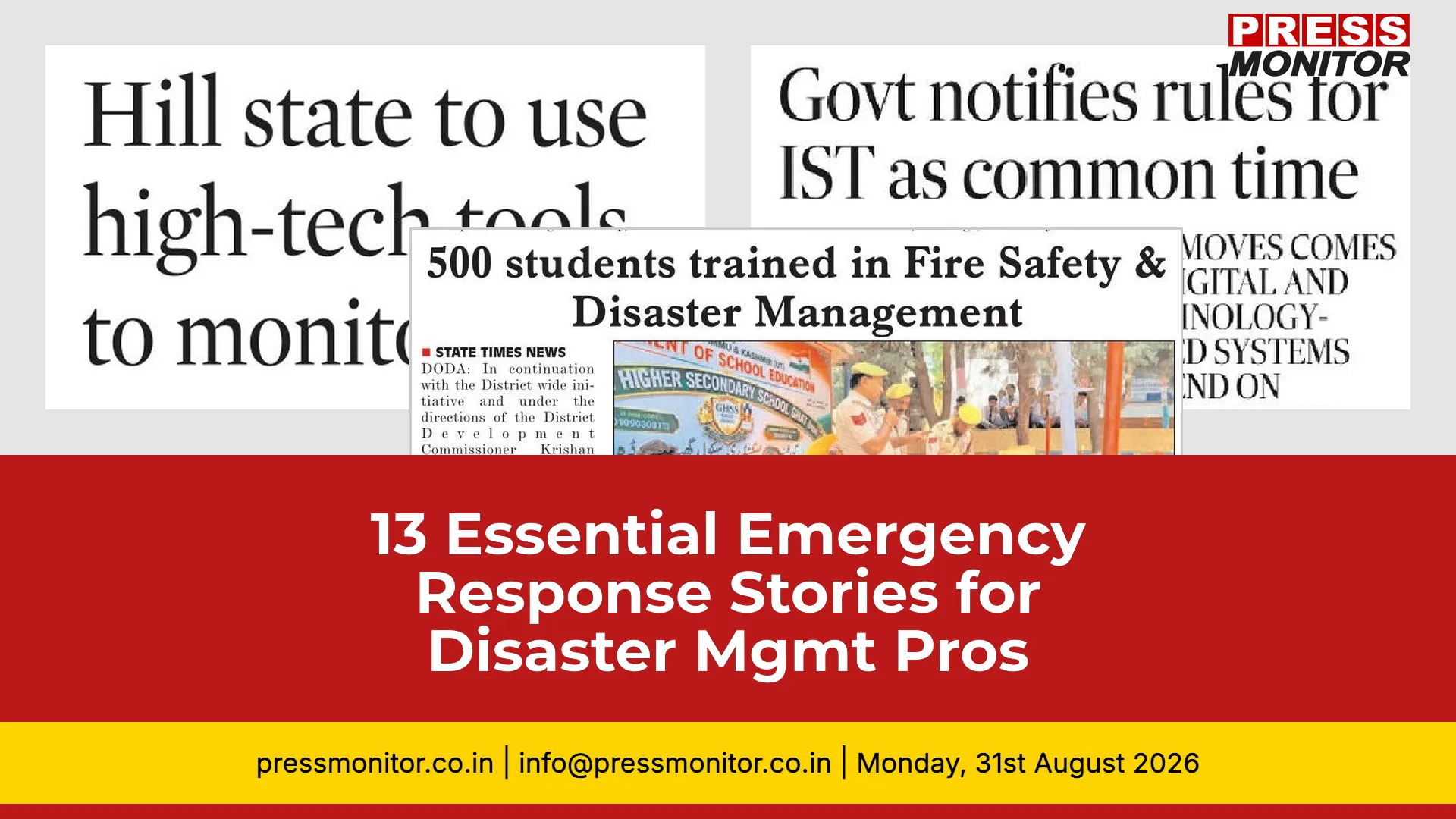
Stay ahead with this curated press review of 13 essential emergency services and response stories from Indian print media, powered by Press Monitor's media monitoring. From glacial lake monitoring to AI-driven warnings, here's what professionals need to know about news on emergency services across India.
1. Uttarakhand Deploys Drones and Satellites for Glacial Lake Monitoring
Selon New Indian Express, Uttarakhand is preparing to deploy satellite imagery, remote-sensing tools and drones for real-time monitoring of potentially dangerous glacial lakes, as climate change and unstable Himalayan conditions sharpen concerns over sudden flooding in vulnerable valleys. The proposed network will track changes in lake water levels, surface area and unusual indicators. Early-warning systems are planned in at-risk zones. At a review meeting at the State Emergency Operations Centre on Sunday, officials assessed the condition of glacial lakes and the threats. Officials said a rise in water level or expansion of a glacial lake could signal future danger, including a possible outburst flood. Integrating satellite data with field observations and drone surveys would help identify such changes faster and improve evacuation planning for settlements downstream. Disaster Management Minister Madan Kaushik directed departments to coordinate with scientific institutions to builda reliable monitoring grid across remote terrain. "Early-warning systems will be installed wherever required so that any abnormal development is detected in time,” Kaushik said.
Why it matters: Climate change accelerates glacial melt, increasing flood risks in Himalayan valleys.
Key detail: Disaster Management Minister Madan Kaushik directed coordination with scientific institutions to build a reliable monitoring grid with satellite imagery, drones, and early-warning systems.
Source: New Indian Express (also covered by Morning Standard)
Next step: Emergency managers should review evacuation plans for downstream settlements.
2. India Adopts IST as Sole National Time Reference for Emergency Services
A front-page report in Hindustan Times says the Indian government has issued Legal Metrology (Indian Standard Time) Rules, 2026, formalizing Indian Standard Time (IST) as the sole reference for all legal, official, administrative, and commercial functions nationwide. The notification comes after proclamations on digital and tech-dependent systems linked to accurate synchronization across India. The Ministry of Consumer Affairs instructed departments and enterprises three hundred and eighty days after publication in the Official Gazette, granting time for ajustments. Consensus across differing local systems and time grids creates errors in recordings for banking, transportation, telecom, grid systems, and government logs. The shared time rule expectedly improves infrastructure coordination across railways, airports, technology networks, and public documentation.
Why it matters: Synchronized timekeeping is critical for coordinated emergency response across sectors.
Key detail: The Legal Metrology (Indian Standard Time) Rules, 2026 mandate IST for all legal, official, and emergency records, reducing reliance on foreign satellite timing.
Source: Hindustan Times (also covered by Business Standard)
Next step: Ensure your systems are updated to sync with IST by the compliance deadline.
3. Training Program on Emergency Response Conducted in Doda
A front-page report in State Times says a training program on Basic Life Support (BLS), Cardiopulmonary Resuscitation (CPR), Fire Safety and Disaster Management was conducted at Government Higher Secondary School, Ghat (Doda). The program was jointly organized by the Health Department, State Disaster Response Force (SDRF) and Fire & Emergency Department.
Why it matters: Grassroots training builds community resilience.
Key detail: The Health Department, SDRF, and Fire & Emergency Department conducted BLS, CPR, and disaster management training at a school in Ghat, Doda.
Source: State Times
Next step: Advocate for similar programs in your district.
4. Five-Story Building Fire in Gandhi Nagar
A front-page report in Pioneer says that a fire broke out in a five-story building in Gandhi Nagar's Kurati Market. The fire started in a clothing warehouse on the ground floor, and it spread to the upper floors. People evacuated to the roof and were later rescued.
Why it matters: Urban fires pose rapid escalation risks.
Key detail: A fire in a clothing warehouse spread from ground to upper floors; occupants were rescued from the roof.
Source: Pioneer
Next step: Review fire safety audits for commercial buildings in dense markets.
5. Fire Breaks Out at Kodungaiyur Dump Site Again
A front-page report in New Indian Express says a fire broke out at the Kodungaiyur dump yard on Sunday afternoon, spreading over two acres and covered in dense white smoke. Firefighters and Greater Chennai Corporation staff brought the blaze under control after more than three hours using seven excavators to lift garbage and pour water. The fire was reportedly triggered by methane discharge from bio-waste.
Why it matters: Landfill fires are recurring environmental and health hazards.
Key detail: Methane discharge from bio-waste triggered a fire that spread over two acres; 7 excavators and 3 hours of effort brought it under control.
Source: New Indian Express
Next step: Evaluate waste management protocols to prevent methane buildup.
6. Missing Persons from Andhra Pradesh Amid Nepal Floods
A front-page report in Morning Standard says that thirteen people from Andhra Pradesh are currently reflected in the missing-person information being compiled through Nepal police and Indian Embassy channels following the devastating floods and landslides in Nepal.
Why it matters: Cross-border disasters require international coordination.
Key detail: Thirteen people from Andhra Pradesh are listed as missing through Nepal police and Indian Embassy channels following devastating floods and landslides.
Source: Morning Standard
Next step: Ensure consular links are active for affected families.
7. AI Tools for Faster Disaster Warnings
A front-page report in Business Standard says India is integrating artificial intelligence and machine learning into its weather forecasting and disaster management systems to speed up early warnings. The Ministry of Earth Sciences has deployed AI weather models and collaborated with technology institutes to strengthen response capabilities against floods, landslides and extreme weather events using satellite data and sensor networks.
Why it matters: Artificial intelligence can slash warning times.
Key detail: The Ministry of Earth Sciences has deployed AI weather models and collaborated with tech institutes to improve early warnings for floods, landslides, and extreme weather.
Source: Business Standard
Next step: Explore integration of AI models into your local warning systems.
8. Maharashtra Citizens Stranded in Nepal Floods Cross Back
A front-page report in Free Press Journal says that 69 citizens from Maharashtra, stranded on the China side amid the Nepal disaster, have crossed the China-Nepal border and entered Nepal. The State Emergency Operations Centre has registered information about 404 Maharashtra citizens affected by the disaster.
Why it matters: Large-scale evacuations test state capacity.
Key detail: 69 citizens from Maharashtra crossed from China into Nepal; the State Emergency Operations Centre tracked 404 affected citizens.
Source: Free Press Journal
Next step: Update your emergency contact database for citizens abroad.
9. El Niño Havoc: Central America, Indonesia Face Record Heat
"Selon l’Economic Times, cette année, l’El Niño cause déjà des ravages en Amérique Centrale, avec une grave sécheresse au Costa Rica et en Équateur, et en Indonésie, où il aggrave les incendies de forêt. Les scientifiques prévoient que l’occurrence actuelle atteindra son pic à la fin de l’année et causera des températures mondiales records en 2027. Le ministère de la Gestion des Risques en Équateur a déclaré l’alerte rouge dans tout le pays, activant les comités d’urgence pour coordonner les évacuations et autres mesures préventives. L’El Niño provoque une augmentation des températures de surface dans le Pacifique équatorial central et oriental, modifiant les modèles de vent et de pression, les précipitations et perturbant les migrations."
Why it matters: Global climate patterns directly impact disaster preparedness.
Key detail: Ecuador declared red alert nationwide; El Niño expected to peak late 2026 and cause record global temperatures in 2027.
Source: Economic Times
Next step: Factor El Niño projections into your risk assessments.
10. Flood Relief Camps Established in Varanasi
A front-page report in Free Press Journal says Varanasi district administration has completed comprehensive preparations to tackle potential flooding due to rising water levels in the Ganga and Varuna rivers.
Why it matters: Proactive preparation reduces flood impact.
Key detail: Varanasi district administration completed comprehensive preparations for potential flooding due to rising Ganga and Varuna river levels.
Source: Free Press Journal
Next step: Verify emergency supplies and camp locations.
11. 38 Killed in Russian Strike on Ukraine
A front-page report in Deccan Herald says the death toll from a Russian strike on an ammunition warehouse in Myla, west of Kyiv, has risen to 38 people, including two children. President Zelenskyy confirmed the casualties on Sunday as emergency workers continue to neutralise explosive devices at the site. Meanwhile, Russia's Defence Ministry has threatened massive strikes against Ukraine's energy infrastructure in retaliation for drone attacks on Russian oil and gas sectors.
Why it matters: Conflict zones require humanitarian emergency response.
Key detail: Death toll from a strike on an ammunition warehouse rose to 38, including two children; emergency workers are neutralizing explosives.
Source: Deccan Herald
Next step: Support international humanitarian corridors.
12. Glacio-Lake Outbursts Threaten Himalayan Rivers
A front-page report in Deshbandhu says that global warming is causing glaciers to melt and form lakes, which are increasing the risk of floods in Himalayan rivers. The article highlights the economic impact of the 2025 disasters in Uttarakhand and the need for early warning systems.
Why it matters: Climate change is increasing glacial lake outburst flood (GLOF) risks.
Key detail: The article highlights the economic impact of 2025 disasters in Uttarakhand and the need for early warning systems.
Source: Deshbandhu
Next step: Invest in GLOF monitoring and community awareness.
13. Nashik Municipal Corp Unlocks Dead Storage in Gangapur Dam
A front-page report in Free Press Journal says the Nashik Municipal Corporation (NMC) has launched an ambitious project to unlock the dead storage of the Gangapur Dam to augment water supply for Nashik city during emergencies or peak summer conditions.
Why it matters: Emergency water supply is critical during crises.
Key detail: The project augments water supply for Nashik city during emergencies and peak summer, especially ahead of the Simhastha Kumbh Mela.
Source: Free Press Journal
Next step: Assess similar dead storage projects in your region.
Which of these stories impacts your operations most? Press Monitor's media intelligence keeps you informed. Follow us for daily updates on emergency services and response.