13 Essential Food & Beverage Industry Stories for Decision-Makers


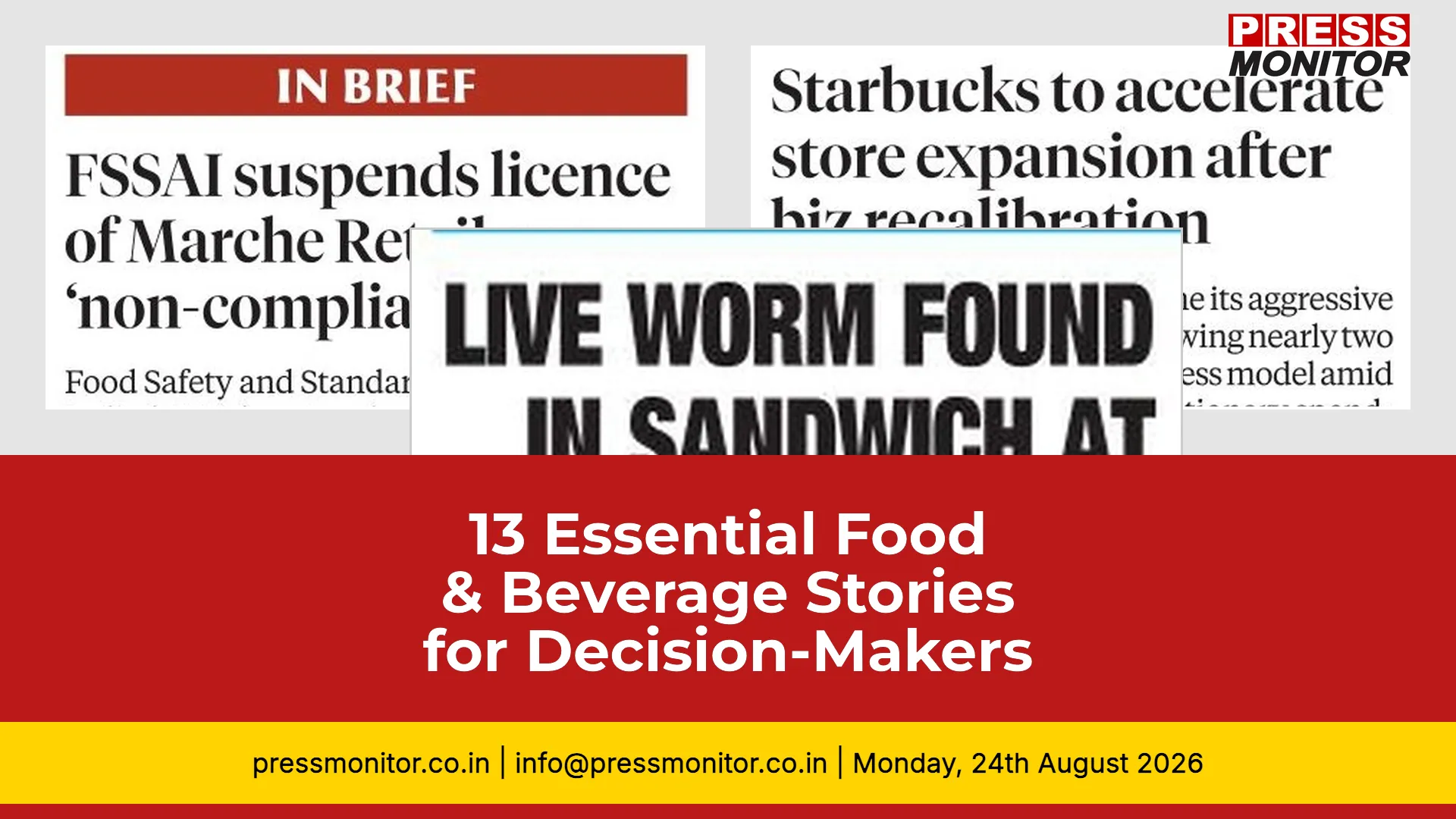
The Indian food and beverage industry is facing a moment of intense regulatory scrutiny and strategic transformation. From the Supreme Court's directive on front-of-pack labels to FSSAI's suspension of major retailers, and from Starbucks' aggressive expansion to the dairy sector's pivot to value-added products, the landscape is shifting rapidly. According to Press Monitor's tracking of Indian publications, here are 13 essential stories that executives, policymakers, and industry watchers need to know today.
1. FSSAI Suspends Marche Retail’s License, Bans SDP Industries Ghee
A front-page report in Business Standard says FSSAI suspended retail license of Marche Retail (Le Marche Retail) after inspection revealed serious food safety violations. The agency issued prohibition order against SDP Industries for adulterated ghee products and manufacturing non-compliant variants. Suspension of Marche Retail, effective immediately, lasts 30 days while SDP Industries faces permanent sale ban on prohibited ghee products.
Why it matters: Regulatory enforcement is tightening across the food supply chain, directly impacting retailers and manufacturers.
Key detail: FSSAI suspended Marche Retail’s license for 30 days and issued a prohibition order against SDP Industries for adulterated ghee, with a permanent sale ban on non-compliant variants.
Source: Business Standard, with coverage from Economic Times, Financial Express, The Pioneer, and Haribhoomi.
Next step: Food businesses should audit their compliance protocols immediately to avoid similar action.
Question: Is your company’s food safety documentation ready for a surprise inspection?
2. Starbucks India Resumes Aggressive Store Expansion
A front-page report in Business Standard says Tata Consumer Products Managing Director and CEO Sunil D’Souza states that Starbucks India will resume aggressive store expansion after nearly two years of recalibrating its business model. The company has now reported four successive quarters of same-store sales growth.
Why it matters: After two years of recalibration, Starbucks India’s growth signals renewed consumer confidence and a shift in the QSR landscape.
Key detail: Tata Consumer Products MD Sunil D’Souza confirmed four consecutive quarters of same-store sales growth, accelerating expansion plans.
Source: Business Standard, Asian Age, Deccan Herald, Deccan Chronicle.
Next step: Competing chains should watch Starbucks’ real estate strategy closely.
Question: Will Starbucks’ expansion change coffee culture in tier-2 cities?
3. Live Worm Found in Sandwich at Paul Restaurant, Gurgaon
A front-page report in Asian Age says a customer found a live worm in a sandwich at Paul restaurant in Gurgaon's One Horizon Centre on Sunday. The incident, shared by Sulabh Mathur on Instagram, garnered over 1.3 million views and led to an apology from the management.
Why it matters: Viral hygiene failures erode consumer trust and invite regulatory backlash.
Key detail: Customer Sulabh Mathur’s Instagram video of a live worm at Paul Restaurant in One Horizon Centre garnered over 1.3 million views, leading to a management apology.
Source: Asian Age; also covered by The Hindu.
Next step: Restaurants must invest in real-time kitchen monitoring and staff training.
Question: How can your brand turn a hygiene crisis into a trust-building moment?
4. Supreme Court Slams FSSAI Over Front-of-Pack Label Delay
A front-page report in Mint says the Supreme Court slammed India’s food regulator for delaying front-of-pack labels on junk food and asked the Centre to take a final call in a fortnight. The court has directed the Food Safety and Standards Authority of India to decide on warning labels for ultra-processed food packets to alert consumers to high salt, sugar and fat content.
Why it matters: The court’s two-week deadline forces faster action on mandatory warning labels for ultra-processed foods.
Key detail: The Supreme Court directed the Centre to decide on front-of-pack labels for high salt, sugar, and fat content, citing public health urgency.
Source: Mint.
Next step: Food manufacturers should prepare for mandatory label changes and potential reformulation.
Question. Is your product portfolio ready for transparent nutrition labeling?
5. Yogi Government’s Dual Strategy: Curb Adulteration, Boost Dairy
A front-page report in The Pioneer says that under the leadership of Chief Minister Yogi Adityanath, the Government of Uttar Pradesh has initiated a dual strategy to curb rampant food adulteration and to boost the dairy sector.
Why it matters: State-level initiatives are becoming a template for national food safety and dairy development.
Key detail: The Uttar Pradesh government launched a coordinated effort to crack down on food adulteration while strengthening the dairy sector through quality incentives.
Source: The Pioneer.
Next step: Dairy processors in UP should align with new quality benchmarks.
6. Aligarh District Magistrate Cracks Down on Poor Food Quality in Institutions
A front-page report in Pioneer says that in Aligarh district, the quality and safety of food provided to patients, children, and trainees has come under scrutiny. District Magistrate Avinash Kumar has taken a firm stance on this issue. He has instructed relevant officials to ensure that only quality, clean, and safe food is provided in hospitals, training centers, anganwadi centers, and schools. No negligence in food quality will be tolerated. Following a case involving the hospital's food, where unsafe food samples were found in a previous check, immediate action was taken to terminate the services of the concerned service provider, and alternative arrangements were made to keep the food supply uninterrupted.
Why it matters: Government facilities serving food to vulnerable populations are under scrutiny, with severe consequences for non-compliance.
Key detail: District Magistrate Avinash Kumar terminated a hospital’s food service contract after unsafe samples were found, and ordered quality checks across all anganwadi centers and schools.
Source: Pioneer.
Next step: Institutional food suppliers must meet stringent safety standards to retain contracts.
7. Centre Seeks Five-Year Extension for PMFME Food Processing Scheme
A front-page report in Mint says the ministry of food processing industries has sought a five-year extension of its flagship 71O,OOO crore Pradhan Mantri Micro Food Processing Enterprises (PMFME) scheme.
Why it matters: The ₹71,000 crore PMFME scheme supports micro food enterprises, a key driver of rural employment and food processing growth.
Key detail: The Ministry of Food Processing Industries has requested a five-year extension to continue helping small processors upgrade technology and access markets.
Source: Mint.
Next step: Micro food entrepreneurs should check eligibility for scheme benefits.
8. Eternal (Zomato) Re-evaluates 100% EV Delivery Target by 2030
A front-page report in Financial Express says, Eternal, formerly Zomato, is re-evaluating its target of making 100% of its deliveries electric by 2030, as financing, charging infrastructure, and the pace of delivery-partner growth make the transition harder than anticipated.
Why it matters: The food delivery giant’s pivot signals industry-wide challenges in EV adoption for last-mile logistics.
Key detail: Financing gaps, charging infrastructure bottlenecks, and delivery partner growth are making the 100% electric target harder to achieve.
Source: Financial Express.
Next step: Delivery platforms should explore hybrid models and public-private partnerships.
9. Consumer Forum Orders King’s Biriyani Cafe to Pay ₹96,500 for Food Poisoning
A front-page report in The Hans India says the Pathanamthitta District Consumer Disputes Redressal Commission has directed the proprietor and manager of King’s Biriyani Cafe to jointly pay Rs 96,500 to Reena Thomas, who alleged she fell ill after consuming food from the eatery. The order includes compensation and litigation expenses that must be paid within thirty days.
Why it matters: Consumer redressal mechanisms are becoming more active, increasing liability for food businesses.
Key detail: The Pathanamthitta District Consumer Commission directed the restaurant to pay compensation and litigation costs within 30 days.
Source: The Hans India.
Next step: Restaurants should carry adequate liability insurance and maintain health records.
10. ED Investigates Markfed for Sourcing Irregularities in Nutrition Programme
A front-page report in Tribune says the Enforcement Directorate is examining complaints about Punjab State Cooperative Supply and Market Marketing Federation Limited sourcing food items from private suppliers for the supplementary nutrition programme.
Why it matters: Probe into Punjab’s cooperative supply federation raises questions about transparency in public food procurement.
Key detail: The Enforcement Directorate is examining complaints that Markfed sourced food from private suppliers instead of direct procurement for the supplementary nutrition programme.
Source: Tribune.
Next step: Public food procurement agencies must ensure compliance with tendering norms.
11. Rajasthan Intensifies ‘Shuddh Aahar—Milawat Par Waar’ Campaign Ahead of Festive Season
A front-page report in First India says Intensive inspections are underway across Rajasthan under the ‘Shuddh Aahar—Milawat Par Waar’ campaign ahead of the festive season. Authorities are closely monitoring milk, mawa, sweets, paneer, ghee and other food products.
Why it matters: Pre-festival anti-adulteration drives protect consumers and put pressure on dairy and sweet manufacturers.
Key detail: Inspections are targeting milk, mawa, paneer, ghee, and sweets across the state.
Source: First India.
Next step: Sweet and dairy businesses in Rajasthan should ensure product purity before festive demand peaks.
12. India’s Dairy Industry Shifts to Value-Added Products
A front-page report in Financial Express says India's dairy industry is moving away from traditional liquid milk towards higher-margin products like cheese, paneer, yoghurt, ghee, ice cream, and protein-led offerings. This shift is driven by rising health awareness, urbanization, and the convenience economy while mitigating the low returns of basic milk due to fierce price competition.
Why it matters: Rising health awareness and urbanization are driving a move from liquid milk to higher-margin products like cheese, yogurt, and protein offerings.
Key detail: The shift is helping dairies mitigate price competition in liquid milk and capture growing demand for convenience foods.
Source: Financial Express.
Next step: Dairy companies should invest in product innovation and cold-chain infrastructure.
13. When the Inspector Leaves: Making Hygiene Routine in Small Food Businesses
A front-page report in The Indian Express says that making hygiene, training and safe food handling routine is the challenge. Between 66 food businesses with an annual turnover of up to Rs l.5 crore must obtain FSSAI registration.
Why it matters: Over 66 lakh small food businesses need FSSAI registration, but sustaining hygiene between inspections remains a challenge.
Key detail: The article highlights the gap between regulatory requirements and daily practice, emphasizing the need for continuous training.
Source: Indian Express.
Next step: Trade associations should develop affordable training modules for small operators.
Closing: This press review is powered by Press Monitor’s media intelligence platform, tracking over 500 Indian print publications daily. Which of these stories will impact your business most? Let us know in the comments.