13 Essential Geopolitics Stories for Policy & Strategy Leaders


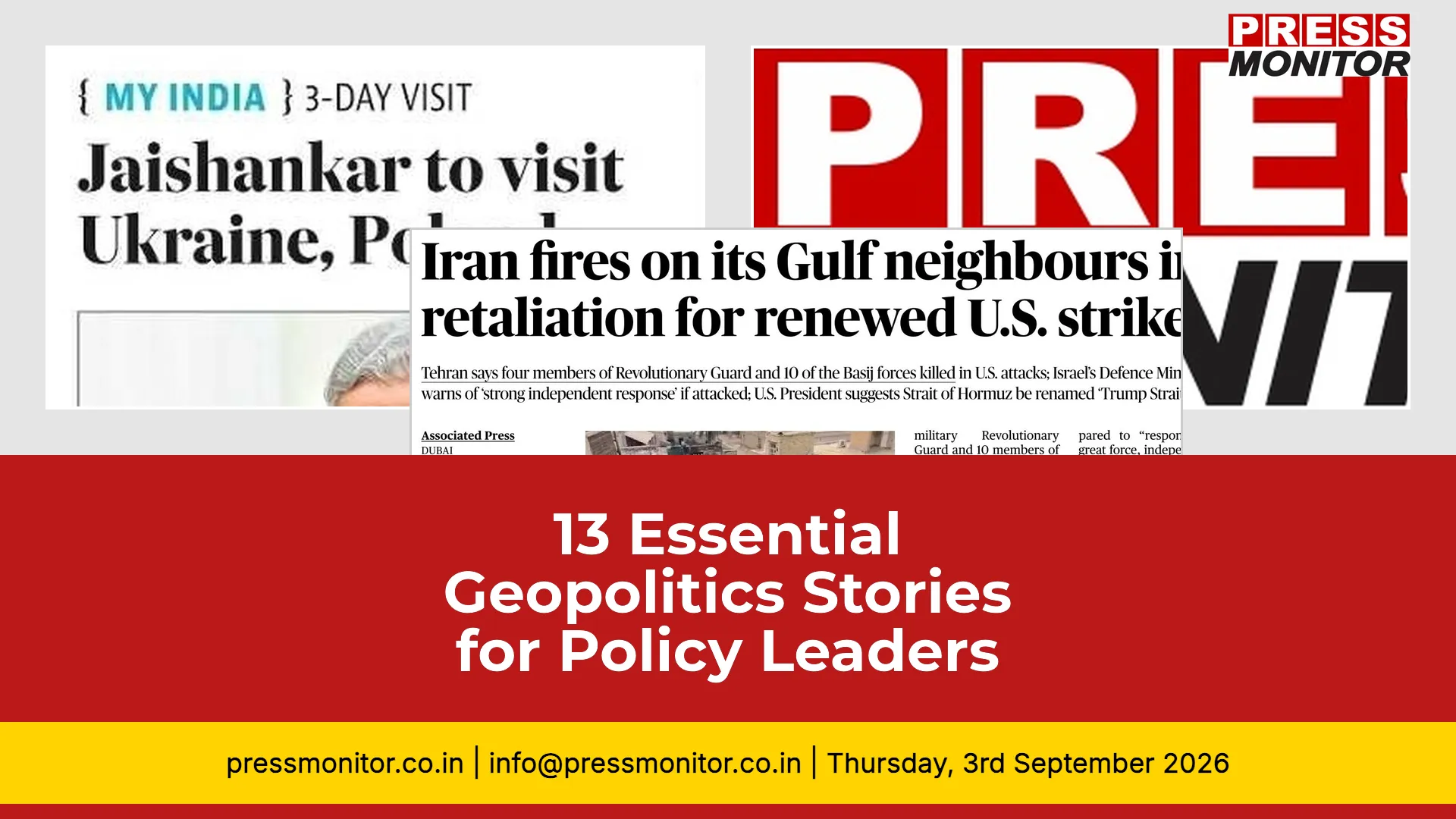
According to Press Monitor's tracking of Indian publications, this print media monitoring report delivers 13 essential stories on news on geopolitics that are reshaping the global order. This press review draws from today's front pages across Indian newspapers to provide media intelligence on the developments that matter most for strategic decision-makers.
1. Jaishankar's Diplomatic Visit to Ukraine and Poland
A front-page report in Hindustan Times says that External Affairs Minister S Jaishankar will undertake an official visit to Ukraine and the Republic of Poland from September 3 to 5. In Kyiv, Jaishankar is expected to press for finding a peaceful resolution to the Russia-Ukraine conflict.
Why it matters: India's External Affairs Minister is navigating a complex diplomatic landscape as he visits two nations at the centre of the Russia-Ukraine conflict. Jaishankar's mission signals India's independent foreign policy stance.
Key detail: The three-day visit from September 3-5 includes consultations with Ukrainian Foreign Minister Andrii Sybiha and Polish Deputy PM Radoslaw Sikorski, with a focus on peaceful resolution.
Source: Hindustan Times
Next step: Monitor bilateral statements for shifts in India's positioning on the Russia-Ukraine dialogue.
2. Putin, Xi Weigh Trilateral with Trump at APEC
Why it matters: The possibility of a Russia-China-US trilateral summit at APEC could reshape global power dynamics and diplomatic alignments.
Key detail: Putin and Xi discussed the idea on the sidelines of the SCO summit in Kyrgyzstan, with the November APEC meet as the proposed venue.
Source: Hindustan Times (cross-referenced with Economic Times)
Next step: Watch for official confirmation from the Kremlin or White House ahead of the APEC summit.
3. Iran Fires on Gulf Neighbours
A front-page report in The Hindu says Iran fired on U.S. allies in the Gulf early Wednesday in retaliation for renewed American strikes, including a deadly attack on a wedding party in southern Iran's Hormozgan province. Tehran said four Revolutionary Guard members and 10 Basij forces personnel were killed, while Kuwait and Bahrain reported coming under attack. Israel's Defence Minister Israel Katz warned of a strong independent response if attacked, and U.S. President Donald Trump suggested renaming the Strait of Hormuz as the "Trump Strait".
Why it matters: Iran's military escalation in the Gulf has raised tensions across the region and triggered warnings from Israel and the US.
Key detail: Four Revolutionary Guard members and 10 Basij forces were killed in retaliation for American strikes, including an attack on a wedding party in Hormozgan province.
Source: The Hindu (via Associated Press, Dubai)
Next step: Track further military responses and the impact on global energy markets.
4. SCO Summit: Xi, Modi, Putin Meet in Bishkek
A front-page report in Asian Age says the silver jubilee Shanghai Cooperation Organisation summit in Bishkek, Kyrgyzstan brought together Chinese President Xi Jinping, Indian Prime Minister Narendra Modi and Russian President Vladimir Putin amid a shifting geopolitical order. Prime Minister Modi made a robust statement on ending terrorism while Pakistan Prime Minister Shehbaz Sharif was present, and face-to-face meetings between Xi and Modi could help further reset ties after the 2020 Galwan skirmishes. Pakistan is set to host the next SCO summit, which could keep India away from top-level representation.
Why it matters: The silver jubilee SCO summit brought together the leaders of the world's largest nations, signaling shifting alliances in a multipolar world.
Key detail: Modi made a robust statement on ending terrorism; Pakistan is set to host the next SCO summit, which could affect India's top-level representation.
Source: Asian Age (cross-referenced with Deccan Chronicle)
Next step: Observe how the SCO's evolving membership impacts India's strategic autonomy.
5. Xi Courts Egypt Amid US Rivalry
A front-page report in Statesman says Chinese President Xi Jinping has arrived in Cairo for a three-day visit, his first to Egypt in a decade, for talks with President Abdel Fattah el-Sissi marking 70 years of diplomatic ties. Analysts say China is cultivating a relationship with one of America's key allies in West Asia as it moves to expand its influence in the region, positioning itself as a stabiliser in contrast with the United States, whose military entanglement there includes its six-month war with Iran.
Why it matters: China's President Xi Jinping is expanding Beijing's influence in West Asia, positioning itself as a stabiliser in contrast with US military entanglement.
Key detail: Xi's first visit to Egypt in a decade marks 70 years of diplomatic ties and reflects China's strategy to cultivate relationships with America's regional allies.
Source: Statesman (Cairo)
Next step: Assess how China's Middle East outreach affects US diplomatic leverage in the region.
6. India-China Boundary Talks Suggest Movement, But Hard Questions Remain
A front-page report in The Hindu says Security Adviser Ajit Doval and China’s Foreign Minister Wang Yi held the 25th round of talks between the Special Representatives on the India-China boundary question. The phrase ‘Early and Substantial Harvest’ is significant because it is India’s own coinage.
Why it matters: The 25th round of India-China boundary talks shows cautious progress, but fundamental disputes remain unresolved.
Key detail: Security Adviser Ajit Doval and China's Foreign Minister Wang Yi held talks; the phrase 'Early and Substantial Harvest' is India's own coinage, signalling calibrated optimism.
Source: The Hindu (by Ashok K. Kantha, Former Ambassador of India to China)
Next step: Watch for follow-up rounds and any confidence-building measures announced.
7. Russian Drones Attack Kyiv
A front-page report in Indian Express says Russian drones attacked central Kyiv on Wednesday morning, wounding nine people and damaging residential and university buildings on the seventh day of attacks.
Why it matters: Continued Russian drone strikes on Ukraine's capital demonstrate the ongoing escalation and raise questions about international security frameworks.
Key detail: Nine people were wounded and residential and university buildings damaged in central Kyiv on the seventh day of attacks.
Source: Indian Express (via Reuters, Kyiv)
Next step: Monitor NATO and EU responses to the targeting of civilian infrastructure.
8. India's Call for Peace Between Russia and Ukraine
A front-page report in The Economic Times says Narendra Modi spoke for sanity and humanity in Bishkek, Kyrgyzstan, during the Shanghai Cooperation Organisation summit. He urged a shift from 'endless war' to 'end of war', emphasizing self-interest as a reason for Putin to listen to India. The article highlights the detrimental effects of Russia's prolonged war on Ukraine on its economy, military, and alliances.
Why it matters: Prime Minister Modi's appeal for an end to the Russia-Ukraine war at the SCO summit highlights India's role as a voice for diplomacy.
Key detail: Modi urged a shift from 'endless war' to 'end of war', emphasising self-interest as a reason for Putin to listen to India.
Source: Economic Times
Next step: Evaluate whether India's peace initiative gains traction in upcoming multilateral forums.
9. India, Japan Sign Maritime Security Pact
A front-page report in Statesman says India and Japan have signed a maritime security agreement in New Delhi, concluded by defence ministers Rajnath Singh and Shinjiro Koizumi. The pact will see the Indian Navy and the Japan Maritime Self-Defence Force work together on search and rescue, disaster relief, maritime domain awareness, joint exercises and logistical support. Writer Shibashis Chatterjee argues the deal marks a strategic alignment rather than a formal alliance, deepening cooperation while preserving strategic autonomy.
Why it matters: The India-Japan maritime security agreement deepens strategic cooperation in the Indo-Pacific without formalising a military alliance.
Key detail: Defence Ministers Rajnath Singh and Shinjiro Koizumi concluded the pact covering search and rescue, disaster relief, maritime domain awareness, and joint exercises.
Source: Statesman (by Shibashis Chatterjee)
Next step: Track implementation timelines and joint exercise schedules.
10. Xi Jinping Urges Middle Eastern Countries to Oppose External Interference
A front-page report in New Indian Express says Chinese President Xi Jinping urged Middle Eastern countries to oppose ‘external interference’ and said Beijing was ready to work with regional states to safeguard maritime shipping, jeopardised by the US-Iran war.
Why it matters: China's call for regional states to resist external interference reflects Beijing's growing diplomatic ambitions in the Middle East.
Key detail: Xi said Beijing was ready to work with regional states to safeguard maritime shipping jeopardised by the US-Iran war.
Source: New Indian Express
Next step: Observe whether Middle Eastern nations align with China's position or continue to rely on US security guarantees.
11. West Asia Crisis Escalates
A front-page report in Hindustan Times says oil steadied near the highest closing level in five weeks as hostilities broke out again between the US and Iran, renewing the threat to energy exports from the Middle East.
Why it matters: Renewed US-Iran hostilities threaten energy exports from the Middle East, with oil prices holding near five-week highs.
Key detail: Oil steadied near the highest closing level in five weeks as the cycle of violence continued.
Source: Hindustan Times
Next step: Monitor OPEC statements and global energy market responses.
12. Next Round of American Sanctions Soon: Bessent
A front-page report in Economic Times says that US Treasury Secretary Scott Bessent warned that airlines, the maritime industry, and digital assets could be possible targets as the Trump administration continues its planned efforts to squeeze Iran's economy. Bessent also warned against any support for Iran, stating that the fastest way for the conflict to end is for no one to provide any support to the regime.
Why it matters: US Treasury Secretary Scott Bessent's warning of expanded sanctions targeting airlines, maritime industry, and digital assets signals a broader economic pressure campaign against Iran.
Key detail: Bessent stated the fastest way for the conflict to end is for no one to provide any support to the Iranian regime.
Source: Economic Times
Next step: Assess the potential impact on global shipping routes and digital asset markets.
13. Congo Ebola Deaths Top 3,000
A front-page report in Statesman says Congo's Ebola outbreak has killed more than 3,000 people out of over 6,100 confirmed cases, making it the fastest-growing Ebola outbreak ever. The US Centres for Disease Control said efforts to contain the virus remained below established response targets as it spread to six provinces, with North Kivu recording a higher fatality rate. In other reports, the European Union weighed its response after Germany blamed Russia for a foiled drone attack at Leipzig/Halle Airport, and Ukrainian President Volodymyr Zelenskyy warned airlines that Russian airspace is becoming increasingly unsafe.
Why it matters: The fastest-growing Ebola outbreak in history continues to spread across Congo, with the US CDC reporting response efforts remain below targets.
Key detail: Over 3,000 deaths out of 6,100 confirmed cases across six provinces, with North Kivu recording a higher fatality rate.
Source: Statesman
Next step: Follow international health organisations' response and any travel or trade restrictions imposed.
Closing: These stories, drawn from Press Monitor's print media monitoring of Indian publications, underscore how media intelligence shapes our understanding of a rapidly shifting world. Which geopolitical development will define the next quarter?