13 Essential Health Stories for Healthcare Leaders


According to Press Monitor's tracking of Indian publications, this media monitoring report covers 13 essential health stories shaping India's healthcare landscape today. From TB elimination milestones to counterfeit drug threats, these developments demand attention from every healthcare leader. This press review draws on media intelligence gathered from India's most trusted print outlets.
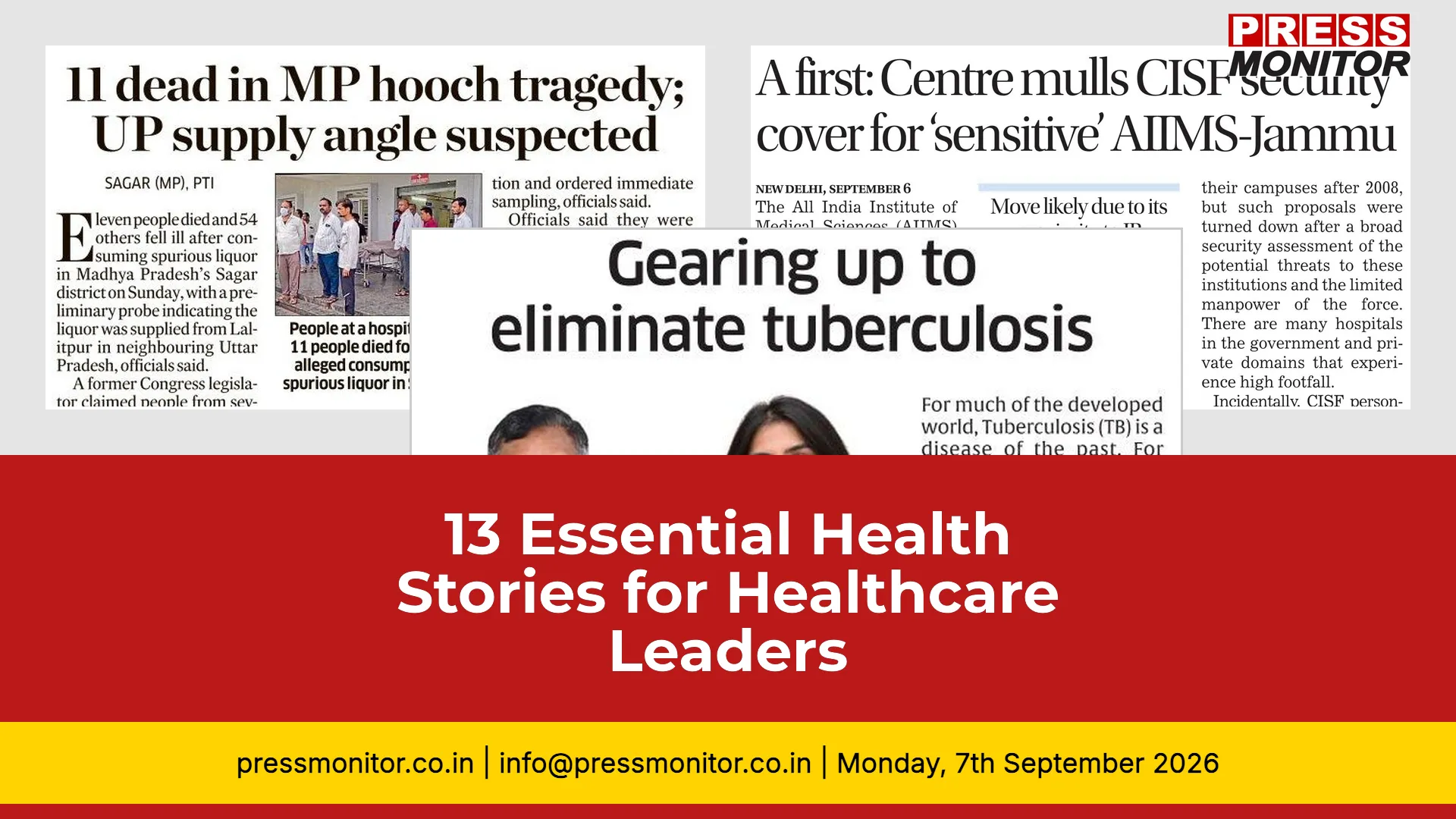
1. Sagar Hooch Tragedy Kills Seven in Madhya Pradesh
A front-page report in Deccan Herald says seven people died and fifty-four fell ill after consuming spurious liquor in Madhya Pradesh’s Sagar district on Sunday. Preliminary probes indicate the illicit drinks were supplied from neighbouring Uttar Pradesh, prompting the suspension of three excise officials and two police personnel. Chief Minister Mohan Yadav has ordered a strict investigation while opposition lawmakers demand a judicial inquiry into the tragedy.
Why it matters: Spurious liquor deaths expose critical gaps in rural excise enforcement and public health safety across India.
Key detail: Seven people died and fifty-four fell ill after consuming illicit liquor in Sagar district; three excise officials and two police personnel suspended.
Source: Deccan Herald
Next step: Demand a judicial inquiry into the supply chain and strengthen rural excise monitoring.
2. AIIMS Jammu Set for CISF Security Cover
A front-page report in Tribune says the Centre is considering permanent armed security cover for the All India Institute of Medical Sciences in Jammu, which could make it the first hospital in India to be guarded by the Central Industrial Security Force. The proposal, reported on September the sixth, comes after security officials flagged the hospital's sensitive location a few kilometres from the India Pakistan International Border in Samba district. The Ministry of Home Affairs has historically resisted armed personnel at hospitals after the Mumbai terror attacks in 2008, while security surveys and manpower estimates are underway.
Why it matters: AIIMS Jammu could become the first hospital in India under permanent central paramilitary guard, raising questions about healthcare security infrastructure.
Key detail: The Centre is considering permanent CISF deployment following security concerns about the hospital's proximity to the India-Pakistan border in Samba district.
Source: Tribune
Next step: Monitor the Ministry of Home Affairs' final decision on armed deployment at healthcare facilities.
3. India Reduces TB Incidence by 21 Percent
A front-page report in The Pioneer says that India has reduced tuberculosis (TB) incidence by 21 percent and TB mortality by 25 percent, according to the World Health Organization Global TB Report 2025. The article adds that India is strengthening indigenous innovation in diagnostics, medicines, and vaccines through institutions like the Indian Council of Medical Research (ICMR) and companies such as Macleods Pharmaceuticals and Molbio Diagnostics to eliminate TB by 2047 and serve other high-burden countries.
Why it matters: A 21 percent drop in TB incidence and 25 percent drop in mortality marks significant progress toward India's 2047 elimination target.
Key detail: WHO Global TB Report 2025 confirms the decline; indigenous innovation through ICMR, Macleods Pharmaceuticals, and Molbio Diagnostics is driving the effort.
Source: The Pioneer
Next step: Track how indigenous diagnostics companies scale up for global high-burden countries.
4. New Drug Policy Grants NPPA Suo Motu Powers
A front-page report in Business Line says the proposed new pharma policy grants suo motu powers to the National Pharmaceuticals Pricing Authority to bring new medicine doses under price control. The United Western Bank board approved a Rs 350-crore rehabilitation package offered by SICOM and the Maharashtra Government to meet a Thursday RBI deadline. India moved up four ranks in the World Bank's 'Doing Business 2007' report due to reforms in business registration and cross-border trade.
Why it matters: Expanding price control to new medicine doses could reshape pharmaceutical pricing and patient access across India.
Key detail: The proposed policy grants the National Pharmaceuticals Pricing Authority suo motu powers; India moved up four ranks in the World Bank Doing Business report.
Source: Business Line
Next step: Watch for implementation timelines and industry feedback on price control expansion.
5. Aditya Birla Backs Hospital Cost Reform
A front-page report in Financial Express says Aditya Birla Health Insurance chief Mayank Bathwal advocates for standardised hospital rates and wider adoption of the National Health Claims Exchange to ensure cost predictability and streamline patient admission and discharge processes. He highlights how the Bima Sugam platform will cut distribution costs and enhance transparency during insurance portability. Additionally, Bathwal emphasises that expanding outpatient department coverage enables early preventive care interventions, ultimately rewarding healthy consumers and improving claim ratios.
Why it matters: Standardised hospital rates and wider NHCX adoption could bring cost predictability and transparency to patient admissions and insurance portability.
Key detail: Aditya Birla Health Insurance chief Mayank Bathwal advocates for the Bima Sugam platform to cut distribution costs and expand outpatient department coverage.
Source: Financial Express
Next step: Monitor NHCX adoption rates across insurers and hospitals.
6. WHO Reports Loneliness as a Global Health Concern
A front-page report in Statesman says that loneliness is becoming one of the most serious yet least discussed problems confronting contemporary society. In 2025, the World Health Organization reported that roughly one in six people worldwide experiences loneliness, making it a global public-health concern affecting young and old alike. The article examines how urbanisation, migration, and digital technology contribute to isolation in India, while also referencing historical figures like Rabindranath Tagore and Jawaharlal Nehru who understood loneliness deeply.
Why it matters: One in six people worldwide experiences loneliness, making it a pressing public health issue that India's urbanisation and digital divide amplify.
Key detail: WHO 2025 report highlights loneliness affecting young and old alike, with urbanisation, migration, and digital technology contributing to isolation in India.
Source: Statesman
Next step: Integrate loneliness screening into primary healthcare protocols.
7. Fake Drugs Threaten Patient Safety Across India
A front-page report in Business Line says that at least four separate incidents related to fake medicines, voluntary recalls and alleged misbranding were reported in August, raising critical questions about patient safety in India. These include the seizure of counterfeit blood pressure drugs in Gujarat, a fake rabies vaccine flagged in Delhi, Sun Pharma voluntary withdrawal of eye drops, and Cipla warehouse licence controversy in Pune over alleged misbranding of Reactin Plus tablets.
Why it matters: Four separate incidents of counterfeit medicines, voluntary recalls, and misbranding in August raise urgent questions about pharmaceutical supply chain integrity.
Key detail: Counterfeit BP drugs seized in Gujarat, fake rabies vaccine flagged in Delhi, Sun Pharma eye drop withdrawal, and Cipla warehouse licence controversy in Pune.
Source: Business Line
Next step: Strengthen supply chain traceability and batch-level verification systems.
8. 17 Differences Found in Fake Vaccine Vials
A front-page report in Deccan Chronicle says laboratory tests found seventeen differences between seized counterfeit anti-rabies vaccine vials and retained samples of Abhayrab Batch KE25Ol2, with the samples declared Not of Standard Quality by the Central Drugs Laboratory, Kasauli. Indian Immunologicals Limited confirmed the genuine batch was released through Batch Release Certificate and supplied eighty-three thousand three hundred seventy vials through authorised channels. Doctors advised people to verify vaccine authenticity and consult healthcare professionals if they have doubts about the vaccine they received.
Why it matters: Laboratory confirmation of 17 differences between counterfeit and genuine anti-rabies vaccine vials underscores the need for rigorous quality control in immunisation programmes.
Key detail: Central Drugs Laboratory, Kasauli declared seized vials Not of Standard Quality; Indian Immunologicals confirmed 83,370 genuine vials were supplied through authorised channels.
Source: Deccan Chronicle
Next step: Verify vaccine authenticity through authorised channels before administration.
9. 150km Patient Travel Delays Specialist Care
A front-page report in Economic Times says that despite expanded healthcare coverage, specialist care in India remains heavily urban-centric and delayed. Patients in underserved regions are forced to travel between 100 and 150 kilometres for basic specialist consultations. This tension formed the core of a panel discussion featuring Dr Aparna Hegde, Rizwan Koita from the National Accreditation Board for Hospitals and Healthcare, and Dr Shibu Vijayan.
Why it matters: Despite expanded healthcare coverage, specialist care remains heavily urban-centric, forcing patients in underserved regions to travel 100 to 150 kilometres for basic consultations.
Key detail: Panel discussion featured Dr Aparna Hegde, Rizwan Koita from NABH, and Dr Shibu Vijayan on the urban-rural healthcare access gap.
Source: Economic Times
Next step: Advocate for telemedicine infrastructure in rural primary health centres.
10. Indian Immunologicals Confirms Fake Rabies Vaccine Batch Not Exported
A front-page report in Economic Times says Indian Immunologicals Ltd confirmed that no part of a counterfeit Abhayrab rabies vaccine batch seized in Delhi was exported, reassuring international health authorities. Delhi Police arrested four people and seized fake vials from a residential premises, while the Central Drugs Standard Control Organisation tightened surveillance across the country. The manufacturer stated that batch release certification from the Central Research Institute in Kasauli ensures vaccines reach patients only through authorised supply chains.
Why it matters: Confirmation that no part of the counterfeit Abhayrab batch was exported reassures international health authorities and validates domestic supply chain controls.
Key detail: Delhi Police arrested four people and seized fake vials from residential premises; CDSCO tightened surveillance across the country.
Source: Economic Times
Next step: Support CDSCO's tightened surveillance and batch-level tracking initiatives.
11. PIL Challenges HPV Vaccination Programme
A front-page report in Economic Times says a petition has been filed before the Supreme Court challenging the government-backed human papillomavirus vaccination programme for violating constitutional rights of informed consent and bodily autonomy. The public interest litigation, filed by the Universal Health Organisation, seeks suspension of the school-based component until a legally compliant consent protocol is established. Separately, Indian Immunologicals Limited confirmed that no part of the counterfeit Abhayrab rabies vaccine batch seized in Delhi was exported.
Why it matters: A Supreme Court petition challenging the government-backed HPV vaccination programme raises fundamental questions about informed consent and bodily autonomy in public health policy.
Key detail: The Universal Health Organisation filed the PIL seeking suspension of the school-based component until a legally compliant consent protocol is established.
Source: Economic Times
Next step: Watch for the Supreme Court's response and potential consent protocol reforms.
12. Nidhi Ambulance Pothole Crisis Leaves Family Stranded
A front-page report in Times of India says Nidhi, wife of Pravendra Singh, went into active labour and her family called an emergency ambulance to take her to hospital. Shortly after the ambulance arrived, it plunged into a massive pothole on the village link road connecting the main highway, leaving the vehicle immobilised. The report includes a complaint that PWD did not repair the road.
Why it matters: An ambulance plunging into a pothole during an emergency highlights the deadly intersection of poor rural infrastructure and healthcare access.
Key detail: Nidhi, wife of Pravendra Singh, went into active labour when the ambulance became immobilised on a village link road; PWD had not repaired the road.
Source: Times of India
Next step: Push for urgent road infrastructure repairs along healthcare access routes.
13. Homeopaths Cross-Practice Modern Medicine in Maharashtra
A front-page report in Times of India says Maharashtra has approved ten homeopaths to practise modern medicine under a one-year certificate course, with two based in Mumbai. The trend is driven by job insecurity among alternative practitioners and a shortage of affordable MBBS doctors in areas like Mankhurd and Badlapur. Experts suggest these practitioners could be deployed at primary health centres with rigorous training, though concerns remain about patient safety.
Why it matters: Maharashtra's approval of ten homeopaths to practise modern medicine under a one-year certificate course raises patient safety concerns amid a shortage of MBBS doctors.
Key detail: Two of the ten approved practitioners are based in Mumbai; the trend is driven by job insecurity among alternative practitioners and shortage of affordable MBBS doctors in Mankhurd and Badlapur.
Source: Times of India
Next step: Debate the patient safety implications of cross-practice without rigorous training standards.
These stories reflect the complexity of India's health sector — from policy reforms to patient safety challenges. Which development concerns you most? Share your perspective with Press Monitor, your source for media monitoring and health sector intelligence, delivering news on health from India's print media monitoring ecosystem.