13 Essential Healthcare Stories for Industry Leaders


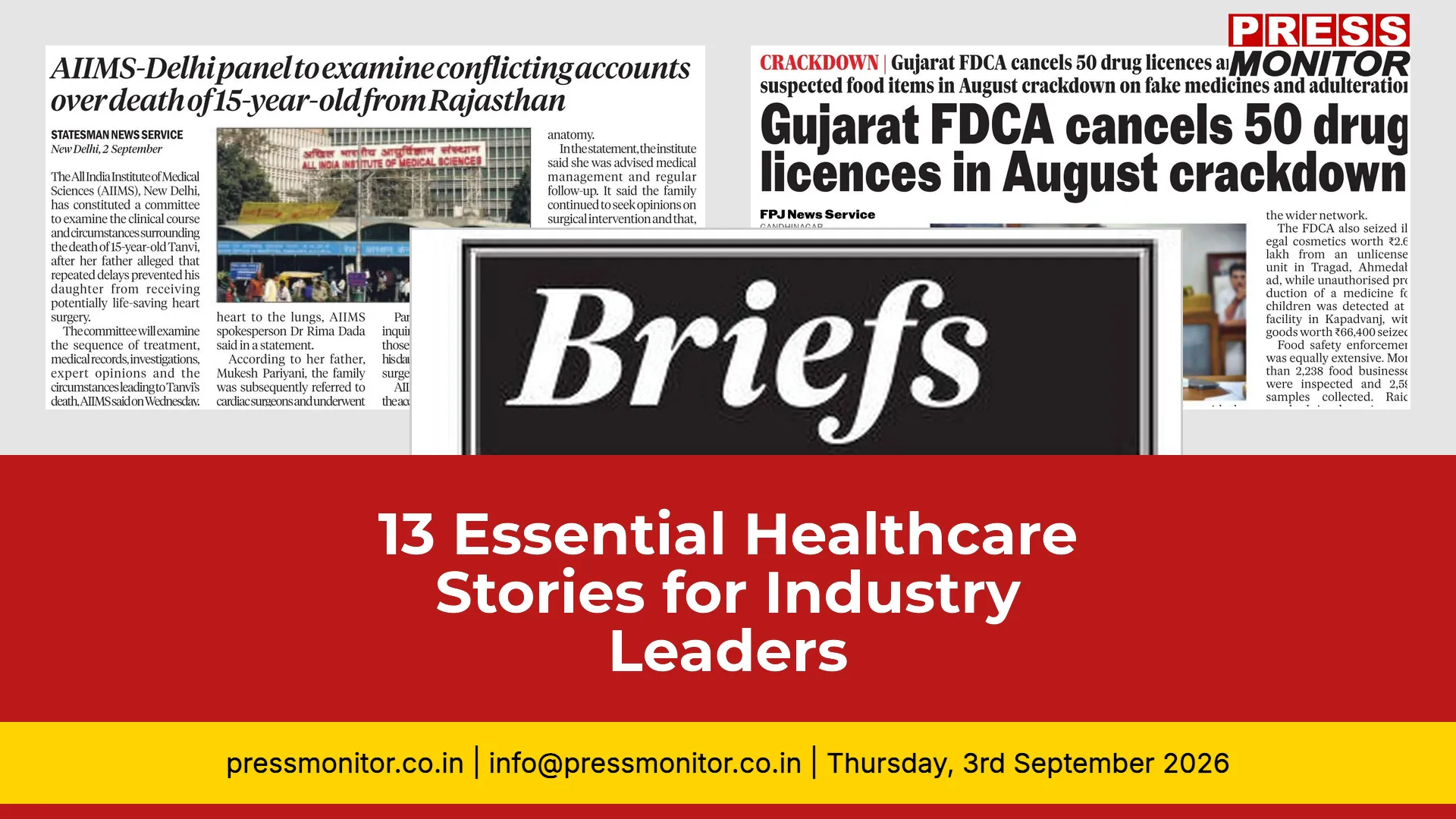
According to Press Monitor's tracking of Indian publications, this print media monitoring review delivers news on healthcare from 13 distinct stories across today's Indian print landscape. From AIIMS investigations to pharmaceutical crackdowns, this press review covers the developments that matter most to healthcare leaders and policy makers.
1. AIIMS Constitutes Committee to Probe Teen Girl's Death
A front-page report in Statesman says the All India Institute of Medical Sciences, New Delhi, has constituted a committee to examine the circumstances surrounding the death of 15-year-old Tanvi from Kota, Rajasthan, after her father Mukesh Pariyani alleged that repeated delays prevented her from receiving potentially life-saving heart surgery. Tanvi was diagnosed with ventricular septal defect with pulmonary atresia, a complex congenital heart condition, at the AIIMS cardiology OPD in October 2012, and her father claimed money and blood were deposited in April 2014 but the operation was postponed several times. The institute disputes the account, saying doctors concluded in 2017 that corrective surgery was not feasible, and Tanvi died in the early hours of 1 September after being admitted for a possible heart-lung transplant.
The death of 15-year-old Tanvi from Kota, Rajasthan, at AIIMS Delhi has prompted the institute to form a committee examining the clinical course and circumstances surrounding her passing. Tanvi was diagnosed with ventricular septal defect with pulmonary atresia — a complex congenital heart condition — at the AIIMS cardiology OPD in October 2012. Her father Mukesh Pariyani alleged that repeated delays prevented her from receiving potentially life-saving heart surgery, and that money and blood were deposited in April 2014 but the operation was postponed several times. AIIMS disputes the account, saying doctors concluded in 2017 that corrective surgery was not feasible due to her cardiac anatomy. Tanvi died in the early hours of 1 September after being admitted for a possible heart-lung transplant.
Why it matters: The case raises critical questions about patient safety protocols, clinical governance, and accountability in India's premier public hospital. Media monitoring of this story across five publications underscores public concern over medical negligence and institutional transparency.
Key detail: AIIMS has formed a committee to review Tanvi's records, treatment, and the events leading to her death.
Source: Statesman, Hindustan Times, The Hindu, First India, Times of India
Next step: Follow the committee's findings and any regulatory action taken by the Health Ministry.
What do you think — should AIIMS be held to a higher standard of accountability?
2. Gujarat FDCA Cancels Licences of 50 Drug Companies
A front-page report in Free Press Journal says Gujarat's Food and Drug Regulatory Authority has cancelled the sales licences of 50 drug companies and seized 42,988 kg of suspected food items worth Rs 293.47 lakh in an August crackdown on fake medicines and adulteration. Health Minister Praful Pansheriya directed a zero tolerance approach, with inspections covering blood storage centres, restaurants and over 2,238 food businesses, while probes traced a fake drug supply chain from Lucknow to Ahmedabad and Sanand.
The Gujarat Food and Drug Regulatory Authority has cancelled the sales licences of 50 drug companies and seized 42,988 kg of suspected food items worth Rs 293.47 lakh in an August crackdown on fake medicines and adulteration. Health Minister Praful Pansheriya directed a zero tolerance approach, with inspections covering blood storage centres, restaurants and over 2,238 food businesses, while probes traced a fake drug supply chain from Lucknow to Ahmedabad and Sanand.
Why it matters: This is one of the largest pharmaceutical regulatory actions in Gujarat, signaling a hardening stance against counterfeit medicines that threaten public health.
Key detail: 50 licences cancelled, 42,988 kg of suspected food items seized, fake drug supply chain traced from Lucknow to Ahmedabad and Sanand.
Source: Free Press Journal
Next step: Monitor whether other states follow Gujarat's zero tolerance approach.
How does this impact your supply chain?
3. Sun Pharma Semaglutide Samples for Novo Nordisk Patent Test
A front-page report in Free Press Journal says Pharma Laboratories Ltd. will provide samples of its semaglutide tablets to Novo Nordisk A/S for testing if it infringes on Pharma Labs’ patent. The high court is hearing an application by Sun Pharma Laboratories, a subsidiary of Sun Pharmaceutical Industries Ltd, to manufacture and market semaglutide tablets used to treat type 2 diabetes and manage chronic weight loss.
The high court has directed Sun Pharma Laboratories Ltd, a subsidiary of Sun Pharmaceutical Industries Ltd, to give samples of its semaglutide tablets to Novo Nordisk A/S for testing in a patent dispute. The court was hearing the company's application seeking to manufacture and market semaglutide tablets, used to treat type 2 diabetes and manage chronic weight loss.
Why it matters: This patent dispute between Indian and Danish pharmaceutical giants could reshape the generic diabetes and weight-loss medication market in India and globally.
Key detail: Sun Pharma Labs to provide semaglutide tablet samples to Novo Nordisk for patent infringement testing.
Source: Free Press Journal
Next step: Track the court's ruling and its impact on semaglutide availability in India.
Will generic semaglutide reach patients faster if Sun Pharma prevails?
4. Haryana Government to Expand Kalpana Chawla Medical College Hospital
A front-page report in The Pioneer says that Haryana Chief Minister Nayab Singh Saini announced the expansion of Kalpana Chawla Government Medical College and Hospital (KCGMO), Karnal, to provide better modern and specialised healthcare facilities. The Phase-II expansion will substantially increase the hospital's medical facilities and capacity.
Haryana Chief Minister Nayab Singh Saini announced the expansion of Kalpana Chawla Government Medical College and Hospital (KCGMO), Karnal, to provide better modern and specialised healthcare facilities. The Phase-II expansion will substantially increase the hospital's medical facilities and capacity.
Why it matters: The expansion signals Haryana's commitment to strengthening public healthcare infrastructure in rural and semi-urban areas.
Key detail: Phase-II expansion of KCGMO Karnal will increase medical facilities and capacity.
Source: The Pioneer
Next step: Watch for budget allocation details and construction timelines.
Will this expansion improve healthcare access for Karnal's residents?
5. Madhya Pradesh Sacks Rewa Hospital Chief
A front-page report in Indian Express says the Madhya Pradesh government has removed Dr Rahul Mishra as superintendent of Sanjay Gandhi Memorial Hospital in Rewa after a video showed him making an insensitive remark to the family of Kalpana Mishra, a 25-year-old pregnant woman who died along with her newborn following a caesarean section. The Public Health and Medical Education Department transferred charge to Dr Priyank Sharma on 1 September without citing reasons, days after the video went viral. Madhya Pradesh Congress president Jitu Patwari accused the government of protecting the superintendent, alleging he had links with Deputy Chief Minister and Health Minister Rajendra Shukla.
The Madhya Pradesh government has removed Dr Rahul Mishra as superintendent of Sanjay Gandhi Memorial Hospital in Rewa after a video showed him making an insensitive remark to the family of Kalpana Mishra, a 25-year-old pregnant woman who died along with her newborn following a caesarean section. The Public Health and Medical Education Department transferred charge to Dr Priyank Sharma on 1 September without citing reasons. Madhya Pradesh Congress president Jitu Patwari accused the government of protecting the superintendent, alleging he had links with Deputy Chief Minister and Health Minister Rajendra Shukla.
Why it matters: The sacking highlights the growing role of social media in holding healthcare administrators accountable and the political tensions surrounding hospital governance.
Key detail: Dr Rahul Mishra removed as superintendent; Dr Priyank Sharma transferred charge; Congress alleges political connections.
Source: Indian Express
Next step: Monitor whether the Congress allegations lead to any further investigation.
Should political connections in hospital administration be subject to stricter scrutiny?
6. Woman Forced to Deliver Baby Outside Health Centre in Faridabad
A front-page report in Times of India says a woman was forced to give birth to her baby outside the main gate of a primary health centre in Faridabad. The family found the gate locked and medical staff unavailable.
A woman was forced to give birth to her baby outside the main gate of a primary health centre in Faridabad. The family found the gate locked and medical staff unavailable.
Why it matters: This incident exposes the gaps in primary healthcare infrastructure and the urgent need for better staffing and access in India's public health centres.
Key detail: Woman gave birth outside locked gate of primary health centre in Faridabad; medical staff were unavailable.
Source: Times of India
Next step: Follow up on whether the health centre has been penalised or staffing improved.
How many more families are facing similar emergencies across India?
7. Gujarat's 108 Service Saves 19.66 Lakh Lives
A front-page report in Free Press Journal says Gujarat's 108 Emergency Service has completed 19 years, having responded to nearly 1.99 crore emergency cases and saved more than 19.66 lakh lives since its launch on 29 August 2007. The free pre-hospital emergency network answers an emergency every 21 seconds with an average response time of 13 minutes and nine seconds, and has attended over 62.97 lakh pregnancy and childbirth-related emergencies while assisting in 164,715 deliveries. The service has also expanded to include an air ambulance operation with GUJSAIL and GVK EMRI and boat ambulances at Porbandar and Okha.
Gujarat's 108 Emergency Service has completed 19 years, having responded to nearly 1.99 crore emergency cases and saved more than 19.66 lakh lives since its launch on 29 August 2007. The free pre-hospital emergency network answers an emergency every 21 seconds with an average response time of 13 minutes and nine seconds, and has attended over 62.97 lakh pregnancy and childbirth-related emergencies while assisting in 164,715 deliveries. The service has also expanded to include an air ambulance operation with GUJSAIL and GVK EMRI and boat ambulances at Porbandar and Okha.
Why it matters: Gujarat's 108 service is a model for pre-hospital emergency care in India, demonstrating how sustained investment in emergency infrastructure saves lives at scale.
Key detail: 19.66 lakh lives saved, 1.99 crore emergency responses, 13 min 9 sec average response time, 164,715 deliveries assisted.
Source: Free Press Journal
Next step: Study the 108 model for replication in other states.
Can other states replicate Gujarat's emergency response success?
8. Consultancy Services Invitation for Multi Specialty Hospital in Jharkhand
A front-page report in Hindustan Times says the Jharkhand State Building Construction Corporation Limited invites proposals from qualified consultants for Environmental Clearance, Environmental Management Plan, and Compliance Monitoring for constructing a 2,800 bedded Multi Specialty Teaching Hospital Cum Medical College at Ranchi.
The Jharkhand State Building Construction Corporation Limited invites proposals from qualified consultants for Environmental Clearance, Environmental Management Plan, and Compliance Monitoring for constructing a 2,800 bedded Multi Specialty Teaching Hospital Cum Medical College at Ranchi.
Why it matters: This major infrastructure project signals Jharkhand's commitment to expanding healthcare education and facility capacity in the state.
Key detail: 2,800 bedded Multi Specialty Teaching Hospital Cum Medical College at Ranchi; consultancy for environmental clearance and compliance monitoring.
Source: Hindustan Times
Next step: Track the consultant selection process and construction timeline.
Will this hospital become a regional healthcare hub?
9. Chhattisgarh's Remarkable Transformation Reflected in AIIMS Raipur
A front-page report in Statesman says Vice President C P Radhakrishnan on Wednesday said AIIMS Raipur reflected Chhattisgarh’s remarkable transformation after decades.
Vice President C P Radhakrishnan said AIIMS Raipur reflected Chhattisgarh's remarkable transformation after decades, highlighting the state's healthcare advancements.
Why it matters: The recognition of AIIMS Raipur as a symbol of Chhattisgarh's development trajectory underscores the importance of sustained investment in public health infrastructure.
Key detail: Vice President C P Radhakrishnan praised AIIMS Raipur as evidence of Chhattisgarh's transformation.
Source: Statesman
Next step: Monitor AIIMS Raipur's expanding role in central India's healthcare delivery.
How will AIIMS Raipur shape healthcare access in Chhattisgarh and beyond?
10. 500 CISF Personnel Donate Blood at AIIMS Delhi
A front-page report in The Pioneer says the Central Industrial Security Force (CISF) organised a mega voluntary blood donation drive at the CISF NHCC Hospital in Mahipalpur, New Delhi, on Wednesday in coordination with the Blood Centre at AIIMS, Delhi. Around 500 personnel donated blood, with Director General Praveer Ranjan leading by example. The drive comes amid a reported blood shortage in Delhi, where daily availability of about 960 units falls nearly 440 units short of the requirement of roughly 1,400 units.
The Central Industrial Security Force (CISF) organised a mega voluntary blood donation drive at the CISF NHCC Hospital in Mahipalpur, New Delhi, in coordination with the Blood Centre at AIIMS, Delhi. Around 500 personnel donated blood, with Director General Praveer Ranjan leading by example. The drive comes amid a reported blood shortage in Delhi, where daily availability of about 960 units falls nearly 440 units short of the requirement of roughly 1,400 units.
Why it matters: The blood shortage in Delhi is a recurring crisis, and corporate and institutional drives like this are essential to bridging the gap.
Key detail: 500 CISF personnel donated blood; Delhi needs 1,400 units daily but only 960 are available.
Source: The Pioneer
Next step: Encourage more institutional blood donation drives to address Delhi's shortage.
Can corporate partnerships help close Delhi's blood supply gap?
11. Bharati Hospital Launches Birthmark Clinic in Pune
A front-page report in Free Press Journal says Bharati Hospital in Pune is set to open an advanced Birthmark Clinic offering modern laser-based treatments for children with congenital skin marks and pigmentation disorders. The facility was announced by Medical Director Dr Sanjay Lalwani during the inauguration of a state-of-the-art laser machine made by Italy-based DEKA. The clinic will provide treatments at affordable costs while giving dermatology trainees hands-on experience with advanced equipment.
Bharati Hospital in Pune is set to open an advanced Birthmark Clinic offering modern laser-based treatments for children with congenital skin marks and pigmentation disorders. The facility was announced by Medical Director Dr Sanjay Lalwani during the inauguration of a state-of-the-art laser machine made by Italy-based DEKA. The clinic will provide treatments at affordable costs while giving dermatology trainees hands-on experience with advanced equipment.
Why it matters: Specialized clinics for pediatric dermatology are rare in India, and Bharati Hospital's initiative fills an important gap in accessible, affordable care.
Key detail: Advanced Birthmark Clinic launched with DEKA laser machine; affordable treatments for children with congenital skin marks.
Source: Free Press Journal
Next step: Track patient uptake and outcomes from the new clinic.
Will this clinic become a referral centre for pediatric dermatology in western India?
12. Girl, 7, Dies After Chloroquine Dose in Andhra Pradesh
A front-page report in The Hans India says a seven-year-old girl, Jamuna, died after falling unconscious following a chloroquine dose distributed during a malaria prevention drive in Gollaguppa village in Polavaram district. Thirty-two villagers have been discharged while 21 remain under treatment after falling sick, with only nine needing continued hospital care. Chief Minister N Chandrababu Naidu has ordered a full inquiry, and tablet samples have been sent to the Visakhapatnam Forensic Science Laboratory.
A seven-year-old girl, Jamuna, died after falling unconscious following a chloroquine dose distributed during a malaria prevention drive in Gollaguppa village in Polavaram district. Thirty-two villagers have been discharged while 21 remain under treatment after falling sick, with only nine needing continued hospital care. Chief Minister N Chandrababu Naidu has ordered a full inquiry, and tablet samples have been sent to the Visakhapatnam Forensic Science Laboratory.
Why it matters: The tragic death highlights the risks of mass drug distribution campaigns and the critical need for pharmacovigilance at the grassroots level.
Key detail: 7-year-old Jamuna died after chloroquine dose; 32 discharged, 21 under treatment, 9 in hospital; CM ordered full inquiry.
Source: The Hans India
Next step: Monitor the forensic results and any policy changes to malaria prevention protocols.
How can mass drug distribution be made safer for vulnerable communities?
13. Novonesis Invests Rs 6,600 Crore in Maharashtra
A front-page report in Free Press Journal says Danish biosimilars producer Novonesis has announced a Rs 6,600 crore investment to expand its enzyme plant at Patalganga in Maharashtra over the next four years. The expanded facility, expected to be fully operational by 2030, will produce enzymes for industries including biofuels, household care, and food and beverages. Company president and chief executive Ester Baiget said the plant will help meet rising demand from emerging markets such as India, the Middle East, Africa and South Asia.
Danish biosimilars producer Novonesis has announced a Rs 6,600 crore investment to expand its enzyme plant at Patalganga in Maharashtra over the next four years. The expanded facility, expected to be fully operational by 2030, will produce enzymes for industries including biofuels, household care, and food and beverages. Company president and chief executive Ester Baiget said the plant will help meet rising demand from emerging markets such as India, the Middle East, Africa and South Asia.
Why it matters: This major biotech investment signals growing confidence in India's pharmaceutical and biotech manufacturing ecosystem.
Key detail: Rs 6,600 crore investment; enzyme plant at Patalganga, Maharashtra; fully operational by 2030; serving biofuels, household care, food and beverages.
Source: Free Press Journal
Next step: Track the environmental clearance and construction milestones for the Patalganga facility.
How will this investment impact India's position in the global biosimilars market?
Closing: These 13 stories, tracked through our media intelligence network, reflect the breadth and depth of today's healthcare news on India. From AIIMS accountability to pharmaceutical regulation, from emergency services to biotech investment, the print media landscape offers unparalleled insight for healthcare professionals and policy makers. What story stood out most to you?