13 Essential Pharmaceuticals Stories for Life Sciences Leaders


According to Press Monitor's tracking of Indian publications, today's news on pharmaceuticals spans AI-driven drug discovery, blockbuster obesity treatments, antibiotic resistance crises, and major industry investments. This press review delivers 13 essential stories every life sciences leader needs to know, powered by media monitoring and media intelligence from India's print media monitoring landscape.
1. Piyush Goyal Backs Full Medical Device Funding
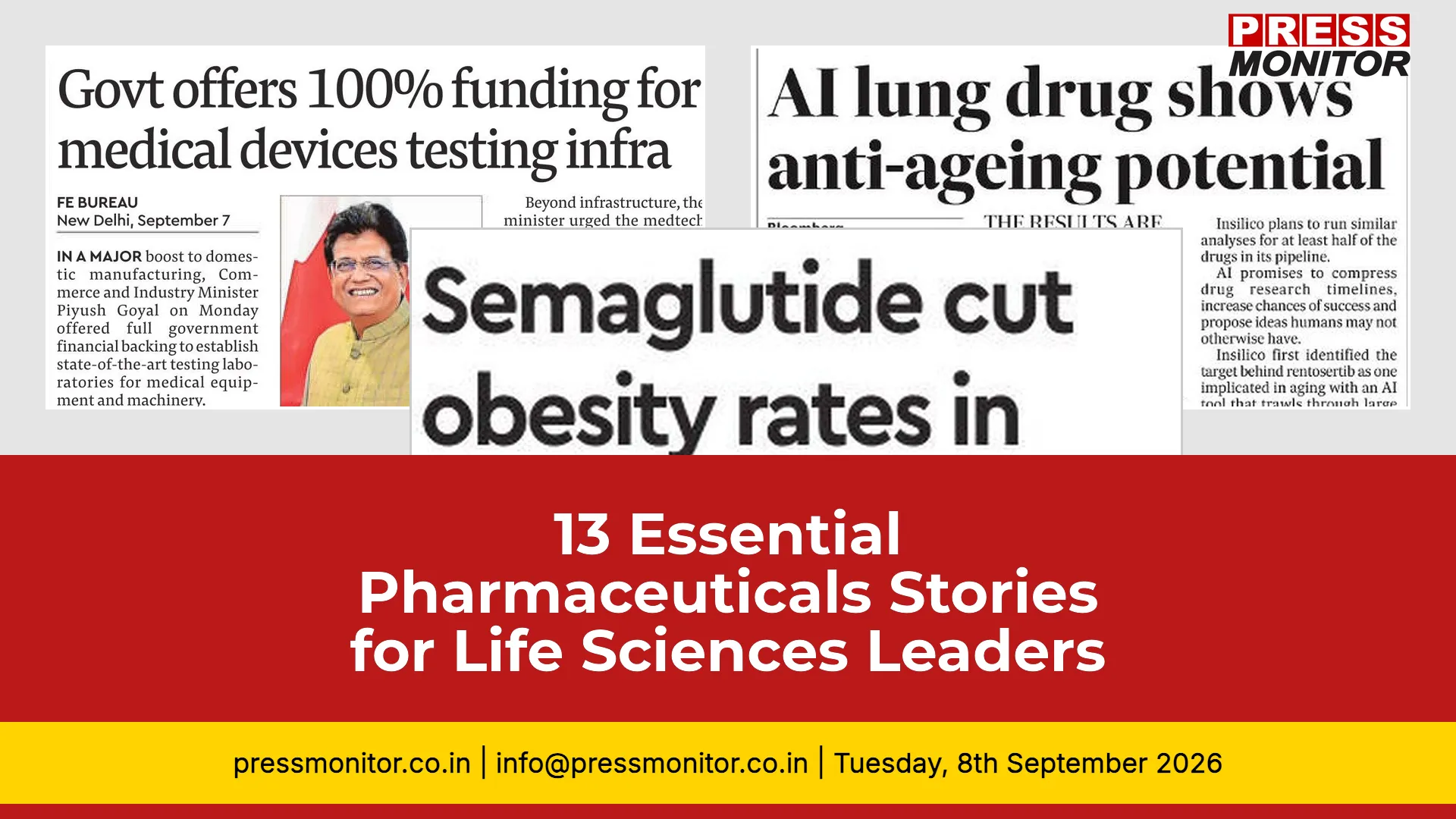
A front-page report in Financial Express says Commerce and Industry Minister Piyush Goyal offered full government financial backing to establish state-of-the-art testing laboratories for medical equipment at the PharmaMachTech and LabNext Expo 2026 organised by EEPC India in New Delhi on September 7. He said the Bureau of Indian Standards would fund one hundred percent of the cost of the best testing equipment. Goyal urged the medtech sector to build a robust local component ecosystem and accelerate innovation through international technology partnerships and intellectual property frameworks. Commerce and Industry Minister Piyush Goyal announced the government will fund 100 percent of testing equipment costs for medical devices at the PharmaMachTech and LabNext Expo. This commitment positions India as a global hub for medtech innovation and manufacturing.
Why it matters: Full government backing removes a major barrier for domestic medical device companies competing globally.
Key detail: Bureau of Indian Standards will fund the best testing equipment; Goyal urged firms to build robust local component ecosystems.
Source: Financial Express, Asian Age, Free Press Journal, Economic Times
Next step: Monitor which Indian firms secure the first testing lab contracts.
2. Insilico Medicine Drug Reduces Biological Age
A front-page report in Hindustan Times says Ina mid-stage study, Insilico Medicine's drug rentosertib helped reduce biological age as measured by six different aging clocks examining chemical changes in the body, according to an analysis published in Nature Biotechnology on Monday. The Hong Kong-listed company said those who were given a placebo saw little change in their biological age on those same clocks. Alex Zhavoronkov, the AI drug discovery startup's Chief Executive Officer, cautioned that the results are still early and the long-term health effects of the drug on larger groups of people are unknown, noting the analysis included 42 patients with a chronic lung disease. Insilico Medicine's AI-generated drug rentosertib reduced biological age across six aging clocks in a mid-stage study of 42 patients with chronic lung disease, according to an analysis in Nature Biotechnology.
Why it matters: AI-driven drug discovery is delivering measurable anti-aging results, validating the platform technology behind Insilico's pipeline.
Key detail: Placebo group showed little change; CEO Alex Zhavoronkov cautioned results are early and long-term effects remain unknown.
Source: Hindustan Times, Business Standard
Next step: Watch for larger clinical trials and regulatory pathways for aging indications.
3. Novo Nordisk Wegovy Trial Shows 40.4% Weight Loss in Children
A front-page report in Financial Express says Novo Nordisk has said that in a late-stage trial, forty point four percent of kids aged six to under twelve treated with semaglutide, the active ingredient in its weight-loss drug Wegovy, were no longer classified as having obesity after sixty-eight weeks, assuming full adherence to treatment. Novo Nordisk reported that 40.4 percent of children aged six to under twelve treated with semaglutide were no longer classified as having obesity after 68 weeks in a late-stage trial.
Why it matters: First-ever data on Wegovy's effect in pediatric populations opens a massive new market for GLP-1 weight-loss drugs.
Key detail: Full adherence assumed; Eli Lilly has not yet proven whether its rival obesity drug works in children.
Source: Financial Express, Business Standard
Next step: Track pediatric prescribing guidelines and competitor responses.
4. Sun Pharma Leads MFN Pricing Shift
A front-page report in New Indian Express says that Sun Pharmaceutical Industries has begun offering most‑favoured nation pricing to United States buyers, a strategy that several other Indian manufacturers are expected to adopt to counter potential tariff risks and distributor pressure. The move is aimed at protecting profit margins amid heightened bargaining power of distributors and pharmaceutical benefit managers, according to Namit Joshi, chairman of Pharmexcil. Pharma exporters warn that United States tariffs under Section Two Thirty Two and the lack of long‑term contracts threaten their sustainability in the United States market. Sun Pharmaceutical Industries has begun offering most-favoured nation pricing to United States buyers, a strategy other Indian manufacturers are expected to adopt to counter potential tariff risks.
Why it matters: MFN pricing protects profit margins amid distributor bargaining power and Section 232 tariff threats.
Key detail: Pharma exporters warn that US tariffs and lack of long-term contracts threaten sustainability in the American market.
Source: New Indian Express, Morning Standard
Next step: Observe which other Indian pharma firms follow Sun Pharma's MFN pricing lead.
5. Mounjaro Tops India Drug Sales
A front-page report in Business Line says Mounjaro has emerged as India's bestselling pharmaceutical brand, recording sales of Rs 1,256 crore in the 12 months ended August 2026, up 502 per cent from the previous year. The anti-obesity drug's rapid rise reflects a broader shift as patients increasingly choose injectable GLP-1 medicines over oral treatments. Tirzepatide, the molecule in Mounjaro, now accounts for nearly three-fourths of the injectable GLP-1 market by value and has overtaken semaglutide. Mounjaro emerged as India's bestselling pharmaceutical brand, recording sales of Rs 1,256 crore in the 12 months ended August 2026, up 502 percent from the previous year.
Why it matters: Tirzepatide now accounts for nearly three-fourths of the injectable GLP-1 market by value, overtaking semaglutide.
Key detail: The anti-obesity drug's rapid rise reflects a shift toward injectable GLP-1 medicines over oral treatments.
Source: Business Line
Next step: Monitor generic competition as Mounjaro's patent landscape evolves.
6. Novartis Pelacarsen Fails Final-Stage Trial
A front-page report in Mint says that Novartis’s heart‑drug candidate pelacarsen failed a final‑stage trial in Switzerland, reducing lipoprotein(a) levels but not lowering heart attacks or deaths. The setback came late this week and has pushed the company’s shares down about 3.9 percent at Zurich trading. CEO Vas Narasimhan warned that successful late‑stage trials could lift the firm’s growth forecast, but the result undermines those hopes. Novartis's heart-drug candidate pelacarsen failed a final-stage trial in Switzerland, reducing lipoprotein(a) levels but not lowering heart attacks or deaths, pushing shares down about 3.9 percent.
Why it matters: The setback underscores the high risk of cardiovascular drug development despite promising biomarker results.
Key detail: CEO Vas Narasimhan warned that successful late-stage trials could lift the firm's growth forecast.
Source: Mint
Next step: Assess impact on Novartis's cardiovascular pipeline and investor confidence.
7. ICMR Study: Carbapenem-Resistant Infections More Deadly
A front-page report in The Indian Express says a major study of hospitalised patients across India found that infections caused by antibiotic-resistant bacteria are more likely to be fatal and more expensive to treat than infections caused by drug-susceptible strains. The Indian Council of Medical Research's antimicrobial resistance surveillance network conducted the study across 20 tertiary-care hospitals between April 2022 and April 2025, using data from 159,336 hospitalised patients. Dr Kamini Walia, co-author and senior scientist at the ICMR Division of Epidemiology and Communicable Diseases, stated that carbapenem resistance should be regarded as a major threat to patient survival, particularly in severe and blood infections. A major ICMR study of 159,336 hospitalised patients across 20 tertiary-care hospitals found that carbapenem-resistant bacterial infections are more likely to be fatal and more expensive to treat than drug-susceptible strains.
Why it matters: Antimicrobial resistance is a growing patient safety and economic burden on India's healthcare system.
Key detail: Study covered April 2022 to April 2025; Dr Kamini Walia of ICMR called carbapenem resistance a major threat to patient survival.
Source: Indian Express
Next step: Support integrated surveillance systems and infection-control protocols in hospitals.
8. HRV Pharma Invests Rs 150 Crore in Peptides and Oncology APIs
A front-page report in Business Line says HRV Pharma will invest Rs 150 crore to expand capabilities across synthetic peptides and high-potency oncology APIs. The company will allocate Rs 40-50 crore for a dedicated cGMP peptide manufacturing capacity and approximately Rs 7,100 crore for a joint venture focused on high-potency oncology APIs and specialised molecules in New Delhi on Monday. HRV Pharma will invest Rs 150 crore to expand capabilities across synthetic peptides and high-potency oncology APIs, including a dedicated cGMP peptide manufacturing capacity.
Why it matters: India's peptide and oncology API sectors are attracting significant capital as global demand surges.
Key detail: Rs 40-50 crore for cGMP peptide manufacturing; approximately Rs 7,100 crore for a joint venture on high-potency oncology APIs.
Source: Business Line
Next step: Track the JV's progress and peptide business contribution from fiscal year 2028.
9. HRV Pharma Bets Rs 350 Crore on Peptides and Oncology APIs
A front-page report in Mint says Hyderabad-based HRV Pharma is expanding its peptides and oncology capabilities through manufacturing partnerships, investing about Rs 350 crore in dedicated capacity while keeping its business asset-light. The company signed an agreement with Hyderabad-based Arene Lifesciences to jointly invest Rs 50 crore in a dedicated peptide facility, and is also investing Rs 100 crore in a manufacturing facility for high-potency oncology active pharmaceutical ingredients. HRV Pharma expects its peptide business to begin contributing to financial performance from fiscal year 2028, with products reaching the market over the next 12 to 18 months, focusing initially on the US. Hyderabad-based HRV Pharma is expanding peptides and oncology capabilities through manufacturing partnerships, investing about Rs 350 crore in dedicated capacity while keeping its business asset-light.
Why it matters: The asset-light model with strategic partnerships offers a template for Indian pharma companies scaling specialty manufacturing.
Key detail: Agreement with Arene Lifesciences for Rs 50 crore peptide facility; Rs 100 crore for high-potency oncology APIs; products reaching market in 12-18 months focusing initially on the US.
Source: Mint
Next step: Compare this investment with the earlier Rs 150 crore announcement for a full picture of HRV Pharma's expansion.
10. GLP-1 Sales Steady at Rs 247 Crore
A front-page report in Financial Express says that the GLP‑1 weight‑loss drug market in India has entered a stable phase, with monthly sales rising only marginally to Rs 247 crore in August from Rs 245 crore in July, according to Pharmarack. The shift toward injectable semaglutide has seen sales climb to Rs 76 crore, while oral demand fell slightly. The market shift follows Novo Nordisk’s patent expiry and a flood of lower‑cost generic versions. The GLP-1 weight-loss drug market in India has entered a stable phase, with monthly sales rising marginally to Rs 247 crore in August from Rs 245 crore in July, according to Pharmarack.
Why it matters: Market stabilization after the semaglutide patent expiry and generic flood signals a new equilibrium in obesity pharmacotherapy.
Key detail: Injectable semaglutide sales climbed to Rs 76 crore while oral demand fell slightly.
Source: Financial Express
Next step: Watch for next-generation GLP-1 formulations and combination therapies.
11. Novartis India Acquires Minipress Trademark for Rs 1,250 Crore
A front-page report in Indian Express says Novartis India has acquired the Minipress and Minipres trademarks from Pfizer Inc and Pfizer Products Inc for an aggregate consideration of Rs 1,250 crore. The acquisition gives Novartis India ownership of Minipress-related trademarks registered in India and associated intellectual property rights. Minipress XL, containing prazosin, is used to treat hypertension and manage urinary symptoms linked to benign prostatic hyperplasia. Novartis India acquired the Minipress and Minipres trademarks from Pfizer Inc for an aggregate consideration of Rs 1,250 crore, gaining ownership of hypertension and BPH treatment brands.
Why it matters: This acquisition strengthens Novartis India's portfolio in cardiovascular and urology therapeutics.
Key detail: Minipress XL contains prazosin, used to treat hypertension and urinary symptoms linked to benign prostatic hyperplasia.
Source: Indian Express
Next step: Monitor integration plans and pricing strategy for Minipress under Novartis India.
12. Indian Pharmacopoeia Sets Semaglutide Monograph
A front-page report in Business Line says the Indian Pharmacopoeia Commission is drafting a strict quality monograph for semaglutide manufacturers, establishing official benchmarks for purity and potency. This regulatory shift follows the recent patent expiry and rapid generic market entry by major Indian firms amid growing counterfeit risks. The Indian Pharmacopoeia Commission is drafting a strict quality monograph for semaglutide manufacturers, establishing official benchmarks for purity and potency amid growing counterfeit risks.
Why it matters: Regulatory standardization is critical as generic semaglutide floods the market post-patent expiry.
Key detail: The monograph follows rapid generic market entry by major Indian firms and addresses counterfeit risks.
Source: Business Line
Next step: Prepare for compliance requirements under the new semaglutide quality standards.
13. 100 Exhibitors At Pharma Expo 2026
A front-page report in Economic Times says that the Pharma LabNext MachTech Expo 2026 was inaugurated at Sharatmandapam in New Delhi, with over 100 exhibitors and 120 international delegates from 45 countries participating. The event, organised by the Government of India, aims to promote trade in pharma machinery and lab equipment through B2B meetings. The expo covers pharma processing, packaging, analytics, and lab technologies under the theme of a stronger, healthier tomorrow. The Pharma LabNext MachTech Expo 2026 was inaugurated in New Delhi with over 100 exhibitors and 120 international delegates from 45 countries, promoting trade in pharma machinery and lab equipment.
Why it matters: The expo underscores India's growing role in pharmaceutical manufacturing infrastructure and equipment supply chains.
Key detail: Event covers pharma processing, packaging, analytics, and lab technologies under the theme of a stronger, healthier tomorrow.
Source: Economic Times
Next step: Identify partnership opportunities for domestic pharma equipment manufacturers.
Closing: These 13 stories reflect the velocity of change across pharmaceuticals and life sciences in India. From AI drug discovery to antimicrobial resistance, from GLP-1 market dynamics to medical device policy, the landscape demands constant vigilance. Which of these developments will reshape your sector most in the coming quarter?