13 Essential Religion & Faith Stories for Policy Leaders


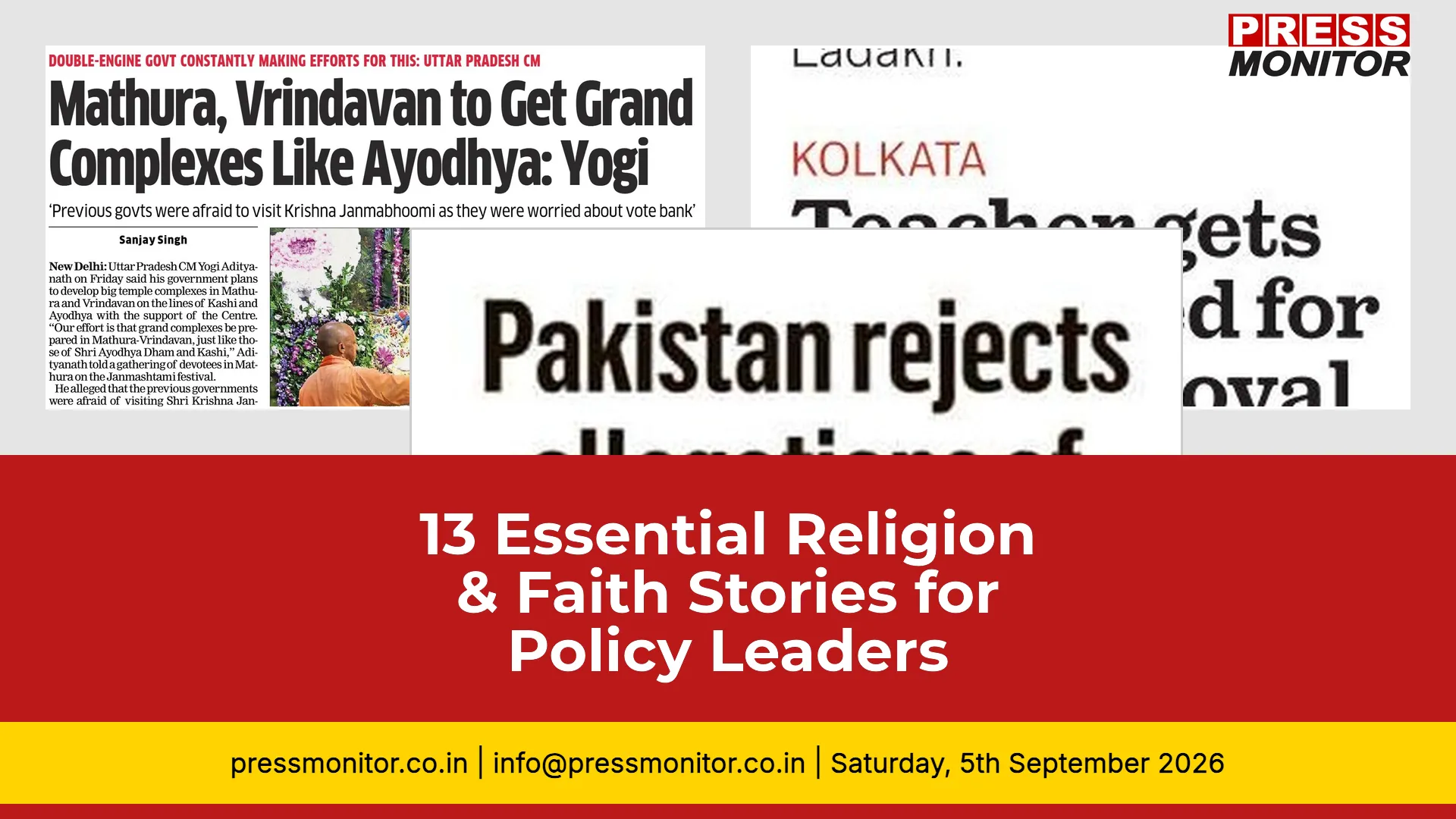
According to Press Monitor's tracking of Indian publications, today's print media landscape delivers essential media monitoring insights — this news on religion & faith covers temple development announcements in Uttar Pradesh, constitutional debates over religious expression, and communal tensions across the country. This curated review highlights 13 stories that demand attention from policy leaders, religious institutions, and civil society, offering media intelligence on the forces shaping India's spiritual and political landscape.
1. Yogi Adityanath Unveils Grand Temple Plan
A front-page report in Economic Times says Uttar Pradesh Chief Minister Yogi Adityanath announced plans to develop grand temple complexes in Mathura and Vrindavan, mirroring the recent infrastructure and religious developments in Ayodhya and Kashi. Speaking at a Janmashtami gathering, Adityanath praised the transformative growth of Ayodhya Dham, highlighting new transport links and daily pilgrimage numbers reaching up to one hundred thousand visitors. He also criticised former administrations for avoiding the region due to electoral concerns while emphasising the enduring strength of Sanatan traditions.
Why it matters: Uttar Pradesh's temple development plans signal a major shift in religious infrastructure policy and could reshape pilgrimage tourism across the region.
Key detail: Up to 100,000 daily pilgrims visiting Ayodhya Dham; new transport links announced for Mathura and Vrindavan temple complexes.
Source: Economic Times, Delhi, September 5, 2026
Next step: Watch for state budget allocation announcements for temple corridor projects and their impact on regional economic development.
2. West Bengal Teacher Tilak Row
A front-page report in Free Press Journal says a private missionary school in Kolkata suspended a teacher on Friday after a student alleged in a video that she repeatedly wiped a sandalwood tilak from his forehead, leading to a first information report and debate over religious freedom in educational institutions. In Hyderabad, two groups of engineering students at Jawaharlal Nehru Technological University clashed in hostel areas around nine in the evening on Thursday and again after midnight, prompting three cases, a student protest and custody of nineteen students.
Why it matters: The suspension of a teacher over a tilak dispute raises urgent questions about religious freedom in educational institutions and the boundaries of disciplinary action.
Key detail: FIR lodged against the teacher; student video went viral; school secretary defended the teacher's actions citing sweat smudging the mark.
Source: Free Press Journal / Indian Express / Hindustan Times, Kolkata, September 4-5, 2026
Next step: Monitor whether the state government issues formal guidelines on religious symbols in schools and how this affects teacher conduct policies.
3. Pakistan Denies Hindu Temple Demolition
A front-page report in Deccan Herald says Pakistan rejected allegations that a century-old Hindu temple in Narowal was deliberately demolished by religious zealots, asserting instead that the structure was damaged by torrential rains on July 21. India condemned the incident and demanded an immediate investigation and restoration measures, which Islamabad dismissed as a politically motivated falsehood.
Why it matters: The Indo-Pak diplomatic row over a century-old Hindu temple in Narowal highlights ongoing tensions around religious heritage protection across borders.
Key detail: Pakistan asserts the temple was damaged by torrential rains, not deliberate demolition; India demands immediate investigation and restoration.
Source: Deccan Herald, Islamabad, September 5, 2026
Next step: Track whether the Foreign Office escalates the demand for an international investigation or seeks bilateral mediation.
4. Kanthapuram Denies Women Face Lower Status
A front-page report in Free Press Journal says Islamic scholar Kanthapuram A. P. Aboobacker Musliar has rejected suggestions that his organisation consigns women to a secondary role, stating it neither advocates their confinement nor denies them education and opportunity. Addressing a programme in Thrissur on Thursday, September 3, he clarified that institutions associated with his group include schools and madrasas exclusively for girls and women, with women serving as teachers in some. The clarification followed criticism over comments he made while defending guidelines issued for religious programmes organised by bodies linked to his faction of Samastha Kerala Jamiyyathul Ulama, which sought restrictions on young women sharing public stages or mingling with unrelated men during religious events.
Why it matters: The clarification from Islamic scholar Kanthapuram on women's roles follows widespread criticism and reignites the debate on gender equity within religious institutions.
Key detail: Kanthapuram stated his organisation neither advocates women's confinement nor denies them education; institutions include schools and madrasas exclusively for girls and women.
Source: Free Press Journal, Thiruvananthapuram, September 3, 2026
Next step: Observe whether Kerala's political parties use this clarification to advance or block gender equity legislation in religious educational institutions.
5. Ram Mandir Trust Overhaul After Theft Scandal
A front-page report in Free Press Journal says the Shri Ram Janmabhoomi Teerth Kshetra Trust is undergoing a major administrative overhaul after controversy over the alleged theft of devotees' offerings in Ayodhya. Newly appointed General Secretary Govind Dev Giri defended former secretary Champat Rai, calling his intentions spotless while acknowledging lapses in judgement and administrative oversight that led to Rai's resignation. The trust has appointed retired Air Marshal Jeetendra Mishra as its first CEO and promised stronger checks, transparency, and decentralised responsibilities to restore devotees' confidence in the management of temple offerings.
Why it matters: The administrative overhaul of the Shri Ram Janmabhoomi Teerth Kshetra Trust, including the appointment of a retired Air Marshal as CEO, signals a new era of governance for one of India's most significant religious institutions.
Key detail: Former secretary Champat Rai resigned; new CEO Jeetendra Mishra appointed; stronger checks and transparency promised.
Source: Free Press Journal, Ayodhya, September 5, 2026
Next step: Monitor the trust's implementation of decentralised responsibilities and whether donor confidence is restored in the coming months.
6. Hijab Question Is Constitutional
A front-page report in Deccan Herald says the Allahabad High Court recently denied a minor Muslim student permission to wear the hijab with her school uniform while seeking admission to Class XI. The court held that she failed to establish the hijab as an obligatory Islamic practice and that its prohibition did not interfere with the core of her faith. The judgment has revived the constitutional debate over religious expression in educational institutions, especially as the Supreme Court has yet to settle the underlying question.
Why it matters: The Allahabad High Court's ruling on a Muslim student's hijab admission request revives the constitutional debate over religious expression in educational institutions, with the Supreme Court yet to settle the underlying question.
Key detail: The court held the student failed to establish the hijab as an obligatory Islamic practice; prohibition did not interfere with the core of her faith.
Source: Deccan Herald, September 5, 2026
Next step: Watch for potential Supreme Court intervention or appeals that could set a national precedent on religious attire in schools.
7. Mirwaiz Prevented from Leading Friday Prayers
A front-page report in Economic Times says Mirwaiz Umar Farooq was placed under house arrest in Srinagar on Friday while attempting to address the congregation at Jama Masjid. The Hurriyat leader described the incident as punishment for voicing public concerns, while also reflecting on separatist leader Yasin Malik's ongoing court case and his commitment to maintaining innocence.
Why it matters: The house arrest of Hurriyat leader Mirwaiz Umar Farooq at Srinagar's Jama Masjid raises concerns about religious freedom and political restrictions on clergy in Jammu & Kashmir.
Key detail: Mirwaiz described the incident as punishment for voicing public concerns; Yasin Malik's ongoing court case was also referenced.
Source: Economic Times, Srinagar, September 5, 2026
Next step: Track whether the Hurriyat or other Kashmiri religious leaders issue formal statements or legal challenges against the restriction.
8. Christian Groups Halt Prayers After Attacks
A front-page report in Indian Express says Christian groups across several West Bengal districts have suspended house prayers following a series of mob attacks targeting prayer meetings and burials. The incidents, spanning Howrah, Purba Bardhaman, and South twenty four Parganas over late August and early September, involve allegations of forced conversions and violent disruptions. Local authorities are investigating as religious leaders and community members seek legal protection amid rising communal tensions.
Why it matters: The suspension of house prayers by Christian groups in West Bengal following mob attacks signals deepening communal tensions and a crisis of safety for minority religious communities.
Key detail: Incidents spanned Howrah, Purba Bardhaman, and South 24 Parganas over late August and early September; allegations of forced conversions and violent disruptions.
Source: Indian Express, Kolkata, September 4, 2026
Next step: Monitor whether local authorities announce protective measures or legal reforms to safeguard minority religious gatherings.
9. Koti Tirth Corridor Project Launched In Goa
A front-page report in Indian Express says Goa Chief Minister Pramod Sawant launched the Koti Tirth Corridor Development Project at Divar on Friday. He stated that nearly 1,000 temples were destroyed by the Portuguese and that the Kadamba dynasty period from the 10th to 14th centuries was Goa's true golden era. The project includes constructing a new Saptakoteshwar temple at the historic site in Naroa, Divar, where the original was destroyed in the 16th century.
Why it matters: Goa's Koti Tirth Corridor Development Project represents a significant state-level initiative to restore and preserve Hindu religious heritage, with nearly 1,000 temples reportedly destroyed by the Portuguese.
Key detail: New Saptakoteshwar temple to be constructed at the historic site in Naroa, Divar, where the original was destroyed in the 16th century.
Source: Indian Express, Panaji, September 4, 2026
Next step: Watch for tourism and heritage funding announcements linked to the corridor project and its impact on Goa's religious tourism economy.
10. 84 Groups Register For Kumbh Mela
A front-page report in Free Press Journal says eighty-four religious and charitable organisations have completed online registration for the Simhastha Kumbh Mela through a new electronic system. Nashik District Collector Ayush Prasad confirmed that verification has begun following applications submitted between the nineteenth of August and the third of September twenty twenty six. While eligible groups may receive up to fifteen lakh rupees in state infrastructure support, authorities clarified that no funds have yet been sanctioned or distributed.
Why it matters: The digital registration of 84 religious and charitable organisations for the Simhastha Kumbh Mela reflects the growing formalisation of religious event management and state support for faith-based gatherings.
Key detail: Verification begun following applications submitted between August 19 and September 3, 2026; eligible groups may receive up to 15 lakh rupees in state infrastructure support.
Source: Free Press Journal, Nashik, September 5, 2026
Next step: Monitor the distribution of infrastructure support funds and whether the electronic registration system becomes a model for other religious festivals.
11. Dalai Lama Returns to Dharamshala
A front-page report in Deccan Herald says the Tibetan spiritual leader returned to Dharamshala after spending over two months in Ladakh. Kangra's Gaggal airport in Himachal Pradesh received him on Friday, according to PTI.
Why it matters: The Tibetan spiritual leader's return to Dharamshala after over two months in Ladakh underscores the continued significance of Dharamshala as a centre of Buddhist spiritual leadership and exile governance.
Key detail: Kangra's Gaggal airport in Himachal Pradesh received the Dalai Lama on Friday, according to PTI.
Source: Deccan Herald, September 5, 2026
Next step: Track any announcements from the Tibetan government-in-exile or the Dalai Lama's office regarding upcoming spiritual or political engagements.
12. Women Journalists Assaulted at Police Station
A front-page report in Millennium Post says two women journalists alleged they were assaulted at a south Delhi police station and plan to approach the Delhi High Court seeking CCTV footage. The journalists claim discriminatory treatment based on their Muslim identity, while police deny the allegations, citing obstruction of a VVIP route.
Why it matters: The alleged assault of two women journalists at a south Delhi police station, with claims of discriminatory treatment based on Muslim identity, raises critical questions about press freedom and religious bias in law enforcement.
Key detail: Journalists plan to approach the Delhi High Court seeking CCTV footage; police deny allegations citing obstruction of a VVIP route.
Source: Millennium Post, New Delhi, September 4, 2026
Next step: Monitor the Delhi High Court's response to the CCTV footage request and whether the incident triggers broader discussions on journalist safety and religious discrimination in policing.
13. CPM Leader Calls Krishna Jayanti an RSS Project
A front-page report in Free Press Journal says CPM leader P Jayarajan described Sree Krishna Jayanti shobhayatras in Kerala as part of a political project of the Rashtriya Swayamsevak Sangh. He alleged the processions were intended to consolidate the organisation's influence among families across the State during celebrations on 4 September. Jayarajan contrasted the widespread processions with older public celebrations such as Sree Narayana Guru's birth anniversary.
Why it matters: The CPM leader's characterization of Sree Krishna Jayanti shobhayatras as an RSS political project highlights the growing politicisation of religious festivals in Kerala and the deepening ideological divide between left parties and Hindu nationalist organisations.
Key detail: P Jayarajan alleged the processions were intended to consolidate RSS influence among families; contrasted with older public celebrations like Sree Narayana Guru's birth anniversary.
Source: Free Press Journal, Kochi, September 4, 2026
Next step: Observe whether Kerala's political parties respond with counter-narratives or policy proposals regarding religious procession permits and public funding.
Closing question: As India's religious landscape evolves amid infrastructure development, constitutional debates, and communal tensions, how will print media continue to serve as the authoritative record of these defining moments?