13 Essential Startup Stories for Entrepreneurs


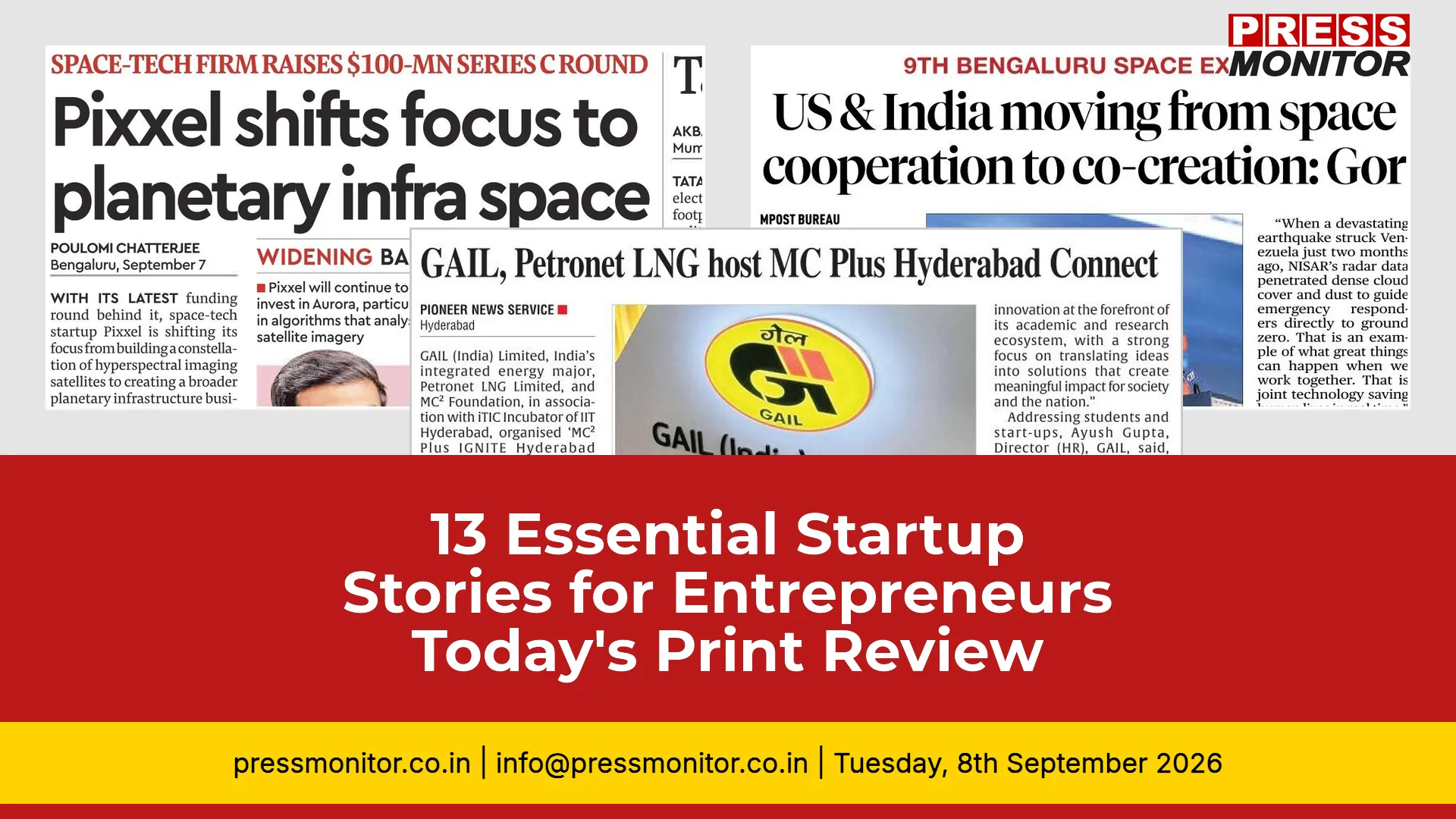
According to Press Monitor's tracking of Indian publications, this press review delivers 13 essential startup and entrepreneurship stories that every founder, investor, and ecosystem builder needs to know. From record-breaking space-tech funding to policy shifts reshaping the innovation landscape, this media intelligence report covers the developments that will define tomorrow's business headlines through print media monitoring. These stories are news on startups that demand immediate attention.
1. Pixxel Raises $100 Million in Series C
A front-page report in Financial Express says space-tech startup Pixxel raised a $100 million Series C funding round on Monday and is shifting focus from building a hyperspectral imaging satellite constellation to a broader planetary infrastructure business spanning sensing, data intelligence, and spacecraft systems. Co-founder Awais Ahmed stated that the fresh capital will improve cash flows and revenue, expand the satellite constellation, scale manufacturing, and unlock additional debt financing using already secured contracts. The Bengaluru-based company plans to continue investing in its Aurora Earth intelligence platform and accelerate satellite manufacturing through its Gigapixxel facility, with India remaining the manufacturing anchor while expanding internationally. Pixxel founder Awais Ahmed is leading India's space-tech ambitions after the Bengaluru-based satellite imaging startup raised $100 million in its Series C round — the single largest funding round by a space technology company in India. Why it matters: This capital infusion signals global confidence in Indian deep-tech and positions Pixxel as a planetary infrastructure leader. Key detail: Total funding now stands at $195 million, with Temasek, Seraphim, 360 ONE Asset, and IMM Investment joining the round. Source: Financial Express, 7 September. Next step: Watch for Pixxel's expansion of the Aurora Earth intelligence platform and Gigapixxel manufacturing facility. How will this reshape India's share of the global space economy?
2. US and India Move from Cooperation to Co-Creation in Space
A front-page report in Millennium Post says that US Ambassador Sergio Gor addressed the ninth Bengaluru Space Expo and declared that the United States and India are moving beyond cooperation to co-creation in the space sector. He said the two nations are jointly designing instruments, co-funding startups, and co-authoring the future of human discovery. Gor highlighted the TRUST initiative established by President Trump and Prime Minister Modi, and noted that NISAR satellite data helped emergency responders during the Venezuela earthquake. US Ambassador Sergio Gor declared at the Bengaluru Space Expo that Washington and New Delhi are shifting from cooperation to co-creation in the space sector. Why it matters: This signals a new era of joint technology development, co-funded startups, and shared infrastructure. Key detail: The TRUST initiative and NISAR satellite data collaboration were highlighted, with NASA and ISRO working together on the Moon Base Programme. Source: Millennium Post, 7 September. Next step: Indian space startups should prepare for expanded access to the American market and joint venture opportunities.
3. MC Plus IGNITE Hyderabad Connect Brings Energy and Startups Together
A front-page report in The Pioneer says GAIL (India) Limited, Petronet LNG Limited, and MC2 Foundation, in association with the iTIC Incubator of IIT Hyderabad, organised MC Plus IGNITE Hyderabad Connect at IIT Hyderabad. Anil K Khandelwal, former CMD of Bank of Baroda, delivered the keynote address while Deepak Gupta, Chairman and Managing Director of GAIL, Akshay Kumar Singh, MD and CEO of Petronet LNG Limited, Professor BS Murty, Director of IIT Hyderabad, and Ayush Gupta, Director of HR at GAIL, graced the event. The event featured a panel discussion on innovation and the startup ecosystem and MC2 Plus is India's flagship energy innovation accelerator envisioned by the Ministry of Petroleum and Natural Gas in collaboration with leading energy-sector organisations. GAIL, Petronet LNG, and MC2 Foundation partnered with iTIC Incubator at IIT Hyderabad to host MC Plus IGNITE Hyderabad Connect. Why it matters: Energy-sector innovation is increasingly dependent on startup collaboration. Key detail: Former Bank of Baroda CMD Anil K Khandelwal delivered the keynote, emphasising customer-centricity and digital transformation. Source: The Pioneer, Hyderabad. Next step: Energy startups should engage with MC2 Plus, India's flagship energy innovation accelerator.
4. Late-Stage Startup Funding Falls 38% in India
A front-page report in Economic Times says late-stage startup funding in India fell 38% year-on-year to five point six billion dollars in two thousand twenty-five to twenty-twenty-six, with firms closing rounds at smaller sizes and lower valuations. Investors are taking longer to commit capital and demanding stronger operating performance, while some proposed raises have been shelved entirely. Companies including Navi, Yulu, and BookMyShow have seen deal sizes narrowed or valuations cut during extended negotiations. Late-stage startup funding in India dropped 38% year-on-year to $5.6 billion in FY2025-26, with investors demanding stronger operating performance. Why it matters: This trend affects valuations and deal sizes across the startup ecosystem. Key detail: Companies including Navi, Yulu, and BookMyShow have seen deal sizes narrowed or valuations cut during extended negotiations. Source: Economic Times, 18 July. Next step: Founders should prepare for extended fundraising timelines and leaner valuations.
5. Swiggy Sells Lynk Logistics to Udaan for Rs 500 Crore
A front-page report in Times of India says Swiggy is selling its retail distribution platform Lynk Logistics to B2B e-commerce startup Udaan in a share-swap transaction valued at Rs 500 crore. Swiggy will acquire a 2.8% stake in Udaan and inject Rs 75 crore in cash for an additional 0.4% stake, bringing its total holding to 3.2%. The deal strengthens Udaan's distribution platform and gives it deeper access to key markets like Bengaluru, Hyderabad, Chennai, and Kolkata. Swiggy is selling its retail distribution platform Lynk Logistics to B2B e-commerce startup Udaan in a share-swap transaction valued at Rs 500 crore. Why it matters: This M&A reshapes India's logistics and distribution landscape. Key detail: Swiggy acquires a 2.8% stake in Udaan and injects Rs 75 crore for an additional 0.4% stake, bringing its total holding to 3.2%. Source: Times of India, 18 July. Next step: Monitor how Udaan leverages Lynk's distribution network across Bengaluru, Hyderabad, Chennai, and Kolkata.
6. IISc Incubator Targets 300 DeepTech Startups by 2030
A front-page report in Deccan Herald says the Foundation for Science, Innovation and Development, the DeepTech and deep science company by the Indian Institute of Science, has appointed Omprakash Subbarao as its new CEO. The appointment aims to bring greater industry orientation and targets a portfolio of 300 deep science and DeepTech startups by 2030. The Foundation for Science, Innovation and Development at IISc has appointed Omprakash Subbarao as CEO, targeting 300 deep science and DeepTech startups by 2030. Why it matters: India's premier research institution is doubling down on startup creation. Key detail: The appointment aims to bring greater industry orientation to the incubator. Source: Deccan Herald, 18 July. Next step: DeepTech founders should explore IISc's incubation pipeline for mentorship and funding access.
7. India and US Collaborate on Moon Base Programme
A front-page report in Business Standard says India and the United States will collaborate to expand the space economy and join the Moon Base programme, with US Ambassador Sergio Gor inviting Indian startups to explore opportunities in the American market. NASA has officially invited ISRO to join the Moon Base programme, while India plans to land its first astronauts on the Moon by 2040 and launch up to 300 more satellites in the next seven years. ISRO Chairman V Narayanan highlighted the need for more foreign tie-ups and private-sector participation to increase India's share in the global space economy from the current 2 percent, noting that ISRO is targeting six more missions this year including the first uncrewed Gaganyaan flight. India and the United States will collaborate on the Moon Base programme, with ISRO targeting six more missions this year including the first uncrewed Gaganyaan flight. Why it matters: India's space ambitions are accelerating with international partnerships. Key detail: India plans to land its first astronauts on the Moon by 2040 and launch up to 300 more satellites in seven years. Source: Business Standard, 7 September. Next step: Space startups should align with ISRO's roadmap for maximum opportunity.
8. Agnikul Opens Two Units for Reusable Rockets
A front-page report in Business Standard says Agnikul Cosmos inaugurated two new units at its Chennai facility to test reusable rocket stages and manufacture launch vehicle components in-house. The stage testing and inspection facility and the Pressurant Tank Realization, Overwrapping and Outfitting Facility were inaugurated in the presence of Gaganyaan astronaut Group Captain Shubhanshu Shukla. Agnikul is now the only Indian private space company with in-house post-flight requalification infrastructure. Agnikul Cosmos inaugurated two new units at its Chennai facility for testing reusable rocket stages and manufacturing launch vehicle components. Why it matters: Agnikul is now the only Indian private space company with in-house post-flight requalification infrastructure. Key detail: Gaganyaan astronaut Group Captain Shubhanshu Shukla attended the inauguration. Source: Business Standard, 7 September. Next step: Reusable rocket technology could dramatically lower launch costs for Indian startups.
9. GalaxEye Wins US Patent for OptoSAR Satellite Imaging
A front-page report in Business Standard says GalaxEye, an Indian space technology company, has been granted a US patent for its OptoSAR imaging technology, making it the first Indian startup to receive a US patent for satellite imaging. The patent covers the core invention for aligning and synchronising optical and microwave sensors for simultaneous data acquisition. The company plans to scale towards a 30-satellite constellation over the next five years. GalaxEye became the first Indian startup to receive a US patent for satellite imaging, covering its OptoSAR technology for aligning optical and microwave sensors. Why it matters: IP protection is critical for deep-tech startups seeking global markets. Key detail: The company plans to scale towards a 30-satellite constellation over five years. Source: Business Standard, 7 September. Next step: GalaxEye's patent positions it competitively in the global Earth observation market.
10. Gaja Capital Pivots to India's AI Stack
A front-page report in Business Standard says Gaja Capital is pivoting toward AI and deeptech after building its fund management business over two decades. The firm has invested in Fractal Analytics during a secondary sale and placed approximately 95 crore rupees in Sarvam AI, while also evaluating intelligent manufacturing and quantum computing. Gaja Capital is investing in India's AI and deep-tech ecosystem, placing approximately 95 crore rupees in Sarvam AI and investing in Fractal Analytics during a secondary sale. Why it matters: Asset managers are increasingly targeting AI and deep-tech as the next growth frontier. Key detail: The firm is also evaluating intelligent manufacturing and quantum computing. Source: Business Standard, 7 September. Next step: AI startups should engage with Gaja Capital for growth equity opportunities.
11. Kartikeya Sharma Announces Panchkula AI Skill Centre
A front-page report in Statesman says Rajya Sabha Member of Parliament Kartikeya Sharma announced plans to establish an Artificial Intelligence Skill Centre in Panchkula on seven September. Addressing a youth dialogue programme, he emphasized equipping young people with emerging technological skills to foster entrepreneurship and new business models. Rajya Sabha MP Kartikeya Sharma announced plans to establish an Artificial Intelligence Skill Centre in Panchkula to equip young people with emerging technological skills. Why it matters: Government-backed skilling initiatives can fuel entrepreneurship in emerging tech. Key detail: The announcement was made at a youth dialogue programme on 7 September. Source: Statesman, 7 September. Next step: Young entrepreneurs in Haryana should explore the Panchkula AI Centre for training and mentorship.
12. Bengali Cuisine Goes Global Through Speciality Restaurants
A front-page report in Business Standard says Anjan Chatterjee, founder and chairman of Speciality Restaurants, talks about his journey from Only Fish to OhI Calcutta and his ambition to take Bengali cuisine to a global audience. He discusses food safety, regulatory hurdles, and the need for a single-window clearance system in the hospitality sector. Nearly twenty-nine per cent of his turnover comes from deliveries. Anjan Chatterjee, founder and chairman of Speciality Restaurants, is taking Bengali cuisine to a global audience through brands like Only Fish and OhI Calcutta. Why it matters: Food entrepreneurship is navigating regulatory hurdles and scaling through delivery channels. Key detail: Nearly 29% of turnover comes from deliveries, and Chatterjee advocates for a single-window clearance system in hospitality. Source: Business Standard, Kolkata. Next step: Hospitality entrepreneurs should watch for regulatory reform that could ease expansion.
13. West Bengal Launches Rs 70,000 Crore Reform Drive
A front-page report in Business Standard says West Bengal Finance Minister Swapan Dasgupta unveiled a comprehensive reform agenda targeting power sector liberalisation, global capability centres, and startup promotion during a Kolkata roundtable on Monday. Facing inherited liabilities of around eight trillion rupees, the state plans to leverage approximately seventy thousand crore rupees in central scheme funding while addressing critical challenges like land acquisition and building regulations to attract major domestic corporate houses. West Bengal Finance Minister Swapan Dasgupta unveiled a comprehensive reform agenda targeting power sector liberalisation, global capability centres, and startup promotion. Why it matters: State-level economic reforms create new opportunities for entrepreneurs and investors. Key detail: The state plans to leverage approximately 70,000 crore rupees in central scheme funding while addressing challenges like land acquisition and building regulations. Source: Business Standard, Kolkata, 7 September. Next step: Startups should monitor how West Bengal's reform agenda opens new markets and incentives.
According to Press Monitor's tracking of Indian publications, these 13 stories reflect a dynamic startup ecosystem where space technology, AI, energy innovation, and policy reform are converging. Which story will have the biggest impact on your business this week?