13 Essential Water Stories for Infrastructure Leaders


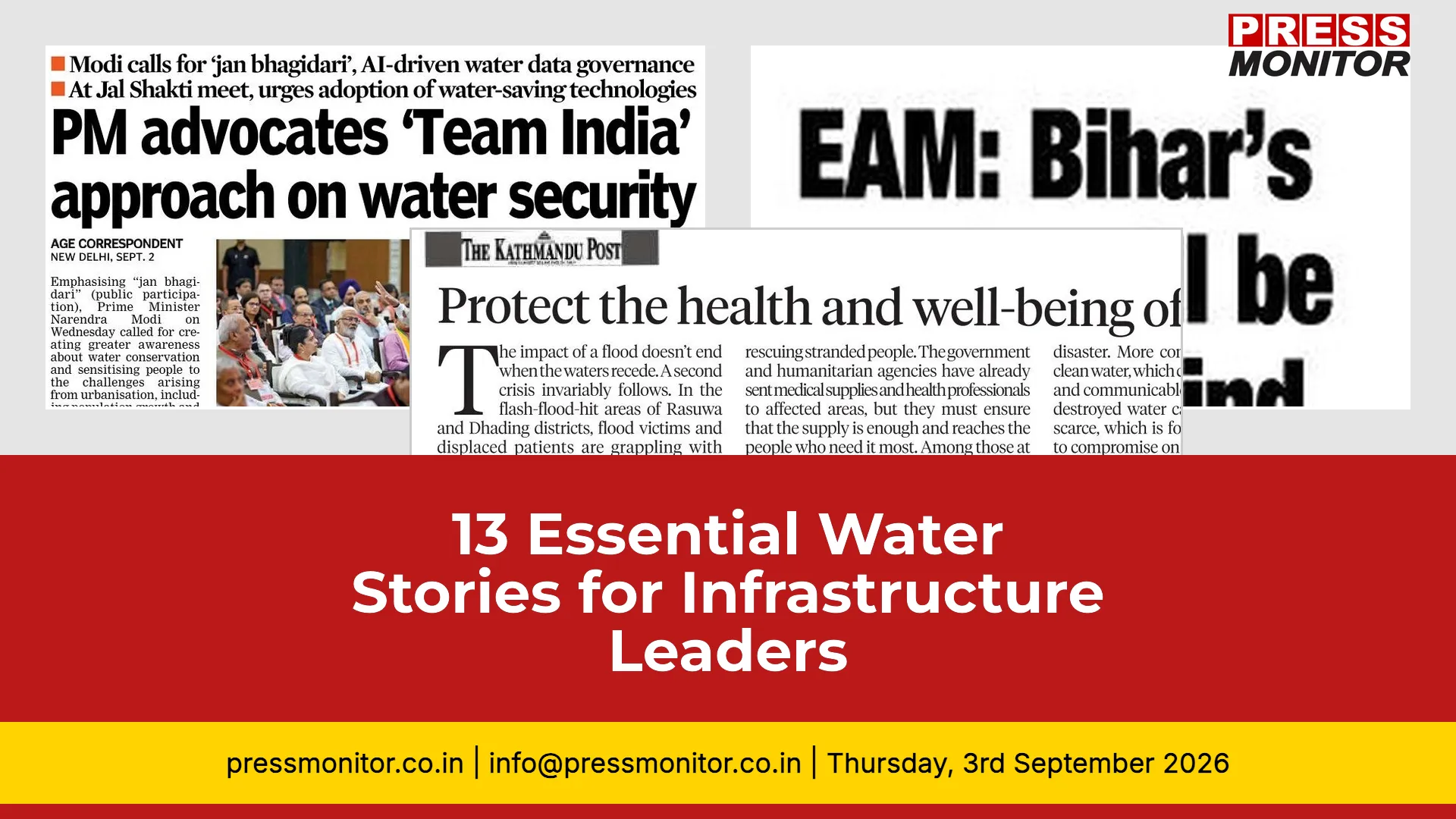
According to Press Monitor's tracking of Indian publications, this media monitoring report covers 13 essential stories on water and wastewater from today's print media. From PM Modi's AI-driven water governance push to the Minjur desalination plant and the Farakka treaty renewal, this press review delivers media intelligence on the developments shaping India's water future. These news on water stories matter for infrastructure leaders, policymakers, and anyone tracking India's most critical resource.
1. PM Modi Champions AI-Driven Water Governance at National Summit
A front-page report in Asian Age says Prime Minister Narendra Modi chaired the valedictory session of a two-day national departmental summit on water organised by the Ministry of Jal Shakti in New Delhi on Wednesday. He called for greater 'jan bhagidari' (public participation) in water conservation, wider adoption of water-saving technologies and artificial intelligence-driven water data governance. The Prime Minister also urged a 'Team India' approach to deepen cooperative federalism between the Centre and the states on water security.
Why it matters: The Prime Minister's call for AI-driven water data governance and anticipatory planning signals a paradigm shift in how India manages water scarcity. This is the most covered story across Indian print media today.
Key detail: PM Modi chaired the valedictory session of the two-day National Departmental Summit on Water organised by the Ministry of Jal Shakti, urging greater public participation, water-saving technologies, and a Team India approach to cooperative federalism.
Source: Asian Age, Hindustan Times, First India, Indian Express, Deccan Chronicle
Next step: Tracked by Press Monitor for real-time updates on policy implementation.
2. Jaishankar Assures Bihar on Farakka Treaty Renewal
A front-page report in Asian Age says external affairs minister S. Jaishankar has assured JD(U) working president and Rajya Sabha MP Sanjay Kumar Jha that Bihar's water requirements will be taken into account before the government decides on the renewal of the Farakka (Ganga) Water Treaty with Bangladesh. The treaty, signed in 1996, is due to expire in December this year. In a letter dated 28 August, Jaishankar said interministerial discussions led by the ministry of Jal Shakti, with various stakeholders, have been held to discuss the treaty's implementation and future.
Why it matters: The Ganga Water Treaty with Bangladesh expires in December 2026, and Bihar's drinking water and industrial needs are at the centre of the renewal debate.
Key detail: External Affairs Minister S. Jaishankar assured JDU working president and Rajya Sabha MP Sanjay Kumar Jha that any decision will keep Bihar's water requirements in mind. Interministerial discussions led by the Ministry of Jal Shakti have been held.
Source: Asian Age
Next step: Watch for parliamentary debate on treaty renewal in the coming weeks.
3. Nepal Flood Survivors Face Health Crisis
A front-page report in Statesman says survivors of the flash flood that struck the Bhotekoshi River on August 26, killing more than 700 people, are grappling with shortages of essential medicines, unsafe water and poor sanitation in Nepal's Rasuwa and Dhading districts and Nuwakot. It warns that vulnerable groups, including people with chronic illnesses, pregnant women, children and older people, risk a second crisis, citing UNICEF's estimate that more than 17,000 children need urgent humanitarian assistance. The report urges the government to ensure uninterrupted healthcare, clean drinking water and sanitation for survivors, calling them a fundamental right of citizens.
Why it matters: Over 700 people killed in the Bhotekoshi flash flood, with 17,000 children needing urgent humanitarian assistance according to UNICEF. A second crisis of water contamination and disease is emerging.
Key detail: Survivors in Rasuwa, Dhading, and Nuwakot districts face shortages of essential medicines, unsafe water, and poor sanitation. WHO and UNICEF are deploying portable water-testing kits.
Source: Statesman
Next step: Follow international aid coordination and long-term recovery efforts.
4. Minjur Desal Plant Among ₹14,112 Crore Tamil Nadu Infrastructure Projects
A front-page report in New Indian Express says... Chief Minister C Joseph Vijay announced a slew of urban infrastructure projects worth l4,ll2 crore, including a %4,8OO-crore desalination plant at Minjur, 2,4OO crore for revamping Madurai’s 4O-yearold underground sewerage system, and £l,85O crore for road works across urban local bodies.
Why it matters: Tamil Nadu's urban infrastructure push includes a ₹4,800 crore desalination plant at Minjur, ₹2,400 crore for Madurai's sewerage system, and ₹1,850 crore for road works.
Key detail: Chief Minister C Joseph Vijay announced the slew of projects, signalling a major investment in water infrastructure and urban development across the state.
Source: New Indian Express, Morning Standard
Next step: Monitor tender announcements and project timelines for the Minjur desalination plant.
5. Telangana Groundwater Rises 1.61 Metres Despite Rainfall Deficit
A front-page report in Deccan Chronicle says groundwater levels across Telangana rose by a net average of 1.61 metres, from 9.48 metres below ground level at the end of July to 7.87 metres at the end of August, bucking fears of a fall due to the El Nino-impacted monsoon. The State Groundwater Department's monthly report found rises in 27 of the state's 38 districts, with the highest increase of 4.65 metres in Kamareddy and the lowest of 0.34 metres in Jogulamba Gadwal. Agriculture Department officials said farmers relying on groundwater have kept their crops going despite a 38 per cent rainfall deficit in August, though crop stress could emerge if September remains dry.
Why it matters: Groundwater levels bucked El Nino fears, rising across 27 of 38 districts. Farmers kept crops going despite a 38% rainfall deficit in August.
Key detail: The highest rise of 4.65 metres was in Kamareddy; the lowest of 0.34 metres in Jogulamba Gadwal. Crop stress could emerge if September remains dry.
Source: Deccan Chronicle
Next step: Watch September rainfall data for confirmation of sustained recovery.
6. Rs 1,850 Crore Urban Development Projects Across Tamil Nadu
A front-page report in New Indian Express says that Rs 1850 crore will be spent on various urban development projects across Tamil Nadu. These include sewerage infrastructure, waste-to-energy projects, road repairs, urban greening, and heritage modernisation.
Why it matters: Tamil Nadu is investing in sewerage infrastructure, waste-to-energy projects, road repairs, urban greening, and heritage modernisation.
Key detail: The investment spans multiple urban local bodies and signals a comprehensive approach to sustainable urban development.
Source: New Indian Express
Next step: Track which urban local bodies will receive the largest allocations.
7. Telangana Seeks 152m Tummidihatti Barrage
A front-page report in Deccan Chronicle says Telangana has asked Maharashtra to permit a barrage at Tummidihatti with a full reservoir level of 152 metres, four metres higher than the level agreed in 2016. At a meeting in New Delhi facilitated by the Central Water Commission, Telangana said the higher level would let it nearly double its annual drawal from 43 tmcft to 80 tmcft by moving water entirely by gravity. The project, linking the proposed barrage to the Sundilla barrage via canals and a tunnel, is expected to cost around Rs 12,300 crore.
Why it matters: The proposed barrage could nearly double Telangana's annual drawal from the Godavari River from 43 tmcft to 80 tmcft, reshaping interstate water dynamics.
Key detail: The project linking the barrage to Sundilla barrage via canals and a tunnel is expected to cost around ₹12,300 crore. Telangana wants the full reservoir level raised by 4 metres from the 2016 agreement.
Source: Deccan Chronicle
Next step: Monitor Maharashtra's response and Central Water Commission facilitation talks.
8. Karnataka Seeks Early CWC Nod for Mekedatu Balancing Reservoir
A front-page report in Deccan Herald says Karnataka Water Resources Minister N Chaluvarayaswamy has urged the Central Water Commission to grant early approval for the Mekedatu balancing reservoir project, stressing its critical role in meeting Bengaluru's long-term drinking water needs. The minister met CWC Chairman Anupam Prasad in New Delhi on Wednesday, accompanied by Additional Chief Secretary Gaurav Gupta, to discuss statutory and technical clearances. The proposed reservoir is designed to secure drinking water supplies, generate hydropower and enable regulated downstream releases, with particular value in deficit years.
Why it matters: The reservoir is critical for Bengaluru's long-term drinking water needs, hydropower generation, and regulated downstream releases during deficit years.
Key detail: Karnataka Water Resources Minister N Chaluvarayaswamy met CWC Chairman Anupam Prasad in New Delhi, accompanied by Additional Chief Secretary Gaurav Gupta.
Source: Deccan Herald
Next step: Watch for CWC's statutory and technical clearance timeline.
9. Interstate Committee Formed to Rejuvenate Yamuna
A front-page report in Hindustan Times says the central government has constituted an interstate committee comprising the chief secretaries of five Yamuna basin states to oversee the action plan for rejuvenation of the Yamuna and preventing pollution sources from meeting the river stream.
Why it matters: Pollution sources continue to meet the Yamuna river stream, and a dedicated interstate committee signals renewed focus on river rejuvenation.
Key detail: The committee comprises chief secretaries of five Yamuna basin states and will oversee the action plan for preventing pollution sources from reaching the river.
Source: Hindustan Times
Next step: Monitor the committee's first meeting and action plan rollout.
10. BWSSB Invites Tenders for STP Upgrade in Bangalore
A front-page report in Times of India says the Bangalore Water Supply and Sewerage Board (BWSSSB) has invited tenders for the rehabilitation and upgradation of existing sewage treatment plants (STP) at Munekolalu and Bhattarahalli Lakes.
Why it matters: Rehabilitation and upgradation of sewage treatment plants at Munekolalu and Bhattarahalli Lakes is critical for Bangalore's water quality and public health.
Key detail: BWSSB has formally invited tenders for the STP upgrade, signalling progress on wastewater infrastructure in India's fastest-growing city.
Source: Times of India
Next step: Track tender response rates and expected completion timelines.
11. Telangana Urges National Water Security Framework
A front-page report in Deccan Chronicle says Telangana has urged the Centre and all states to adopt a unified framework for national water security, calling it a public mission rather than a departmental programme. Irrigation minister N. Uttam Kumar Reddy pitched the idea at the Jal Sanchay Jan Bhagidari summit organised by the ministry of jal shakti in New Delhi, saying every rupee spent must produce a measurable and lasting water benefit. He added that Telangana was ready to share its experience in tank restoration, community participation and reservoir desiltation pilots with other states.
Why it matters: Telangana's proposal for a unified national water security framework, pitched as a public mission rather than a departmental programme, could reshape water policy across India.
Key detail: Irrigation minister N. Uttam Kumar Reddy made the pitch at the Jal Sanchay Jan Bhagidari summit, saying every rupee spent must produce a measurable and lasting water benefit.
Source: Deccan Chronicle
Next step: Watch for Centre's response and other states' willingness to adopt the framework.
12. Rajasthan Ministers Attend Jal Shakti Summit
A front-page report in First India says Rajasthan PHED Minister Kanhaiya Lal Choudhary and Water Resources Minister Suresh Rawat attended the two-day Departmental Summit-2026 of the Ministry of Jal Shakti, which concluded at Sushma Swaraj Bhavan in New Delhi on Wednesday. They were accompanied by ACS Hemant Gera and ACS Abhay Kumar, with the summit focusing on the water sector and coordination among states and the Centre. Ministers and senior officials from various states deliberated on key water resources and public health engineering issues, with dinners planned at BJP chief Nitin Nabin's residence and possibly the Prime Minister's residence.
Why it matters: Rajasthan's participation in the National Departmental Summit on Water highlights the state's focus on water policy coordination with the Centre.
Key detail: Rajasthan PHED Minister Kanhaiya Lal Choudhary and Water Resources Minister Suresh Rawat attended, accompanied by ACS Hemant Gera and ACS Abhay Kumar.
Source: First India
Next step: Monitor Rajasthan-specific water policy announcements emerging from the summit.
13. Almatti Dam Nears Full Storage Capacity
A front-page report in Deccan Herald says reservoir storage and flow data for major Karnataka dams shows Almatti nearly full, holding 122.66 tmcft against a capacity of 123.08 tmcft. The figures cover eleven reservoirs including Tungabhadra, Bhadra, Hidkal, Malaprabha, Narayanpura, Vanivilas Sagar, Harangi, Hemavathi, KR Sagar and Kabini. Almatti recorded the highest inflow at 23,339 cusecs against an outflow of 18,386 cusecs.
Why it matters: Almatti reservoir holding 122.66 tmcft against a capacity of 123.08 tmcft signals strong monsoon inflows for Karnataka's water supply and irrigation.
Key detail: Almatti recorded the highest inflow at 23,339 cusecs against an outflow of 18,386 cusecs. Eleven reservoirs across Karnataka were tracked, including Tungabhadra, Bhadra, and Hidkal.
Source: Deccan Herald
Next step: Monitor downstream water releases and irrigation scheduling for the coming weeks.
Which of these water developments will impact your sector most? Follow Press Monitor for daily print media intelligence on India's water and wastewater landscape.