13 Top Agriculture Stories for Agribusiness Leaders


Your daily media monitoring brief from Press Monitor — 360° Indian print media intelligence curated for agriculture executives. Today's press review covers 13 essential stories from across India's largest print publications.
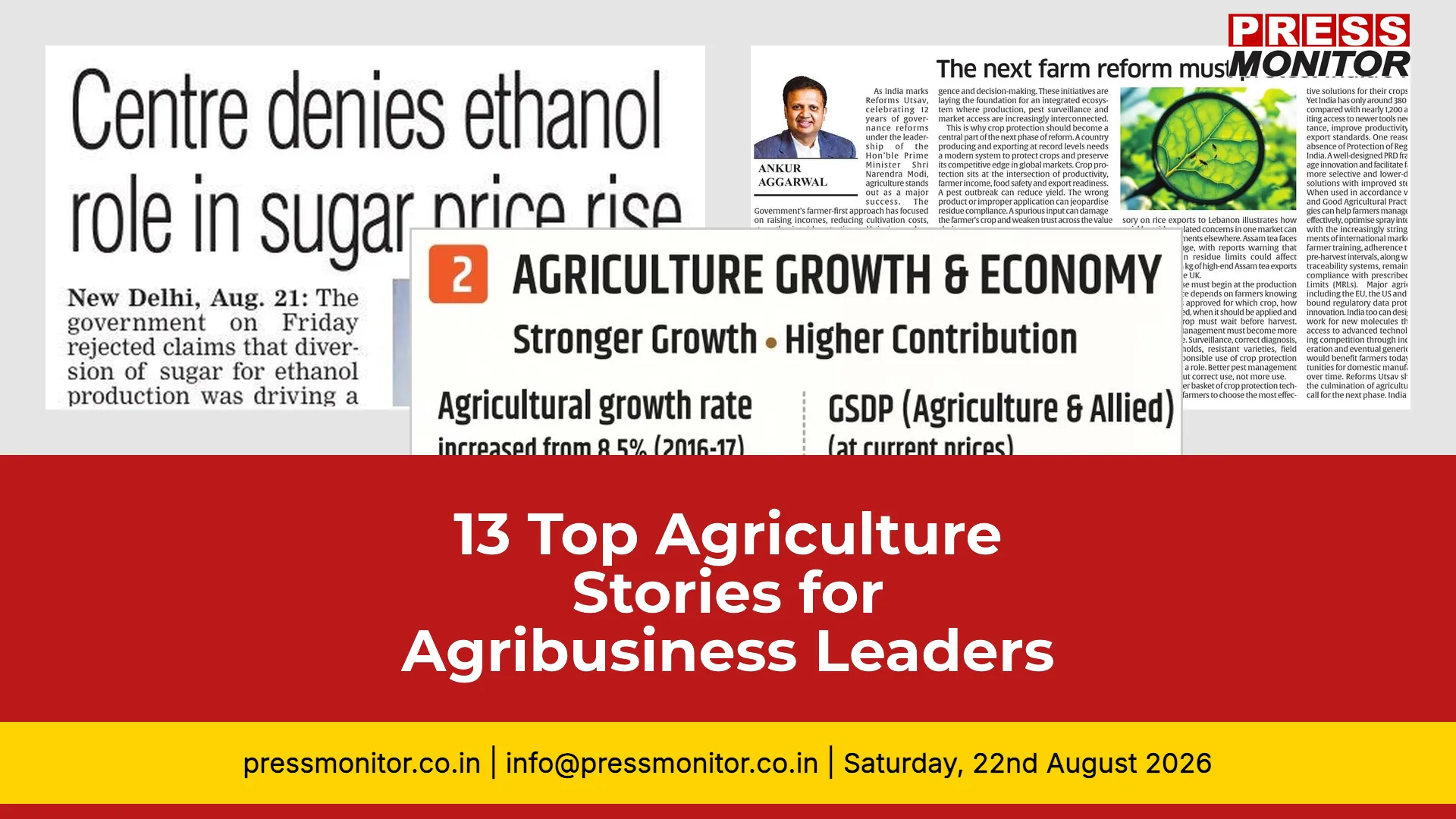
1. Sugar Ethanol Diversion Declines to 9%
A front-page report in Deccan Chronicle says that the share of sugar diverted for making ethanol for doping in petrol has declined to around 9 per cent in the 2025-26 season from about 12 per cent in 2022-23, while nearly three-fourths of India’s ethanol production now comes from grains, particularly maize. The clarification came as retail sugar prices rose to 255.70 a kg on August 20 from 248.18 a kg on July 20. The government attributed the increase to lower-than-expected sugar production, stronger demand ahead of the festive season, weather-related crop damage, tightening global supplies and speculation and hoarding by some sections of the industry.
Why it matters: Changes in ethanol policy directly affect sugar prices and farm profitability.
Key detail: The share of sugar diverted to ethanol dropped from 12% in 2022-23 to 9% in 2025-26, while grain-based ethanol (mostly maize) now accounts for nearly three-fourths of production. Sugar prices rose from ₹48 to ₹67/kg in three months.
Source: Deccan Chronicle (also covered by The Hans India — cross-source count: 2)
Next step: Monitor festive-season demand and government's ethanol blending roadmap.
2. Indian Agriculture Success: Record Foodgrain Production
A front-page report in The Pioneer says India's total foodgrain production is estimated at 376.56 million tonnes in 2025-26, the highest ever in the country’s history. Agricultural exports are projected to reach a record USD 52.55 billion in FY 2025-26.
Why it matters: India's foodgrain output hit an all-time high of 376.56 MT in 2025-26, with agricultural exports projected at $52.55 billion.
Key detail: This record underscores India's self-sufficiency and export competitiveness.
Source: The Pioneer
Next step: Explore export opportunities for your agri-commodities.
3. 8% Agricultural Growth Rate
A front-page report in The Hindu says Agricultural growth rate of GSDP (Agriculture & Allied) increased from 8.5 percent in 2016-17 to 8 percent in 2025-26. Uttar Pradesh contributes 21 percent of India’s foodgrain production, with 76 percent land under agriculture and 86 percent irrigation coverage, producing 40 lakh tonnes of fruits & vegetables annually, ranking first in India.
Why it matters: GSDP growth in agriculture & allied sectors held steady at 8%, with Uttar Pradesh contributing 21% of India's foodgrain.
Key detail: 86% irrigation coverage in UP drives productivity.
Source: The Hindu
Next step: Evaluate supply chain investments in high-growth regions.
4. Sugar Prices Rise on Ethanol Policy
A front-page report in The Hindu says diversion of sugar cane and foodgrains to ethanol production is driving food prices higher, with sugar prices rising from Rs 48 to Rs 67 a kg over the last three months. The Congress demanded an immediate review of the E2O fuel policy and questioned why petrol prices were not reduced despite falling global crude rates.
Why it matters: Food inflation concerns mount as ethanol diversion pushes sugar prices up; Congress demands E20 policy review.
Key detail: Sugar rose from ₹48 to ₹67/kg; global crude dip not passed to petrol consumers.
Source: The Hindu
Next step: Track policy debates that could impact feedstock costs.
5. Soybean Oil Imports May Surge
A front-page report in Business Line says that soybean oil imports could jump sharply in August due to various factors, according to Sanjeev Asthana, President of the Solvent Extractors’ Association of India (SEA).
Why it matters: SEA president Sanjeev Asthana flags potential import jump in August, affecting domestic oilseed prices.
Key detail: Factors include global supply dynamics and domestic demand.
Source: Business Line
Next step: Assess your exposure to edible oil price volatility.
6. Palm Oil Prices Hit 20-Month High
A front-page report in Amar Ujala says that the sharp increase in palm oil prices due to reduced production in Indonesia has raised concerns in India. The rise in palm oil prices, driven by Indonesia’s biofuel policy and drought in Southeast Asia, has reached a 20-month high, impacting global markets. This increase could significantly affect India, a major importer of edible oils, which relies on palm oil imports for about 90% of its needs.
Why it matters: Indonesia's biofuel policy and SE Asia drought drive palm oil to 20-month highs; India imports ~90% of its palm oil.
Key detail: This will stoke food inflation in a country heavily reliant on imports.
Source: Amar Ujala
Next step: Hedge against edible oil price risks.
7. Oilseeds Ease as Demand Thins
A front-page report in Free Press Journal says India’s oilseed complex traded with a softer undertone as sluggish crushing demand and increased arrivals pressured soybean and groundnut quotations, while mustard displayed a mixed bias across Rajasthan’s benchmark physical markets.
Why it matters: Soybean and groundnut prices soften on sluggish crushing demand; mustard mixed.
Key detail: Increased arrivals pressure spot markets.
Source: Free Press Journal
Next step: Rebalance procurement strategies based on regional trends.
8. India-Singapore Boost Ties in Agriculture & Food Trade
A front-page report in Business Line says India and Singapore are set to deepen cooperation in semiconductors, digital connectivity, fintech, green hydrogen, healthcare and industrial parks while working to strengthen trade in agricultural and processed food products.
Why it matters: Bilateral cooperation expands into semiconductors, health, and processed food trade.
Key detail: Strengthened agri-trade protocols will open new export channels.
Source: Business Line
Next step: Leverage trade agreements for processed food exports.
9. National Agricultural Conference Inaugurated by Sri Ravi Shankar
"A front-page report in Deccan Herald says that Sri Ravi Shankar inaugurated the National Agricultural Conference in Kanakapura Road. The event included a book release featuring Vineet Nayar's ‘Humans First Machine Second’ at the Khincha Auditorium, Bharatiya Vidya Bhavan. Additionally, the Book Brahma Literature Festival hosted a sitar recital by Ustad Rafeeq Khan and Ustad Shafeeq Khan and a Carnatic music concert by TS Satyavathi and team."
Why it matters: Leadership insights on farming innovation and sustainability shared at the event.
Key detail: Vineet Nayar's book 'Humans First Machine Second' released; cultural performances highlighted.
Source: Deccan Herald
Next step: Engage with conference takeaways for digital transformation in agri.
10. Rs 15 Crore Agricultural Investment in Khargpur
A front-page report in Dainik Jagran says a Rs 15-crore agricultural investment deal has been finalized in Khargpur district, aiming to enhance yield and infrastructure. Prime Minister inaugurated multiple projects supporting local farming communities as part of the Union’s agrarian expansion initiative.
Why it matters: Government investment aims to boost yield and infrastructure in the district.
Key detail: Part of Union's agrarian expansion initiative; PM inaugurated multiple projects.
Source: Dainik Jagran
Next step: Identify partnership opportunities in government-led agri projects.
11. GDP Outlook Mixed — Erratic Rainfall a Headwind
A front-page report in New Indian Express says India's real GDP growth for the first quarter of the current fiscal year is projected to exceed consensus estimates, driven by resilient private consumption, healthy exports, and robust tax collections. However, the broader economy faces headwinds from soaring oil prices, shifting US tariffs, geo-political uncertainties and erratic rainfall.
Why it matters: Strong Q1 GDP growth but erratic rainfall threatens farm output.
Key detail: Resilient consumption and exports offset by oil prices, tariffs, and weather shocks.
Source: New Indian Express
Next step: Prepare contingency plans for weather-related disruptions.
12. LIC Invites SARFAESI Valuers for Plantations & Agri Land
A front-page report in Business Standard says that fresh applications are invited for empanelment of the SARFAESI Valuers only for valuation of Plantations, Agricultural Dry Lands, Cash Crops, for the period 2026-2031.
Why it matters: Empanelment notice for valuing plantations, dry lands, and cash crops (2026-31).
Key detail: Opens opportunities for agricultural appraisal professionals.
Source: Business Standard
Next step: Apply if your firm handles agricultural asset valuation.
13. Carlsberg India Posts Strong Volume Growth
A front-page report in Free Press Journal says Carlsberg India delivered strong volume growth in the first half of this year. The company's planned India listing has moved a step closer with the pre-filing of a draft red herring prospectus.
Why it matters: Carlsberg's India IPO moves closer; strong H1 growth reflects demand for agricultural inputs (barley, etc.).
Key detail: Pre-filed draft red herring prospectus for listing.
Source: Free Press Journal
Next step: Watch the IPO for agri-supply chain insights.
Closing: Which of these stories will impact your business most? Press Monitor’s daily media monitoring keeps you ahead of the curve — powered by India’s largest print media database. #Agriculture #PressMonitor