14 Essential Rural Development Stories for Leaders


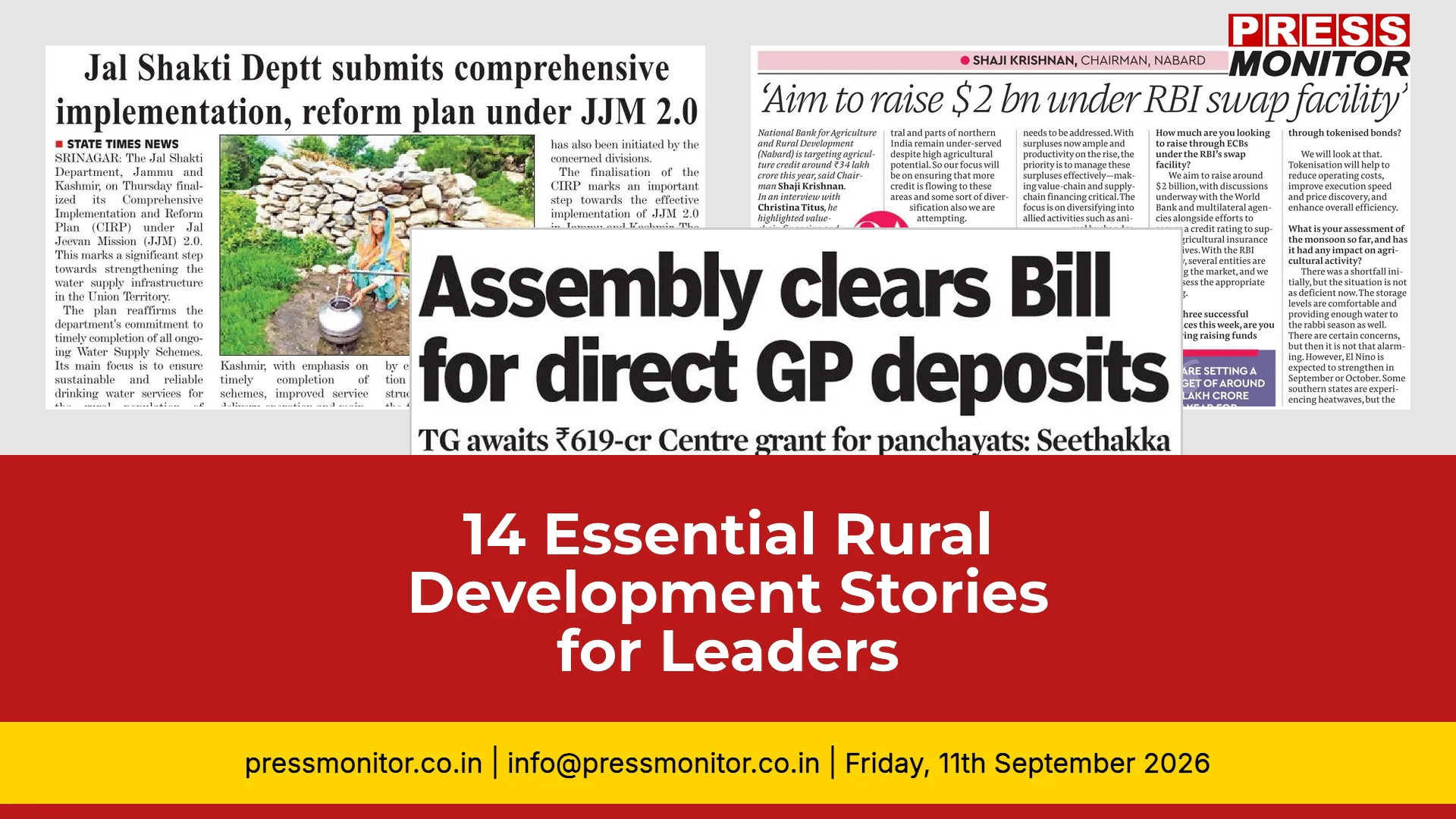
Welcome to this week’s essential press review on rural development. Our advanced media monitoring tracks every major shift in policy, funding, and grassroots innovation. This press review distills 14 high-impact stories so you don’t have to scan dozens of publications. Media intelligence is now faster, grounded in verified print data, and tailored for decision-makers who shape hinterland economies. Here is your briefing on news on rural affairs.
1. Jal Shakti Department Finalises JJM 2.0 Plan
A front-page report in State Times says the Jal Shakti Department in Jammu and Kashmir has finalised its Comprehensive Implementation and Reform Plan under the Jal Jeevan Mission 2.0. The initiative aims to establish sustainable drinking water infrastructure for rural communities through a strategic, time-bound operational framework. Additionally, funds totalling Rs 2,128 crore have been released to PHE divisions to accelerate the rollout and retrofitting of water supply schemes across the region.
Why it matters: Sustainable drinking water remains the backbone of rural revitalization and public health.
Key detail: The Jammu and Kashmir Jal Shakti Department has locked in its Comprehensive Implementation and Reform Plan, backed by Rs 2,128 crore released to PHE divisions for retrofitting and rollout.
Source: State Times
Next step: Track district-wise rollout timelines and community adoption metrics.
2. NABARD Targets Rs 34 Lakh Crore Credit
A front-page report in Financial Express says the National Bank for Agriculture and Rural Development is targeting an agricultural credit of around Rs 34 lakh crore this fiscal year. The institution will concentrate on directing funds to underserved eastern, central, and northern regions while boosting value-chain financing to reduce post-harvest losses. Additionally, the bank aims to raise approximately US dollars 2 billion through external commercial borrowings under the Reserve Bank of India swap facility to support agricultural insurance initiatives.
Why it matters: Agricultural credit flows directly dictate farm economy resilience and post-harvest value chains.
Key detail: The National Bank for Agriculture and Rural Development is steering Rs 34 lakh crore toward underserved eastern, central, and northern regions, while raising US$2 billion via RBI swap facilities for insurance initiatives.
Source: Financial Express
Next step: Monitor lending disbursement rates against crop cycles.
3. Rs 619 Crore Centre Grant For Panchayats
A front-page report in Deccan Chronicle says the Telangana Assembly passed the Telangana Panchayat Raj Fourth Amendment Act, paving the way for direct fund access to gram panchayats from the Centre and state government. The state is awaiting six hundred nineteen crore rupees from the Centre, said Panchayat Raj Minister Danasari Seethakka.
Why it matters: Direct fiscal devolution empowers gram panchayats to execute local infrastructure without bureaucratic delays.
Key detail: The Telangana Assembly passed the Fourth Amendment Act to enable direct fund access, with Minister Danasari Seethakka confirming an awaited Rs 619 crore Centre grant.
Source: Deccan Chronicle
Next step: Watch for state-level implementation guidelines and audit reports.
4. Karnataka Targets SC Over Rs 1,862 Crore
A front-page report in Free Press Journal says the Karnataka government plans to approach the Supreme Court over the Centre’s alleged withholding of Rs 1,862.2 crore allocated to gram panchayats under the 15th Finance Commission. Minister Eshwar Khandre met with legal counsel and senior officials to address the refusal to release funds for the 2025-26 fiscal period. The state faces severe drought conditions causing drinking water shortages across numerous villages.
Why it matters: Inter-governmental fund disputes highlight systemic bottlenecks in rural finance and drought relief.
Key detail: Karnataka plans to approach the Supreme Court regarding withheld Finance Commission allocations for gram panchayats, amid severe village-level water scarcity requiring tanker supplies.
Source: Free Press Journal
Next step: Follow court proceedings and potential budget reallocations.
5. Karnataka Targets Rs 32.8 Lakh Crore Growth
A front-page report in Deccan Herald says that Karnataka Chief Minister Shivakumar aims to boost the state's gross state domestic product to Rs 32.8 lakh crore, aiming to create six lakh jobs through foreign investment and several social programmes. He highlighted health initiatives like tele-ICUs and social justice plans that offer free houses, five lakh sites for SC and ST communities, and fifty thousand jobs for youth from backward communities.
Why it matters: State-level economic expansion hinges on integrating social justice, healthcare, and job creation into rural planning.
Key detail: Chief Minister Siddaramaiah aims to boost GSDP to Rs 32.8 lakh crore, creating six lakh jobs alongside tele-ICU expansions and free housing sites for marginalized communities.
Source: Deccan Herald
Next step: Assess private investment inflows and sector-specific job pipelines.
6. 5 Percent Spectrum Price Approved For Satellites
A front-page report in Business Standard says the Digital Communications Commission has approved spectrum usage pricing at five percent of adjusted gross revenue for satellite internet services in India, offering discounted rates for remote areas. Major providers like Eutelsat One Web, Reliance Jio, and Starlink are awaiting final cabinet approval and security clearances before launching operations. Experts note that resolving these regulatory and security hurdles will unlock high speed connectivity vital for rural development, health care, and education.
Why it matters: Affordable satellite broadband is the fastest route to bridging the digital divide in remote hinterlands.
Key detail: The Digital Communications Commission approved a 5 percent adjusted gross revenue pricing model for satellite internet, pending cabinet approval for providers like Starlink and One Web.
Source: Business Standard
Next step: Track security clearances and first-mile connectivity pilots.
7. Scindia: India Telecom Boom Lays Ground for Fintech, 6G
A front-page report in Hindustan Times says Union Minister of Communications Jyotiraditya Scindia stated on Thursday that India’s rapid expansion of digital and telecom connectivity has laid the foundation for the country’s fintech growth and its ambition to lead the world in 6G. Speaking at the Global Fintech Fest in Mumbai, Scindia noted that India has become the world’s second-largest telecom market, with internet users rising from twenty-five crore to over one hundred crore and broadband connections increasing from six crore to over one hundred two crore in a decade. He highlighted that fifty-two crore of India’s one hundred thirty-three crore mobile phone users are in rural areas, calling the mobile phone the new bank branch, the telecom network the new financial highway, and data the fuel for the AI economy.
Why it matters: Telecommunications infrastructure is rapidly evolving into the primary financial highway for rural entrepreneurship.
Key detail: Union Minister Jyotiraditya Scindia highlighted that 52 crore of India’s 133 crore mobile users reside in rural areas, positioning mobile phones as new bank branches and data as AI economy fuel.
Source: Hindustan Times
Next step: Evaluate fintech penetration metrics in tier-3 and rural districts.
8. Madhya Pradesh Road Maintenance Tender Opens
A front-page report in Times of India says the Madhya Pradesh Rural Road Development Authority has invited online tenders for the repair and maintenance of rural roads built under the Pradhan Mantri Gram Sadak Yojana following their initial fifteen year warranty period. Bids for projects across twenty districts will be accepted through the electronic procurement portal until 12 October 2026, with tender documents available starting 25 September 2026.
Why it matters: Post-warranty infrastructure upkeep ensures lasting rural connectivity and supply chain efficiency.
Key detail: The MP Rural Road Development Authority invited e-procurement bids for PMGSY road repairs across twenty districts, closing on 12 October 2026.
Source: Times of India
Next step: Monitor contractor shortlists and project award announcements.
9. UP Launches Two Lakh Women Loans
A front-page report in Hindustan Times says the Uttar Pradesh government will launch the Mahila Udyami Credit Yojana, providing interest-free loans up to Rs 2 lakh to approximately ten million women for small businesses. Deputy Chief Minister Keshav Prasad Maurya announced the initiative on Thursday, detailing a three-stage repayment structure designed to benefit one crore women in the first phase. The programme focuses on streamlining bank approvals, integrating drone technology for agricultural clusters, and bolstering rural economic self-reliance.
Why it matters: Microfinance targeted at women entrepreneurs accelerates household income stability and rural business formation.
Key detail: Deputy Chief Minister Keshav Prasad Maurya announced the Mahila Udyami Credit Yojana, offering interest-free loans up to Rs 2 lakh to ten million women, supported by drone tech integration for agricultural clusters.
Source: Hindustan Times
Next step: Track bank approval turnaround times and default rates.
10. Prince Rahim Aga Khan V Meets Prime Minister Modi
A front-page report in Millennium Post says Prince Rahim Aga Khan V, the fifty-first Imam of the Ismaili Muslims, met Prime Minister Narendra Modi in New Delhi on Thursday to discuss India's partnership with the Aga Khan Development Network in agriculture, rural development, healthcare, and women empowerment. The Prince began his India visit on September 9 following an invitation from Vice President C P Radhakrishnan and will travel to Ahmedabad, Mumbai, and Hyderabad until September 15.
Why it matters: International development partnerships bring specialized expertise in agriculture, healthcare, and rural governance.
Key detail: The Ismaili Imam discussed expanding Aga Khan Development Network collaborations across Ahmedabad, Mumbai, and Hyderabad, focusing on sustainable livelihoods and community health.
Source: Millennium Post
Next step: Follow joint venture announcements and pilot site selections.
11. UP Sets 3 Crore Women SHG Target
A front-page report in Millennium Post says the Uttar Pradesh government has set a target of bringing three crore women into self-help groups and turning one crore of them into Lakhpati Didis by creating better livelihood opportunities and increasing their incomes. Deputy Chief Minister Keshav Prasad Maurya reviewed the work of technical support agencies, banks, milk producer companies and HCL Foundation under the Uttar Pradesh State Rural Livelihood Mission and said over one crore women would receive Rs 20,000 as the first instalment under the Uttar Pradesh Women Entrepreneur Scheme with the government bearing the loan interest.
Why it matters: Self-help group scaling creates decentralized micro-economies that reduce migration pressures.
Key detail: Uttar Pradesh aims to onboard three crore women into SHGs, with one crore designated as Lakhpati Didis through coordinated efforts involving banks, HCL Foundation, and milk producer companies.
Source: Millennium Post
Next step: Review monthly progress dashboards and credit linkage success.
12. Keshav Prasad Maurya Urges Rapid Housing
"A front-page report in Free Press Journal says Deputy Chief Minister Keshav Prasad Maurya directed officials in Uttar Pradesh to intensify district‑level campaigns to boost employment under the Viksit Bharat‑G RAM‑G scheme. He reviewed Rural Development Department programmes on ten September 2026, urged timely wage payments and regular monitoring by Block Development Officers, and ordered completion of six lakh eighteen thousand houses under the Pradhan Mantri Awas Yojana‑Gramin within the stipulated timeframe. Eligible homeless women, persons with disabilities and other priority families should be identified through special drives."
Why it matters: Accelerated rural housing delivery improves living standards and stimulates local construction employment.
Key detail: Officials were directed to fast-track Viksit Bharat-G RAM-G campaigns and complete 6.18 lakh PMAY-G houses on schedule, prioritizing homeless women and persons with disabilities.
Source: Free Press Journal
Next step: Verify block-level completion certificates and wage payment audits.
13. 25 Road Tenders Issued by Sundargarh
A front-page report in Hindustan Times says Rural Works Circle, Sundargarh issued e-Procurement notice number twenty-five of twenty twenty-six to twenty twenty-seven for MMSY roads. The tender from Chief Construction Engineer lists bidding availability from eighteen September twenty twenty-six to thirty October twenty twenty-six with technical and financial bid openings on eight and ten October respectively.
Why it matters: Decentralized procurement mechanisms ensure timely rural road upgrades under MMSY frameworks.
Key detail: The Sundargarh Rural Works Circle issued e-procurement notices for multiple road projects, with technical and financial bid openings scheduled for early October 2026.
Source: Hindustan Times
Next step: Track bid evaluation outcomes and contract signing dates.
14. Suryapet MPDO Seeks Vendor Panel
A front-page report in Deccan Chronicle says the Office of the District PR Engineer, Suryapet Division, has invited sealed applications from eligible vendors, firms, and suppliers for a Mandal-level panel to supply labour and materials for various MGNREGA works. The panel will support construction of residential units, SHG/VO buildings, grain storage facilities, and work sheds in Suryapet district, with applications to be submitted to the relevant MPDO office along with required documents.
Why it matters: Local vendor onboarding strengthens MGNREGA execution capacity and keeps wages circulating within district economies.
Key detail: The Suryapet Mandal Parishad Development Office invited sealed applications for labour and material supply panels covering residential units, grain storage, and work sheds.
Source: Deccan Chronicle
Next step: Monitor panel selection committees and subsequent work orders.
This print media monitoring roundup captures the pulse of India’s rural transformation. Which initiative will drive the most measurable impact in your region? Tag relevant officials and share your insights below. Tracked by Press Monitor.