15 Defining Automotive Stories for Industry Leaders


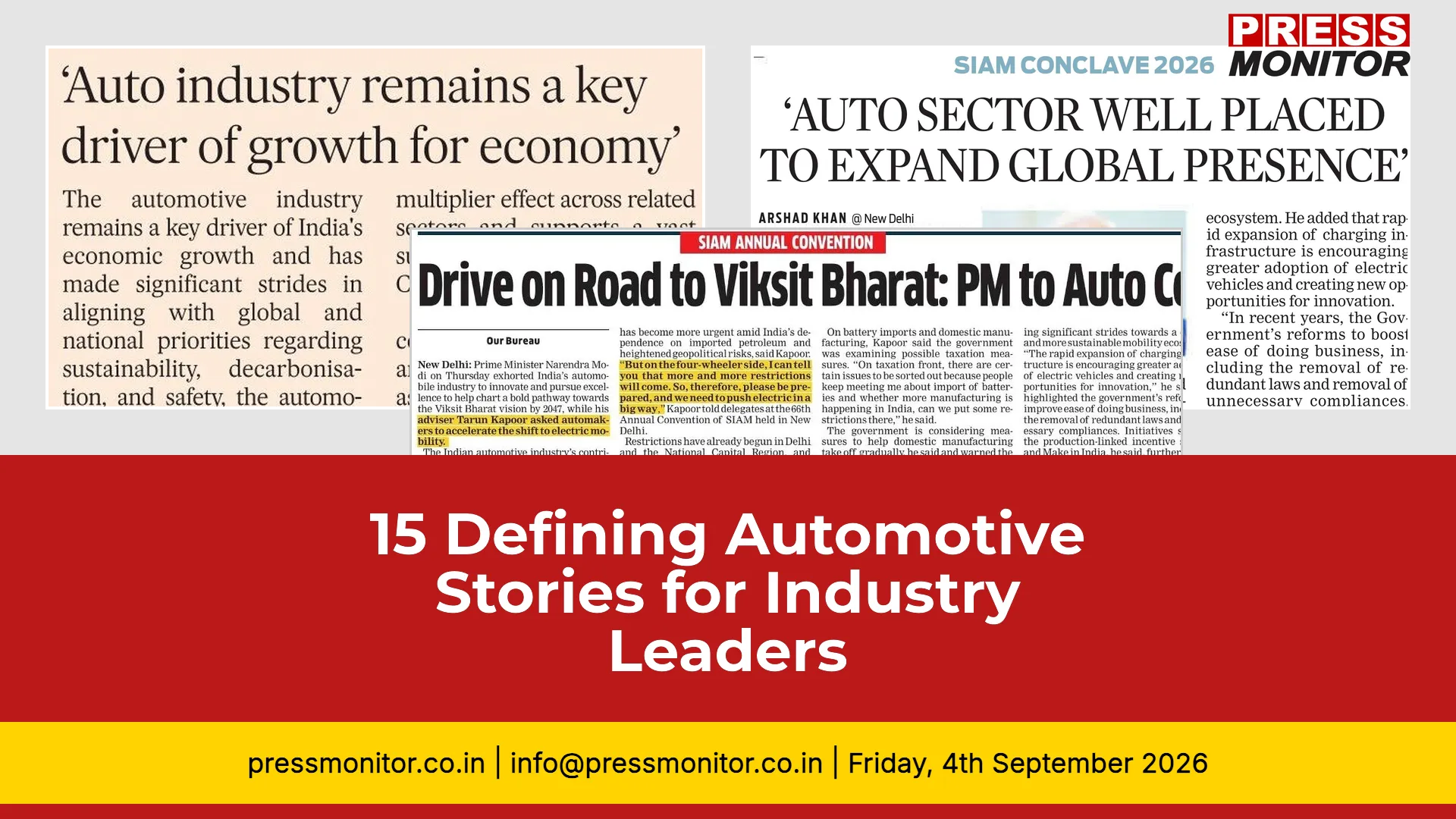
India's automotive sector is at a pivotal moment, with print media tracking a surge in EV adoption, global expansion ambitions, and policy shifts reshaping the industry. according to Press Monitor's tracking of Indian publications, here are the 15 defining stories from today's print editions.
1. SIAM Reports Record Automotive Sales
A front-page report in Free Press Journal says the automotive industry remains a key driver of India's economic growth and has made significant strides in aligning with global and national priorities regarding sustainability, decarbonisation, and safety. Society of Indian Automobile Manufacturers President Shailesh Chandra stated at the annual convention that the sector's overall contribution to the Indian economy exceeded 22.75 lakh crore, contributing to about 15% of the country's goods and services tax collections. The industry provides direct and indirect employment to more than 30 million people and supports a vast supply chain network. The Society of Indian Automobile Manufacturers President Shailesh Chandra stated that the sector's overall contribution to the Indian economy exceeded 22.75 lakh crore, contributing to about 15% of GST collections and providing direct and indirect employment to more than 30 million people. This underscores the sector's backbone role in the national economy.
2. SIAM Conclave 2026: Auto Sector To Expand Global Presence
A front-page report in Morning Standard says Prime Minister Narendra Modi urged the automobile industry to continue innovating and charting a bold pathway towards Viksit Bharat at the SIAM Annual Convention 2026. He stated that with recent free trade agreements providing greater access to global markets, the Indian automobile sector is well placed to further expand its global presence. Modi also highlighted that government reforms, including the PLI Scheme and Make in India, have strengthened manufacturing capabilities and that a GST rate reduction in September 2026 led to a sharp surge in sales. Prime Minister Narendra Modi urged the automobile industry to chart a bold pathway towards Viksit Bharat, citing recent free trade agreements and government reforms including the PLI Scheme and Make in India. A GST rate reduction in September 2026 led to a sharp surge in sales, signaling strong consumer demand.
3. PM Modi Urges Auto Industry Innovation
A front-page report in Economic Times says Prime Minister Narendra Modi exhorted India's automobile industry to innovate and pursue excellence towards the Viksit Bharat vision by 2047. His adviser Tarun Kapoor urged automakers to accelerate the shift to electric mobility, warning that restrictions on four-wheelers will increase. The government is also examining taxation measures on battery imports while supporting domestic manufacturing through initiatives like Make in India and production-linked incentive schemes. PM Modi exhorted India's automobile industry to innovate and pursue excellence towards the Viksit Bharat vision by 2047. His adviser Tarun Kapoor warned that restrictions on four-wheelers will increase, and the government is examining taxation measures on battery imports while supporting domestic manufacturing.
4. Modi Urges Auto Industry for Viksit Bharat
A front-page report in Millennium Post says Prime Minister Narendra Modi exhorted India's automobile industry to chart a bold pathway towards the Viksit Bharat vision by 2047. Addressing the Society of Indian Automobile Manufacturers Annual Convention 2026 in New Delhi on Thursday, Modi highlighted that recent free trade agreements provide greater access to international markets. He noted that the rapid expansion of charging infrastructure is encouraging greater adoption of electric vehicles and creating new opportunities for innovation. Addressing the SIAM Annual Convention 2026 in New Delhi, Modi highlighted that recent free trade agreements provide greater access to international markets and that the rapid expansion of charging infrastructure is encouraging greater adoption of electric vehicles.
5. Maruti Sees EV Capacity Easing
A front-page report in Mint says Maruti Suzuki expects its capacity constraints to ease over the next three to four months, allowing it to ramp up domestic EV output into twenty-twenty-seven. The automaker, which currently supplies two thousand units a month and exports the eViTara rebadged as Toyota eBella to Europe, plans to increase its annual capacity from twenty-five thousand to one hundred twenty-five thousand units. Sales of electric vehicles in India rose eighty-four percent to nearly two million units last year, with a penetration of four point two percent, and surged eighty-three percent to about thirty-three thousand units in July. Maruti Suzuki expects its capacity constraints to ease over the next three to four months, planning to increase annual EV capacity from twenty-five thousand to one hundred twenty-five thousand units. Sales of electric vehicles in India rose eighty-four percent to nearly two million units last year.
6. Piyush Goyal urges automakers beyond India
A front-page report in Times of India says Commerce and Industry Minister Piyush Goyal urged India's automobile industry to look beyond the domestic market during the Society of Indian Automobile Manufacturers annual convention in New Delhi on Wednesday. He argued that rising costs, regulatory burdens and shrinking young workforces in developed economies are pushing global manufacturing towards India, citing nearly a million vehicle exports last year and urging companies to maintain aligned quality standards for domestic and export markets. Goyal also said India needs a broader clean mobility strategy balancing environmental goals, economic viability and energy security across electric vehicles, hybrids, compressed natural gas and conventional powertrains, and that details of the India United States bilateral trade agreement would be finalised only after Washington offers India preferential terms over Vietnam and Bangladesh. Commerce and Industry Minister Piyush Goyal urged India's automobile industry to look beyond the domestic market, citing nearly a million vehicle exports last year. He also said India needs a broader clean mobility strategy balancing environmental goals, economic viability and energy security.
7. Maruti Suzuki, Hyundai Expand Production Capacity
A front-page report in Financial Express says carmakers are ramping up production capacity as festive demand picks up, with Maruti Suzuki and Hyundai Motor India expanding their operations. Maruti Suzuki India MD Hisashi Takeuchi highlighted that small cars under the eighteen percent GST bracket recorded thirty percent growth, while Hyundai Motor India MD Tarun Garg said the Brezza had received over sixty thousand bookings in thirty five days. Carmakers are ramping up production capacity as festive demand picks up. Maruti Suzuki India MD Hisashi Takeuchi highlighted that small cars under the eighteen percent GST bracket recorded thirty percent growth, while Hyundai Motor India MD Tarun Garg said the Brezza had received over sixty thousand bookings in thirty five days.
8. Piyush Goyal Invites Global Auto Majors
A front-page report in Economic Times says Commerce and industry minister Piyush Goyal on Thursday invited global automobile companies to manufacture in India and use the country as a base to serve global markets. Goyal cautioned about black sheep among automakers who are not making adequate efforts to increase localisation in India, asking them to review their indigenisation programmes afresh. Commerce and industry minister Piyush Goyal invited global automobile companies to manufacture in India and use the country as a base to serve global markets, cautioning about black sheep among automakers who are not making adequate efforts to increase localisation.
9. Goyal pulls up industry on auto indigenisation
A front-page report in Financial Express says Commerce and Industry Minister Piyush Goyal on Thursday criticised carmakers for using multiple corporate structures to claim enhanced levels of indigenisation of their products. Speaking at an industry event in India, he cautioned that he would be keeping an eye out for them and said using IT tools and artificial intelligence he will know exactly the levels of indigenisation. The minister also invited global automobile companies to manufacture in India and use the country as a base to serve global markets. Piyush Goyal criticised carmakers for using multiple corporate structures to claim enhanced levels of indigenisation, stating he will use IT tools and artificial intelligence to monitor the levels of indigenisation closely.
10. Modi Urges Auto Sector To Innovate For Viksit Bharat 2047
A front-page report in Financial Express says Prime Minister Narendra Modi on Thursday exhorted India's automobile industry to continue innovating, pursue excellence, and chart a bold pathway towards the Viksit Bharat 2047 vision. He said that recent free trade agreements providing greater access to international markets position India's auto sector well to expand its global presence. Modi also noted that India is making significant strides towards a cleaner and more sustainable mobility ecosystem. Prime Minister Narendra Modi exhorted India's automobile industry to continue innovating and pursue excellence, noting that recent free trade agreements position India's auto sector well to expand its global presence.
11. Indian Auto Industry Told to Collaborate on EV Infrastructure
A front-page report in Mint says Kamran Rizvi, secretary in the heavy industries ministry, urged the Indian automobile industry to collaborate on charging infrastructure for large-scale electrification at the SIAM annual convention in New Delhi on Thursday. He also asked automobile and component makers to increase research and development spending, noting that electric three-wheelers already account for fifty percent of segment sales, far exceeding the ten percent target by 2026. Kamran Rizvi, secretary in the heavy industries ministry, urged the Indian automobile industry to collaborate on charging infrastructure for large-scale electrification, noting that electric three-wheelers already account for fifty percent of segment sales.
12. Uber and Wayve Launch London Robotaxis
A front-page report in Asian Age says Uber and British tech company Wayve are launching London’s first self-driving taxi service on Thursday, starting with a small rollout of Ford Mustang Mach-E electric vehicles fitted with Wayve’s autonomous vehicle technology. The London rollout will still have a person behind the wheel overseeing each trip, unlike more autonomous robotaxi services operating in several United States and Chinese cities. Uber and British tech company Wayve are launching London's first self-driving taxi service, starting with a small rollout of Ford Mustang Mach-E electric vehicles fitted with Wayve's autonomous vehicle technology.
13. Hyundai India Aims One Million Units
A front-page report in The Pioneer says Hyundai India has accelerated a third production shift at its Talegaon plant by 18 months as demand outpaces planning. CEO Tarun Garg said the company expects to cross one million units of annual capacity by FY30, with upgrades planned at Chennai and Talegaon. The company is preparing to launch a born electric B-segment SUV but will not bet on hybrids without government price support. Hyundai India CEO Tarun Garg said the company expects to cross one million units of annual capacity by FY30, with upgrades planned at Chennai and Talegaon. The company is preparing to launch a born electric B-segment SUV.
14. 50 E-Buses And Automated Testing Launch
A front-page report in Hindustan Times says Delhi chief minister Rekha Gupta inaugurated an automated vehicle testing station at Tehkhand and flagged off 50 new e-buses on Thursday. The government also launched public EV charging stations at DTC depots in Hasanpur and Ghazipur and started an interstate electric bus service to Rewari in Haryana. Delhi chief minister Rekha Gupta inaugurated an automated vehicle testing station at Tehkhand and flagged off 50 new e-buses, with the government also launching public EV charging stations at DTC depots.
15. 80% of MSMEs Lack Capabilities
A front-page report in Times of India says that India’s shift to electric mobility is exposing a capability gap among MSME auto component manufacturers. The report, dated 18 July 2026, highlights that domestic OEM sourcing of auto components grew 16 percent to Rs 6.6 lakh crore in FY26, while component exports reached Rs 1 lakh crore, yet only about 10 percent of MSME suppliers have embedded software capability and 14 percent have systems integration skills, with China accounting for 36 percent of auto component imports. It also notes that MSMEs face financial constraints, with inventory levels reaching 60 days and EBITDA margins around 12 percent. India's shift to electric mobility is exposing a capability gap among MSME auto component manufacturers, with only about 10 percent of MSME suppliers having embedded software capability and 14 percent having systems integration skills.
Which of these developments will have the most lasting impact on your business? Track the full print media intelligence on automotive and vehicles at pressmonitor.co.in.