15 Essential Bus Transport Stories for Transport Leaders


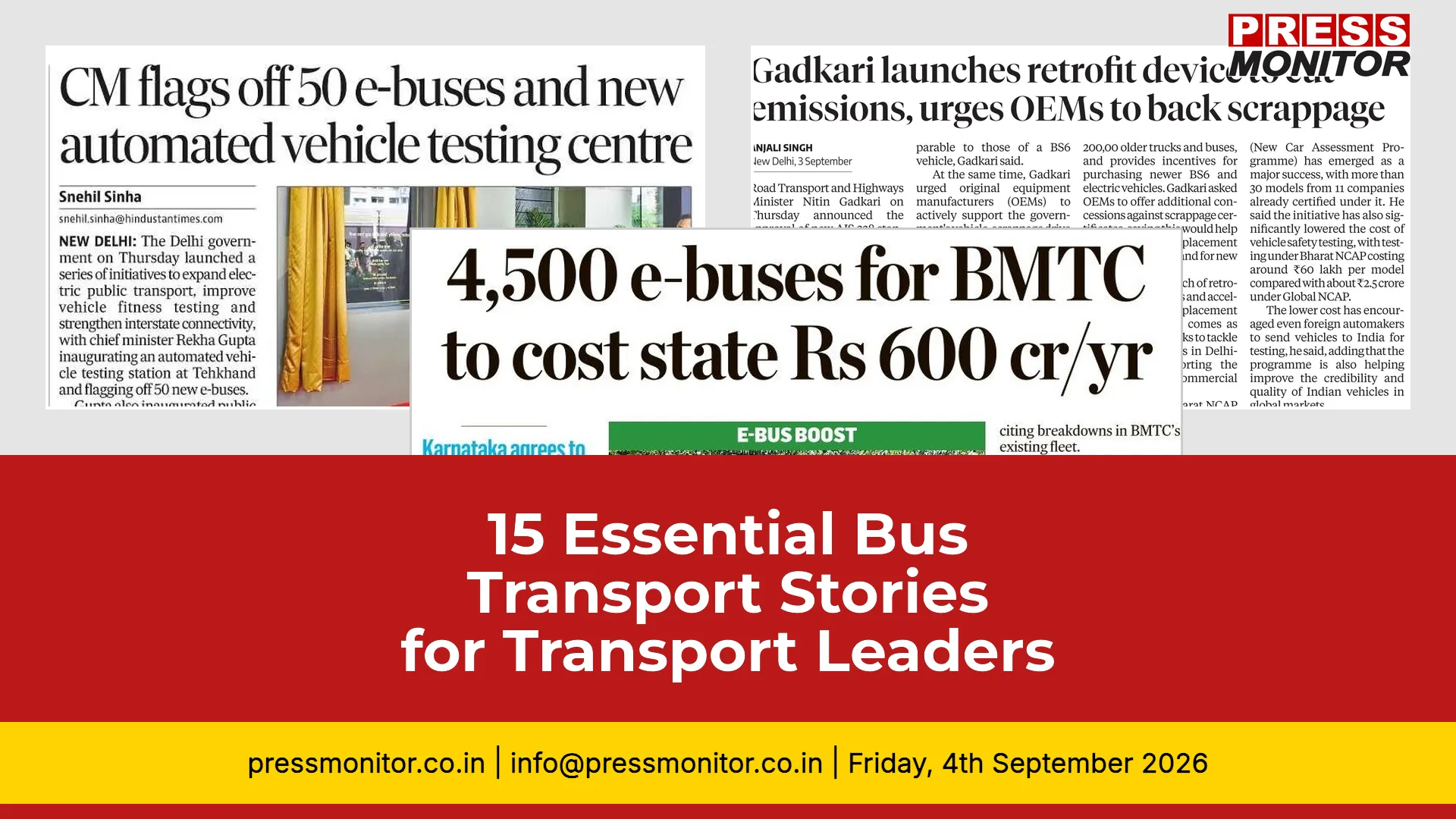
According to Press Monitor's tracking of Indian publications, today's print media landscape delivers 15 essential stories on bus transport and the broader bus industry — from electric bus deployments and emission-cutting retrofit devices to wage disputes and safety reforms. This press review captures the news on bus transport that fleet operators, transit authorities, and policy makers need to act on today, powered by media monitoring of India's most influential newspapers. The media intelligence gathered here reflects the depth and diversity of Indian print media monitoring coverage on this critical sector.
1. Delhi CM Flags Off 50 E-Buses
A front-page report in Hindustan Times says Delhi chief minister Rekha Gupta inaugurated an automated vehicle testing station at Tehkhand and flagged off 50 new e-buses on Thursday. The government also launched public EV charging stations at DTC depots in Hasanpur and Ghazipur and started an interstate electric bus service to Rewari in Haryana.
Why it matters: Delhi Chief Minister Rekha Gupta inaugurated an automated vehicle testing station and flagged off 50 new electric buses, marking a major step in India's public transit electrification. Tracked by Press Monitor across four publications.
Key detail: The launch included public EV charging stations at Hasanpur and Ghazipur depots and an interstate electric bus service between Delhi and Rewari. Delhi now has the country's largest electric bus fleet.
Source: Hindustan Times, The Pioneer, Millennium Post, Statesman
Next step: Monitor DTC's rollout timeline and charging infrastructure deployment along the Rewari corridor.
2. Retrofit Devices Cut Emissions 90%
A front-page report in Business Standard says that Minister Nitin Gadkari announced new standards for retrofitting devices that cut particulate matter by ninety percent and nitrogen oxides by fifty percent on pre-BS6 heavy vehicles. The device costs between four thousand and five thousand rupees. He urged original equipment manufacturers to support the scrappage drive with discounts, targeting the removal of two hundred thousand older trucks and buses under the Parivar-tan scheme.
Why it matters: Minister Nitin Gadkari announced retrofit emission-control devices that can lower particulate matter by 90 percent and nitrogen oxide by 50 percent on older diesel trucks and buses. This is a game-changer for fleet operators facing scrappage deadlines.
Key detail: The devices cost Rs 4,000 to Rs 5,000 each and will bring older vehicles to BS-VI standards. The government targets removal of 200,000 older trucks and buses under the Parivar-tan scheme.
Source: Business Standard, Times of India
Next step: Fleet operators should evaluate retrofit costs against replacement costs and engage with OEMs for discount programs.
3. Karnataka Funds 600 Crore for E-Buses
A front-page report in Deccan Herald says Karnataka has agreed to provide over Rs 600 crore annually to the Bengaluru Metropolitan Transport Corporation as viability gap funding for leasing 4,500 electric buses under the Centre’s PM E-Drive scheme. The decision concludes months of negotiations over operational costs and maintenance, with the state cabinet approving the plan to modernise public transit and replace ageing vehicles.
Why it matters: Karnataka approved over Rs 600 crore annually as viability gap funding for BMTC to lease 4,500 electric buses under PM E-Drive, concluding months of negotiations.
Key detail: The state cabinet's decision covers operational costs and maintenance, with the aim of modernising public transit and replacing ageing vehicles in Bengaluru.
Source: Deccan Herald
Next step: Watch for BMTC's leasing rollout schedule and the impact on Bengaluru's air quality metrics.
4. Bharat NCAP 2.0 Upgrade From 2027
A front-page report in The Pioneer says Union Road Transport and Highways Minister Nitin Gadkari announced that Bharat NCAP will receive a major upgrade from October 2027, evaluating the entire crash chain including crash avoidance and pedestrian protection. The government is also introducing a points-based driving licence system and stricter bus type-approval checks following 3,855 bus deaths in 2024.
Why it matters: Union Minister Nitin Gadkari announced Bharat NCAP will upgrade from October 2027, evaluating the entire crash chain including crash avoidance and pedestrian protection — directly affecting bus manufacturers.
Key detail: The upgrade follows 3,855 bus deaths in 2024 and introduces a points-based driving licence system and stricter bus type-approval checks.
Source: The Pioneer
Next step: Bus manufacturers should prepare for updated crash-test protocols and type-approval requirements.
5. BEST Buses Too Tall For SCLR Flyover
A front-page report in Free Press Journal says BEST has asked bus manufacturer Switch Mobility to reduce the height of some electric double-decker buses by 17 centimetres after they faced clearance problems under the Santacruz-Chembur Link Road flyover. The issue has affected Route 310, which passes through the SCLR stretch, with the buses around 457 centimetres high and their roofs coming close to the underside of the flyover. BEST Committee chairperson Trushna Vishwasrao confirmed that the manufacturer had been asked to make the modification for a few buses.
Why it matters: BEST's electric double-decker buses faced clearance problems under the Santacruz-Chembur Link Road flyover, with Route 310 affected. The manufacturer Switch Mobility has been asked to reduce bus height by 17 cm.
Key detail: The buses are around 457 cm high, and their roofs come close to the underside of the flyover. BEST Committee chairperson Trushna Vishwasrao confirmed the modification request.
Source: Free Press Journal
Next step: Fleet operators should audit existing routes for height restrictions before deploying new electric double-decker models.
6. School Bus Operators Demand Tax Reform
A front-page report in Tribune says the School and College Bus Operator Association Punjab held a state-level maha panchayat at the grain market on Thursday to press for a separate transport policy and lower taxes for school and college buses. Several schools affiliated with the Federation of Private Schools and Associations of Punjab remained closed in Bathinda, Barnala, and Mansa districts in protest. Association president Gurpreet Singh Sra said the vehicles generally travel only fifty to sixty kilometres a day compared to around five hundred kilometres by regular buses but are covered under the same tax structure.
Why it matters: The School and College Bus Operator Association Punjab held a maha panchayat demanding a separate transport policy and lower taxes for school buses, which travel only 50 to 60 km per day compared to 500 km for regular buses but face the same tax structure.
Key detail: Several schools in Bathinda, Barnala, and Mansa districts remained closed in protest. Association president Gurpreet Singh Sra led the demand.
Source: Tribune
Next step: State transport departments should consider differentiated tax structures for school bus operators to avoid service disruptions.
7. Rs 10.014 Crore Shortfall for BMTC
A front-page report in Deccan Herald says that on 18 July 2026, after accounting for revenue from the buses, BMTC is expected to face an annual shortfall of Rs 10.014 crore. The state will provide Rs 600 crore as viability gap funding under the central scheme.
Why it matters: BMTC faces an annual shortfall of Rs 10.014 crore after accounting for revenue from buses, even as the state provides Rs 600 crore as viability gap funding under the central scheme.
Key detail: The funding gap highlights the financial sustainability challenges facing urban bus operators in India's tech capital.
Source: Deccan Herald
Next step: BMTC should explore diversified revenue streams including advertising, data monetisation, and public-private partnerships.
8. BMTC Unveils Non-AC Metro Feeder Bus Service
A front-page report in Deccan Herald says Bengaluru Metropolitan Transport Corporation introduced a non-AC metro feeder bus service on Thursday. The new route, numbered 285-MY, connects Yelahanka NES Office to Nellukunte via Rajanukunte, Doddaballapur, Kantanakunte and Gundamagere Cross, with one bus making five trips per day.
Why it matters: BMTC introduced a new non-AC metro feeder bus service (Route 285-MY) connecting Yelahanka NES Office to Nellukunte, improving last-mile connectivity for metro commuters.
Key detail: One bus makes five trips per day on the route via Rajanukunte, Doddaballapur, Kantanakunte, and Gundamagere Cross.
Source: Deccan Herald
Next step: BMTC should evaluate ridership data and consider expanding the feeder network to other metro stations.
9. MSRTC NCMC Card Recharge Controversy
A front-page report in Free Press Journal says the Maharashtra State Road Transport Corporation's new National Common Mobility Card-based concession system has sparked controversy as passengers allege they bear agent charges on recharges. From September 1, senior citizens and women must use NCMC cards for concessions, but a Rs 100 recharge through an authorised agent credits only Rs 86.14 due to a Rs 13.86 deduction, while recharging through an ST conductor credits Rs 98 with a Rs 2 gateway fee. Passenger representatives and union leaders demand full operationalisation of the recharge network, recharge facilities through conductors or gram panchayats, continuation of the Aadhaar-based option, and adequate conductor training to prevent agitation.
Why it matters: MSRTC's new National Common Mobility Card-based concession system has sparked controversy as passengers allege they bear agent charges on recharges — a Rs 100 recharge credits only Rs 86.14 through agents.
Key detail: From September 1, senior citizens and women must use NCMC cards for concessions. Passenger representatives demand full operationalisation of the recharge network and continuation of the Aadhaar-based option.
Source: Free Press Journal
Next step: MSRTC should address passenger concerns and ensure transparent recharge policies to avoid agitation.
10. School Girl Sexually Assaulted On Bus
A front-page report in Times of India says police have registered a case under the BNS and Pocso Act after a school girl was allegedly sexually assaulted by the bus driver while she was alone inside the vehicle on Wednesday afternoon. The accused was produced before a court and remanded to police custody until Saturday.
Why it matters: Police registered a case under the BNS and POCSO Act after a school girl was allegedly sexually assaulted by a bus driver while alone inside the vehicle, raising serious concerns about bus safety protocols.
Key detail: The accused was produced before a court and remanded to police custody until Saturday.
Source: Times of India
Next step: Bus operators must implement mandatory CCTV, driver background checks, and emergency alert systems across their fleets.
11. BEST Announces Rs 1,111 Crore Wage Plan
A front-page report in Free Press Journal says the proposed wage revision for around 38,200 BEST employees and wet-lease workers could add Rs 1,111 crore annually to the undertaking’s salary bill. The plan includes Rs 475 crore yearly for approximately 9,000 wet-lease staff and Rs 636 crore for regular employees, alongside a massive Rs 6,000 crore arrear liability covering wages from 2016 to 2025. This proposal will soon be submitted to the BMC and the state government’s Study Committee for consideration.
Why it matters: BEST's proposed wage revision for around 38,200 employees and wet-lease workers could add Rs 1,111 crore annually to the salary bill, including Rs 6,000 crore in arrears covering wages from 2016 to 2025.
Key detail: The plan includes Rs 475 crore yearly for approximately 9,000 wet-lease staff and Rs 636 crore for regular employees. The proposal will be submitted to the BMC and state government Study Committee.
Source: Free Press Journal
Next step: BMC and state government should assess the fiscal impact and negotiate a phased implementation plan.
12. Unions Secure Pay Parity Agreement
A front-page report in Free Press Journal says that unions have demanded pay parity and the government has agreed to the need for it. A BEST official confirmed the development.
Why it matters: Unions have demanded pay parity and the government has agreed to the need for it, marking a significant development for BEST workers and the broader public transport labour landscape.
Key detail: A BEST official confirmed the development, signaling government willingness to address long-standing wage disparities.
Source: Free Press Journal
Next step: Both sides should formalise the agreement with a timeline and implementation roadmap to prevent future disputes.
13. 60 Priority Corridors For EV Charging
A front-page report in Times of India says that nearly half of mapped EV charging stations in India are nonfunctional, with the ministry of heavy industries identifying 60 priority corridors for electrification. The ministry has proposed that SIAM coordinate with automakers to divide these corridors among OEMs for charging infrastructure deployment, aiming to saturate all important highways within two to three years. The proposal comes as the government reduces direct EV subsidies and looks to industry to lead the ecosystem build-out, with a Rs 2000 crore corpus allocated for charging infrastructure.
Why it matters: The ministry of heavy industries identified 60 priority corridors for EV charging electrification, with nearly half of mapped stations currently nonfunctional — a critical gap for electric bus operators.
Key detail: SIAM is proposed to coordinate with automakers to divide corridors among OEMs, with a Rs 2,000 crore corpus allocated for charging infrastructure.
Source: Times of India
Next step: Bus operators should align their fleet electrification plans with the identified priority corridors.
14. Congress Tackles Punjab Factional Tussle
A front-page report in Tribune says the Congress party leadership met in Delhi to address factional disputes in its Punjab unit ahead of Rahul Gandhi's proposed visit. Senior leaders including Bhupesh Baghel, Amrinder Raja Warring, and Partap Singh Bajwa attended the meeting, while opponents of Warring's leadership were not invited. The party also plans a bus yatra across Punjab after September fifteen to re-energise its organisation and mobilise workers.
Why it matters: Congress party leadership met in Delhi to address factional disputes in its Punjab unit ahead of Rahul Gandhi's proposed visit, with plans for a bus yatra across Punjab after September 15.
Key detail: Senior leaders including Bhupesh Baghel, Amrinder Raja Warring, and Partap Singh Bajwa attended the meeting.
Source: Tribune
Next step: The bus yatra could significantly impact public transport demand and political engagement in Punjab.
15. Congress Rally Highlights Welfare Schemes
A front-page report in Free Press Journal says minister Revanth Reddy attended an event at Elkathurthy Mandal Centre where party leaders and activists took out a huge rally. Congress Mandal President Mappu Srinivas briefed the gathering on welfare and development initiatives, including the Mahalakshmi scheme, free bus rides, and gas cylinders at Rs 500. The government is also implementing free electricity, Rythu Bharosa for farmers, loan waivers, Indiramma houses, Rajiv Aarogyasri, and new ration cards while strengthening women's groups and providing employment opportunities to youth.
Why it matters: Minister Revanth Reddy attended a Congress rally in Elkathurthy highlighting welfare schemes including free bus rides, gas cylinders at Rs 500, and the Mahalakshmi scheme — key policy signals for the bus transport sector.
Key detail: The rally also highlighted free electricity, Rythu Bharosa for farmers, loan waivers, Indiramma houses, Rajiv Aarogyasri, and new ration cards.
Source: Free Press Journal
Next step: Bus operators in Telangana should prepare for potential increased demand from free bus ride schemes.
Which of these stories will have the biggest impact on your operations this quarter? Stay ahead with Press Monitor's print media intelligence — tracking Indian publications so you don't have to.