15 Essential Electricity & Power Generation Stories for Energy Professionals


In today's fast-evolving energy landscape, staying ahead requires more than just headlines — it demands comprehensive print media monitoring that captures the full picture from India's vast print media ecosystem. According to Press Monitor's tracking of Indian publications, here are 15 essential electricity and power generation stories that every energy professional needs on their radar.
1. NEET-PG Exam Disrupted by Power Failure in Jaipur
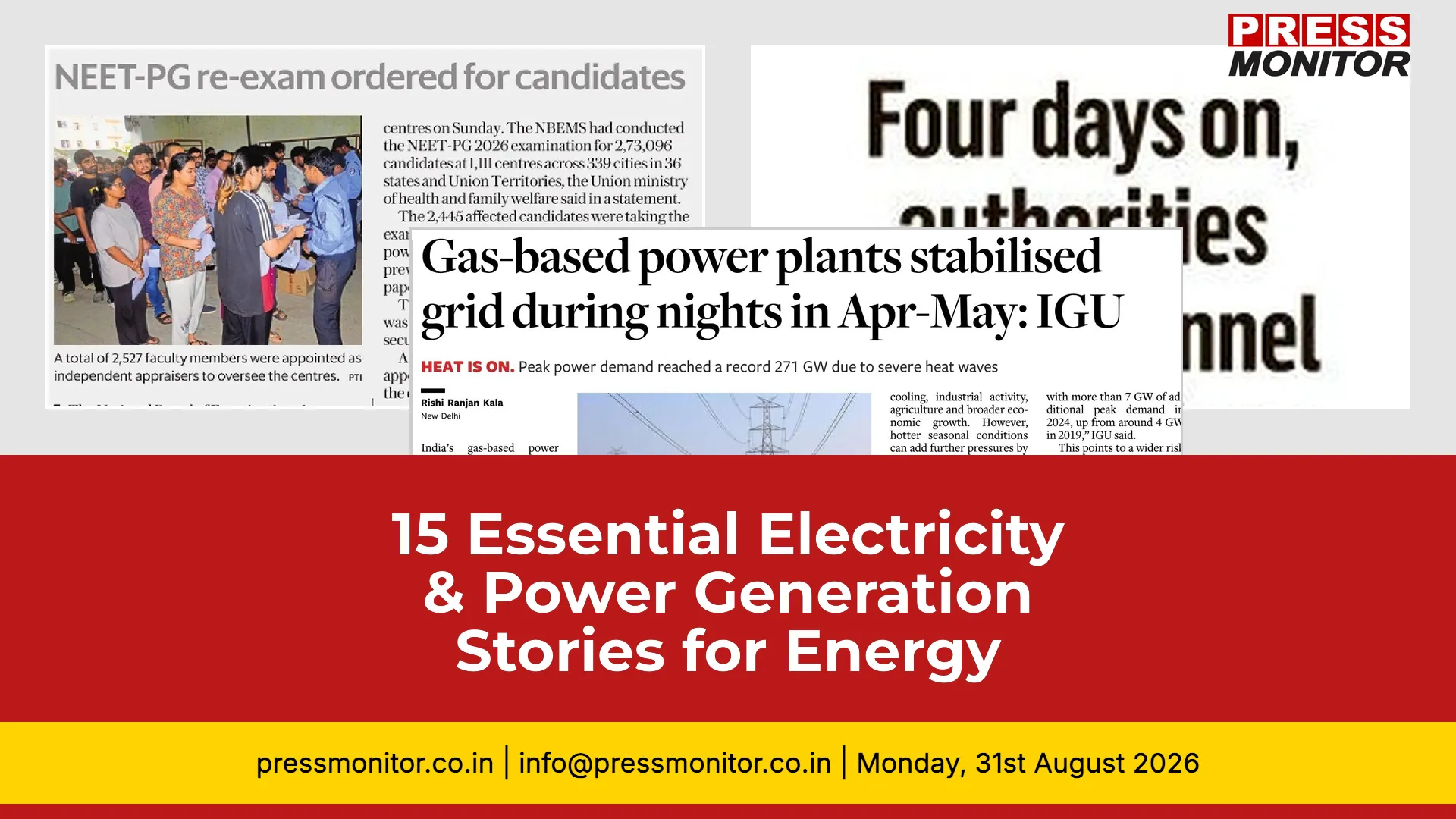
A front-page report in Mint says the National Board of Examinations in Medical Sciences (NBEMS) has ordered a re-examination for NEET-PG 2026 candidates at Jaipur on 5 September after a power supply breakdown disrupted the exam at two centers. Over 2,445 candidates were affected, and approximately 2,527 faculty members were deployed as independent appraisers to supervise the re인지ament, involving centres across India including 36 Union Territories and states.
Why it matters: A power failure at two exam centres disrupted the NEET-PG 2026 exam, affecting 2,445 candidates. This underscores the critical need for reliable power supply infrastructure. Key detail: NBEMS ordered a re-examination on 5 September and deployed 2,527 faculty as independent appraisers. Source: Mint. Next step: Energy authorities must ensure backup power for critical public events.
2. Catastrophic Nepal Floods Devastate Power Infrastructure
A front-page report in Deccan Herald says heavy machinery and rescue efforts continue as Nepal’s floods—triggered by ice, rock, and debris down a mountain valley on the China-Nepal border—killed over seventy-eight people, left more than three thousand missing, and submerged construction projects like the Upper Trishuli complex, along with damaging nearly ten percent of nation's power capacity.
Why it matters: Floods triggered by ice and debris killed over 78 people, left 3,000 missing, and damaged nearly 10% of Nepal's power capacity, including the Upper Trishuli complex. Source: Deccan Herald. Next step: Cross-border energy cooperation is vital for disaster resilience.
3. Gas Plants Stabilise Grid During Peak Summer
"A front-page report in Business Line says India's gas-based power plants helped stabilise the grid during the peak power demand season in April and May 2026 due to severe heat waves. The International Gas Union noted that India's peak power demand reached 270 GW in May. Gas power purchases on the Indian Gas Exchange increased by 340 per cent year-on-year during the peak season."
Why it matters: India's gas-based power plants helped stabilise the grid during peak demand of 270 GW in May 2026. Gas power purchases on the Indian Gas Exchange surged 340% YoY. Source: Business Line. Next step: Gas power remains a flexible backup for renewables.
4. Rajasthan Plans 172 Battery Energy Storage Units
A front-page report in Business Line says the Rajasthan government has approved a pilot project in which 172 Battery Energy Storage System (BESS) units of one megawatt/4 MWh capacity will be set up across 172 locations in the state. The projects, operating on a build-own-operate model for 15 years, will be positioned in 33/11-kV substations to assist in peak load management and peak power procurement savings.
Why it matters: Rajasthan approved a pilot for 172 BESS units (1 MW/4 MWh each) at substations for peak load management. Source: Business Line. Next step: This model could be replicated across states.
5. Renewable Energy Contributes 20% of India's Power Generation
A front-page report in Times of India says that renewable energy contributed nearly 20% of India’s power generation in July, marking a year-on-year growth of over 30%.
Why it matters: In July 2026, renewable energy contributed nearly 20% of India's power generation, with over 30% year-on-year growth. Source: Times of India. Next step: Accelerate grid integration for higher renewable share.
6. India to Supply Extra Power to Nepal Amid Floods
"Selon Business Standard, India is set to provide the neighboring country with any additional power that it may require in advance to cope with the tragedy. It is learnt that Nepal has sought advance import approvals from India effective September in view of the generation deficits caused by this natural disaster. The relevant authorities are processing these requests," a top power ministry official told Business Standard. "In the wake of this tragedy, India will provide power to Nepal if and when the requirement for the same is communicated to India as per their needs," he added. The cut in hydropower flows from Nepal to India is unlikely to have any discernable impact on New Delhi’s domestic supplies, officials added.
Why it matters: India is ready to supply additional power to Nepal after floods disrupted hydropower. Nepal sought advance import approvals. Source: Business Standard. Next step: Strengthen cross-border power trading mechanisms.
7. NCRTC Signs PPA for 110 MW Captive Solar Plant
“Selon le Statesman News Service, le NCRTC a signé un accord de vente d’électricité avec NIRLNCRTC Renewables Limited (NNRL) pour une centrale solaire de 110 MW à construire par NNRL. L’accord a été signé en présence du PDG du NCRTC, Shalabh Goel; du Directeur Finances et Commissaire Exécutif Désigné du NIRL, Dr Prasanna Kumar Acharya; du Directeur Finances du NCRTC, Namita Mehrotra; du Directeur des Électriques et de la Production de Wagon du NCRTC, Mahendra Kumar; et de hauts fonctionnaires du NCRTC et du NIRL,” a déclaré un porte-parole du NCRTC. Le projet, de première de son genre pour les systèmes de transport RRTS et métropolitains du pays, est destiné à alimenter près de 60 % de l’électricité requise par le corridor Delhi-Meerut Namo Bharat. Il renforcera l’efficacité opérationnelle à long terme du corridor grâce à une énergie propre et fiable. Le coût estimé de la centrale solaire est d’environ 450 crore roupies et sera développé dans la ville de Jaulan, dans l’Uttar Pradesh, grâce à un modèle de financement dette-capital de 80:20. La production d’électricité sera acheminée via le réseau électrique de l’Uttar Pradesh vers les postes de transformation (RSS) du NCRTC situés dans l’Uttar Pradesh et Delhi, puis distribuée dans tout le corridor Namo Bharat. Le projet tire parti de la politique énergétique solaire de l’Uttar Pradesh pour promouvoir l’utilisation des énergies renouvelables. La mise en service est prévue dans les 24 prochains mois. L’électricité représente environ 30-35 % du coût d’exploitation du corridor Namo Bharat, ce qui en fait l’une des plus importantes dépenses récurrentes. Le projet de centrale solaire en captif ne devrait réduire les dépenses énergétiques annuelles d’environ 25 % tout en contribuant à un avenir plus propre et plus durable.
Why it matters: The solar plant will power 60% of the Delhi-Meerut Namo Bharat corridor, reducing energy costs by 25%. Source: Statesman. Next step: This sets a precedent for renewable energy in transit systems.
8. Srisailam Reservoir Storage Drops, Raising Concerns
A front-page report in Deccan Chronicle says that water storage in Srisailam reservoir has steadily declined, reaching 150.8 tmc ft by Sunday evening from a peak of around 185 tmc earlier this week. The reservoir’s water level has dropped to 872.10 feet against the full reservoir level of 885 feet. Telangana generates 8.657 million units of electricity daily by drawing 17,320 cusecs of water. Declining storage has raised concerns over irrigation availability in Rayalaseema, with farmers in Kurnool, Anantapur, and Nandyal districts reporting lack of water for agriculture.
Why it matters: Water storage declined to 150.8 TMC from 185 TMC, affecting hydropower generation and irrigation. Telangana generates 8.657 million units daily. Source: Deccan Chronicle. Next step: Monitor water levels for power and agriculture planning.
9. Flood Scare Halts Two Mega Tunnel Projects in Uttarakhand
A front-page report in Morning Standard says two major tunnel projects in Uttarakhand have come under safety scrutiny after an accident and unstable rock formations disrupted construction, underscoring the geological risks of building large infrastructure in the fragile Himalayas. Flash floods in Nepal have sparked renewed concerns on mega projects. Work at the Tapovan-Vishnugad hydroelectric project in Chamoli remains suspended after water and debris entered an under-construction tunnel on August thirteen, trapping workers and prompting a rescue operation.
Why it matters: Work on Tapovan-Vishnugad hydro project and Silkyara-Barkot tunnel halted due to safety concerns after water and debris entered. Source: Morning Standard. Next step: Geological risk assessment is critical for Himalayan infrastructure.
10. FDRE Tariffs Fall Despite Rising Costs
A front-page report in Business Line says that Firm and Despatchable Renewable Energy (FDRE) tariffs have fallen despite rising costs, possibly reflecting intensifying competition among developers.
Why it matters: Firm and Despatchable Renewable Energy tariffs are declining, indicating intense competition among developers. Source: Business Line. Next step: This trend could accelerate renewable adoption.
11. US Voters Target AI Data Centres Over Energy Costs
A front-page report in Deccan Chronicle says that US voters are increasingly opposing data centres powering the artificial intelligence boom due to rising electricity bills and noise. Candidates in at least 21 races across 18 states have aired advertisements targeting Big Tech, while Texas Governor Greg Abbott has frozen new projects to assess their impact on power and water supplies.
Why it matters: Rising electricity bills and noise from data centres are becoming election issues in 18 states. Texas froze new projects. Source: Deccan Chronicle. Next step: India's data centre boom must balance energy sustainability.
12. India Eyes $300 Billion Data Centre Boom
A front-page report in Millennium Post says India is preparing for a massive expansion of data centres, with capacity potentially rising to 6.7 GW and investments reaching $300 billion by 2030. The report warns that this growth must be balanced with sustainable resource use and human capital development to avoid the infrastructure pitfalls seen in the United States.
Why it matters: India's data centre capacity could rise to 6.7 GW by 2030, requiring massive power infrastructure. Source: Millennium Post. Next step: Sustainable resource use is key to avoid pitfalls seen in the US.
13. Maharashtra Launches Solar Scheme for BPL Consumers
A front-page report in Free Press Journal says that the Swayampurna Maharashtra Residential Rooftop (SMART) scheme has been launched to benefit BPL and economically weaker consumers using up to 100 units. The scheme aims to cover 12,397 consumers, offering 1 kW solar units for 2,500 (BPL), 5,000 (SC/ST), and 10,000 (general weaker sections), with 25 years of free electricity.
Why it matters: The SMART scheme offers 1 kW solar units at subsidised rates, with 25 years free electricity. Covers 12,397 consumers. Source: Free Press Journal. Next step: Expand such schemes to boost rooftop solar adoption.
14. New Delhi Solar Policy May Cut Rooftop Installation Costs
A front-page report in Hindustan Times says that the Delhi government is working on a new solar policy aimed at slashing the upfront cost of rooftop installations for households. The draft policy, which was finalised earlier this month, is expected to be placed before the Cabinet this week.
Why it matters: The draft policy aims to slash upfront costs for households. Expected to be placed before Cabinet this week. Source: Hindustan Times. Next step: This could accelerate residential solar adoption in the capital.
15. MP Bhumre Reviews Solar Power Progress in Maharashtra
A front-page report in Free Press Journal says MP Sandipan Bhumre has directed officials to accelerate the Revamped Distribution Sector Scheme and other initiatives to reduce electricity losses. During a District Electricity Committee meeting, officials detailed the installation of rooftop solar systems and upgrades to agricultural power infrastructure across the district.
Why it matters: Officials directed to accelerate RDSS and reduce electricity losses. Rooftop solar installations and agricultural power upgrades discussed. Source: Free Press Journal. Next step: Local-level monitoring is vital for scheme implementation.
This press review, powered by Press Monitor's media intelligence, provides a snapshot of the day's most impactful stories in electricity and power generation. For a comprehensive media monitoring solution tailored to your industry, stay tuned to Press Monitor.