15 Essential Emergency Services & Response Stories for Disaster Management Professionals


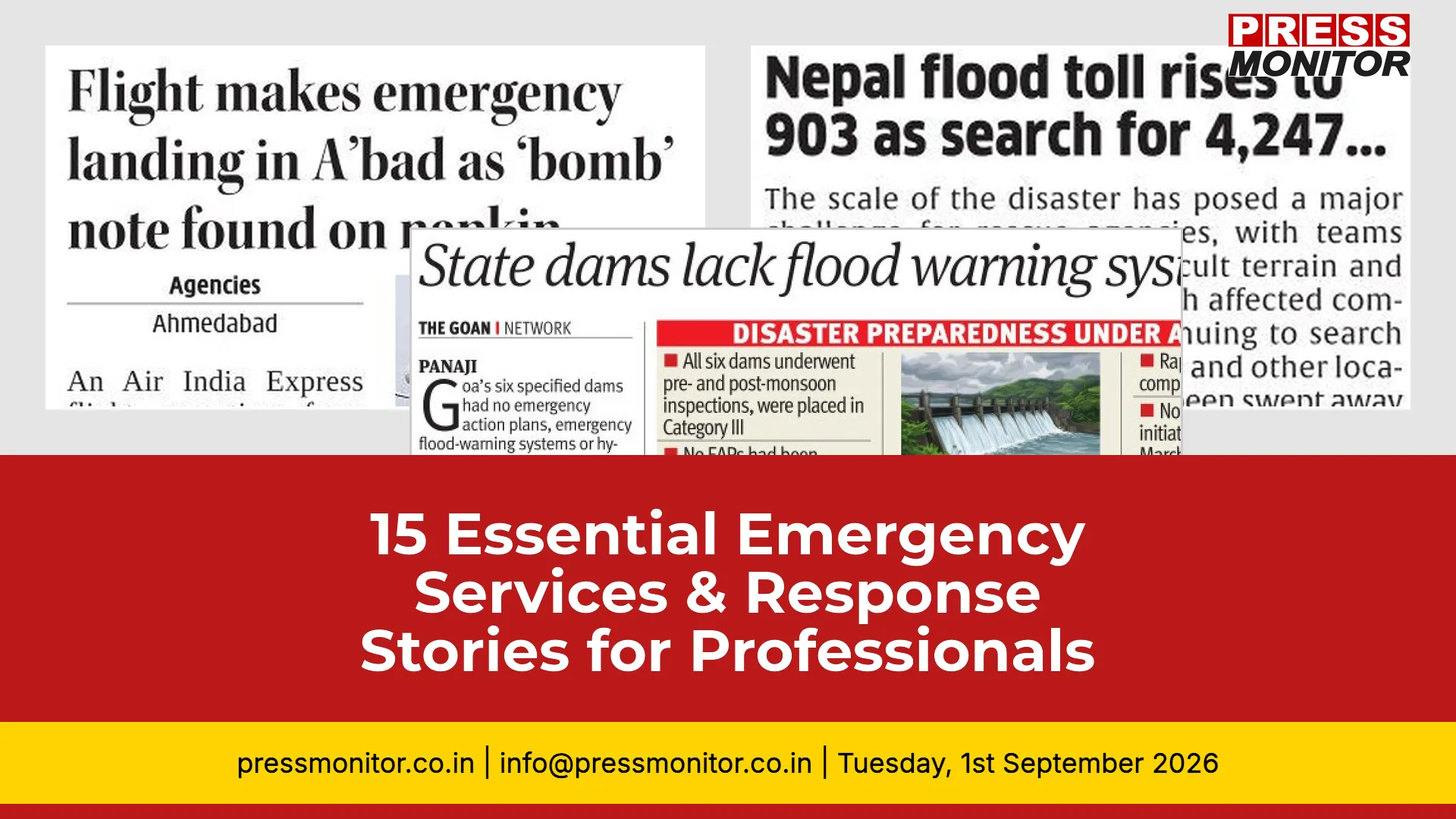
India's print media today delivers a powerful snapshot of the country's emergency preparedness landscape. From catastrophic floods in Nepal to dam safety failures in Goa, from bomb threats on flights to fire safety audits at political offices, these stories reveal where systems are strong and where they urgently need reinforcement. Here are 15 key stories tracked by Press Monitor, grounded in today's verified Indian print media — a media monitoring briefing for decision-makers.
1. Air India Express Bomb Threat: Napkin Alert Forces Emergency Landing
A front-page report in First India says: An Air India Express flight operating from Dammam to New Delhi made an emergency landing at Sardar Vallabhbhai Patel International Airport in Ahmedabad after discovering a napkin with the word 'BOMB?' written on it in the aircraft's lavatory. Authorities conducted a thorough search but found no explosives, and all 32 passengers were safely evacuated
Why it matters: The incident highlights vulnerabilities in aviation security and the effectiveness of emergency protocols. A napkin with 'BOMB?' written on it in the lavatory forced a Dammam-Delhi flight to divert to Ahmedabad. All 32 passengers were safely evacuated — a testament to crew training.
Key detail: The flight landed safely after a thorough search found no explosives.
Source: First India (front page)
Next step: Airlines should review cabin security procedures and passenger communication protocols.
2. Nepal Floods: 903 Dead, 4,200 Missing
A front-page report in The Pioneer says the death toll from devastating flash floods in Nepal has risen to 903. Rescue teams are currently searching for over 4,200 missing people across eight districts, including foreign nationals and security personnel.
Why it matters: The deadliest natural disaster in the region this year reveals gaps in early warning and rescue capacity. Rescue teams are searching for thousands across eight districts.
Key detail: The death toll includes foreign nationals and security personnel.
Source: The Pioneer (front page, also reported by Indian Express and Free Press Journal)
Next step: International aid coordination and long-term flood mitigation planning are critical.
3. Goa Dams: Zero Emergency Action Plans Despite Structural Safety
"A front-page report in The Free Press Journal says that Goa’s six specified dams had no emergency action plans, emergency flood-warning systems or hydrological networks with inflow forecasting in place as of March 31, 2026, exposing a significant gap in the State’s emergency preparedness despite all six dams being assessed as structurally sound and safe. The finding is part of the Goa State Dam Safety Organisation’s Annual Report for 2025-26, prepared under the Dam Safety Act, 2021, which was tabled in the House by Minister Subhash Shirodkar on Monday."
Why it matters: Six specified dams in Goa lack any emergency flood-warning system or action plan, despite being assessed as structurally sound. This exposes a dangerous gap in preparedness.
Key detail: The Goa State Dam Safety Organisation's annual report, tabled in the assembly, confirms no mock drills or community awareness were conducted.
Source: Free Press Journal (front page)
Next step: Immediate implementation of emergency action plans and flood-warning systems is needed.
4. Kolkata Fire Safety Audit at TMC Leader's Office
A front-page report in The Hindu says a joint team of Kolkata Police and Fire Department officials visited the Camac Street office of Trinamool Congress (TMC) general secretary Abhishek Banerjee to conduct a fire safety audit and examine the building plan. The visit came only four days after a team of Kolkata Municipal Corporation (KMC) officials and Kolkata Police visited the premises to remove an electric billboard that led to an alleged clash between the officials and party workers.
Why it matters: A joint police and fire department team visited Trinamool Congress general secretary Abhishek Banerjee's office on Camac Street for a fire safety audit — days after a clash over an illegal billboard. This underscores the intersection of political tension and compliance enforcement.
Key detail: The audit examined building plans and fire safety measures.
Source: The Hindu (front page, also reported by Economic Times)
Next step: Political offices should proactively ensure compliance to avoid escalation.
5. Delhi Government Adopts GPS to Monitor Interstate Buses
A front-page report in Millennium Post says the Delhi government plans to adopt a GPS to monitor buses entering the national capital from neighbouring states in real-time and facilitate swift action in emergencies. Chief Minister Rekha Gupta said the city government plans to link the GPS systems of buses entering Delhi from neighbouring states with the relevant Delhi government department’s system.
Why it matters: Real-time GPS tracking of buses entering Delhi from neighbouring states will enable swift emergency response. Chief Minister Rekha Gupta announced the plan to link GPS systems with Delhi's department.
Key detail: The initiative targets women's safety and emergency response for all passengers.
Source: Millennium Post (front page, also reported by The Pioneer)
Next step: Implementation timeline and coordination with neighbouring states are key.
6. Delhi HC Rejects Plea Against C-DOT's Emergency Alert System Deal
A front-page report in Mint says the Delhi High Court on Monday dismissed a plea by Germany-based Utimaco Technologies challenging the Centre’s decision to appoint state-owned Centre for Development of Telematics(C-DOT) as the sole implementation agency for India’s emergency cell broadcast system without a public tender.
Why it matters: The High Court dismissed a challenge to the government's decision to appoint C-DOT as sole implementation agency for India's emergency cell broadcast system without a public tender. This clears the way for a critical national emergency alert infrastructure.
Key detail: Germany-based Utimaco Technologies had challenged the decision.
Source: Mint (front page)
Next step: Expedite deployment of the emergency broadcast system across telecom networks.
7. Mandakini in Spate: Chitrakoot Battles Rising Floodwaters
A front-page report in Free Press Journal says that heavy monsoon rains have intensified across UP, triggering flood concerns in several districts as the Ganga and Yamuna continue to rise in Prayagraj.
Why it matters: Heavy monsoon rains have pushed the Mandakini river to dangerous levels, threatening Chitrakoot district. The Ganga and Yamuna are also rising in Prayagraj, signalling a broader flood risk.
Key detail: The situation is being monitored by the UP government's emergency operations centre.
Source: Free Press Journal (front page)
Next step: Pre-positioning rescue teams and relief supplies in vulnerable areas.
8. Delhi Schools Shut After Safety Violations Found
A front-page report in Millennium Post says school premises were sealed after multiple safety violations were uncovered following inspection. Front-page report specifically notes fire safety failures, including blocked exits, non-functional equipment and illegal basement operations. Officials detained multiple staff members while conducting environmental regulation enforcement procedures.
Why it matters: Multiple schools in Delhi were sealed after inspections revealed fire safety failures — blocked exits, non-functional equipment, and illegal basement operations. This is a direct threat to children's safety.
Key detail: Officials detained staff members and are enforcing environmental regulations.
Source: Millennium Post (front page)
Next step: A city-wide school safety audit should be conducted immediately.
9. Bhopal e-Waste Crisis: NGT Flags 'Nuclear Emergency' Risk
A front-page report in Free Press Journal says that the National Green Tribunal alerted Madhya Pradesh over the e-waste crisis, calling it a 'nuclear and radiological emergency.' The state generates around 5,000 metric tonnes annually, with Bhopal alone adding 415 tonnes yearly. Only about 10 percent of e-waste is scientifically processed while the rest, at approximately 2,545 tonnes, is handled through unauthorized scrap units. The order highlighted gaps in hazard waste transport mechanisms, unauthorized scraps (250+ units), and lack of clarity on who is responsible for nuclear emergency preparedness, particularly in transporting hazardous waste from source to destination.
Why it matters: The National Green Tribunal has warned that unprocessed e-waste in Madhya Pradesh poses a radiological emergency. Only 10% of 5,000 metric tonnes of e-waste is scientifically processed; the rest goes to unauthorised scrap units.
Key detail: The gap in hazardous waste transport and responsibility for nuclear emergency preparedness is glaring.
Source: Free Press Journal (front page)
Next step: Immediate action to formalise recycling and ensure safe transport of hazardous materials.
10. Delhi Govt Seals Maujpur Play School for Violations
A front-page report in The Pioneer says that a private play school in northeast Delhi’s Maujpur was sealed on August 31 after a Government inspection found serious violations involving fire safety, building permissions, emergency access and the use of a basement for classes.
Why it matters: A private play school in northeast Delhi was sealed after inspection found serious violations in fire safety, building permissions, and use of a basement for classes. This is part of a broader crackdown on unsafe educational facilities.
Key detail: The school was sealed on August 31.
Source: The Pioneer (front page)
Next step: Parents and schools must prioritise compliance audits.
11. India Needs Regional Disaster Risk Models, Says Expert
A front-page report in New Indian Express says that human failures in land use and management are worsening natural calamities in states like Kerala and Assam. The author argues for a shift from emergency response to prevention through scientific assessments and regional risk models tailored to specific geologies.
Why it matters: V Nandakumar argues that human failures in land use and management are worsening disasters in Kerala and Assam. A shift from emergency response to prevention through scientific risk models is essential.
Key detail: The article calls for region-specific geological assessments.
Source: New Indian Express (front page)
Next step: Policy makers should invest in regional risk modelling and land-use regulation.
12. Himachal Pradesh Records 16% Rain Deficit in August
A front-page report in Tribune says that Himachal Pradesh experienced a 16% rainfall deficit in August, with Lahaul and Spiti being the driest district with a 77% shortfall. The state witnessed eight districts recording below-normal rainfall, while Sirmaur emerged as the wettest district with a 19% surplus. CM Sukhvinder Singh Sukhu directed the State Emergency Operation Centre to assess monsoon damage and prepare data on water released from dams.
Why it matters: While Lahaul and Spiti faced a 77% deficit, Sirmaur had a surplus. CM Sukhvinder Singh Sukhu has directed the State Emergency Operation Centre to assess monsoon damage.
Key detail: The deficit highlights uneven rainfall patterns and the need for adaptive water management.
Source: Tribune (front page)
Next step: Data-driven allocation of relief resources.
13. Human Follies Worsen Calamities: Expert Analysis
A front-page report in Morning Standard says that changing rainfall patterns, floods, landslides, heat waves and other extreme climatic events are no longer rare. Rain itself is not a disaster. Disaster results from the interaction of natural hazards with vulnerable landscapes, inappropriate land use, inadequate scientific understanding, weak early-warning systems and delayed decisions.
Why it matters: Changing rainfall patterns, floods, landslides, and heatwaves are no longer rare. The article stresses that disaster results from the interaction of natural hazards with vulnerable landscapes and weak early-warning systems.
Key detail: The piece by V Nandakumar calls for a prevention-first approach.
Source: Morning Standard (front page)
Next step: Integrate scientific understanding into development planning.
14. Explosion near Manori Power House Causes Extensive Damage
A front-page report in The Hans India says widespread damage occurred to the factory and nearby infrastructure due to an explosion occurring near the Manori power house on 18 July 2026. Immediate impact assessments are underway following the incident reported to authorities.
Why it matters: An explosion near a power house in Mumbai has caused widespread damage to factory and nearby infrastructure. The incident is under investigation, with impact assessments underway.
Key detail: The explosion occurred on July 18.
Source: The Hans India (front page)
Next step: Strengthen industrial safety regulations and emergency response plans.
15. Landslide in Arunachal Pradesh: A Reminder of Geological Risks
A front-page report in Dainik Bhaskar says... on a landslide in Arunachal Pradesh.
Why it matters: A landslide in Arunachal Pradesh, reported by Dainik Bhaskar, underscores the vulnerability of hilly regions to geological hazards. Although details are limited, the event adds to the day's emergency landscape.
Key detail: The report appears on the front page.
Source: Dainik Bhaskar (front page)
Next step: Comprehensive landslide risk mapping and early warning systems for the Northeast.
These 15 stories, curated from India's leading print publications, provide a comprehensive press review of today's emergency services landscape. Press Monitor delivers this media intelligence to help professionals stay ahead of critical developments. Which of these stories is most relevant to your work? Share your thoughts below.