15 Essential Logistics, Freight & Supply Chain Stories for Leaders


India's print media is tracking critical shifts in logistics, freight, and supply chains. From escalating trade wars to energy disruptions and infrastructure expansions, these 15 stories from today's newspapers provide actionable intelligence. According to Press Monitor's tracking of Indian publications, here are the developments that matter for supply chain leaders.
1. US-Canada Trade War Escalates: 50% Tariffs Trigger Retaliation
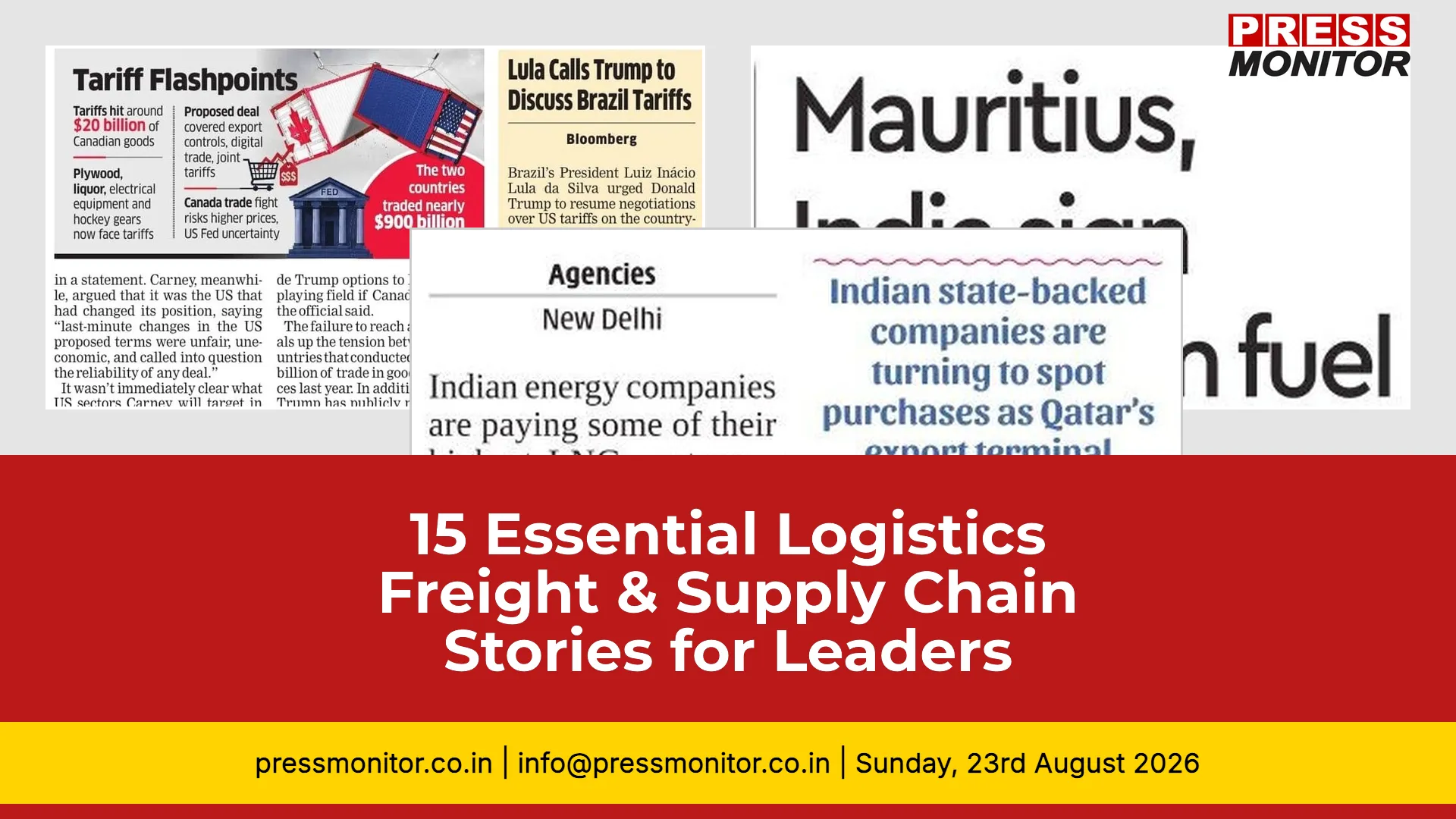
A front-page report in Economic Times says that a proposed 'two O' billion deal between Canada and the US has collapsed, leading to immediate counter-tariffs on Canadian goods such as plywood, liquor, electrical equipment AND hockey gear. Canadian Prime Minister Mark Carney criticized the US for 'just-minute' changes in the proposed terms.
Why it matters: The $20 billion tariff dispute disrupts North American supply chains, affecting raw material flows and raising costs for Indian importers. Key detail: US imposed 50% tariffs on Canadian goods; Canada will retaliate dollar-for-dollar from Sept 8, targeting plywood, liquor, and electrical equipment.
Source: Economic Times, cross-covered by Hindustan Times, Asian Age, Times of India, The Hindu. Next step: Monitor commodity price impacts and explore alternative sourcing routes.
2. India-Mauritius Fuel Deal: IOC to Supply Entire Import Requirement
"A front-page report in The Financial Express says that India and Mauritius have deepened their energy partnership with a five-year agreement under which Indian Oil will supply the island nation’s entire import requirement of petrol, diesel, and aviation turbine fuel, strengthening New Delhi’s role as a key energy-security partner in the Indian Ocean. The agreement was exchanged during Petroleum Minister Hardeep Singh Puri’s official visit to Mauritius on August 20-21, alongside a government-to-government memorandum of understanding (MoU) to expand cooperation in oil and gas, including petroleum product supplies, training and capacity building, and biofuels. The long-term sales and purchase agreement between IOC and Mauritius’ State Trading Corporation is designed to provide Mauritius with assured supplies and reduce its exposure to price volatility."
Why it matters: Strengthens India's energy security footprint in the Indian Ocean, reducing Mauritius's exposure to volatile spot markets. Key detail: Five-year agreement covers petrol, diesel, and aviation turbine fuel; IOC also opened a $25 million bunker facility.
Source: Financial Express, cross-covered by Millennium Post, Indian Express. Next step: Assess logistics partnerships for bunkering services in the region.
3. LNG Prices Surge as Qatar Supply Disruptions Hit India
"Selon First India, Indian energy companies are paying some of their highest LNG spot-market prices in years as the Qatar disruption disrupts supplies. GAIL India recently paid more than $23 per million British thermal units for a September cargo, while Gujarat State Petroleum Corp. paid in the mid-$23 range. The cargoes are the costliest imported into India since 2O22. Indian state-backed companies are turning to spot purchases as Qatar’s export terminal remains damaged following Iranian attacks and shipping through the Strait of Hormuz remains disrupted. Indian state-backed companies are turning to spot purchases as Qatar’s export terminal remains damaged post Iranian attacks. European demand is also pushing up prices. India traditionally relies on long-term LNG contracts from Qatar, but supply disruptions have increased pressure on spot markets. Bharat Petroleum Corp. also bought a spot-market cargo, though its price was not disclosed. The higher costs come as the government seeks to support fertiliser producers, major consumers of natural gas."
Why it matters: Indian energy companies face highest spot prices since 2022, impacting fertiliser and industrial production costs. Key detail: GAIL India paid over $23 per MMBtu for September cargo; Gujarat State Petroleum Corp. paid mid-$23.
Source: First India. Next step: Evaluate long-term LNG contracts and alternative fuel strategies.
4. LPG Pipeline Network to Expand by 1,800 km
"A front-page report in The Financial Express says that the Petroleum and Natural Gas Regulatory Board (PNGRB) has authorised the development of nearly 1,800 km of new LPG pipelines across Telangana, Maharashtra, Uttar Pradesh, Uttarakhand, Karnataka and Goa at an estimated investment of 7,000 crore. This expansion will almost a quarter as it seeks to make fuel supplies more resilient and reduce dependence on road transport. The PNGRB-authorised common-carrier LPG pipeline network will increase from about 7,700 km to nearly 9,500 km, an increase of around 23.5%. The newly authorised projects – 556-km Cherlapally to Nagpur, 611-km Jhansi to Sitarganj, and 633-km Shikrapur to Goa and Hubli – are to be developed by GAIL (India), improving the efficiency and reliability of moving LPG inland."
Why it matters: Reduces reliance on road transport for LPG, improving supply chain resilience and efficiency. Key detail: PNGRB approved 7,000 crore investment; three new pipelines across Telangana, Maharashtra, UP, Uttarakhand, Karnataka, Goa.
Source: Financial Express, cross-covered by Millennium Post. Next step: Identify logistics hubs near new pipeline corridors.
5. India-China Diplomatic Formula to Manage Supply Chain Disruptions
A front-page report in Economic Times says: India’s External Affairs Minister S. Jaishankar addressed concerns during The Economic Times World Leaders Forum, focusing on improving business visa access for Indian entrepreneurs with China and outlining four strategic points to manage geopolitical risks in global economy, supply chain disruptions, and market distortions, as bilateral relations slipped due to unstable border conditions (2020–2024).
Why it matters: Easing bilateral tensions could unlock smoother trade flows and reduce supply chain risks. Key detail: External Affairs Minister S. Jaishankar outlined four points including improved business visa access for Indian entrepreneurs.
Source: Economic Times. Next step: Prepare for potential trade normalization by diversifying China-linked supply chains.
6. Global Supply Chains Disrupted by West Asia War
A front-page report in Indian Express says the ongoing war in West Asia has disrupted critical trade routes, hitting global supply chains for essential commodities and goods. The conflict triggered a spike in commodity prices and constrained the availability of products essential to major economic activities.
Why it matters: Conflict impacts critical trade routes, spiking commodity prices and constraining product availability. Key detail: War in West Asia has directly hit essential commodities and goods.
Source: Indian Express. Next step: Review inventory buffers and alternative logistics routes.
7. Surat Weaving Hub Shuts Factories as Production Costs Surge
A front-page report in Indian Express says the disruption to the supply of crude oil following the Iran-US-Israel conflict has had an impact on Surat’s textile weaving industry. The cost of polyester yarn have skyrocketed, and the woven textile grey cloth is not fetching high prices. The Unn Industrial Estate in Surat therefore has decided to keep its factory shut for two days a week.
Why it matters: Crude oil supply disruption from Iran conflict raises polyester yarn costs, impacting textile supply chains. Key detail: Unn Industrial Estate decided to keep factories shut two days a week.
Source: Indian Express. Next step: Source alternative yarn suppliers or adjust production schedules.
8. Festive Hiring Moves to Tier 2/3 Markets
A front-page report in Economic Times says India's seasonal festive temp hiring is increasingly moving beyond large metros with Tier II and tier II markets emerging as significant employment hubs. Companies are adding stores, warehouses and last-mile capacity closer to consumers in cities like Jaipur, Lucknow and Ahmedabad.
Why it matters: Companies are adding warehouses and last-mile capacity closer to consumers in smaller cities. Key detail: Cities like Jaipur, Lucknow, Ahmedabad see significant hiring for delivery, warehouse, and retail sales roles.
Source: Economic Times. Next step: Plan logistics network expansion into emerging hubs.
9. Festive Hiring Demand Up 20-25%
A front-page report in Economic Times says employers are treating festive markets as core to fulfilment planning. Hiring is concentrated in delivery, warehouse, retail sales, and customer support, with 20-25% demand rise in tier II/III markets and 15-20% in tier I.
Why it matters: Festive season is now core to fulfilment planning, with higher demand for temporary staff. Key detail: 20-25% rise in tier II/III markets, 15-20% in tier I.
Source: Economic Times. Next step: Engage staffing partners for seasonal workforce.
10. Iran Allows Iraqi Oil Tankers Passage Through Hormuz
A front-page report in Indian Express says Iran has granted permission for several Iraqi oil tankers to pass through the Strait of Hormuz following requests from Baghdad.
Why it matters: Partial easing of Strait of Hormuz restrictions could stabilise oil shipping costs. Key detail: Iran granted permission following Baghdad's requests.
Source: Indian Express. Next step: Monitor shipping insurance rates and charter availability.
11. Indian Railways' First Double-Stack Long-Haul Container Train
A front-page report in Statesman says Indian Railways has achieved a major operational milestone by successfully dispatching its first double-stack long-haul container train from JNPT, Mumbai towards Varnama in Vadodara Division.
Why it matters: Boosts freight capacity and efficiency on key routes. Key detail: Train from JNPT, Mumbai to Varnama, Vadodara.
Source: Statesman. Next step: Evaluate rail freight options for container movement.
12. Fertiliser Supplies for Rabi Season Secure Despite Hormuz Disruptions
A front-page report in Hindustan Times says India’s fertiliser supplies for the upcoming Rabi season appear secure despite continuing disruptions around the Strait of Hormuz. The development comes as fertiliser companies typically lock in imports during August so that cargoes reach Indian ports in September and October, just ahead of peak winter sowing demand.
Why it matters: Ensures agricultural input availability for winter sowing. Key detail: Fertiliser companies locked in imports in August; supplies expected to reach ports in Sept-Oct.
Source: Hindustan Times. Next step: Align logistics with fertiliser import schedules.
13. India-UK CETA Unlocks New Opportunities for Kerala
A front-page report in The Pioneer says that the India-UK Comprehensive Economic and Trade Agreement (CETA), effective from 15 July 2026, expands trade in goods and services, offering duty-free access for 99% of Indian goods to the UK and growth prospects for Kerala's marine products, spices, and Ayurveda. The deal also boosts digital trade, logistics via Vizhinjam International Seaport, and collaborations in IT, healthcare, and innovation.
Why it matters: Duty-free access for 99% of Indian goods to UK boosts trade via Vizhinjam port. Key detail: Agreement effective 15 July 2026; benefits marine products, spices, Ayurveda, and digital trade.
Source: The Pioneer. Next step: Explore logistics partnerships for UK-bound exports from Kerala.
14. Ukrainian Drones Hit Russian Ozon Warehouse, Killing 10
A front-page report in Indian Express says that Ukrainian drones killed at least 10 people in attacks across Russia, including an Ozon warehouse and an industrial facility in several separate attacks there, according to Russian officials.
Why it matters: Attacks on logistics infrastructure escalate economic warfare, impacting e-commerce supply chains. Key detail: Ukrainian drones struck an Ozon warehouse and an industrial facility.
Source: Indian Express. Next step: Assess risk to logistics assets in conflict zones.
15. Trade Scam or Supply Chain Play? Little Chinese Ownership in Indian Pumps Exported to US
A front-page report in The Hindu says that data and industry sources reveal little Chinese ownership of such pumps/components sent to the U.S. by Indian/India-based firms; many are large U.S. multinationals with global production centers.
Why it matters: Clarifies supply chain dynamics amid US tariff scrutiny on Chinese goods. Key detail: Data shows many large US multinationals with global production centres are behind exports.
Source: The Hindu. Next step: Review supply chain documentation for compliance with US tariff rules.
This press review is powered by Press Monitor's media intelligence. Which story impacts your supply chain the most? Share your thoughts below.