15 Essential Religion & Faith Stories for Faith Leaders


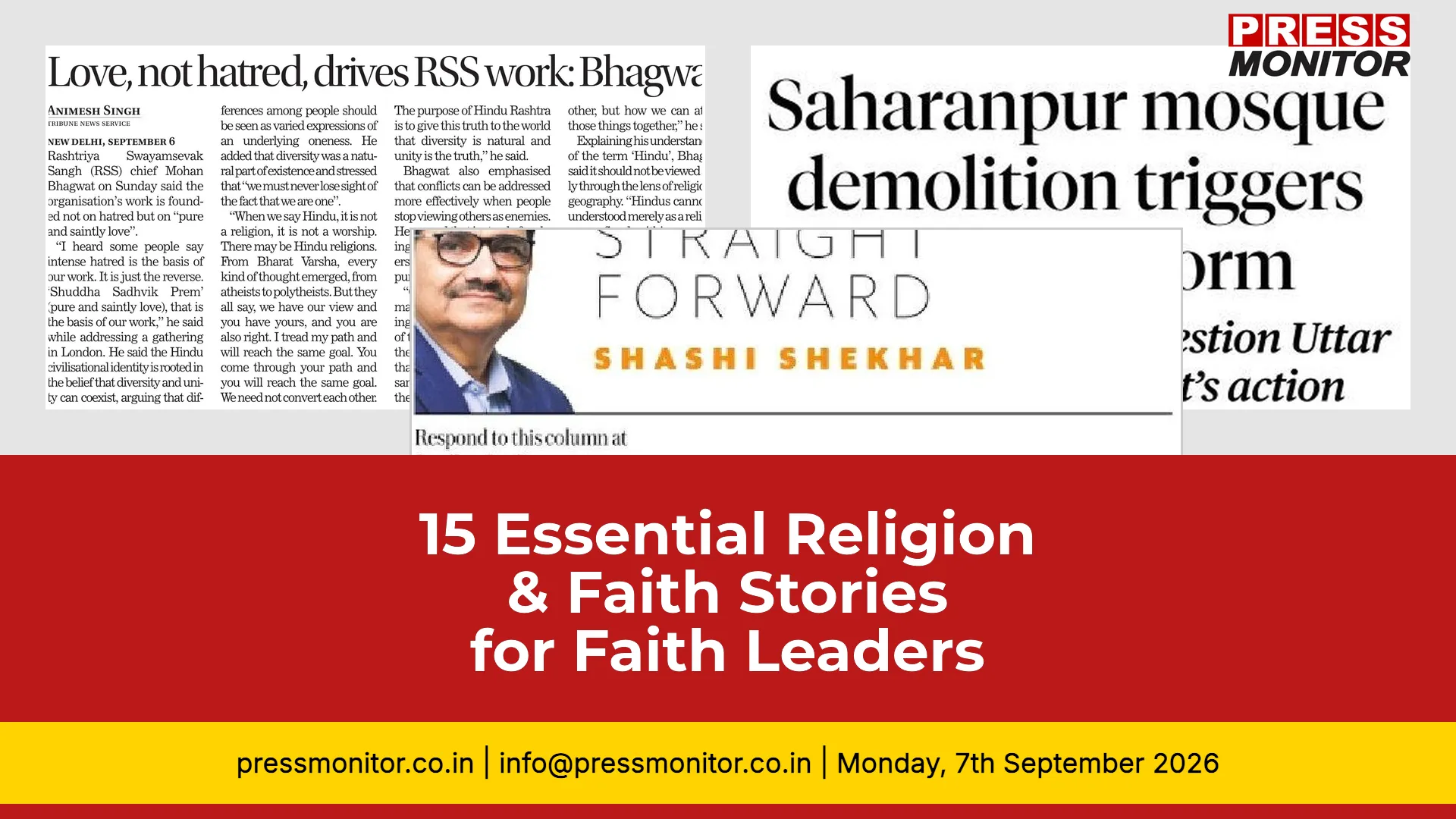
According to Press Monitor's tracking of Indian publications, this media monitoring report presents 15 defining stories from today's print landscape — news on religion & faith that spans RSS leadership messaging in London to mosque demolitions in Uttar Pradesh, temple governance reforms, and interfaith tensions. This press review delivers media intelligence on the stories that matter most to faith communities and their stakeholders.
1. Uttar Pradesh Mosque Demolition Sparks Political Confrontation
A front-page report in Millennium Post says opposition leaders are questioning the Uttar Pradesh government's demolition of an old mosque on the Saharanpur Collectorate premises. Former chief ministers Mayawati and Akhilesh Yadav, along with AIMIM president Asaduddin Owaisi and several MPs, have criticised the action, alleging the mosque committee still had legal options available before the structure was razed. Local leaders have announced plans to challenge the demolition in court, disputing the circumstances and timing of the administration's decision. The demolition of a historic mosque on the Saharanpur Collectorate premises has ignited a major political confrontation. Opposition leaders including former chief ministers Mayawati and Akhilesh Yadav, along with AIMIM president Asaduddin Owaisi, have criticized the Uttar Pradesh government for ignoring due process and razing the religious structure despite legal options remaining available to the mosque committee. Local leaders have announced plans to challenge the demolition in court.
Why it matters: This story sits at the intersection of religious freedom, governance, and electoral politics in India's most populous state.
Key detail: The mosque committee still had legal options available before the structure was razed, raising questions about the timing and circumstances of the administration's decision.
Source: Millennium Post, Delhi | By: Biswajeet Banerjee
Next step: Watch for the Allahabad High Court challenge and political reactions from both ruling and opposition benches.
2. Ram Mandir Trust CEO Reaches Ayodhya
A front-page report in Mint says newly appointed Ram Mandir Trust CEO Air Marshal Jeetendra Mishra reached Ayodhya to assume charge amid operational challenges. The Trust faces the task of establishing ancient glory and reviving civilizational traditions linked to Hindu temples while protecting devotee faith from donation theft concerns. Uttar Pradesh claims top religious tourism status, though the Ram temple donation theft discovery caused a dent in that success. Newly appointed Ram Mandir Trust CEO Air Marshal Jeetendra Mishra reached Ayodhya to assume charge amid operational challenges. The Trust faces the task of establishing ancient glory and reviving civilizational traditions linked to Hindu temples while protecting devotee faith from donation theft concerns. Uttar Pradesh claims top religious tourism status, though the Ram temple donation theft discovery caused a dent in that success.
Why it matters: The appointment of a CEO for the Ram Mandir Trust marks a new chapter in the management of one of India's most significant religious sites.
Key detail: The Trust plans to make daily donation details available online and is evaluating proposals from two banks and an IIT to reduce human intervention in counting cash offerings.
Source: Mint, Delhi | By: Shashi Shekhar
Next step: Monitor the Trust's transparency initiatives and their impact on devotee confidence and donation flows.
3. RSS Chief Rejects Hatred Claim
A front-page report in Tribune says Rashtriya Swayamsevak Sangh chief Mohan Bhagwat told a gathering in London on Sunday that the organisation's work is based on pure and saintly love rather than hatred. He argued that Hindu identity is cultural and civilisational, not confined to religion or geography. He said the purpose of Hindu Rashtra is to present the truth that diversity is natural and unity is the truth, and urged societies to manage conflict by pursuing shared goals instead of viewing others as enemies. RSS chief Mohan Bhagwat told a gathering in London on Sunday that the organisation's work is based on pure and saintly love rather than hatred. He argued that Hindu identity is cultural and civilisational, not confined to religion or geography. He said the purpose of Hindu Rashtra is to present the truth that diversity is natural and unity is the truth, and urged societies to manage conflict by pursuing shared goals instead of viewing others as enemies.
Why it matters: As the RSS enters its centenary year, Bhagwat's global outreach message on love and unity carries significant weight for India's religious and political discourse.
Key detail: Bhagwat emphasized the concept of apnanpan, or belongingness, linking individuals to family, community, society, humanity and nature.
Source: Tribune, Delhi | By: Animesh Singh, Tribune News Service
Next step: Track how this message is received by international audiences and whether it influences diaspora engagement strategies.
4. VHP Excludes Muslims From Garba
A front-page report in Asian Age says the Vishwa Hindu Parishad has issued guidelines asking organisers in Maharashtra to restrict entry at Navratri Garba and Dandiya events to Hindus only and advised them to verify attendees using Aadhaar cards and apply tilak on foreheads. Samajwadi Party MLA Rais Shaikh strongly condemned the move, labeling it an unconstitutional fatwa that fosters communal division and demanding the Maharashtra Government take proactive measures to prevent fringe groups from enforcing illegal bans. The Vishwa Hindu Parishad has issued guidelines asking organisers in Maharashtra to restrict entry at Navratri Garba and Dandiya events to Hindus only and advised them to verify attendees using Aadhaar cards and apply tilak on foreheads. Samajwadi Party MLA Rais Shaikh strongly condemned the move, labeling it an unconstitutional fatwa that fosters communal division and demanding the Maharashtra Government take proactive measures to prevent fringe groups from enforcing illegal bans.
Why it matters: This directive raises serious questions about religious freedom, communal harmony, and the role of state government in policing cultural events.
Key detail: The VHP's guidelines come ahead of the Navratri festival season, a time when Garba events draw massive crowds across Maharashtra.
Source: Asian Age, Delhi | By: Bhagwan Parab
Next step: Observe whether the Maharashtra Government takes action against the VHP's guidelines and how event organisers respond.
5. Muslim Scholars Forums Unite Against Kerala CM
A front-page report in Deccan Herald says two prominent Sunni Muslim forums in Kerala, the EK faction and the AP faction, have united to criticise Chief Minister V D Satheesan over a row concerning Muslim scholar Kanthapuram AP Aboobacker Musliyar's remarks on women's appearance at public platforms. The EK faction, which is close to the Indian Union Muslim League, strongly condemned Satheesan for opposing the AP faction leader, accusing him of double standards regarding women's entry to the Sabarimala temple. The unusual alliance between the historically divided factions sends a strong message against political involvement in religious matters. Two prominent Sunni Muslim forums in Kerala, the EK faction and the AP faction, have united to criticise Chief Minister V D Satheesan over a row concerning Muslim scholar Kanthapuram AP Aboobacker Musliyar's remarks on women's appearance at public platforms. The EK faction, which is close to the Indian Union Muslim League, strongly condemned Satheesan for opposing the AP faction leader, accusing him of double standards regarding women's entry to the Sabarimala temple. The unusual alliance between the historically divided factions sends a strong message against political involvement in religious matters.
Why it matters: The unusual alliance between historically divided Muslim factions sends a strong message against political involvement in religious matters.
Key detail: The EK faction's condemnation of Satheesan for double standards on women's entry to Sabarimala highlights the complex intersection of gender, faith, and politics in Kerala.
Source: Deccan Herald, Bangalore | By: Arjun Raghunath
Next step: Watch for further developments in the Sabarimala row and how the united Muslim forums leverage their alliance.
6. France First Traditional Hindu Mandir Inaugurated
A front-page report in The Pioneer says France's first traditional Hindu mandir was officially inaugurated in Paris on Sunday following a grand murti-pratishtha ceremony led by His Holiness Mahant Swami Maharaj. The historic ceremony marked the conclusion of a thirteen-day inaugural festival that brought together swamis, devotees and distinguished dignitaries from across Europe, North America, Africa, Australia and Asia. Visitors and delegates from more than forty countries, including India, the United States, Canada, Africa, Australia and England, participated in the celebrations. France's first traditional Hindu mandir was officially inaugurated in Paris following a grand murti-pratishtha ceremony led by His Holiness Mahant Swami Maharaj. The historic ceremony marked the conclusion of a thirteen-day inaugural festival that brought together swamis, devotees and distinguished dignitaries from across Europe, North America, Africa, Australia and Asia. Visitors and delegates from more than forty countries, including India, the United States, Canada, Africa, Australia and England, participated in the celebrations.
Why it matters: The inauguration of a traditional Hindu mandir in France represents a significant milestone for the Hindu diaspora and interfaith dialogue in Europe.
Key detail: The ceremony brought together delegates from India, the United States, Canada, Africa, Australia, and England, underscoring the global reach of Hindu religious institutions.
Source: The Pioneer, Delhi
Next step: Monitor how this event influences Hindu cultural diplomacy and interfaith relations in Europe.
7. Sena Minister Defiant Over DJ Row
A front-page report in Times of India says that Maharashtra minister of state Yogesh Kadam has defended the use of DJ music at Hindu festivals, while cabinet colleagues Sanjay Shirsat and Meghana Bordikar oppose it. The debate follows a growing demand in Pune for a blanket ban on DJs at religious events, and CM Devendra Fadnavis has said the state government is working on a consensus to restrict high-decibel DJ systems and return to traditional celebrations. Maharashtra minister of state Yogesh Kadam has defended the use of DJ music at Hindu festivals, while cabinet colleagues Sanjay Shirsat and Meghana Bordikar oppose it. The debate follows a growing demand in Pune for a blanket ban on DJs at religious events, and CM Devendra Fadnavis has said the state government is working on a consensus to restrict high-decibel DJ systems and return to traditional celebrations.
Why it matters: The DJ row highlights the tension between modern festival culture and traditional religious practices in Maharashtra.
Key detail: CM Fadnavis has indicated the state government is working on a consensus to restrict high-decibel DJ systems and return to traditional celebrations.
Source: Times of India, New Delhi
Next step: Watch for the government's final decision on DJ restrictions at religious events in Maharashtra.
8. IIT Mandi Caste Poster Row
A front-page report in Tribune says a caste hierarchy poster displayed at the Indian Institute of Technology Mandi campus sparked controversy after users questioned how such material was allowed in a premier educational institution. The poster discussed karma, birth and death, Lord Krishna’s teachings, prescribed duties, lust, spiritual intelligence and self-control. After the backlash, the institute said the Janmashtami programme was organised by students and not officially endorsed, while Registrar Kumar Sambhav Pandey and Director Professor Laxmidhar Behera said an inquiry committee had been formed to examine the incident and ensure the campus was not used to disturb social harmony. A caste hierarchy poster displayed at the Indian Institute of Technology Mandi campus sparked controversy after users questioned how such material was allowed in a premier educational institution. The poster discussed karma, birth and death, Lord Krishna's teachings, prescribed duties, lust, spiritual intelligence and self-control. After the backlash, the institute said the Janmashtami programme was organised by students and not officially endorsed, while Registrar Kumar Sambhav Pandey and Director Professor Laxmidhar Behera said an inquiry committee had been formed to examine the incident and ensure the campus was not used to disturb social harmony.
Why it matters: This incident raises critical questions about caste discourse in premier educational institutions and the boundaries of religious expression on campus.
Key detail: The institute confirmed an inquiry committee has been formed to examine the incident and ensure the campus was not used to disturb social harmony.
Source: Tribune, Delhi
Next step: Follow the inquiry committee's findings and any policy changes at IIT Mandi regarding campus events.
9. Ganesh Chaturthi Eco-Friendly Celebrations Urged
A front-page report in Deccan Herald says the Karnataka government is pushing for eco-friendly Ganesh Chaturthi celebrations by enforcing a ban on Plaster of Paris idols and chemically coloured idols, with the high court directing strict enforcement. The festival, historically transformed by Bal Gangadhar Tilak in 1893, now faces challenges from excessive noise pollution and communal violence during processions. The Karnataka government is pushing for eco-friendly Ganesh Chaturthi celebrations by enforcing a ban on Plaster of Paris idols and chemically coloured idols, with the high court directing strict enforcement. The festival, historically transformed by Bal Gangadhar Tilak in 1893, now faces challenges from excessive noise pollution and communal violence during processions.
Why it matters: The push for eco-friendly Ganesh Chaturthi reflects the growing intersection of environmental policy and religious practice in India.
Key detail: The high court has directed strict enforcement of the ban on Plaster of Paris idols and chemically coloured idols ahead of the festival season.
Source: Deccan Herald, Bangalore
Next step: Monitor compliance with the eco-friendly idol ban and the impact on festival celebrations across Karnataka.
10. Devotional Fervour Marks Janmashtami At Arya Samaj Bakshi Nagar
A front-page report in State Times says Shri Krishna Janmashtami was celebrated with great devotion, enthusiasm and religious fervour at Arya Samaj, Bakshi Nagar, Jammu, with devotees and participants coming together to commemorate the birth of Lord Krishna. Discourses by Chain Lal Ranvijay Shastri, Vikas Shastri and Dr Vidya Dhar Shastri highlighted the timeless teachings of Lord Krishna and their relevance in contemporary life, while young talents including Master Bhavya, Priyanshu and Ribhab Arya and soulful bhajans by Sunita Gupta, Neena Trehan and Ritu enriched the spiritual atmosphere. Dr Anita Gupta, President of Arya Samaj, expressed heartfelt gratitude to all those who contributed to the event's success. Shri Krishna Janmashtami was celebrated with great devotion, enthusiasm and religious fervour at Arya Samaj, Bakshi Nagar, Jammu, with devotees and participants coming together to commemorate the birth of Lord Krishna. Discourses by Chain Lal Ranvijay Shastri, Vikas Shastri and Dr Vidya Dhar Shastri highlighted the timeless teachings of Lord Krishna and their relevance in contemporary life, while young talents including Master Bhavya, Priyanshu and Ribhab Arya and soulful bhajans by Sunita Gupta, Neena Trehan and Ritu enriched the spiritual atmosphere.
Why it matters: This story highlights the enduring relevance of Lord Krishna's teachings and the role of Arya Samaj in preserving spiritual traditions in Jammu.
Key detail: Young talents including Master Bhavya, Priyanshu and Ribhab Arya and soulful bhajans by Sunita Gupta, Neena Trehan and Ritu enriched the spiritual atmosphere.
Source: State Times, Jammu | By: STATE TIMES NEWS
Next step: Observe how Arya Samaj continues to engage younger generations in spiritual celebrations.
11. HC Dismisses Plea Against Rambhadracharya
A front-page report in The Pioneer says the Allahabad High Court has dismissed a writ petition seeking the registration of an FIR against spiritual leader Rambhadracharya. The court observed that the petitioner must first exhaust statutory remedies under the Bharatiya Nagarik Suraksha Sanhita before approaching the high court. Ramesh Upadhyay of Varanasi filed the petition alleging objectionable remarks by Rambhadracharya against the Upadhyay community and Shankaracharyas. The Allahabad High Court has dismissed a writ petition seeking the registration of an FIR against spiritual leader Rambhadracharya. The court observed that the petitioner must first exhaust statutory remedies under the Bharatiya Nagarik Suraksha Sanhita before approaching the high court. Ramesh Upadhyay of Varanasi filed the petition alleging objectionable remarks by Rambhadracharya against the Upadhyay community and Shankaracharyas.
Why it matters: This dismissal underscores the legal protections available to religious leaders and the procedural requirements for filing complaints against them.
Key detail: The court's observation that the petitioner must first exhaust statutory remedies under the Bharatiya Nagarik Suraksha Sanhita sets an important procedural precedent.
Source: The Pioneer, Delhi | By: PIONEER NEWS SERVICE
Next step: Watch for any further legal action against Rambhadracharya and the broader implications for religious freedom protections.
12. Shiv Sena Opposes Vaishno Devi Fare Hike
A front-page report in State Times says the Jammu and Kashmir unit of Shiv Sena (UBT) opposed a proposed 15 to 16 percent fare hike for helicopter services on the Shri Mata Vaishno Devi pilgrimage, urging the Shri Mata Vaishno Devi Shrine Board to drop it for pilgrims' convenience. State President Manish Sahni said the one-way fare from Katra to Sanjichhat was Rs 1,039 on 1 April 2014 and has now reached Rs 2,320, with a proposed hike potentially taking it to about Rs 2,700. The party also paid tribute to Meenatai Thackeray on her death anniversary at its central office. The Jammu and Kashmir unit of Shiv Sena (UBT) opposed a proposed 15 to 16 percent fare hike for helicopter services on the Shri Mata Vaishno Devi pilgrimage, urging the Shri Mata Vaishno Devi Shrine Board to drop it for pilgrims' convenience. State President Manish Sahni said the one-way fare from Katra to Sanjichhat was Rs 1,039 on 1 April 2014 and has now reached Rs 2,320, with a proposed hike potentially taking it to about Rs 2,700. The party also paid tribute to Meenatai Thackeray on her death anniversary at its central office.
Why it matters: The fare hike debate highlights the tension between commercial operations and pilgrimage accessibility at one of India's most visited religious sites.
Key detail: The party also paid tribute to Meenatai Thackeray on her death anniversary at its central office.
Source: State Times, Jammu | By: STATE TIMES NEWS
Next step: Monitor the Shrine Board's response to the opposition and any government intervention in the fare decision.
13. Akhilesh Yadav Condemns BJP Wealth Allegations
A front-page report in Indian Express says SP chief Akhilesh Yadav criticised BJP Uttar Pradesh incharge Vinod Tawde for calling his coalition's PDA slogan paraya dhan apna. Yadav accused the ruling party of seizing others wealth and predicted his alliance would form the next state government. He further condemned the Saharanpur mosque demolition, claiming it aimed to divert attention from inflation and joblessness. SP chief Akhilesh Yadav criticised BJP Uttar Pradesh incharge Vinod Tawde for calling his coalition's PDA slogan paraya dhan apna. Yadav accused the ruling party of seizing others wealth and predicted his alliance would form the next state government. He further condemned the Saharanpur mosque demolition, claiming it aimed to divert attention from inflation and joblessness.
Why it matters: This political statement connects the mosque demolition controversy to broader issues of inflation, unemployment, and electoral strategy in Uttar Pradesh.
Key detail: Yadav's condemnation of the Saharanpur mosque demolition adds another political voice to the growing opposition against the action.
Source: Indian Express, Delhi | By: Press Trust of India
Next step: Watch for how the BJP responds to Yadav's allegations and whether the mosque demolition becomes a campaign issue.
14. Pakistan Condemns Mosque Demolition in Saharanpur
A front-page report in Free Press Journal says Pakistan on Sunday condemned the demolition of a mosque in Uttar Pradesh's Saharanpur, calling it a reprehensible action. Islamabad described the demolition as part of a broader campaign to erase Islamic heritage, while opponents including MLC Shahnawaz Khan confirmed plans to challenge the demolition in the Allahabad High Court. Pakistan on Sunday condemned the demolition of a mosque in Uttar Pradesh's Saharanpur, calling it a reprehensible action. Islamabad described the demolition as part of a broader campaign to erase Islamic heritage, while opponents including MLC Shahnawaz Khan confirmed plans to challenge the demolition in the Allahabad High Court.
Why it matters: Pakistan's condemnation adds an international dimension to the Saharanpur mosque demolition and raises questions about diplomatic implications.
Key detail: MLC Shahnawaz Khan confirmed plans to challenge the demolition in the Allahabad High Court.
Source: Free Press Journal, Mumbai
Next step: Monitor Pakistan's diplomatic response and the Allahabad High Court proceedings.
15. Well Found Under Razed Saharanpur Mosque
A front-page report in Times of India says that workers clearing rubble from a demolished 70-year-old mosque in Saharanpur discovered a nearly 20-foot-deep brick-lined well beneath a strong concrete slab. The discovery raises questions about the structure's antecedents, with officials saying the well will be examined by the Archaeological Survey of India to establish its historical relevance. The mosque was demolished by the district administration after its appeal against an illegal encroachment order was rejected. Workers clearing rubble from a demolished 70-year-old mosque in Saharanpur discovered a nearly 20-foot-deep brick-lined well beneath a strong concrete slab. The discovery raises questions about the structure's antecedents, with officials saying the well will be examined by the Archaeological Survey of India to establish its historical relevance. The mosque was demolished by the district administration after its appeal against an illegal encroachment order was rejected.
Why it matters: The discovery of a historical well beneath the razed mosque adds an archaeological and heritage dimension to the demolition controversy.
Key detail: The mosque was demolished by the district administration after its appeal against an illegal encroachment order was rejected.
Source: Times of India, New Delhi | By: Rahul.Singhl
Next step: Follow the ASI examination of the well and its implications for heritage conservation in Saharanpur.
Which of these stories will shape the conversation on religion and faith in India this week? Follow Press Monitor for daily print media intelligence on the topics that matter.