15 Essential Rural Affairs Stories for Development Leaders


This media monitoring press review highlights 15 essential stories on news on rural affairs and development across India, drawing from Press Monitor's tracking of Indian publications. These stories reveal the evolving landscape of rural governance, infrastructure, health, and economic opportunity. This media intelligence report is essential reading for anyone tracking India's rural future.
1. Bhupathi: From Maoist to University Coordinator
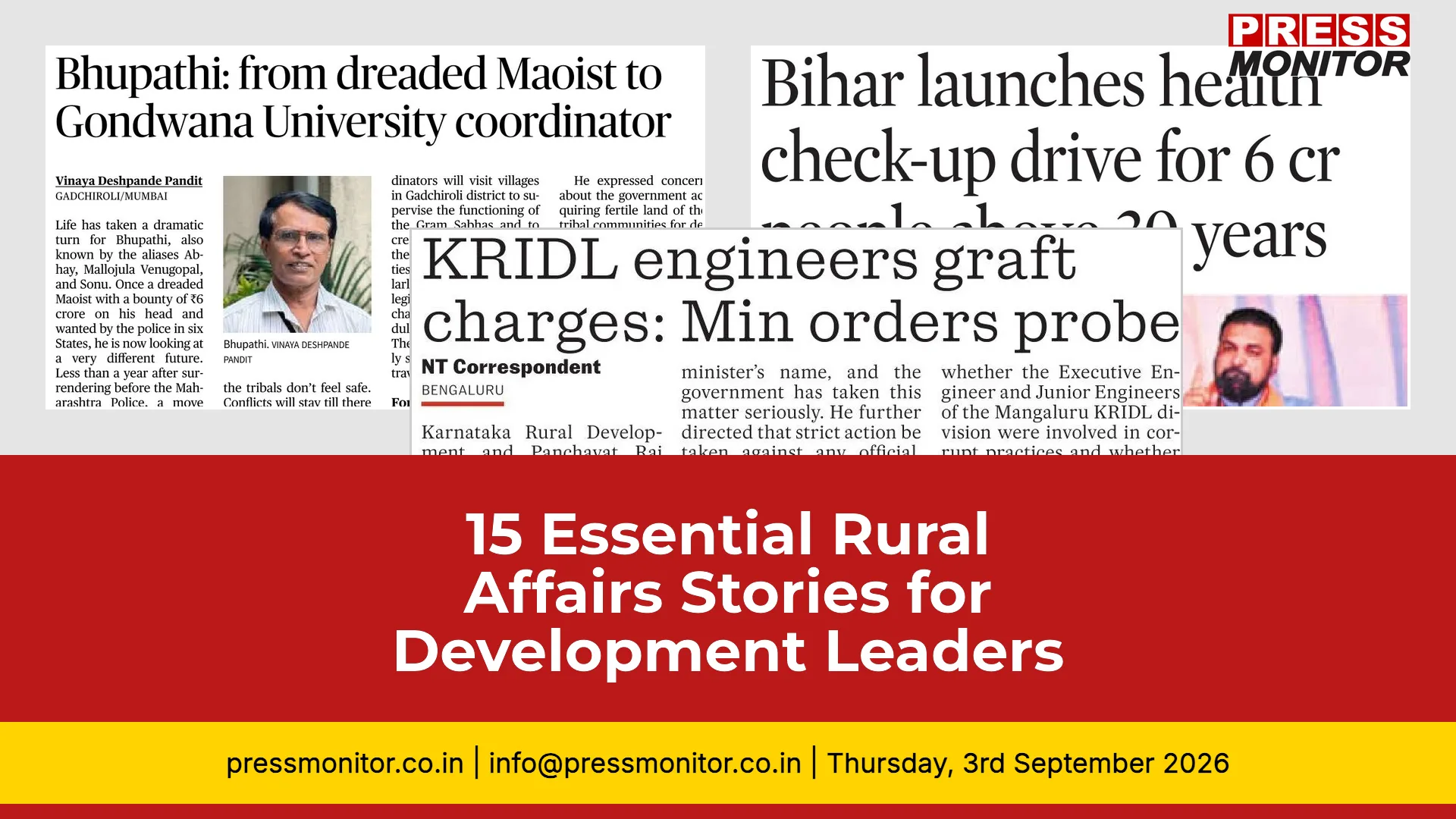
A front-page report in The Hindu says Bhupathi, the 70-year-old former Maoist leader who once carried a Rs 6 crore bounty and was wanted in six States, has been selected as a coordinator at the Village Council Capacity Building and Training Centre at Gondwana University in Gadchiroli. Less than a year after he surrendered before the Maharashtra Police along with 60 insurgents on 15 October 2025, he will visit villages to supervise Gram Sabhas and create awareness of tribal rights under the Panchayats (Extension to Scheduled Areas) Act. He said conflicts would persist until tribals feel safe and receive real rehabilitation.
Why it matters: The rehabilitation of a former Maoist leader into a mainstream academic role signals new possibilities for tribal integration and community trust.
Key detail: Bhupathi, 70, once carried a Rs 6 crore bounty and was wanted in six States. He will supervise Gram Sabhas and create awareness of tribal rights under PESA at Gondwana University in Gadchiroli.
Source: The Hindu, Gadchiroli/Mumbai
Next step: Watch for expanded PESA implementation and tribal district policy shifts.
2. Health Campaign Launched to Screen Six Crore People
A front-page report in New Indian Express says the government launched a door-to-door health campaign to screen around six crore people aged 30 and above for non-communicable diseases and provide treatment at their doorstep. Chief Minister Samrat Choudhary inaugurated the ‘Jaanch Evam Upchar, Chikitsa Aapke Dwar’ campaign.
Why it matters: Reaching six crore citizens with door-to-door non-communicable disease screening is one of India's largest public health outreach efforts for rural populations.
Key detail: Bihar Chief Minister Samrat Choudhary inaugurated the 'Jaanch Evam Upchar, Chikitsa Aapke Dwar' campaign targeting people aged 30 and above for treatment at their doorstep.
Source: New Indian Express
Next step: Monitor treatment outcomes and state-level adoption of the screening model.
3. 7% Commission Row: KRIDL Probe Ordered
A front-page report in Free Press Journal says Karnataka Rural Development and Panchayat Raj Minister Eshwar Khandre has ordered an impartial inquiry into allegations of corruption and intimidation against officials of the Karnataka Rural Infrastructure Development Limited (KRIDL) division in Mangaluru. The action follows a complaint by Puttur Congress MLA K A Ashok Kumar Rai to Chief Minister D K Shivakumar, alleging that engineers were demanding a seven per cent cut from contractors executing government projects. A three-member committee headed by an officer of Superintendent Engineer rank has been directed to submit its report within seven days.
Why it matters: Corruption allegations against rural infrastructure officials threaten public trust in development spending and contractor accountability.
Key detail: Karnataka Rural Development Minister Eshwar Khandre ordered a three-member inquiry into engineers demanding a seven percent cut from contractors executing government projects in Mangaluru.
Source: Free Press Journal
Next step: Track the committee report due within seven days and implications for ongoing rural works.
4. RDPR Dept Jobs Scam: Kumaraswamy Wants Priyank Kharge to Resign
A front-page report in Deccan Herald says, Home Minister Priyank Kharge is facing pressure to resign as Union Minister H D Kumaraswamy released documents showing that the Karnataka Public Service Commission had asked the rural development and panchayat raj department to withhold the appointment of ‘tainted’ candidates as assistant executive engineers.
Why it matters: The KPSC recruitment scandal involving tainted candidates for rural development posts raises serious questions about governance integrity and political accountability.
Key detail: Union Minister H D Kumaraswamy released documents showing the Karnataka Public Service Commission was asked to withhold appointment of tainted candidates as assistant executive engineers.
Source: Deccan Herald
Next step: Observe whether the demand for resignation gains traction and impacts the RDPR department's operations.
5. OUTREACH Bengaluru Seeks Executive Director
A front-page report in Deccan Herald says OUTREACH Association of Volunteers for Rural Development, Bengaluru, has invited applications for an Executive Director to serve as its chief executive officer. The full-time Bengaluru-based role demands 12 to 18 years of experience, including senior management, with the appointee providing strategic and operational leadership and expanding CSR, donor and institutional partnerships. Applications by email, with a one-page statement of suitability, close on 15 September 2026.
Why it matters: Rural development NGOs strengthening leadership signals growing institutional capacity for grassroots impact and CSR partnerships.
Key detail: OUTREACH Association of Volunteers for Rural Development seeks a full-time Executive Director with 12 to 18 years of experience to expand CSR, donor, and institutional partnerships. Applications close 15 September 2026.
Source: Deccan Herald
Next step: Watch for increased NGO leadership appointments in the rural development sector.
6. 3,219 km Rural Roads for Rajasthan
A front-page report in First India says Rajasthan Chief Minister Bhajan Lal Sharma has directed officials to accelerate rural development, with a focus on roads, employment, agriculture, irrigation, education, healthcare and livelihoods. Under PMGSY-IV, 3,219 km of rural roads will be built, including 1,500 km in 2026-27, while 764 works worth Rs 1,681 crore have been sanctioned under Atal Pragati Path. The state is also developing village playgrounds, Amrit Sarovars, nurseries and classrooms in 2,000 rural schools at a cost of Rs 300 crore.
Why it matters: Massive rural road expansion under PMGSY-IV directly impacts agricultural connectivity, market access, and rural mobility.
Key detail: Rajasthan CM Bhajan Lal Sharma directed officials to build 3,219 km of rural roads, including 1,500 km in 2026-27, with 764 works worth Rs 1,681 crore sanctioned under Atal Pragati Path. The state is also developing village playgrounds, Amrit Sarovars, and classrooms in 2,000 rural schools at Rs 300 crore.
Source: First India, Jaipur
Next step: Track PMGSY-IV completion rates and their impact on rural economic activity.
7. Kharge Demands Social Security For Farmers
A front-page report in Hindustan Times says, Congress president Mallikarjun Kharge emphasized that the Congress is committed to rural India by demanding social security for farmers, rural and tribal families to ensure they are partners in India’s development.
Why it matters: Congress president Kharge's commitment to social security for farmers and tribal families positions rural welfare as a central political narrative ahead of key state elections.
Key detail: Kharge emphasized that the Congress is committed to rural India, demanding social security for farmers, rural and tribal families to ensure they are partners in India's development.
Source: Hindustan Times
Next step: Monitor how opposition parties respond to the social security demand and whether it translates into policy proposals.
8. Congress Urges Security for Rural Communities
A front-page report in The Hindu says Congress president Mallikarjun Kharge emphasized the need to provide security to rural communities before a crisis strikes. He spoke at an event organized by the Dr. Y.S. Rajasekhara Reddy Foundation and the Dr. KVP Foundation.
Why it matters: Congress president Kharge's call for proactive rural security before a crisis strikes highlights the intersection of law, order, and rural development policy.
Key detail: Kharge spoke at an event organized by the Dr. Y.S. Rajasekhara Reddy Foundation and the Dr. KVP Foundation, emphasizing the need to provide security to rural communities before a crisis strikes.
Source: The Hindu, New Delhi
Next step: Observe whether the security demand leads to specific policy proposals or budget allocations.
9. Job Engine Stalls at State Borders
A front-page report in New Indian Express says the macroeconomic figures depict a picture of reassuring stability. However, these headlines mask a more urgent structural narrative. There is a persistent spatial and institutional disconnect in India’s economy.
Why it matters: A persistent spatial and institutional disconnect in India's economy masks urgent structural challenges in rural employment and labor market integration.
Key detail: Macroeconomic figures depict reassuring stability, but these headlines mask a more urgent structural narrative of disconnect between urban growth and rural employment opportunities.
Source: New Indian Express, Chennai
Next step: Track state-level employment reforms and their impact on rural-to-urban migration patterns.
10. Shivar Fellowship Supports Distressed Farmers
A front-page report in Free Press Journal says the Shivar Fellowship, founded by Hegana, was developed to support farmers in distress and rural students finding their place in Pune. The initiative addresses the agricultural, social and psychological pressures behind farmer suicides, helping families access available support and build a more secure future. Its work rests on the belief that farmers need support when they are at their most vulnerable, not abandonment.
Why it matters: Initiatives addressing the agricultural, social, and psychological pressures behind farmer suicides are critical for rural mental health and economic resilience.
Key detail: The Shivar Fellowship, founded by Hegana, was developed to support farmers in distress and rural students in Pune, helping families access available support and build a more secure future.
Source: Free Press Journal, Pune
Next step: Watch for expansion of similar fellowship and mental health support programs in other states.
11. CSR Initiative Supports Farmer Families
A front-page report in Free Press Journal says the organisation took responsibility for the education of two daughters of a farmer who died by suicide and helped the family explore an additional livelihood so they could become less dependent on uncertain farm income.
Why it matters: Corporate social responsibility initiatives targeting farmer families provide a model for sustainable livelihood diversification beyond uncertain farm income.
Key detail: The organisation took responsibility for the education of two daughters of a farmer who died by suicide and helped the family explore an additional livelihood.
Source: Free Press Journal
Next step: Monitor CSR partnerships in the rural sector and their scalability.
12. Telangana Urges National Water Security
A front-page report in Deccan Chronicle says Telangana has urged the Centre and all states to adopt a unified framework for national water security, calling it a public mission rather than a departmental programme. Irrigation minister N. Uttam Kumar Reddy pitched the idea at the Jal Sanchay Jan Bhagidari summit organised by the ministry of jal shakti in New Delhi, saying every rupee spent must produce a measurable and lasting water benefit. He added that Telangana was ready to share its experience in tank restoration, community participation and reservoir desiltation pilots with other states.
Why it matters: A unified national water security framework could transform how rural communities access water for agriculture, drinking, and sanitation.
Key detail: Telangana Irrigation Minister N. Uttam Kumar Reddy pitched the idea at the Jal Sanchay Jan Bhagidari summit in New Delhi, saying every rupee spent must produce a measurable and lasting water benefit. Telangana is ready to share its experience in tank restoration and reservoir desiltation.
Source: Deccan Chronicle, Hyderabad
Next step: Track whether the Centre adopts a unified framework and how states respond.
13. Bidar Zilla Panchayat CEO Inspects Villages
A front-page report in Free Press Journal says Bidar Zilla Panchayat Chief Executive Officer Gitte Madhav Vitthalrao made surprise visits to Kamthana, Bagdal and Chatnalli villages of Bidar taluk on Tuesday morning and conducted inspections. He inspected the Primary Health Centre in Kamthana, checking its cleanliness, pharmacy stocks and laboratory facilities, before visiting the Kamthana Gram Panchayat office. There he received grievances from villagers about the drinking water problem and assured them it would be resolved as soon as possible.
Why it matters: Surprise inspections by local governance leaders signal accountability in rural public service delivery, particularly in drinking water and health infrastructure.
Key detail: Bidar Zilla Panchayat CEO Gitte Madhav Vitthalrao conducted surprise visits to Kamthana, Bagdal, and Chatnalli villages, inspecting the Primary Health Centre and receiving grievances about drinking water problems.
Source: Free Press Journal
Next step: Watch for follow-up actions on the drinking water grievances raised during inspections.
14. Odisha Govt Procurement Notice for Bridge Works
A front-page report in New Indian Express says the Government of Odisha has issued a procurement notice for bridge works. The estimated cost ranges from Rs 1122.02 lakh to 4681.06 lakh for the construction of eleven bridges. The tender documents will be available online.
Why it matters: Large-scale bridge construction tenders indicate significant infrastructure investment in rural connectivity, with implications for trade and mobility.
Key detail: The Government of Odisha issued a procurement notice for eleven bridges with estimated costs ranging from Rs 1,122.02 lakh to Rs 4,681.06 lakh. Tender documents will be available online.
Source: New Indian Express
Next step: Track tender responses and construction timelines for rural bridge projects.
15. 19 MSME Parks Inaugurated in Andhra
A front-page report in The Hans India says Andhra Pradesh MSME minister Kondapalli Srinivas has said the state government is working to create an entrepreneur in every household, in line with Chief Minister N Chandrababu Naidu's "One Family, One Entrepreneur" vision. Addressing an MSME growth workshop in Vijayawada on Wednesday, he said 19 MSME parks have been inaugurated and 138 more are under way, expected to host 2,876 industrial units, attract investments of about Rs 8,000 crore and generate 1.03 lakh jobs. The state has also allocated Rs 300 crore under the CMEP scheme and reduced rural bank loan interest rates to support DWCRA women and aspiring entrepreneurs.
Why it matters: MSME park expansion in rural and semi-urban areas drives entrepreneurship, job creation, and economic diversification beyond agriculture.
Key detail: Andhra Pradesh MSME minister Kondapalli Srinivas said 19 MSME parks have been inaugurated and 138 more are under way, expected to host 2,876 industrial units, attract investments of about Rs 8,000 crore, and generate 1.03 lakh jobs. The state allocated Rs 300 crore under the CMEP scheme and reduced rural bank loan interest rates to support DWCRA women and aspiring entrepreneurs.
Source: The Hans India, Vijayawada
Next step: Monitor MSME park occupancy rates and the impact of reduced rural bank loan interest rates on entrepreneurship.
Closing: Which of these rural affairs developments will have the greatest impact on India's development trajectory in the next quarter? Share your perspective in the comments.