15 Essential Rural Development Stories for Policy Leaders


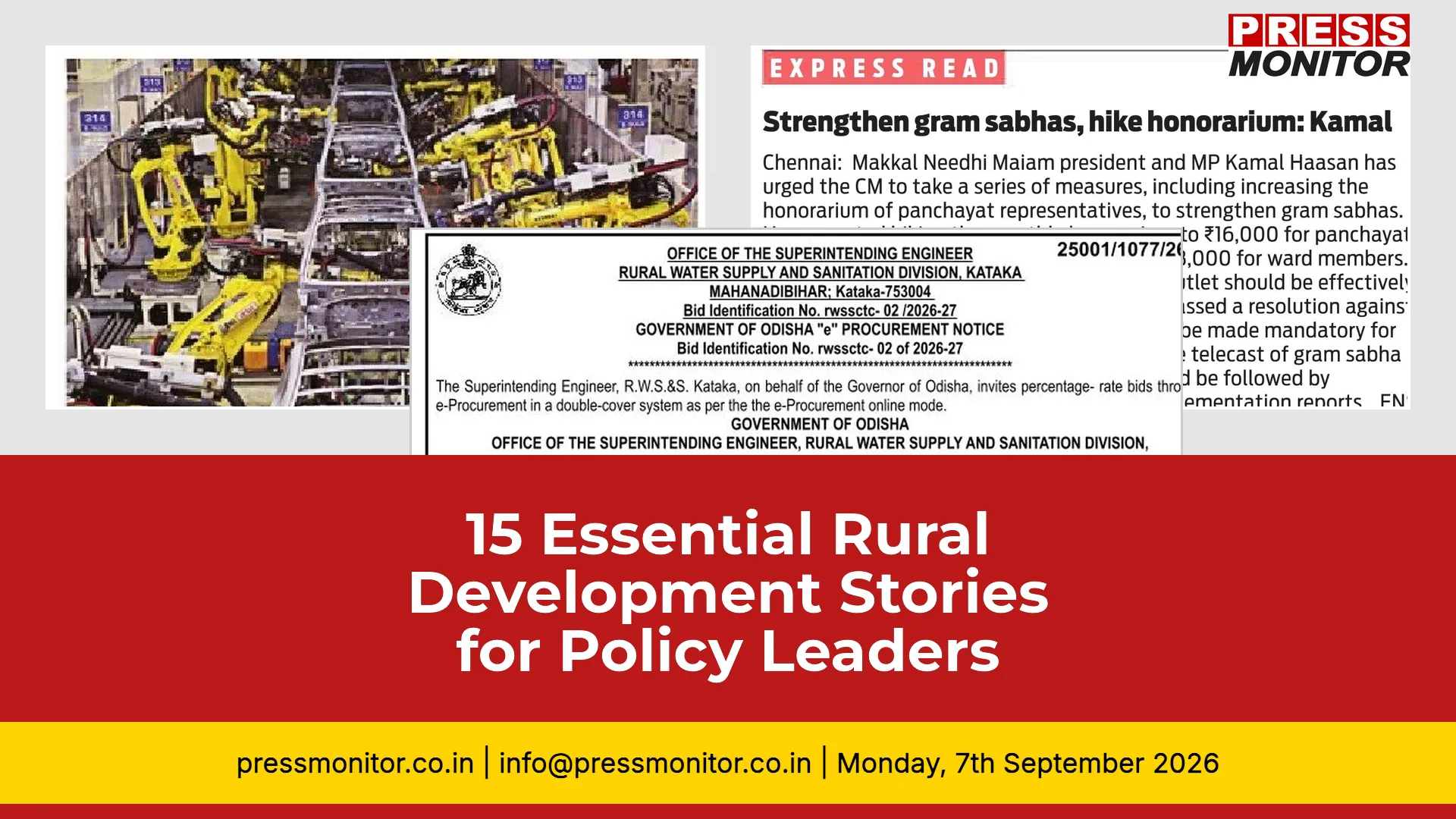
From gram sabha empowerment to rural healthcare breakthroughs, today's print media monitoring of Indian publications reveals 15 stories shaping India's countryside. According to Press Monitor's tracking of Indian publications, these developments demand attention from anyone following news on rural development. This review draws on media intelligence gathered from across the print landscape.
1. Hyundai Targets 30 Per Cent Rural Sales
A front-page report in Mint says Hyundai Motor India Limited is intensifying its focus on rural markets, where sport utility vehicles already account for sixty-nine per cent of sales. The company plans to open six out of every ten new dealership outlets in these regions, aiming to raise rural penetration to approximately thirty per cent within three to four years. This expansion strategy will be driven by the upcoming launch of a midsize sport utility vehicle and a compact electric model. Hyundai Motor India Limited is intensifying its focus on rural markets, where sport utility vehicles already account for sixty-nine per cent of sales. The company plans to open six out of every ten new dealership outlets in these regions, aiming to raise rural penetration to approximately thirty per cent within three to four years. This expansion strategy will be driven by the upcoming launch of a midsize sport utility vehicle and a compact electric model.
Why it matters: Rural India is becoming a decisive battleground for automakers. A 30% rural sales target signals that manufacturers see genuine demand beyond metros.
Key detail: Rural sales grew 23% in Q1 FY27; SUVs account for roughly 68-69% of rural sales.
Source: Mint, Free Press Journal, Millennium Post
Next step: Watch the midsize SUV and compact EV launches as indicators of rural market strategy.
2. Kamal Haasan Urges Gram Sabhas Strengthen
A front-page report in New Indian Express says Makkal Needhi Maiam president and MP Kamal Haasan has urged the Chief Minister to take a series of measures, including increasing the honorarium of panchayat representatives, to strengthen gram sabhas. He suggested hiking the monthly honorarium to Rs 7,000 for panchayat presidents, Rs 5,000 for vice-presidents and Rs 8,000 for ward members. He suggested that the operation of a liquor outlet should be effectively stopped if a properly convened gram sabha passed a resolution against it. Makkal Needhi Maiam president and MP Kamal Haasan has urged the Chief Minister to take a series of measures, including increasing the honorarium of panchayat representatives, to strengthen gram sabhas. He suggested hiking the monthly honorarium to Rs 7,000 for panchayat presidents, Rs 5,000 for vice-presidents and Rs 8,000 for ward members. He suggested that the operation of a liquor outlet should be effectively stopped if a properly convened gram sabha passed a resolution against it.
Why it matters: Gram sabhas are the foundation of rural democracy. Strengthening them with better honorariums and enforcement powers could transform local governance across India.
Key detail: Proposed honorarium hike of up to Rs 8,000 per month for ward members.
Source: New Indian Express
Next step: Watch for the Chief Minister's response and any legislative follow-up on gram sabha empowerment.
3. Rs 154.20 Lakh Water Retrofitting Tender
A front-page report in Hindustan Times says the Government of Odisha has invited percentage-rate bids through electronic procurement for retrofitting two rural public water supply schemes under the Kataka division. The tender, issued by the Superintending Engineer of the Rural Water Supply and Sanitation Division, carries an estimated cost between Rs 85.39 lakhs and Rs 154.20 lakhs. Successful contractors will be required to complete the works within nine calendar months, with applications available from September 9 to September 30, 2026. The Government of Odisha has invited percentage-rate bids through electronic procurement for retrofitting two rural public water supply schemes under the Kataka division. The tender, issued by the Superintending Engineer of the Rural Water Supply and Sanitation Division, carries an estimated cost between Rs 85.39 lakhs and Rs 154.20 lakhs. Successful contractors will be required to complete the works within nine calendar months, with applications available from September 9 to September 30, 2026.
Why it matters: Clean water access in rural India remains a critical challenge. These retrofitting projects signal state-level investment in improving rural water infrastructure.
Key detail: Tender value up to Rs 154.20 lakhs; nine-month completion timeline.
Source: Hindustan Times
Next step: Contractors should mark the September 9 application opening date on their calendars.
4. AI Enters Rural Indian Schools
A front-page report in Times of India says artificial intelligence is slowly making its way into rural classrooms across India, but adoption remains uneven. Teachers are learning to use technology on their own, yet schools continue to face infrastructure gaps, irregular student attendance, and limited digital training. In some rural schools, AI has become a useful aid for teachers to explain difficult concepts and manage classrooms amid staff shortages. Ruby Kumari, an exclusive teacher at UMS Sarouni in Bounsi Banka, Bihar, formed a team to develop the Study Toons project, using tools such as ChatGPT and Canva to create animated educational content based on National Council of Educational Research and Training textbooks. Despite the benefits, educators claim unreliable electricity and erratic internet connectivity are hindering schools from adopting AI effectively. Artificial intelligence is slowly making its way into rural classrooms across India, but adoption remains uneven. Teachers are learning to use technology on their own, yet schools continue to face infrastructure gaps, irregular student attendance, and limited digital training. In some rural schools, AI has become a useful aid for teachers to explain difficult concepts and manage classrooms amid staff shortages. Ruby Kumari, an exclusive teacher at UMS Sarouni in Bounsi Banka, Bihar, formed a team to develop the Study Toons project, using tools such as ChatGPT and Canva to create animated educational content based on National Council of Educational Research and Training textbooks. Despite the benefits, educators claim unreliable electricity and erratic internet connectivity are hindering schools from adopting AI effectively.
Why it matters: AI has the potential to bridge the teacher shortage gap in rural schools, but infrastructure deficits remain a stubborn barrier.
Key detail: Study Toons project uses ChatGPT and Canva to create animated NCERT-based content in Bihar.
Source: Times of India
Next step: Policymakers should prioritize rural digital infrastructure before scaling AI tools in classrooms.
5. 25-Kilometre Himalayan Rail Corridor
A front-page report in The Pioneer says the newspaper page features a corporate engineering profile for an unnamed organisation, with focus areas spanning India, the Himalayan region and Uzbekistan. The profile highlights a 25-kilometre rail corridor through seismic Himalayan terrain, drone based surveys, education and skill development, rural and community development, women empowerment, sustainability and an Uzbekistan solar photovoltaic project, noting recognition as a Champion of Change and an impactful CSR Leader of India in 2025. A corporate engineering profile highlights a 25-kilometre rail corridor through seismic Himalayan terrain, alongside drone-based surveys, education and skill development, rural and community development, women empowerment, sustainability and an Uzbekistan solar photovoltaic project. The profile notes recognition as a Champion of Change and an impactful CSR Leader of India in 2025.
Why it matters: Infrastructure projects in seismic zones require engineering excellence, and this profile showcases how corporate India is investing in rural and community development alongside major engineering feats.
Key detail: 25-km rail corridor through Himalayan terrain; CSR Leader of India 2025 recognition.
Source: The Pioneer
Next step: Follow the rail corridor project timeline and its impact on Himalayan region connectivity.
6. CT Scan Facility Inaugurated At Kamla Hospital
A front-page report in State Times says J&K BJP President and MP Sat Sharma, along with MLA Bisv Bhagat and MLA Ashwani Sharma, inaugurated a modern CT Scan facility at Kamla Hospital in Bishnah on Sunday. The facility aims to make advanced diagnostic healthcare more accessible and affordable in rural and semiurban areas, saving patients from traveling to Jammu for important diagnostic investigations. Hospital management headed by Bharat Bhushan and Anuj was appreciated for extending special care and concessions to poor and needy patients, particularly for CT Scan investigations. J&K BJP President and MP Sat Sharma, along with MLA Bisv Bhagat and MLA Ashwani Sharma, inaugurated a modern CT Scan facility at Kamla Hospital in Bishnah. The facility aims to make advanced diagnostic healthcare more accessible and affordable in rural and semi-urban areas, saving patients from traveling to Jammu for important diagnostic investigations. Hospital management headed by Bharat Bhushan and Anuj was appreciated for extending special care and concessions to poor and needy patients.
Why it matters: Rural healthcare access improves dramatically when diagnostic facilities are brought closer to communities, reducing travel burdens and costs.
Key detail: CT Scan facility in Bishnah serves rural and semi-urban populations in J&K.
Source: State Times
Next step: Monitor patient footfall and the impact on healthcare outcomes in the Bishnah region.
7. 10 Honored Organizations Empower Indian Women
A front-page report in Economic Times says ten organizations have been honored for their contributions to healthcare, education, and women's empowerment across India. ARMMAN has trained over seventeen thousand nurses and four thousand five hundred medical officers to reduce maternal and child mortality. MPOWER reached over seven point one million people with mental health support across seventeen states, while Telerad Foundation delivered over ninety thousand teleconsultations in rural areas. Ten organizations have been honored for their contributions to healthcare, education, and women's empowerment across India. ARMMAN has trained over seventeen thousand nurses and four thousand five hundred medical officers to reduce maternal and child mortality. MPOWER reached over seven point one million people with mental health support across seventeen states, while Telerad Foundation delivered over ninety thousand teleconsultations in rural areas.
Why it matters: Women's empowerment and rural healthcare are two sides of the same coin. These organizations are making measurable impact where it matters most.
Key detail: ARMMAN trained 17,000+ nurses; MPOWER reached 7.1 million people; Telerad delivered 90,000+ rural teleconsultations.
Source: Economic Times
Next step: Explore partnerships with these organizations for rural healthcare and empowerment initiatives.
8. Paithani Training Centre Launched In CSN
A front-page report in Free Press Journal says a Paithani saree training and development centre was inaugurated at Jeevan Vikas Mahavidyalaya by former minister and MLA Abdul Sattar on Saturday under the joint auspices of the Shiv Sena and the Vaijapur Taluka Vikas Manch, on the initiative of industrialist Dr JK Jadhav. Various initiatives were launched at Mahalgaon, Chinchadgaon, Karanjgaon and Shiur, including computer training centres, felicitation of ideal teachers and meritorious students, health awareness campaigns and the honouring of Paithani weavers. A Paithani saree training and development centre was inaugurated at Jeevan Vikas Mahavidyalaya by former minister and MLA Abdul Sattar under the joint auspices of the Shiv Sena and the Vaijapur Taluka Vikas Manch, on the initiative of industrialist Dr JK Jadhav. Various initiatives were launched at Mahalgaon, Chinchadgaon, Karanjgaon and Shiur, including computer training centres, felicitation of ideal teachers and meritorious students, health awareness campaigns and the honouring of Paithani weavers.
Why it matters: Preserving traditional crafts while providing vocational training creates sustainable livelihoods for rural artisans and their communities.
Key detail: Paithani saree training centre inaugurated at Jeevan Vikas Mahavidyalaya in CSN.
Source: Free Press Journal
Next step: Track enrollment numbers and placement rates for Paithani weaver trainees.
9. Sasken Technologies Reaches 25 Lakh Women
A front-page report in Economic Times says Sasken Technologies has highlighted its gender equity and inclusion programme in India on 18 July 2026, with women and girls benefiting from social investment in financial inclusion, nutrition, skilling and rural eye care. The company says it reached 25 lakh women, fed more than 13,000 children through a nutrition plan and has women representing 28 percent of its workforce. Sasken Technologies highlighted its gender equity and inclusion programme, with women and girls benefiting from social investment in financial inclusion, nutrition, skilling and rural eye care. The company says it reached 25 lakh women, fed more than 13,000 children through a nutrition plan and has women representing 28 percent of its workforce.
Why it matters: Corporate social responsibility programs that target women in rural areas create cascading benefits across health, education, and economic participation.
Key detail: 25 lakh women reached; 13,000+ children fed; 28% women in workforce.
Source: Economic Times
Next step: Assess the scalability of Sasken's model for other corporations targeting rural women.
10. Milk Prices Rise to Rs 80
A front-page report in Tribune says dairy farmers in Narukheri village have proposed raising cow milk to Rs 80 per litre and buffalo milk to Rs 100 per litre amid rising input costs. The farmers will hold another meeting on September 10 to review public feedback before finalizing the decision. Dairy farmers in Narukheri village have proposed raising cow milk to Rs 80 per litre and buffalo milk to Rs 100 per litre amid rising input costs. The farmers will hold another meeting on September 10 to review public feedback before finalizing the decision.
Why it matters: Rising input costs are squeezing rural dairy farmers, and price adjustments reflect the broader economic pressures on agriculture.
Key detail: Proposed cow milk at Rs 80/litre and buffalo milk at Rs 100/litre.
Source: Tribune
Next step: Watch the September 10 meeting for the final pricing decision and farmer consensus.
11. Riyali Panchayat Opposes New Crushers
A front-page report in Tribune says the Riyali gram panchayat in the Mand area of Fatehpur development block in Kangra district has strongly opposed the proposed establishment of new stone crushers and the grant of fresh mining leases. Panchayat representatives and members of the Mand Environment Protection Samiti staged a protest and passed a resolution urging the state government to halt permissions, citing traffic, pollution, and ecological concerns. The resolution demands a scientific study, carrying-capacity assessment, and environmental impact assessment before any new mining activity is permitted. The Riyali gram panchayat in the Mand area of Fatehpur development block in Kangra district has strongly opposed the proposed establishment of new stone crushers and the grant of fresh mining leases. Panchayat representatives and members of the Mand Environment Protection Samiti staged a protest and passed a resolution urging the state government to halt permissions, citing traffic, pollution, and ecological concerns. The resolution demands a scientific study, carrying-capacity assessment, and environmental impact assessment before any new mining activity is permitted.
Why it matters: Local governance bodies are pushing back against industrial projects that threaten rural ecosystems, setting a precedent for community-led environmental advocacy.
Key detail: Protest staged by panchayat representatives and Mand Environment Protection Samiti in Kangra district.
Source: Tribune
Next step: Monitor whether the state government responds to the panchayat's resolution.
12. Kangana Backs RSS Schools in Himachal
A front-page report in Millennium Post says that Bharatiya Janata Party member of parliament Kangana Ranaut said Rashtriya Swayamsevak Sangh-run Vidya Bharati schools should be replicated in Himachal Pradesh if the party returns to power there, referencing West Bengal chief minister Suvendu Adhikari's proposal to establish one thousand Vidya Bharati institutions. She made the comments in Shimla on September 6 while chairing a District Development Coordination and Monitoring Committee meeting in Mandi, praising the organisation as a source of national pride and criticising officials over delays in using public funds. Bharatiya Janata Party member of parliament Kangana Ranaut said Rashtriya Swayamsevak Sangh-run Vidya Bharati schools should be replicated in Himachal Pradesh if the party returns to power there, referencing West Bengal chief minister Suvendu Adhikari's proposal to establish one thousand Vidya Bharati institutions. She made the comments in Shimla on September 6 while chairing a District Development Coordination and Monitoring Committee meeting in Mandi, praising the organisation as a source of national pride and criticising officials over delays in using public funds.
Why it matters: Education policy in rural India is increasingly shaped by political commitments to alternative school models, with significant implications for public fund utilization.
Key detail: Kangana Ranaut cited Suvendu Adhikari's proposal for 1,000 Vidya Bharati institutions in West Bengal.
Source: Millennium Post
Next step: Watch for BJP's formal education policy announcement for Himachal Pradesh.
13. Inclusion Goes Beyond Targets Panel
A front-page report in Economic Times says speakers from the social and corporate sector emphasized that meaningful change must go beyond numerical targets. They called for genuine ownership and representation at a panel on Scaling Inclusion, with examples ranging from rural women's land rights to modest income preferences. Speakers from the social and corporate sector emphasized that meaningful change must go beyond numerical targets. They called for genuine ownership and representation at a panel on Scaling Inclusion, with examples ranging from rural women's land rights to modest income preferences.
Why it matters: The shift from target-based to ownership-based inclusion models could reshape how corporations and governments approach rural development programs.
Key detail: Panel examples include rural women's land rights and modest income preferences.
Source: Economic Times
Next step: Identify organizations that are leading ownership-based inclusion models for replication.
14. Dharwad Students Face Faulty School Shoes
A front-page report in Free Press Journal says government school students in Dharwad are struggling with faulty footwear distributed under a state scheme, as several pairs reportedly tore within days. Parents have questioned the quality of the centralised products and demanded thorough independent testing instead of case-by-case replacements. The controversy underscores growing scrutiny over the recent shift from local trader procurement to a state-level tendering system. Government school students in Dharwad are struggling with faulty footwear distributed under a state scheme, as several pairs reportedly tore within days. Parents have questioned the quality of the centralised products and demanded thorough independent testing instead of case-by-case replacements. The controversy underscores growing scrutiny over the recent shift from local trader procurement to a state-level tendering system.
Why it matters: Quality failures in government procurement directly affect rural students, and the shift to centralized tendering raises questions about accountability.
Key detail: Shoes distributed under a state scheme tore within days of use in Dharwad government schools.
Source: Free Press Journal
Next step: Demand independent quality testing protocols for all centrally procured school materials.
15. Rs 1.2 Crore Funds Heal Nepal Floods
A front-page report in Indian Express says that donations worth Rs 1.2 crore helped equip Jibjibe Rural Hospital in Rasuwa, Nepal, with critical medical equipment after the April 25 earthquake. The hospital, now treating about one hundred patients daily, has treated dozens of flood‑injured patients and provided psychosocial care. The donations, mobilised by readers and the Indian Express Citizens’ Relief Fund, allowed the hospital to operate without sending patients to distant centres. Donations worth Rs 1.2 crore helped equip Jibjibe Rural Hospital in Rasuwa, Nepal, with critical medical equipment after the April 25 earthquake. The hospital, now treating about one hundred patients daily, has treated dozens of flood-injured patients and provided psychosocial care. The donations, mobilised by readers and the Indian Express Citizens' Relief Fund, allowed the hospital to operate without sending patients to distant centres.
Why it matters: Cross-border healthcare support demonstrates how Indian media-driven philanthropy can reach beyond borders to serve rural communities in need.
Key detail: Rs 1.2 crore raised; hospital now treats 100 patients daily; flood-injured patients receiving care.
Source: Indian Express
Next step: Follow the ongoing relief efforts and the hospital's capacity to serve the Rasuwa community.
Closing: These 15 stories, drawn from print media monitoring and media intelligence, show that rural India is evolving rapidly — from infrastructure and healthcare to education, governance, and women's empowerment. Which development will you be watching most closely?