15 Essential Social Media Stories for PR Leaders


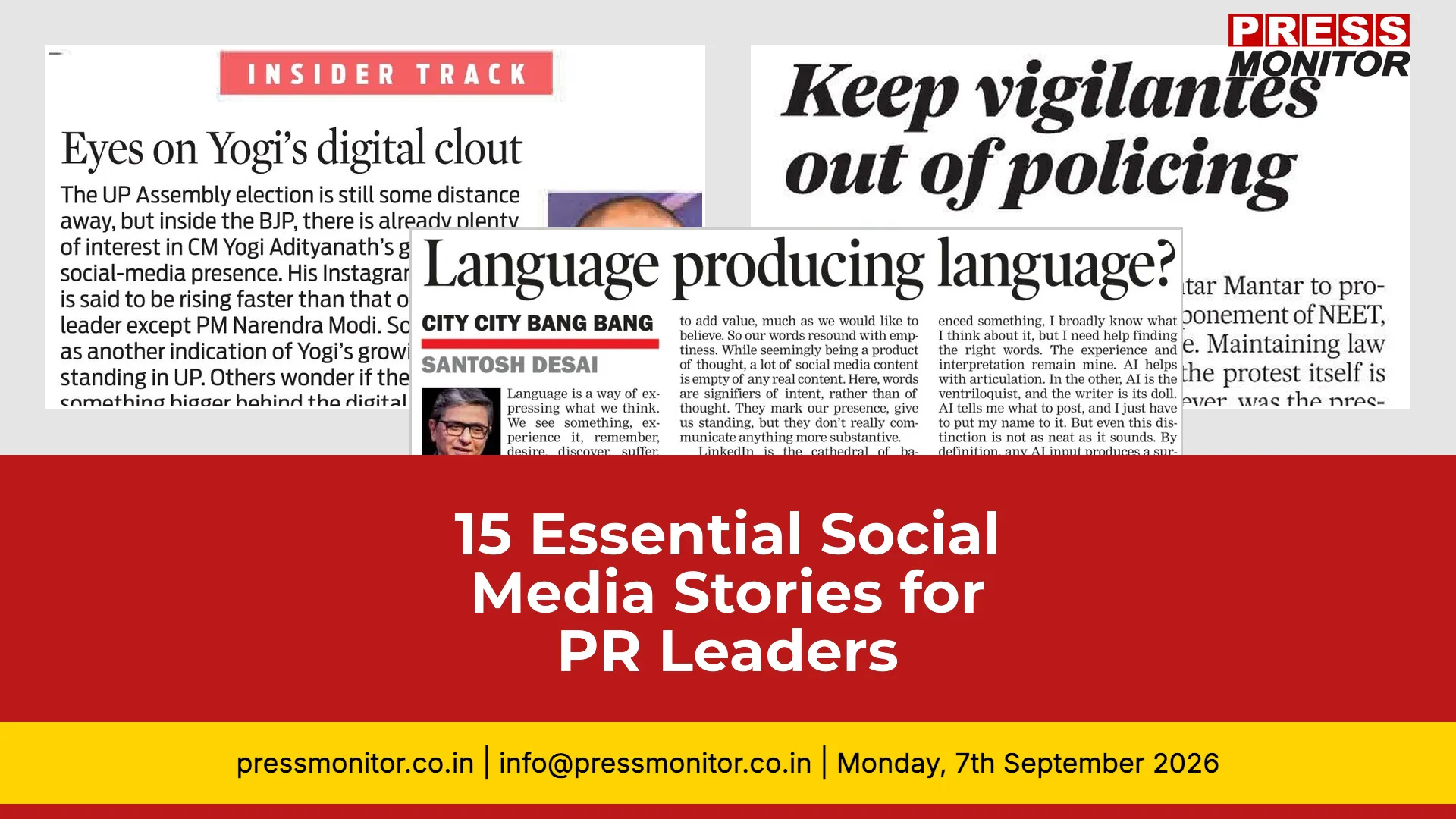
Tracking news on social media & platforms requires precise media monitoring to separate algorithmic noise from verified editorial reporting. Today’s press review highlights how digital governance, influencer accountability, and platform policy are reshaping India’s public discourse. According to Press Monitor's tracking of Indian publications, these developments demand immediate attention from communications directors and policy officers navigating the intersection of traditional journalism and digital virality. Leveraging advanced media intelligence ensures executives decode print data faster than social feeds ever could.
1. Jantar Mantar Vigilante Attack Sparks Law & Order Debate
A front-page report in Free Press Journal says students gathered at Jantar Mantar to protest question-paper leaks and the postponement of NEET, where police had every right to be there but men in mufti armed with lathis attacked protesters. One man, Swatantra Bharadwaj, claimed he cracked the skull of a minor girl's father and boasted that political connections saved him, naming Delhi minister Kapil Mishra and Union minister Chirag Paswan as benefactors, though Paswan has denied any connection and filed a complaint against Bharadwaj for using his name. The police arrested Bharadwaj after students protested the delay, and a separate FIR now includes POCSO Act provisions over alleged online harassment and threats against the minor protester, highlighting that law and order cannot be outsourced to vigilantes.
Why it matters: Highlights the dangerous blurring of lines between citizen activism and state responsibility during digital-era protests.
Key detail: Police faced armed men in mufti attacking NEET protesters; influencer Swatantra Bhardwaj claimed political backing before facing POCSO charges.
Source: Free Press Journal
Next step: Legal teams should monitor emerging court filings regarding vigilante liability and digital threat escalation. Question: How should institutions balance protest rights with rapid digital rumor control?
2. Yogi Adityanath Expands Digital Clout Ahead of UP Elections
A front-page report in Morning Standard says the UP Assembly election is still some distance away, but inside the BJP there is already plenty of interest in Chief Minister Yogi Adityanath's growing social-media presence. His Instagram following is said to be rising faster than that of any BJP leader except Prime Minister Narendra Modi, with some seeing it as another indication of Yogi's growing standing in Uttar Pradesh. His team is active on Instagram, X, Facebook and YouTube, and his selfie videos are getting a big response, with Yogi having 17.7 million followers on X ahead of Rahul Gandhi's roughly 15 million.
Why it matters: Demonstrates how regional leadership leverages short-form video and X to bypass traditional gatekeepers.
Key detail: 17.7 million X followers surpass Rahul Gandhi; Instagram growth tracks closely behind PM Modi within BJP ranks.
Source: Morning Standard
Next step: Political strategists should analyze engagement metrics to forecast voter sentiment shifts ahead of assembly polls. Question: Can sustained digital outreach translate into grassroots electoral conversion?
3. Nine-Hour Detention of Dissenter Ashish Joshi
A front-page report in Deccan Chronicle says former civil servant Ashish Joshi was detained by Delhi Police's Special Cell for nine hours during a morning walk in Nehru Park, Delhi, on 18 July 2026, following an FIR over a social media post criticising Chief Election Commissioner Gyanesh Kumar. The interrogation shifted to a different post about internal government friction, suggesting the state's aim was to suppress politically sensitive disclosures rather than address mere speech offences. The article argues this reflects a broader pattern under the Narendra Modi government of using state machinery disproportionately against dissent while neglecting action against supporters who threaten others.
Why it matters: Raises critical questions about free speech boundaries and the use of state machinery against online criticism.
Key detail: Former civil servant detained after an FIR over a social media post criticising the Chief Election Commissioner.
Source: Deccan Chronicle
Next step: Corporate counsel should review internal communication policies to mitigate regulatory exposure. Question: Where do we draw the line between lawful dissent and actionable speech offences?
4. Nitin Nabin Faces Backlash Over Rasputin Song Post
A front-page report in Tribune says JP president Nitin Nabin was criticised by the Congress and TMC after he shared a video on X of his meeting with the Russian envoy to India Denis Alipov set to the 1978 Boney M hit song Ra Ra Rasputin. The Opposition called the choice of song on the controversial and divisive figure in Russia as comical and tasteless.
Why it matters: Illustrates the reputational risks of tone-deaf content moderation in political digital campaigns.
Key detail: Opposition parties condemned the choice of Boney M track accompanying a meeting with Russia’s envoy to India.
Source: Tribune
Next step: Comms teams must implement cultural sensitivity checks before scheduling high-profile diplomatic content. Question: How can political offices standardise crisis response for viral missteps?
5. Santosh Desai Warns of AI-Generated Language Ecosystems
A front-page report in Times of India says author Santosh Desai argues that language is increasingly detached from lived human experience as social media and large language models produce vast amounts of polished but hollow text. The column warns that artificial intelligence-generated language may become a self-reinforcing textual ecosystem, with people shifting from primary creators of language to selectors and approvers of ready-made words.
Why it matters: Signals a paradigm shift where human experience is outsourced to probabilistic text generation.
Key detail: Large language models decouple language from lived reality, accelerated by social media’s demand for instant reactions.
Source: Times of India
Next step: Thought leaders should audit content pipelines for authenticity and original human insight. Question: Will curated AI outputs eventually replace genuine editorial voice?
6. BSP Directs Workers to Court Gen-Z and Gen-Alpha Voters
A front-page report in First India says Bahujan Samaj Party supremo Mayawati has directed the party to incorporate Generation Z and Generation Alpha concerns into its political agenda, marking a strategic push to engage younger, digital native voters across India. The initiative encourages party workers to leverage social media platforms while avoiding distractions, though observers question whether traditional Bahujan politics can successfully adapt to win over smartphone scrolling constituents. This campaign marks a notable shift in the party outreach efforts as it seeks to revitalise its voter base.
Why it matters: Marks a strategic pivot toward digital-native demographics in traditionally cadre-driven politics.
Key detail: Mayawati mandates integration of youth concerns into party agendas while warning against social media distractions.
Source: First India
Next step: Outreach coordinators should map platform-specific messaging to align with younger voter priorities. Question: Can legacy political structures successfully adapt to algorithmic discovery?
7. Algorithmic Feeds Prioritise Shock Over Authentic Disaster Reporting
A front-page report in Times of India says rescuers pulled survivors from tunnels like Trishuli 3A nine days after floods and landslides killed hundreds. Yet viral AI-generated fabrications and graphic imagery overshadowed authentic reports, revealing how algorithmic feeds prioritize shock over reality during disasters.
Why it matters: Exposes how recommendation engines amplify fabricated imagery during humanitarian crises.
Key detail: Viral AI-generated content overshadowed verified rescue updates during the Trishuli 3A flood response.
Source: Times of India
Next step: Crisis communicators must establish rapid verification protocols to counter synthetic media. Question: Should platforms be legally mandated to deprioritise unverified emergency visuals?
8. Ramayana Parallels Drawn to Modern Digital Manipulation
A front-page report in The Pioneer says the ancient Ramayana offers a nuanced portrait of psychological manipulation through the relationship between Manthara, Kaikeyi and King Dasaratha. The article draws parallels to social media and digital algorithms, noting that information manipulation can become invisible governance sabotage. India must protect democracy by preventing sabotage through misinformation and securing institutions.
Why it matters: Offers historical framing for understanding invisible governance sabotage through information warfare.
Key detail: Ancient psychological manipulation tactics mirror contemporary algorithmic echo chambers and deepfake strategies.
Source: The Pioneer
Next step: Policy advisors should integrate behavioural psychology into national security frameworks. Question: Can traditional wisdom inform modern cyber-resilience strategies?
9. CPI(ML) Condemns Prime Minister’s Instagram Comment
A front-page report in Free Press Journal says Communist Party of India (Marxist-Leninist) General Secretary Dipankar Bhattacharya alleged that Prime Minister Narendra Modi's Instagram comment about young women was provocative. The remarks were made during the "Gen-Z Rising" programme in Patna on Sunday. Bhattacharya claimed the comment encouraged intimidation and violence, with repercussions seen on social media and on the ground. The event was organised by the AISA-Revolutionary Youth Association. Bhattacharya also criticised the targeting of young activists on August 15 under the label "Dimagi Naxal" and demanded legal cases against Jantar Mantar protesters and farmers be withdrawn. All India Students' Association General Secretary Neha thanked the people of Bihar for supporting the Jantar Mantar movement and called for Chief Minister Samrat Choudhary to answer for irregularities in the Bihar Public Service Commission 70th examination and police recruitment tests.
Why it matters: Shows how executive social media remarks trigger immediate opposition mobilisation and ground-level friction.
Key detail: General Secretary alleges provocative remarks encouraged intimidation during a Patna youth programme.
Source: Free Press Journal
Next step: Government relations officers should monitor cross-platform sentiment spikes following official statements. Question: How do casual digital interactions escalate into formal political disputes?
10. Congress Reprimands AI-Powered Digital War Room
A front-page report in First India says silence has reportedly gripped the Uttar Pradesh Congress digital war room after a high-command reprimand. The social media team produced high-tech, artificial intelligence powered videos attracting millions of views, but showed little corresponding ground activity. Local leaders and workers reportedly complained that the cadre is disappearing into the artificial intelligence frenzy, prompting leadership to urge a return to grassroots politics.
Why it matters: Reveals the tension between high-tech content production and tangible grassroots mobilisation.
Key detail: Leadership warns cadres against losing touch with field operations amid viral AI video campaigns.
Source: First India
Next step: Campaign managers should tie digital KPIs directly to voter contact metrics. Question: Does algorithmic reach necessarily equate to electoral influence?
11. Prisons Chief Suspended Over Viral Inmate Lifestyle Videos
A front-page report in Free Press Journal says Dr. Anita R., the Chief Superintendent of Kalaburagi Central Prison, has been suspended facing allegations of dereliction of duty over videos titled 'Prisoners' Bindass Life' showing inmates circulating on social media. Director General of Police Alok Kumar issued an order for a departmental inquiry effective immediately, and Anita R.'s headquarters have been shifted to New Central Prison in Vijayapura during the suspension period.
Why it matters: Highlights institutional accountability failures when sensitive environments leak onto public platforms.
Key detail: Kalaburagi prison superintendent faces departmental inquiry after footage of relaxed inmate conditions circulated online.
Source: Free Press Journal
Next step: Facility administrators must enforce strict digital containment protocols. Question: What safeguards prevent operational transparency from becoming public spectacle?
12. Religious Association Flags Fraudulent Ritual Ads Online
A front-page report in Free Press Journal says that the Trimbakeshwar Purohits’ Association has lodged a complaint with the police administration over fraudulent social media ads offering religious rituals, alleging that unauthorised purohits from outside Trimbakeshwar are exploiting devotees in Nashik. The association has demanded immediate action and has submitted a memorandum to the Inspector of Trimbakeshwar Police Station, marking the second complaint in two months.
Why it matters: Demonstrates how digital marketplaces enable unauthorised service providers to exploit community trust.
Key detail: Trimbakeshwar Purohits lodge police complaint against external actors selling fake religious ceremonies via social media.
Source: Free Press Journal
Next step: Brand protection teams should deploy automated takedown workflows for trademark infringement. Question: How can heritage institutions secure their digital commerce channels?
13. IIT Mandi Forms Panel After Caste Hierarchy Poster Goes Viral
A front-page report in Tribune says a poster displayed during Janmashtami celebrations at IIT Mandi sparked sharp criticism on social media after it was alleged to promote a caste-based hierarchy while explaining the concept of karma from the Bhagavad Gita. The institute distanced itself from the controversial poster, stating the programme was organised by students and it opposes any caste-based discrimination. An inquiry panel has been formed to investigate the matter.
Why it matters: Shows how campus events rapidly escalate into national diversity debates through social amplification.
Key detail: Institute distances itself from student-organised Janmashtami display allegedly promoting discriminatory karma interpretations.
Source: Tribune
Next step: University comms offices should pre-clear cultural programming materials. Question: Who bears responsibility when student initiatives trigger institutional backlash?
14. Cyber Extortion Ring Using Social Media Sentenced to Remand
A front-page report in Deccan Chronicle says three members of the Arjun gang, including alleged ringleader Chandrasekhar Azad, his mother Koduri Meena Kumari and Vinil Chaudhary, were sent to judicial remand following police custody. The suspects allegedly trained minors to pose as wealthy individuals and extort money from affluent girls across Hyderabad and Bengaluru using social media and hidden surveillance devices. Authorities have registered five cases and are tracing financial networks linked to the extortion operations.
Why it matters: Underscores the growing sophistication of digital fraud targeting affluent demographics via hidden surveillance.
Key detail: Three suspects, including alleged ringleader Chandrasekhar Azad, traced to multi-city extortion networks exploiting dating apps.
Source: Deccan Chronicle
Next step: Risk management divisions should update employee cybersecurity training modules. Question: How do financial institutions collaborate with law enforcement to freeze illicit digital flows?
15. YSRCP Accuses State Government of Blocking Scam-Exposing Accounts
A front-page report in Statesman says YSRCP has slammed Andhra Pradesh Chief Minister N Chandrababu Naidu for the dictatorial attitude in blocking all the social media accounts that were exposing the Mega District Selection Committee Teacher Recruitment Scam. Party spokesperson Putta Siva Shankar said the move confirms the irregularities and condemned the blocking of social media handles of YSRCP and its supporters.
Why it matters: Illustrates the weaponisation of platform access controls in regional electoral battles.
Key detail: Opposition claims systematic suspension of handles documenting irregularities in teacher recruitment processes.
Source: Statesman
Next step: Regulatory affairs specialists should track legislative proposals around digital neutrality. Question: Should governments face penalties for selective social media throttling?
According to Press Monitor's tracking of Indian publications, these fifteen developments underscore why print media monitoring remains indispensable for executives who need verified signals before trends hit global feeds. Which of these platform governance shifts will reshape your sector next quarter?