15 Essential Supply Chain Stories for Procurement Leaders


From FAO food price spikes to coal shortages threatening India's power grid, today's news on supply chain procurement and logistics demands constant vigilance. This press review, powered by Press Monitor's media monitoring of Indian publications, delivers 15 essential stories that every supply chain leader needs to know. According to Press Monitor's tracking of Indian publications, these developments reshape how businesses source, store, and move goods across borders, offering actionable media intelligence for procurement professionals.
1. FinMin Eases E-Commerce Export Inventory Rules
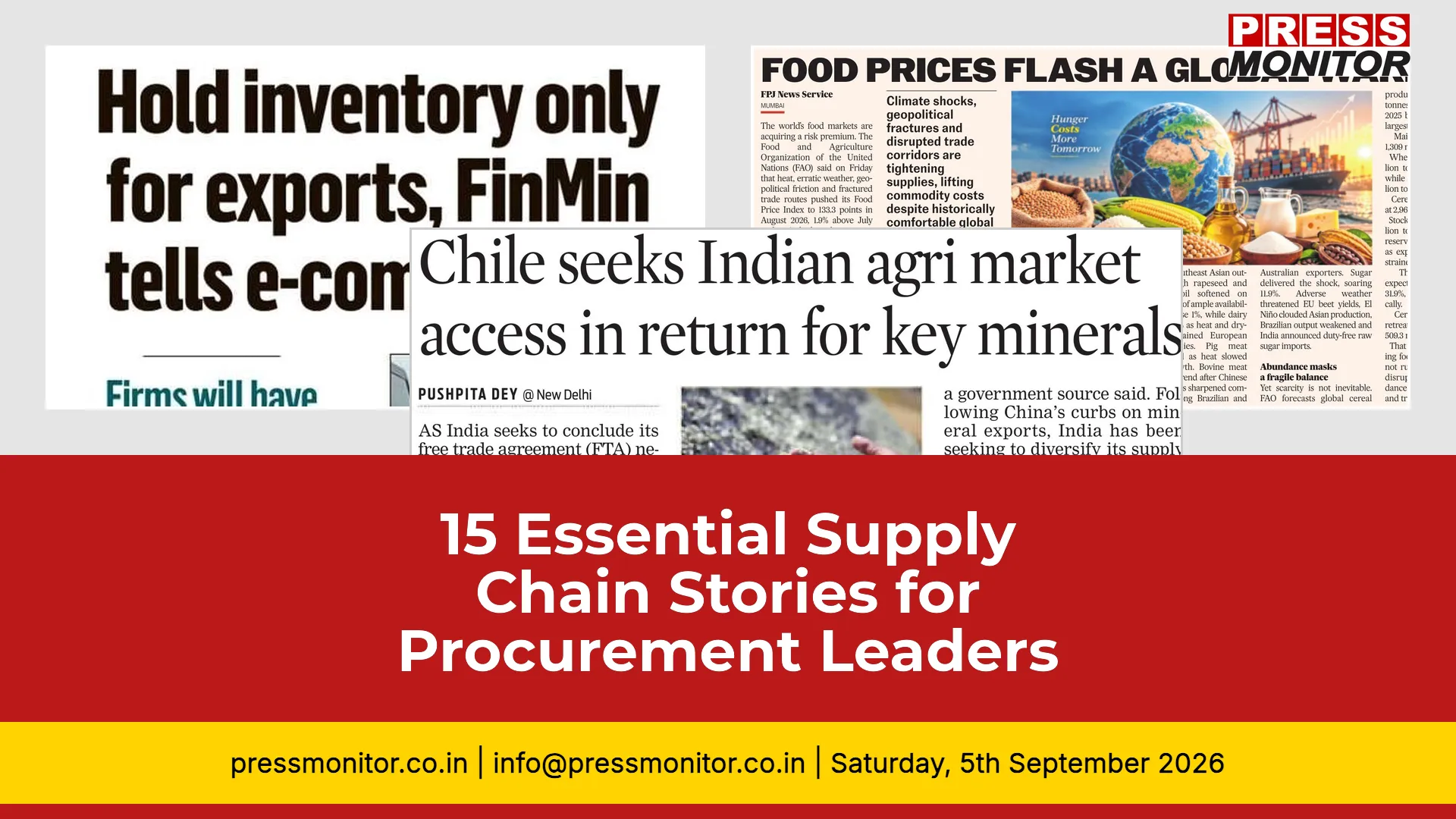
A front-page report in Deccan Herald says the Department of Economic Affairs under the Union Finance Ministry has notified changes to foreign direct investment rules allowing e-commerce firms to maintain inventory only for export purposes. In New Delhi, the 2 September notification added a provision to the Foreign Exchange Management Non-debt Instruments Rules, 2019, in line with the Foreign Trade Policy, 2023, saying restrictions on business-to-consumer and inventory-based e-commerce do not apply when goods made in India are exported. Amit Agarwal, senior partner at Nangia and Co LLP, said the move helps Indian manufacturers scale globally while preserving protections for domestic kirana stores and small retailers. The Finance Ministry's notification allowing e-commerce firms to maintain inventory exclusively for exports is a game-changer for Indian manufacturers. Why it matters: This opens a scalable global route for MSMEs and handicraft exporters while protecting domestic kirana stores. Key detail: The September 2 amendment to the Foreign Exchange Management Non-debt Instruments Rules, 2019, exempts export inventory from B2C restrictions. Source: Deccan Herald, PTI. Next step: Manufacturers should evaluate which product lines qualify and engage FDI-backed platforms.
2. FAO Food Prices Hit Three-Year High
A front-page report in Free Press Journal says the United Nations Food and Agriculture Organization Food Price Index rose to one hundred thirty-three point three points in August two thousand and twenty-six, driven by heat, erratic weather, geopolitical friction and fractured trade routes. The FAO Chief Economist Maximo Torero warned that climate shocks and disrupted logistics are tightening supply expectations, making resilient supply chains essential to price stability. Global food prices surged to their highest since late 2022 in August, driven by extreme heat, drought, and Black Sea war disruptions. Why it matters: Rising commodity costs cascade through every link in the supply chain, from farm to retail shelf. Key detail: The FAO Food Price Index averaged 133.3 points, with grain prices at three-year highs and sugar at a one-year peak. FAO Chief Economist Maximo Torero warned that climate shocks and disrupted logistics are tightening supply expectations. Source: Free Press Journal. Next step: Procurement teams should stress-test commodity hedging strategies now.
3. Chile Seeks Indian Agri Market Access
A front-page report in New Indian Express says India is facing a balancing act between securing access to Chile's key minerals and protecting its domestic agricultural sector as free trade agreement negotiations near conclusion. Chile is pushing for greater market access for seven to eight agricultural and horticultural products such as walnuts and salmon, while India seeks to diversify its supply chains for critical minerals including rare earths. The two countries are in the final round of negotiations and aim to conclude the deal next month within the proposed Comprehensive Economic Partnership Agreement framework. Chile is pushing for greater access for walnuts, salmon, and other horticultural products in India as CEPA negotiations near conclusion. Why it matters: India also seeks critical minerals and rare earth supply chains from Chile, creating a reciprocal trade opportunity. Key detail: The two countries aim to conclude the deal next month within the Comprehensive Economic Partnership Agreement framework. Source: New Indian Express, Morning Standard. Next step: Agri-exporters and mineral traders should prepare for tariff adjustments.
4. Nayab Saini Promises Smooth Paddy Procurement
A front-page report in Tribune says Chief Minister Nayab Singh Saini said on September 4 in Kurukshetra that the state government is in touch with the Central government to ensure smooth paddy procurement, as farmers demand procurement from September 15 and have threatened a protest if the demand is not accepted. Saini said high-moisture paddy creates difficulties for procurement agencies and urged farmers to bring produce meeting prescribed moisture norms. Haryana Chief Minister Nayab Singh Saini assured farmers on September 4 in Kurukshetra that the state is coordinating with the Centre for timely paddy procurement starting September 15. Why it matters: Farmer protests loom if procurement timelines slip, threatening the kharif marketing season. Key detail: Saini urged farmers to bring produce meeting prescribed moisture norms, as high-moisture paddy complicates agency processing. Source: Tribune, Tribune News Service. Next step: State procurement agencies should prepare moisture-testing infrastructure.
5. India: Europe's New Strategic Partner
A front-page report in Millennium Post says Belgian Prime Minister Alexander De Wever said Europe is actively seeking partners that uphold multilateralism and respect, and highlighted India as the world’s largest and fastest‑growing economy with a large talent pool and significant opportunities for trade, investment, technology and supply‑chain resilience. Belgian Prime Minister Alexander De Wever highlighted India as the world's largest and fastest-growing economy, emphasizing supply chain resilience and trade opportunities. Why it matters: European firms seeking diversified sourcing will look to India as a strategic alternative. Key detail: De Wever cited India's large talent pool and opportunities in trade, investment, technology, and supply chain resilience. Source: Millennium Post. Next step: Indian export councils should engage Belgian trade delegations.
6. Eazy Business Solutions Urges AI Adoption for Supply Chains
A front-page report in Business Line says Kunal Singhal, managing director of Eazy Business Solutions, urged farmers, manufacturers, distributors and middlemen in India to adopt artificial intelligence during a Business Line interaction. He said artificial intelligence can analyse existing data, send early alerts and suggest actions to reduce wastage and improve crop and supply chain decisions. Singhal also pointed to digital agriculture tools that improve visibility on soil conditions, crop suitability, water availability and inventory placement for food products with limited shelf life. Kunal Singhal, managing director of Eazy Business Solutions, called on farmers, manufacturers, and distributors to adopt AI for supply chain decisions. Why it matters: AI-driven visibility on soil conditions, crop suitability, and inventory placement can cut food waste significantly. Key detail: Digital agriculture tools can send early alerts and suggest actions to reduce wastage. Source: Business Line. Next step: FMCG and agri-tech firms should pilot AI inventory tools for perishable goods.
7. India Tea Exporters Target Saudi, Iraq Markets
A front-page report in Business Line says the South India Tea Exporters Association plans a delegation to Saudi Arabia, Iraq, Libya and select African countries to boost tea exports, but faces challenges from geopolitical tensions, rising freight costs, shipment delays, port congestion and pesticide residue limits that could hinder sales in European markets. The South India Tea Exporters Association plans a delegation to Saudi Arabia, Iraq, Libya, and African countries to boost tea exports. Why it matters: Geopolitical tensions, rising freight costs, and pesticide residue limits pose serious barriers. Key detail: European market sales could be hindered by pesticide residue limits even as new markets open. Source: Business Line, V Sajeev Kumar. Next step: Tea exporters should audit pesticide compliance for target markets.
8. India Thermal Sector Faces Coal Management Dilemma
A front-page report in The Hindu says India’s thermal power sector is grappling with a fuel management dilemma as generators maintaining adequate coal inventories risk being disadvantaged when limited domestic supplies are redirected to plants falling below prescribed stock norms. Industry experts warn that frequent emergency redistributions could undermine incentives for proper inventory planning, though they concede such measures may be necessary during genuine supply chain disruptions. Government data indicates national coal production remains robust, highlighting that the core challenge lies in logistical efficiency and plant-level allocation rather than an outright shortage. India's thermal power generators face a fuel management paradox: maintaining adequate coal inventories risks disadvantage when limited supplies are redirected to plants below prescribed stock norms. Why it matters: Emergency redistributions undermine inventory planning incentives across the energy supply chain. Key detail: National coal production remains robust; the challenge is logistical efficiency and plant-level allocation. Source: The Hindu, Lalatendu Mishra. Next step: Power generators should advocate for transparent allocation frameworks.
9. Ikea Targets 30 Stores in India by 2030
A front-page report in Business Line says Ikea India is expanding in Karnataka with a second store in Bengaluru, targeting 30 stores across India by 2030. CEO Patrik Antoni met Chief Minister DK Shivakumar to inaugurate the Konanakunte Cross outlet as the company plans to invest over Rs 21,000 crore by 2030. The retailer also aims to quadruple turnover to Rs 8,000 crore and is widening its sourcing ecosystem with around 65 Indian suppliers. Ikea India is expanding in Karnataka with a second Bengaluru store, targeting 30 stores nationwide by 2030 and investing over Rs 21,000 crore. Why it matters: The retailer's sourcing ecosystem now includes around 65 Indian suppliers, reshaping retail supply chains. Key detail: CEO Patrik Antoni met CM DK Shivakumar to inaugurate the Konanakunte Cross outlet; turnover aims to quadruple to Rs 8,000 crore. Source: Business Line. Next step: Indian suppliers should prepare for Ikea's quality and volume requirements.
10. Coal Stocks Critical at 50 Thermal Plants
A front-page report in Times of India says coal stocks at thermal power plants across the country have fallen to less than half the recommended level, with 50 plants classified as having critically low inventories as of 2 September amid high electricity demand and monsoon-led disruptions in supplies. The plants with a combined capacity of around 224 gigawatts had 28.2 million tonnes of coal as of Wednesday, which is 48 per cent of the prescribed requirement of 58.7 million tonnes. Coal ministry officials said all critical plants were being monitored by an inter-ministerial team on a day-to-day basis and regular fuel supplies were being provided to them. Coal stocks at 50 thermal power plants fell below half the recommended level, with 28.2 million tonnes against a prescribed 58.7 million tonnes. Why it matters: A combined capacity of 224 gigawatts is at risk during peak electricity demand and monsoon disruptions. Key detail: An inter-ministerial team is monitoring all critical plants on a day-to-day basis. Source: Times of India, Atul Mathur. Next step: Energy planners should prioritize rail and road logistics for coal transport.
11. Yemen Houthi Clash Kills 81, Disrupts Red Sea Shipping
A front-page report in Economic Times says clashes between Yemen's Houthis and Saudi-backed government forces have killed eighty-one people, according to military and medical sources on Friday. The Iran-backed rebels launched a ground assault with rocket and drone attacks near coastal areas, vying for control of the Bab al-Mandab strait at the Red Sea's southern entrance. The rebels have repeatedly attacked Saudi ships in recent weeks and disrupted the busy shipping lane since the Gaza war broke out in two thousand and twenty-three. Clashes between Yemen's Houthis and Saudi-backed forces killed 81 people, with rebels targeting the Bab al-Mandab strait. Why it matters: Repeated attacks on shipping lanes since the Gaza war began continue to disrupt global supply chains. Key detail: The Iran-backed rebels launched ground assaults with rocket and drone attacks near coastal areas. Source: Economic Times. Next step: Logistics firms should reassess Red Sea routing and insurance costs.
12. Swiggy Shifts Instamart to Inventory-Led Model
A front-page report in Financial Express says Swiggy has shifted its Instamart service to an inventory‑led model after shareholders approved a forty‑nine point five percent cap on foreign ownership. The change means the platform will now record the full value of goods sold rather than just commission, boosting reported revenue and making it more like a conventional retailer. FMCG companies are expected to benefit from a new profitable route to consumers and higher margins for quick‑commerce operators. Swiggy's Instamart service moved to an inventory-led model after shareholders approved a 49.5% foreign ownership cap. Why it matters: The platform now records full goods value, boosting reported revenue and creating a profitable route for FMCG companies. Key detail: Quick-commerce operators gain higher margins while FMCG firms access a new consumer channel. Source: Financial Express. Next step: FMCG brands should negotiate inventory terms with Swiggy Instamart.
13. Indian Miners Build African Mining Assets
A front-page report in Business Standard says India is racing to secure critical minerals, prompting a surge of privately owned Indian and Indian-origin mining companies building assets across Africa. These firms are developing deposits of graphite, cobalt, lithium, tin, tantalum, and tungsten in nations such as the Democratic Republic of Congo, Tanzania, Zambia, and Zimbabwe. Company executives say they prioritise supplying Indian manufacturers but seek stronger government diplomatic support and institutional engagement, contrasting their approach with China's state-backed overseas acquisitions. Indian and Indian-origin mining companies are racing to develop graphite, cobalt, lithium, tin, tantalum, and tungsten deposits across the DRC, Tanzania, Zambia, and Zimbabwe. Why it matters: This surge reflects India's push for critical mineral supply chain independence, contrasting with China's state-backed acquisitions. Key detail: Company executives seek stronger government diplomatic support for their overseas mining investments. Source: Business Standard, Saket Kumar. Next step: The government should institutionalize diplomatic engagement with African mining nations.
14. Jaishankar Seeks End to Ukraine Conflict, Discusses Supply Chain Resilience
A front-page report in Economic Times says India has been in continuous touch with both Ukrainian and Russian sides to find ideas that could mitigate or end the conflict. External Affairs Minister S Jaishankar made the remarks in Warsaw on Friday after meeting Poland's deputy prime minister and foreign minister Radoslaw Sikorski, following talks in Kyiv with Ukrainian leadership. He discussed complex global challenges with his Polish counterpart, including supply chain resilience and food, fuel and fertiliser security. External Affairs Minister S Jaishankar made remarks in Warsaw after meeting Poland's leadership, discussing supply chain resilience and food, fuel, and fertiliser security. Why it matters: India's continuous engagement with both Ukrainian and Russian sides signals a mediating role that protects Indian trade interests. Key detail: Jaishankar discussed complex global challenges including supply chain resilience with Polish counterpart Radoslaw Sikorski. Source: Economic Times, First India. Next step: Trade associations should monitor how conflict resolution impacts global commodity flows.
15. India-Poland Joint Action Plan Reviewed
A front-page report in First India says that Indian External Affairs Minister S Jaishankar met with Polish President Karol Nawrocki and Deputy Prime Minister and Foreign Minister Radostaw Sikorski in Warsaw on 18 July 2026 to review the India‑Poland Joint Action Plan 2024‑28 and discuss supply‑chain resilience, food, fuel and fertiliser security, while also addressing the Ukraine‑Russia conflict and seeking ways to de‑escalate tensions. India and Poland reviewed their Joint Action Plan 2024-28 in Warsaw, focusing on supply chain resilience, food, fuel, and fertiliser security. Why it matters: The review strengthens bilateral ties that support diversified sourcing and strategic mineral supply chains. Key detail: Jaishankar met President Karol Nawrocki and Deputy PM Radoslaw Sikorski to address the Ukraine-Russia conflict and de-escalation pathways. Source: First India. Next step: Indian firms in the minerals and agriculture sectors should explore Polish partnership opportunities.
Closing: These 15 stories, tracked through print media monitoring by Press Monitor, reveal a world where supply chain resilience is no longer optional but existential. Which development will most disrupt your procurement strategy this quarter?