15 Essential Trade Stories for Business Leaders


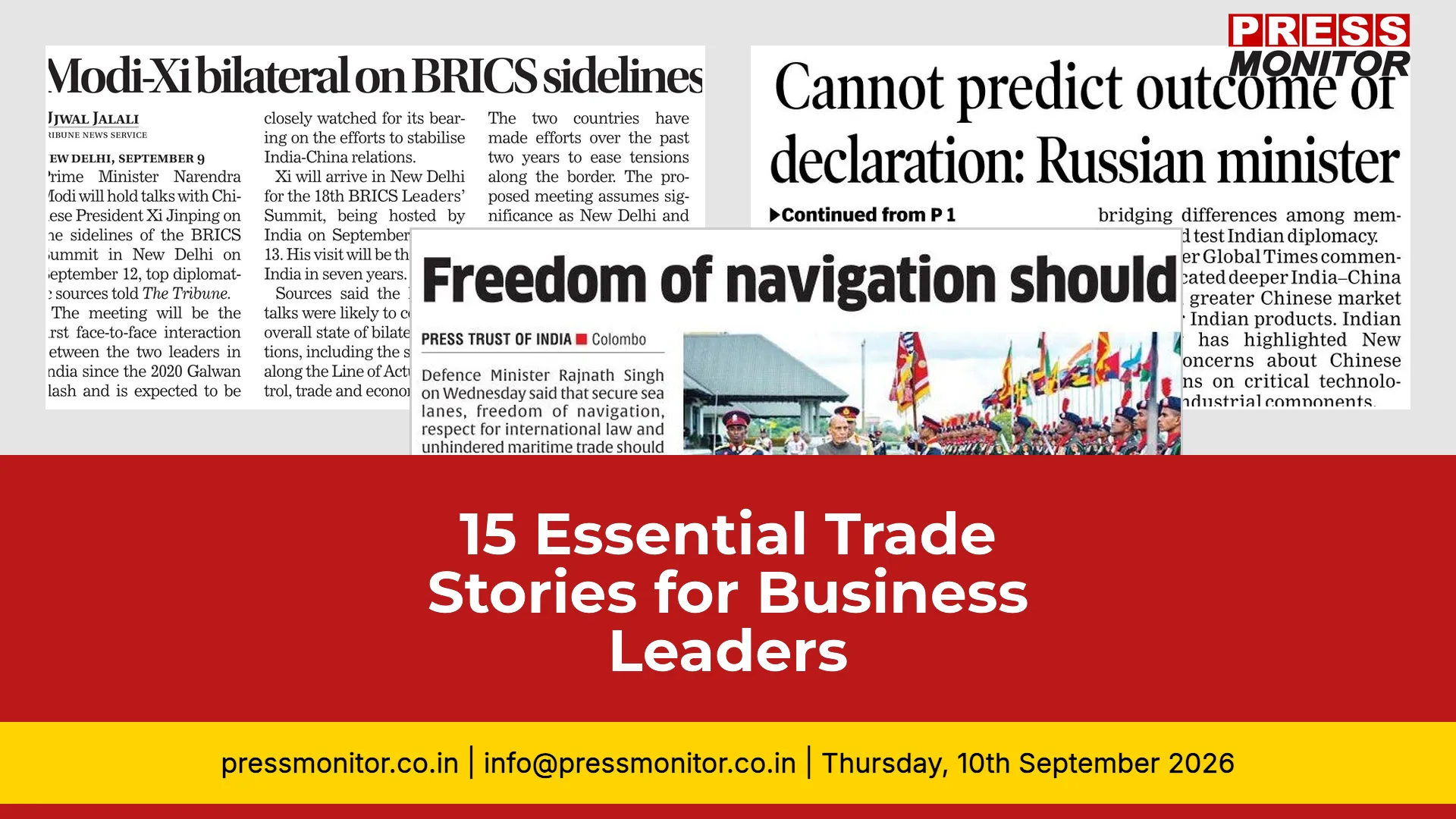
Through media monitoring of India's extensive print landscape, Press Monitor delivers this press review covering 15 essential trade stories. This media intelligence report draws on print media monitoring to bring you news on trade shaping India's economic trajectory — from BRICS summit diplomacy to bilateral pacts and tariff disputes.
25. India US Trade Pact Near Finalisation
A front-page report in Deccan Chronicle says the India-US trade pact has been more or less finalised and will be signed at an appropriate time, according to commerce secretary Rajesh Agarwal on Wednesday. Agarwal noted a few remaining issues including preferential market access, while bilateral trade between the two countries was growing. On the UK agreement, the UK agreed to recognise India's carbon credit trading scheme for carbon pricing relief under its carbon border adjustment mechanism, helping avoid double taxation for Indian exporters. India needs to diversify its services exports beyond IT and professional services to sustain growth, with services accounting for 48 per cent of 863 billion dollars in exports during 2025-26.
Why it matters: The near-finalisation of the India-US trade pact represents a major milestone for bilateral commerce, with services diversification and preferential market access as key pillars.
Key detail: Commerce Secretary Rajesh Agarwal confirmed the pact is more or less finalised; the UK agreed to recognise India's carbon credit trading scheme under its carbon border adjustment mechanism; services account for 48% of $863 billion in exports during 2025-26.
Source: Deccan Chronicle, Hyderabad
Next step: Await the official signing announcement and details on preferential market access provisions.
4. India-Sri Lanka Maritime Cooperation Prioritised
A front-page report in The Pioneer says Defence Minister Rajnath Singh emphasised that secure sea lanes, freedom of navigation, and unhindered maritime trade must remain pivotal priorities for the Indian Ocean Region. Singh made these remarks in Colombo on Wednesday after meeting Sri Lankan President Anura Kumara Dissanayake, reaffirming India and Sri Lanka's joint commitment to regional safety and prosperity. He highlighted that the two nations, as civilisational partners with intertwined destinies, are well positioned to serve as closest partners in safeguarding peace and security in the region.
Why it matters: Secure sea lanes and unhindered maritime trade are critical for India's trade connectivity in the Indian Ocean Region, directly impacting export and import flows.
Key detail: Defence Minister Rajnath Singh emphasised that secure sea lanes, freedom of navigation, and unhindered maritime trade must remain pivotal priorities after meeting Sri Lankan President Anura Kumara Dissanayake.
Source: The Pioneer, Colombo — Press Trust of India
Next step: Track any joint maritime agreements or infrastructure projects announced during Singh's visit.
1. Modi Xi BRICS Summit Talks
A front-page report in Tribune says Prime Minister Narendra Modi will hold talks with Chinese President Xi Jinping on the sidelines of the BRICS Summit in New Delhi on September 12. The meeting marks the first face-to-face interaction between the two leaders since the 2020 Galwan clash. Sources said the talks will cover bilateral relations, border tensions along the Line of Actual Control, trade, and economic ties.
Why it matters: The first face-to-face interaction between the two leaders since the 2020 Galwan clash signals a potential thaw in bilateral relations with major implications for trade and border stability.
Key detail: Talks will cover bilateral relations, border tensions along the Line of Actual Control, trade, and economic ties.
Source: Tribune, Delhi — by JJWAL JALALI
Next step: Watch for official statements on the outcome of the September 12 meeting and any joint communiqué on trade.
8. Suvendu Adhikari Warns JU Campus
A front-page report in The Pioneer says West Bengal Chief Minister Suvendu Adhikari warned that forces raising the "free Kashmir" slogan inside the Jadavpur University campus would be uprooted. Adhikari led a three-kilometre Gerua Sanman Yatra from Golpark to the university gate, joined by hundreds of monks, seers, and BJP workers, stating there is no place for anti-national elements on campus. The Chief Minister also said the government is proposing a Bill on higher education that could include provisions regarding the transfer of college and university teachers, which the Left opposition promptly questioned.
Why it matters: Political stability in West Bengal affects the state's trade environment and business climate, making this a relevant development for trade stakeholders.
Key detail: Chief Minister Adhikari led a three-kilometre Gerua Sanman Yatra and warned that forces raising the free Kashmir slogan would be uprooted; a higher education Bill is also proposed.
Source: The Pioneer, Kolkata — by Saugar Sengupta
Next step: Observe whether the proposed education Bill impacts university-level trade and commerce programmes.
6. BRICS Intra-Bloc Trade Rises
A front-page report in The Hindu says reducing global dependence on the U.S. dollar is expected to be a key part of the discussions in the 18th BRICS Summit, chaired by India, happening in New Delhi on September 12 and 13, 2026. Finance ministries and central bank governors from BRICS countries met in August to discuss the facilitation of cross-border payments and strengthening of national currencies. Trade data shows that merchandise exports by BRICS countries made up about one-fourth of all global exports in 2024, with intra-BRICS import and export dependency rising across the bloc.
Why it matters: Intra-BRICS trade dependency is rising as countries seek to reduce dollar dependence, reshaping global trade patterns and payment systems.
Key detail: BRICS merchandise exports made up about one-fourth of all global exports in 2024; finance ministries met in August to discuss cross-border payment facilitation and national currency strengthening.
Source: The Hindu, Delhi — by Nitika Francis, Gandla Sneha
Next step: Follow the August 2026 finance ministry outcomes on de-dollarisation mechanisms.
23. India-Russia Trade Talks Advance
A front-page report in Economic Times says that Indian Commerce Minister Piyush Goyal will meet Russian trade minister Anton Alikhanoy and Eurasian Economic Commission trade minister Andrey Slepney on the sidelines of the BRICS meeting in New Delhi to advance negotiations for a trade pact with the EAEU, which includes Russia, Armenia, Belarus, Kazakhstan and Kyrgyzstan. The agreement, signed on 20 August 2025, aims to expand exports as India targets a $1 trillion bilateral trade volume with Russia by 2030. Import data shows India’s trade with the BRICS group grew to $4.75 billion in FY26, with Russia’s share rising to $55.4 billion in 2025‑26.
Why it matters: India's push for a trade pact with the EAEU and the $1 trillion bilateral trade target with Russia by 2030 signals a strategic shift in India's trade partnerships.
Key detail: Commerce Minister Piyush Goyal will meet Russian Trade Minister Anton Alikhanov and Eurasian Economic Commission trade minister Andrey Slepney; India's trade with BRICS grew to $4.75 billion in FY26, with Russia's share rising to $55.4 billion in 2025-26.
Source: Economic Times, Delhi — by Kirtika Suneja
Next step: Track the EAEU trade pact negotiation progress and any interim agreements reached at the BRICS meeting.
24. India Russia Trade Targets Hundred Billion Dollars
A front-page report in Business Line says Russian Trade Minister Anton Alikhanov and Indian Commerce Minister Piyush Goyal will discuss strengthening bilateral trade ties and boosting joint ventures at a New Delhi summit this week. Both nations aim to increase cross-border commerce to one hundred billion dollars by twenty thirty while addressing Indias fifty billion dollar trade deficit through expanded agricultural and pharmaceutical exports alongside national currency settlements. India is simultaneously leveraging its leadership role to convene developing nations at an early September diplomatic gathering aimed at advancing sustainable infrastructure and supply chain resilience.
Why it matters: The $100 billion bilateral trade target by 2030 and efforts to address India's $50 billion trade deficit with Russia through agricultural and pharmaceutical exports represent a major trade policy push.
Key detail: Ministers Goyal and Alikhanov will discuss joint ventures and national currency settlements; India is leveraging its BRICS leadership to convene developing nations on sustainable infrastructure and supply chain resilience.
Source: Business Line, Delhi — by Amiti Sen
Next step: Follow up on specific joint venture announcements and currency settlement mechanisms proposed.
2. BRICS Summit Declaration Uncertain
A front-page report in Times of India says Russian deputy foreign minister Sergey Ryabkov stated he cannot predict the outcome of Brics negotiations on the final document due to sharp criticism of Tehran's actions. Kremlin spokesman Dmitry Peskov acknowledged Tran-UAE differences complicated drafting but expressed confidence diplomats would find acceptable wording regarding the Gulf situation.
Why it matters: Sharp divisions over Tehran's actions and Tran-UAE differences could delay or weaken the final BRICS declaration, affecting collective trade and energy policy coordination.
Key detail: Russian deputy foreign minister Sergey Ryabkov stated he cannot predict the outcome; Kremlin spokesman Peskov expressed confidence diplomats would find acceptable wording.
Source: Times of India, New Delhi
Next step: Monitor the final document text once negotiations conclude on September 12-13.
11. US Bans Canadian Dairy, Alcohol Imports
A front-page report in Statesman says the United States has announced new import bans and tariff changes against Canada, banning dairy products, alcoholic beverages, and motorcycles while reshuffling existing tariffs on goods such as cement and medical supplies. The measures follow Ottawa's retaliatory tariffs on American goods, with the bans set to take effect within three weeks and federal agencies instructed to remove Canadian goods from a purchasing list worth fifty billion US dollars.
Why it matters: The US-Canada tariff escalation and import bans are reshaping North American trade flows, with potential ripple effects on global commodity markets.
Key detail: Bans on dairy products, alcoholic beverages, and motorcycles take effect within three weeks; federal agencies must remove Canadian goods from a purchasing list worth $50 billion.
Source: Statesman, Delhi
Next step: Monitor Canadian retaliatory measures and the impact on cross-border supply chains.
14. Messe Muenchen India Acquires IICS
A front-page report in The Pioneer says Messe Muenchen India has acquired the India International Cargo Show from Upstream Business Solutions LLP, expanding its logistics trade-fair portfolio. IICS 2025 attracted over twenty-five thousand trade visitors from more than eighty countries and featured two hundred exhibitors. The acquisition brings IICS alongside Transport Logistics India, Air Cargo India, and the upcoming Project Cargo India, creating an integrated logistics ecosystem covering air, sea, rail, and road.
Why it matters: The acquisition expands the logistics trade-fair ecosystem, creating an integrated platform covering air, sea, rail, and road cargo — a boon for trade facilitation.
Key detail: IICS 2025 attracted over 25,000 trade visitors from 80+ countries and 200 exhibitors; the acquisition brings it alongside Transport Logistics India, Air Cargo India, and Project Cargo India.
Source: The Pioneer, Mumbai
Next step: Watch for expanded IICS event programming and new trade partnerships.
15. Adani Ports Wins 18 MMT Paradip Berth
A front-page report in The Pioneer says Adani Ports and Special Economic Zone Limited has secured a thirty-year Public-Private Partnership concession to develop two dry bulk berths at Paradip Port in Odisha. The addition brings eighteen million metric tonnes of mechanised cargo handling capacity, expanding the firm’s total portfolio to six hundred seventy-one million metric tonnes and supporting its one billion tonne target by two thousand thirty.
Why it matters: The 30-year PPP concession at Paradip Port expands India's cargo handling capacity, directly supporting trade infrastructure and the nation's one billion tonne target.
Key detail: Two dry bulk berths will add 18 million metric tonnes of mechanised cargo handling capacity, bringing the total portfolio to 671 million metric tonnes.
Source: The Pioneer, Ahmedabad — PIONEER NEWS SERVICE
Next step: Track construction timelines and the impact on Odisha's export competitiveness.
7. UAE's BRICS Engagement Drives Shared Prosperity
A front-page report in The Hindu says the United Arab Emirates engagement with BRICS, since becoming a full member in January 2024, focuses on translating economic cooperation into tangible opportunities for trade, investment and connectivity. The article highlights the UAE-India Comprehensive Economic Partnership Agreement, with non-oil bilateral trade growing 17% to over $76 billion in 2025, and notes India's 2026 BRICS Chairship centered on resilience, innovation, cooperation and sustainability.
Why it matters: The UAE's full BRICS membership since January 2024 is translating into tangible trade and investment opportunities, with non-oil bilateral trade growing 17% to over $76 billion.
Key detail: The UAE-India Comprehensive Economic Partnership Agreement is a cornerstone; India's 2026 BRICS Chairship focuses on resilience, innovation, cooperation, and sustainability.
Source: The Hindu, Delhi — by Saeed bin Mubarak Al Hajeri
Next step: Watch for new UAE-India trade facilitation measures announced during the summit.
9. BRICS Summit Focuses on Food & Energy
A front-page report in The Pioneer says the two‑day BRICS summit in New Delhi will begin Saturday, concentrating on boosting collective resilience in food, energy, health, disaster reduction and supply chains, with leaders including China’s Xi Jinping, Iran’s Masoud Pezeshkian, Russia’s Vladimir Putin, South Africa’s Cyril Ramaphosa and Indonesia’s Prabowo Subianto.
Why it matters: Collective resilience in food, energy, and supply chains is a core BRICS agenda item, with direct implications for global commodity trade and India's import strategy.
Key detail: The two-day summit in New Delhi begins Saturday, with leaders including Xi Jinping, Masoud Pezeshkian, Vladimir Putin, Cyril Ramaphosa, and Prabowo Subianto attending.
Source: The Pioneer, New Delhi
Next step: Track specific food and energy cooperation agreements signed during the summit.
18. US EU criticize India trade barriers
A front-page report in Business Standard says the United States and the European Union have strongly criticized India's trade barriers during the country's eighth trade policy review at the World Trade Organization. The concerns include high tariffs, quality-control orders, digital trade restrictions, and unpredictable customs procedures that may undermine India's economic integration.
Why it matters: WTO criticism of India's trade barriers during the eighth trade policy review could pressure India to reform tariffs, quality-control orders, and digital trade restrictions.
Key detail: Concerns include high tariffs, quality-control orders, digital trade restrictions, and unpredictable customs procedures that may undermine economic integration.
Source: Business Standard, New Delhi — by Asit Ranjan Mishra
Next step: Watch for India's response and any policy adjustments ahead of the next WTO review cycle.
20. $14,700 Copper Prices Persist on US Tariffs
A front-page report in Business Line says copper prices are expected to remain elevated after surging past $14,700 a tonne due to fears that the US will increase tariffs on refined copper imports. Prolonged uncertainty surrounding the delayed Commerce Department investigation has triggered large stock shipments to the United States, tightening global supplies outside the country and prompting traders to recommend accumulating positions in domestic futures contracts.
Why it matters: US tariff uncertainty on refined copper imports is driving stockpiling and price volatility, affecting global supply chains and India's commodity trading strategy.
Key detail: Copper prices surged past $14,700 a tonne; prolonged uncertainty has triggered large stock shipments to the US, tightening global supplies outside the country.
Source: Business Line, Delhi — by Gurumurthy K
Next step: Monitor the Commerce Department investigation timeline and its impact on domestic copper futures.
Which development do you think will have the most impact on India's trade trajectory in the coming months?