15 Essential Trade Stories for Business Leaders


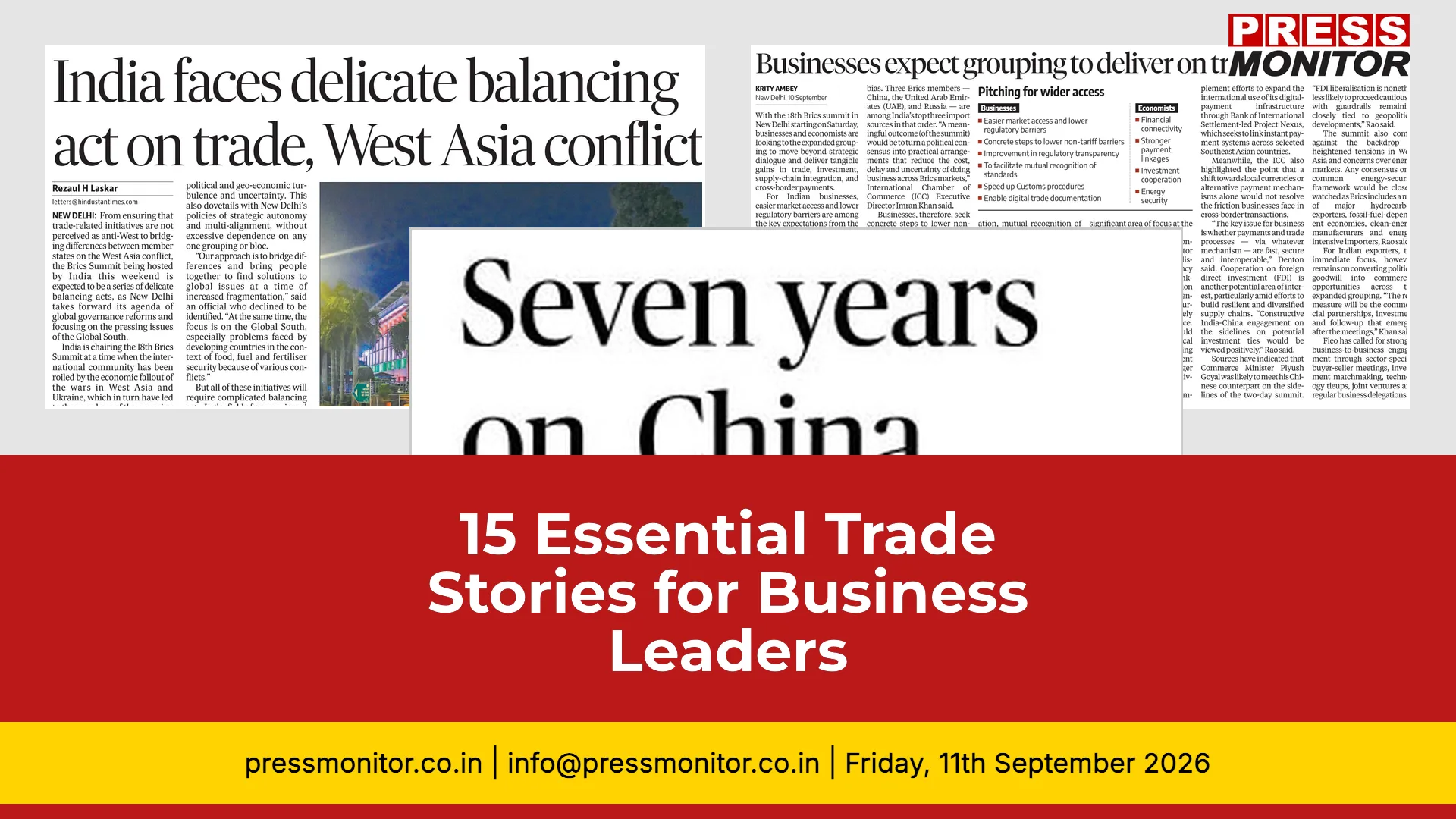
According to Press Monitor's tracking of Indian publications, this media monitoring review delivers 15 essential trade stories for business leaders. From BRICS Summit 2026 dynamics to US-China tariff negotiations and WTO trade policy findings, these stories bring news on trade, covering tariffs, supply chains, and global policy shifts. Press Monitor's press review and media intelligence combine print media monitoring with real editorial data to give you the competitive edge.
1. Brics Summit 2026: India's Balancing Act
A front-page report in Hindustan Times says that India is balancing trade initiatives with geopolitical concerns at the eighteenth Brics Summit while Brazil pushes for the C‑390 Millennium aircraft for the Indian Air Force. The summit, scheduled for September twelfth, brings together India, Brazil, Russia, China, South Africa, Iran, Egypt, Ethiopia, and the United Arab Emirates, with discussions on trade, supply-chain resilience, and North‑South cooperation. Meanwhile, Embraer executives will meet Indian officials on India’s aviation procurements, including the C‑390 and the Make‑in‑India production plan.
Why it matters: India navigates geopolitical tensions while advancing trade and defense procurement at the eighteenth Brics Summit. Key detail: Embraer executives will meet Indian officials on C-390 Millennium aircraft and Make-in-India production plans. Source: Hindustan Times, New Delhi. Next step: Monitor how bilateral deals evolve during the summit. What does this mean for India's defense supply chain?
2. Businesses Expect Brics Summit to Boost Trade and Investment
A front-page report in Business Standard says businesses and economists expect the 18th Brics summit in New Delhi to deliver tangible gains in trade, investment, supply-chain integration, and cross-border payments beyond strategic dialogue. Key expectations include easier market access, lower regulatory barriers, greater use of local currencies, and stronger payment linkages for Indian businesses. The eleven-member grouping accounts for around 26 per cent of global trade, with India's trade heavily import-biased from China, the United Arab Emirates, and Russia.
Why it matters: Business leaders anticipate tangible gains in trade, investment, and supply-chain integration from the 18th Brics summit. Key detail: The eleven-member grouping accounts for around 26 per cent of global trade. Source: Business Standard, New Delhi. Next step: Watch for announcements on market access and cross-border payment linkages. How will Indian businesses leverage this opportunity?
3. Xi Jinping to Attend BRICS Summit
A front-page report in The Hindu says President Xi Jinping will attend the BRICS Summit in New Delhi this weekend, marking his first visit to India in nearly seven years. The two leaders are expected to hold bilateral talks on the sidelines, with Commerce Ministers Wang Wentao and Piyush Goyal also meeting to discuss trade concerns. Border tensions that froze relations for four years have given way to a gradual normalisation process since October 2024.
Why it matters: President Xi Jinping's first visit to India in nearly seven years signals a diplomatic reset. Key detail: Commerce Ministers Wang Wentao and Piyush Goyal will meet to discuss trade concerns alongside Modi-Xi bilateral talks. Source: The Hindu. Next step: Track outcomes of the bilateral trade discussions. Will border tensions give way to deeper economic cooperation?
4. India Steers BRICS Towards Global Reform
A front-page report in Millennium Post says India is hosting the eighteenth BRICS Summit in New Delhi on September twelfth and thirteenth two thousand and twenty six to steer the expanding grouping towards meaningful global reform while preventing it from becoming a rigid anti-Western coalition. Authors JOHN FELIX RAJ and PRABHAT KUMAR DATTA, both from ST XAVIER'S UNIVERSITY, Kolkata, argue that India must balance strategic autonomy with bloc ambitions by advocating institutional reform of bodies such as the International Monetary Fund and the World Bank rather than pursuing a common currency or confrontational policies.
Why it matters: India aims to transform the expanding BRICS bloc into a force for institutional reform rather than a confrontational anti-Western coalition. Key detail: Advocates push for IMF and World Bank reform instead of a common currency. Source: Millennium Post, by John Felix Raj and Prabhat Kumar Datta. Next step: Observe how India balances strategic autonomy with bloc ambitions. Can BRICS reform global governance without fracturing?
5. Modi Set For BRICS Bilateral Meetings
A front-page report in Business Line says Prime Minister Narendra Modi is set for bilateral meetings with Chinese President Xi Jinping and Russian President Vladimir Putin during the BRICS summit in New Delhi on September 12-13. The Modi-Xi talks are expected to focus on the fragile improvement in ties, with the unresolved border issue and widening trade imbalance likely to dominate. India will push for greater exports to Russia to narrow a bilateral trade deficit exceeding $50 billion.
Why it matters: Prime Minister Modi's bilateral meetings with Xi Jinping and Putin will shape India's trade and defense posture. Key detail: India will push for greater exports to Russia to narrow a bilateral trade deficit exceeding $50 billion. Source: Business Line, New Delhi. Next step: Follow the Modi-Xi talks on border and trade imbalance. What concessions might India offer Russia?
6. India Hosts 18th BRICS Summit Sept 12-13
A front-page report in Times of India says India will host the eighteenth BRICS Summit in New Delhi on September twelfth and thirteenth. The summit brings together leaders from member countries, partner countries, and global institutions.
Why it matters: India chairs the summit at a pivotal moment for Global South cooperation. Key detail: The summit brings together leaders from member countries, partner countries, and global institutions. Source: Times of India, New Delhi. Next step: Monitor which partnership initiatives emerge. How will India leverage its chairship for institutional change?
7. BRICS Trade Bonanza 20 Years
A front-page report in Hindustan Times says deeper trade and investment ties among BRICS countries will help bolster economic resilience across the Global South and inject fresh momentum into an increasingly strained multilateral trading system. Market watchers and business leaders said the group, established as BRIC in 2006 with South Africa joining five years later, has evolved into a major platform for Global South countries to deepen economic ties. Analysts said more BRICS collaboration could provide members with greater room to diversify markets and supply chains as protectionism and geopolitical tensions add to uncertainty in the global economy.
Why it matters: Two decades of BRICS collaboration have deepened trade ties and bolstered economic resilience across the Global South. Key detail: The group has evolved from BRIC in 2006 to a major platform for diversifying markets amid protectionism. Source: Hindustan Times, by Zhong Nan. Next step: Assess how BRICS trade momentum affects global supply chains. What comes next after twenty years?
8. BRICS Summit Tests India Amid Geopolitical Shifts
A front-page report in Morning Standard says the Brics summit has returned to New Delhi twenty-five years after the acronym was first coined. The expanded eleven-member grouping now faces significant geopolitical fractures, energy market volatility, and strained supply chains. With India holding the chairmanship, the bloc must overcome internal divisions to offer practical solutions and amplify the Global South voice in global institutions.
Why it matters: The expanded eleven-member bloc faces significant geopolitical fractures and energy market volatility. Key detail: India holds the chairmanship and must overcome internal divisions to amplify the Global South voice. Source: Morning Standard, New Delhi. Next step: Watch how India navigates competing interests within the bloc. Can BRICS offer practical solutions to energy security?
9. India Brics Summit Sparks Trade Talk
Why it matters: India's WTO Trade Policy Review has sparked debate among Brics partners over trade measures and barriers. Key detail: China, Indonesia, and Brazil raised concerns about subsidies and quality-control orders, while Russia, Egypt, and Saudi Arabia praised India's reforms. Source: Business Standard, by Asit Ranjan Mishra, New Delhi. Next step: Track how India responds to WTO scrutiny. Will trade barrier reforms attract more foreign investment?
10. BRICS Expansion Fuels Internal Divisions
A front-page report in Statesman says BRICS has transformed from a niche economic acronym into a powerful geopolitical heavyweight of the Global South through successive waves of expansion since 2001. The bloc added Egypt, Ethiopia, Iran, and the United Arab Emirates as full members in January 2024, followed by Indonesia in January 2025, while ten partner countries joined a new cooperative framework in 2025. However, deep-seated geopolitical rivalries between China and India, economic imbalances dominated by China, and diverging strategic visions between revisionist and reformist members threaten the bloc's cohesion.
Why it matters: Successive waves of expansion have made BRICS a geopolitical heavyweight but also exposed deep rivalries. Key detail: China-India tensions, economic imbalances dominated by China, and diverging strategic visions threaten cohesion. Source: Statesman. Next step: Observe whether the partner-country model can bridge divisions. How does expansion affect decision-making within BRICS?
11. BRICS Summit Returns to New Delhi
Why it matters: The BRICS grouping returns to New Delhi amid war, energy shocks, and geopolitical fragmentation. Key detail: Iran joins as a full member amid tensions with the UAE, adding complexity to the bloc. Source: New Indian Express, Chennai. Next step: Monitor how internal tensions are managed during the summit. What does Iran's full membership mean for BRICS cohesion?
12. India Leads BRICS Summit 2026
A front-page report in Statesman says that India is chairing the 2026 BRICS Summit in New Delhi, aiming to convert enlargement into tangible outcomes by strengthening institutional capacity and launching new partnership initiatives. The summit will explore a partner‑country model that expands reach without compromising cohesion.
Why it matters: India's chairship aims to convert enlargement into tangible outcomes through institutional capacity and new partnership initiatives. Key detail: The summit explores a partner-country model that expands reach without compromising cohesion. Source: Statesman, New Delhi. Next step: Evaluate the feasibility of the partner-country framework. Can BRICS grow without losing focus?
13. Owaisi Demands West Bank Import Ban
A front-page report in Deccan Chronicle says that political leader Asaduddin Owaisi has urged Prime Minister Narendra Modi and the Union government to impose a ban on goods imported from illegal Israeli settlements in the occupied West Bank. This measure aims to curb territorial expansion, address regional oppression, and establish a framework for a two-state solution, aligning national policy with several Western nations.
Why it matters: Political leader Asaduddin Owaisi has urged the government to ban imports from illegal Israeli settlements in the occupied West Bank. Key detail: The move aligns national policy with several Western nations and aims to curb territorial expansion. Source: Deccan Chronicle, Hyderabad. Next step: Watch for government response to the import ban demand. How will India balance diplomatic relations with trade policy?
14. U.S.-Canada Trade Row Warns India On Deals
A front-page report in The Hindu says the United States and Canada have severely strained their decades-long trade partnership with reciprocal tariffs hitting fifty percent and Washington imposing export bans on select goods. The escalation offers India critical warning signs ahead of potential bilateral deals, especially as previous tariff agreements are undermined by ongoing investigations into forced labour and market excesses. Policymakers are urged to carefully weigh long-term vulnerabilities before committing to any new commercial frameworks.
Why it matters: The US-Canada trade escalation with 50% reciprocal tariffs offers India critical warning signs for bilateral deals. Key detail: Previous tariff agreements are undermined by forced labour investigations and market excess probes. Source: The Hindu. Next step: Assess how India should weigh long-term vulnerabilities in trade negotiations. What safeguards should Indian policymakers prioritize?
15. China, US Target Early Tariff Cuts
A front-page report in New Indian Express says the BRICS grouping returns to New Delhi at a moment when the world economy is again being tested by war, energy shocks and geopolitical fragmentation. India's chairship gives immense strategic significance as the bloc seeks to offer practical answers for supply chain resilience and energy security. The twenty-five-year-old grouping now has eleven members after recent expansions, and Iran joins as a full member amid tensions with the UAE.
Why it matters: China and the United States aim to agree on tariff reductions for $30 billion worth of goods from each side. Key detail: A summit in Washington on 24 September could reshape trade relations between the two largest economies. Source: Statesman, Beijing. Next step: Track negotiation progress ahead of the Washington summit. What would an early deal mean for global trade and Indian exporters?
Closing: These 15 stories reflect the interconnected world of trade policy, from BRICS diplomacy to bilateral tariff negotiations. Press Monitor's print media monitoring ensures you stay grounded in verified Indian editorial intelligence. Which story will shape your business strategy next?