15 Pivotal Agriculture Stories for Agribusiness Leaders


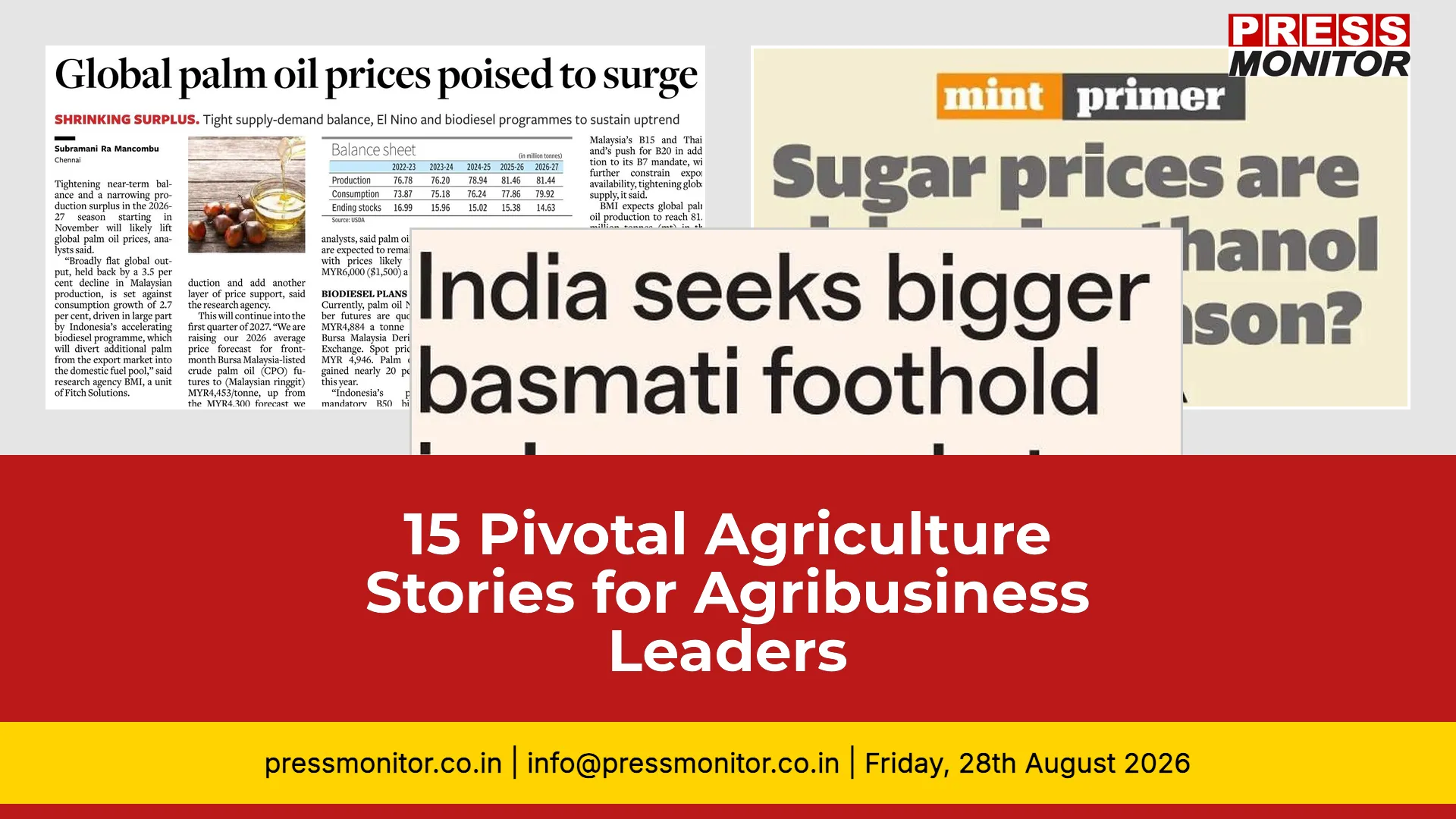
Tracking today's shifts in Indian agriculture requires sharp print media monitoring. This press review distills 15 high-impact developments shaping farm policy, commodity markets, and agribusiness operations. According to Press Monitor's tracking of Indian publications, here is your essential news on agriculture before markets open. Leveraging real-time media intelligence ensures you act on verified data rather than algorithmic noise.
1. Palm Oil Prices Expected to Surge to MYR 6,000/Tonne
A front-page report in Business Line says global palm oil prices are set to rise sharply under tight supply-demand conditions, increasing biodiesel mandates in Indonesia, and recurring El Nino weather disruptions. Supply is forecast to remain almost flat despite 2.7% global consumption growth, largely driven by Indonesia’s compulsory biodiesel program to blend 50% palm oil into fuel as of July 1, 2026. Researchers like BMI and Rabobank anticipate prices to reach $1,500/tonne by mid-2027, benefitting producers amid anticipated production declines and export diversions caused by biofuel policies.
Why it matters: Global supply tightness directly impacts edible oil imports and biodiesel feedstock costs.
Key detail: BMI and Rabobank forecast prices hitting $1,500/tonne by mid-2027 as Indonesia enforces a 50% palm oil fuel blend.
Source: Business Line
Next step: Hedge crude-linked packaging and raw material exposure ahead of Q4 festive demand.
2. Sugar Prices Surge in India
A front-page report in Mint says retail sugar prices have surged unusually fast, rising from %49 per kg a month ago to 365 on 26 August. The spike comes ahead of the festive season.
Why it matters: Retail sugar spikes affect FMCG margins and household inflation metrics.
Key detail: Prices jumped from ₹49 to ₹365 per kg in a month, driven by ethanol diversion and pre-festival stocking.
Source: Mint
Next step: Review procurement contracts and adjust pricing tiers for confectionery lines.
3. India seeks Japan basmati rice access
A front-page report in Free Press Journal says India will press Japan for greater market access for basmati rice and processed foods during a review of their Comprehensive Economic Partnership Agreement. Commerce and Industry Minister Piyush Goyal also pitched India's manufacturing architecture to Japanese investors in Osaka to attract institutional capital.
Why it matters: Export diversification reduces reliance on traditional Middle Eastern and African markets.
Key detail: Commerce Minister Piyush Goyal is leveraging CEPA reviews to secure premium shelf space for processed foods.
Source: Free Press Journal
Next step: Align export compliance documentation with Japanese phytosanitary standards.
4. Unjha’s Isabgol Trade Halts Over GST
A front-page report in Hindustan Times says trading of isabgol seeds has stopped at Unjha Agricultural Produce Market Committee (APMC), Asia’s biggest spice market, for more than a month after conflicting rulings on Goods and Services Tax (GST) left traders unsure about how to bill isabgol coming from Rajasthan.
Why it matters: Tax ambiguity paralyzes Asia’s largest spice market, disrupting herbal supplement supply chains.
Key detail: Traders have paused invoicing for over a month due to conflicting GST rulings on Rajasthan-origin seeds.
Source: Hindustan Times
Next step: Engage trade bodies for centralized clarification to prevent inventory bottlenecks.
5. FMCG Companies Hit by Margin Decline
A front-page report in Mint says that operating margins for FMCG companies have hit a four-year low of 22.2%, while combined net profits declined 7%. The decline is attributed to a spike in crude-linked raw material costs and a 30-40% jump in packaging costs due to supply disruptions following the West Asia war.
Why it matters: Operating margins hit a four-year low, signaling broader cost-push inflation in packaged goods.
Key detail: Combined net profits fell 7% as crude-linked inputs and packaging costs surged 30-40%.
Source: Mint
Next step: Audit vendor SLAs and negotiate volume-based packaging rebates.
6. NABARD and NBFID Sign Pact for Rural Infrastructure
A front-page report in The Pioneer says the National Bank for Agriculture and Rural Development (NABARD) and the National Bank for Financing Infrastructure and Development have signed an initial pact to strengthen collaboration in financing infrastructure projects with significant rural impact.
Why it matters: Cross-institutional financing unlocks capital for cold storage, rural logistics, and irrigation upgrades.
Key detail: The pact prioritizes projects with measurable rural economic impact and farmer income linkage.
Source: The Pioneer
Next step: Map eligible infrastructure grants against regional expansion roadmaps.
7. MoU to strengthen Startup ecosystem
A front-page report in State Times says the YUVA Innovation Hub, TIM Jammu, and SKUAST-Jammu signed a MoU today to strengthen the startup ecosystem in the UT. The agreement under Mission YUVA will focus on sectors like Agritech, Horticulture, and Food Processing, facilitating access to infrastructure and mentorship for Neo-Innovative Enterprises.
Why it matters: State-backed incubation accelerates agritech deployment in horticulture and food processing.
Key detail: YUVA Innovation Hub and SKUAST-Jammu will mentor neo-enterprises under Mission YUVA.
Source: State Times
Next step: Register pilot programs through UT innovation portals for seed funding.
8. 3 lakh kg expired food destroyed
A front-page report in Times of India says food safety teams of the Delhi government destroyed around 3 lakh kg of expired food items, including atta and besan, on Thursday. Health minister Pankaj Singh has directed intensified inspections across markets and manufacturing units ahead of the festive season to safeguard public health.
Why it matters: Festive season inspections tighten FSSAI compliance, raising quality assurance benchmarks.
Key detail: Delhi authorities seized atta, besan, and perishables following intensified market audits.
Source: Times of India
Next step: Conduct internal batch traceability drills before holiday distribution peaks.
9. Mustard Prices See Mixed Trading in Rajasthan
"Selon La Free Press Journal, jeudi, les prix du mustard ont fluctué dans les principaux marchés du Rajasthan. À Ratlam, le soja est resté à 3 000-6 500 roupies par 100 kg, avec une arrivée inchangée de 210 tonnes. Le mustard a maintenu son niveau à 3 300-7 400, malgré une demande modérée, tandis que l'arrivée a été limitée à 150 tonnes. Le mustard a gagné 100-400, atteignant 7 200-8 100 à Kota, soutenu par une meilleure qualité. Jaipur mustard a cependant chuté de 25 %, à 8 300-8 325, tandis que l'arrivée de 250 000 sacs a exercé une pression modérée sur les prix,"
Why it matters: Regional price volatility reflects shifting sowing patterns and mill capacity utilization.
Key detail: Kota mustard gained ₹100-400 on quality premiums, while Jaipur saw a 25% correction amid heavy arrivals.
Source: Free Press Journal
Next step: Lock forward contracts during localized dips to stabilize crushing margins.
10. Bihar Invites E-Tenders for Social Media Management Agency
"A front-page report in The Indian Express says the Department of Agriculture, Government of Bihar, is seeking an agency to manage its social media platforms for the 2026-27 agricultural development schemes. The tender, available online, outlines the requirements for technical and financial proposals, with a pre-bid meeting scheduled for September 3rd. Applicants should upload their submissions by September 21st, and financial proposals by the same date."
Why it matters: Digital outreach modernization signals state-level shift toward data-driven agricultural extension.
Key detail: The Department of Agriculture seeks technical and financial proposals for 2026-27 scheme promotion.
Source: Indian Express
Next step: Prepare capability statements highlighting agri-digital campaign portfolios.
11. Chordia Foods Grows Family Legacy in IN%
A front-page report in Business Standard says Chordia Food Products Ltd has expanded its presence in the hospitality and food service sector, leveraging generational trust with brands like Healthy Spoon and Mix Box. Upon embracing innovation, the company continues to dominate the Horeca (hotel, restaurant, and café) marketplace with ready-to-eat foods, and regional specialties across India, reinforcing its commitment to premium quality and customer loyalty since inception.
Why it matters: Horeca consolidation drives demand for standardized regional ready-to-eat formats.
Key detail: Healthy Spoon and Mix Box expand distribution networks across hotel and café channels.
Source: Business Standard
Next step: Evaluate co-packing partnerships to scale regional SKUs nationally.
12. 20th Grand Nursery Mela Held in Hyderabad
A front-page report in Deccan Chronicle says that visitors purchase flowering plants at the 20th Grand Nursery ‘Mela at the HMDA Grounds near Prasads IMAX in Hyderabad on Thursday. The event is part of the All India Horticulture and Agriculture Exhibition.
Why it matters: Horticulture exhibitions catalyze private investment in ornamental and fruit plant varieties.
Key detail: HMDA grounds hosted buyers seeking climate-resilient stock for urban landscaping projects.
Source: Deccan Chronicle
Next step: Attend sector meetups to source drought-tolerant cultivars.
13. RAKSHA BANDHAN AMUL DOODH PEETA INDIA
A front-page report in Hindustan Times says Raksha Bandhan celebrations are in full swing with Amul promoting its Doodh in India.
Why it matters: Festival-led dairy marketing underscores seasonal consumption elasticity and brand loyalty mechanics.
Key detail: Amul leverages cultural moments to drive volume throughput across tier-2 and tier-3 distribution hubs.
Source: Hindustan Times
Next step: Align promotional calendars with regional festival cycles for maximum retail visibility.
14. Third University Paper Leak in 20 Days Sparks Inquiry
"Selon l’Express de Raipur, l’université Indira Gandhi Krishi Vishwavidyalaya a annulé l’examen de première année en agriculture ‘Fundamentals of Genetics’ suite à une fuite de questions. Il s’agit de la troisième fuite de documents d’examen dans un délai de 20 jours, selon les sources universitaires. L’enquête a révélé que des manipulations avaient été apportées aux enveloppes de questions, similaires à celles observées lors des précédentes fuites. Six personnes ont été arrêtées, dont un professeur de Durg, et la procédure judiciaire est en cours."
Why it matters: Academic integrity breaches in agricultural sciences threaten research pipeline credibility.
Key detail: IGKV Raipur canceled genetics exams after envelope tampering; six arrests made.
Source: New Indian Express
Next step: Strengthen digital examination security protocols across partner institutions.
15. Biodiesel Plans
A front-page report in Business Line says Indonesia’s planned mandatory BSO_ biodiesel blending from July is expected to boost domestic consumption of palm oil feedstock and potentially reduce export availability from the world’s largest producer.
Why it matters: Mandatory blending policies reshape global feedstock flows and domestic refining economics.
Key detail: Indonesia’s B35/B50 rollout diverts palm oil exports, tightening international vegetable oil balances.
Source: Business Line
Next step: Model feedstock substitution scenarios for biofuel procurement teams.
Navigating these intersecting trends demands reliable print media monitoring. Which development will most impact your Q4 strategy? Share your take below.