15 Pivotal Climate Stories for Policy Makers


media monitoring tracks pivotal shifts in India’s environmental landscape today. This press review synthesizes critical developments across national dailies, offering actionable media intelligence for stakeholders navigating climate policy, extreme weather, and sustainable business practices. According to Press Monitor's tracking of Indian publications, the following fifteen stories define the current discourse.
1. Nepal Flash Floods Toll Hits 1,365
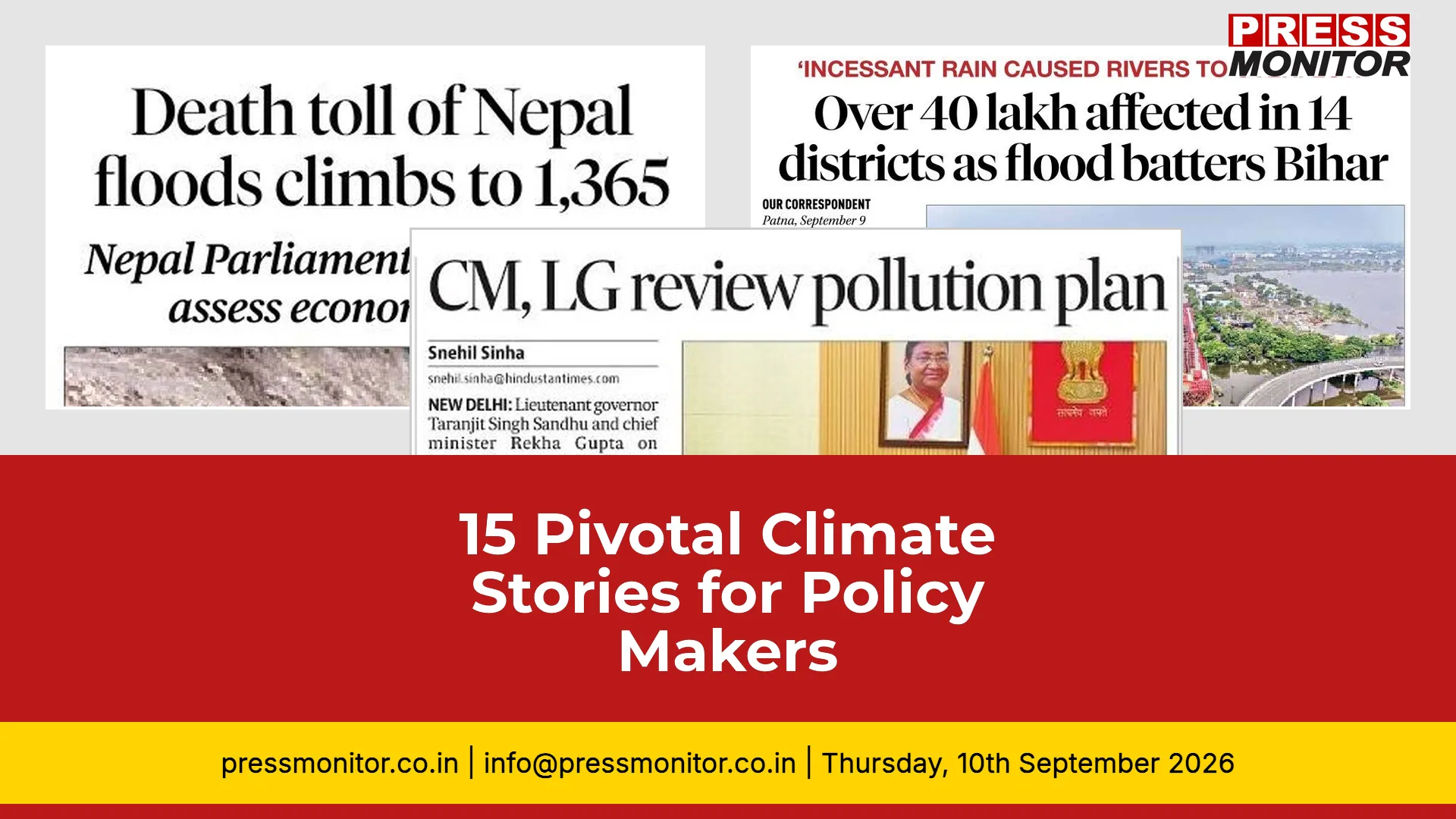
A front-page report in Millennium Post says the death toll from devastating flash floods in Nepal has climbed to 1,365 as more bodies are recovered from affected areas. Rescue teams continue searching for 5,326 missing people including at least 589 foreign nationals, with bodies recovered from Chitwan, Nawalparasi East, Nawalparasi West, and Nuwakot. A seven-member parliamentary sub-committee led by lawmaker Sushila Khadka of the Rastriya Swatantra Party has been formed at the House of Representatives Finance Committee meeting to assess the economic impact of the Rasuwa flash flood and examine climate finance issues.
Why it matters: Cross-border disaster response highlights regional climate vulnerability and diplomatic coordination.
Key detail: The death toll from devastating flash floods in Nepal has climbed to 1,365, with rescue teams searching for over 5,326 missing individuals across multiple districts.
Source: Millennium Post
Next step: Stakeholders should monitor parliamentary sub-committee reports on climate finance and economic impact assessments.
2. 40 Lakh Affected In Bihar Floods
A front-page report in Millennium Post says more than 40 lakh people have been affected by floods across 14 districts of Bihar, with rivers including the Ganga, Gandak, Kosi, and others flowing above the danger mark. The floods, triggered by incessant rains over five days, have displaced thousands and prompted relief operations including community kitchens, relief camps, and evacuation boats. Agriculture Minister Vijay Kumar Sinha has directed an early assessment of crop losses in flood-affected areas.
Why it matters: Massive displacement underscores the urgent need for localized early warning systems and resilient infrastructure.
Key detail: More than 40 lakh people across 14 districts face inundation as rivers flow above danger marks, prompting large-scale evacuation and relief camp operations.
Source: Millennium Post
Next step: Agricultural and disaster management officials must coordinate crop loss assessments and supply chain continuity.
3. Delhi Targets 47 Pollution Hotspots
A front-page report in Hindustan Times says Delhi Lieutenant Governor Taranjit Singh Sandhu and Chief Minister Rekha Gupta reviewed the capital's air pollution mitigation measures ahead of the upcoming winter season on Wednesday. Senior officials and ministers directed cross-functional teams to hold weekly meetings and appointed nodal officers to manage strict compliance across forty-seven identified pollution hotspots. The leadership emphasized measurable implementation and requested fortnightly progress reports to ensure accountability.
Why it matters: Proactive winter preparedness sets a benchmark for urban air quality governance in megacities.
Key detail: Lieutenant Governor Taranjit Singh Sandhu and Chief Minister Rekha Gupta mandated weekly cross-functional meetings and appointed nodal officers to enforce strict compliance across forty-seven identified hotspots.
Source: Hindustan Times
Next step: Urban planners and civic agencies should track fortnightly progress reports to ensure measurable emission reductions.
4. 15% Rainfall Deficit Hits India
A front-page report in Economic Times says India has experienced a fifteen percent rainfall deficit so far this monsoon, with half the districts below average, threatening key pulses and oilseed crops. Karnataka has declared a drought in more than one hundred talukas, while Punjab, Haryana and Rajasthan have been urged to cut water use. Experts warn that yield contraction could reach ten to twenty percent in pulses and soybean, pushing up food inflation. Why itUGHT matter: Monsoon variability directly impacts food inflation, rural livelihoods, and water security.
Key detail: Half of India’s districts report below-average rainfall, with Karnataka declaring drought in over one hundred talukas and experts warning of ten to twenty percent yield contraction in pulses and soybean.
Source: Economic Times
Next step: Policymakers and agribusiness leaders must evaluate irrigation efficiency and import dependency strategies.
5. India Warming Contribution 0.05°C
A front-page report in Millennium Post says India's contribution to global warming stood at about 0.047 to 0.05 degrees Celsius by 2024, placing it below the United States, China, the European Union, and Russia. The study by VK Patel of Cranfield University and PA Taksal of the Indian Institute of Technology Kharagpur calculated India's annual contribution to present-day warming from 1750 to 2024.
Why it matters: Scientific attribution clarifies India’s historical versus contemporary emissions footprint in global climate negotiations.
Key detail: Research by Cranfield University and IIT Kharagpur places India’s cumulative warming contribution at approximately 0.047 to 0.05 degrees Celsius by 2024, ranking below major industrial economies.
Source: Millennium Post
Next step: Environmental economists and treaty negotiators should integrate these baseline figures into updated Nationally Determined Contributions.
6. India Power Demand Hits 260 GW
A front-page report in Economic Times says India’s peak power demand surged past 260 gigawatts on September 8, driven by sultry weather and El Nino-induced irrigation needs. To address the strain on thermal power stations, Northern Coalfields Ltd has significantly boosted coal production and dispatches, easing supply disruptions across northern and central states.
Why it matters: Record energy consumption driven by heatwaves and El Nino stresses grid stability and fossil fuel supply chains.
Key detail: Peak demand surged past 260 gigawatts on September 8, forcing Northern Coalfields Ltd to accelerate production and dispatches to prevent thermal station disruptions.
Source: Economic Times
Next step: Utility executives and grid operators must balance short-term coal logistics with accelerated renewable integration timelines.
7. Flood Evacuates Hundreds of Asian Games Athletes in Nagoya
A front-page report in Hindustan Times says hundreds of Asian Games athletes were briefly evacuated from their accommodation in Nagoya as record rainfall lashed the host city. Rainwater leaked into some venues but the Nagoya Mayor said the situation is not serious enough to jeopardise the opening ceremony on September 19th. Competition begins on Thursday with basketball events underway before the opening.
Why it matters: Extreme weather testing international sporting infrastructure and emergency response protocols.
Key detail: Record rainfall forced temporary evacuations of athlete accommodations in Nagoya, though organizers confirmed venues remained operational ahead of the September 19 opening ceremony.
Source: Hindustan Times
Next step: Event managers and municipal authorities should document drainage capacity gaps and update contingency playbooks.
8. Rasuwa Disaster, IIT Entrepreneurship
A front-page report in Business Line says letters to the editor highlight the Rasuwa disaster in Nepal as a warning for India's Himalayan States, calling for early warning systems and a central Himalayan regulatory zone. Another letter draws parallels with the two thousand and four Tsunami and calls for data-sharing mechanisms with China, while a third letter highlights India's third-place global ranking in university entrepreneurship and urges expansion of Indian Institutes of Technology.
Why it matters: Himalayan ecological warnings intersect with national innovation rankings, highlighting dual priorities for adaptation and growth.
Key detail: Letters to editors urge early warning systems and a central Himalayan regulatory zone, while simultaneously calling for expanded Indian Institutes of Technology to boost university entrepreneurship rankings.
Source: Business Line
Next step: Regional administrators and academic policymakers should align climate resilience funding with STEM infrastructure expansion.
9. Greenply GreenLine Deploy LNG Trucks
A front-page report in Millennium Post says Greenply Industries has partnered with GreenLine Mobility Solutions to deploy LNG powered trucks for transporting its products from its Vadodara manufacturing facility. GreenLine said its vehicles can cut carbon dioxide emissions by up to forty per cent, sulphur oxides by one hundred per cent and particulate matter by ninety one per cent. The initiative will help Greenply assess alternative fuel transportation while maintaining supply chain efficiency and reliability.
Why it matters: Corporate logistics decarbonization demonstrates scalable alternative fuel adoption beyond passenger vehicles.
Key detail: Greenply Industries partnered with GreenLine Mobility Solutions to deploy LNG-powered transport, projecting up to forty percent carbon dioxide reduction and near-total elimination of sulphur oxides.
Source: Millennium Post
Next step: Supply chain directors and fleet managers should pilot similar heavy-duty alternative fuel trials to meet Scope 3 emission targets.
10. BRICS Nations Prioritise Shared EV Policies
A front-page report in Hindustan Times says an analysis by the International Institute for Sustainable Development reveals that at least seven Brics nations are promoting shared electric transport, such as buses and two-wheelers, over private cars ahead of their New Delhi summit. The study highlights how targeted subsidies across India, Indonesia, Thailand and China aim to improve affordable mobility while reducing oil dependency. Experts caution that focusing solely on private vehicles risks subsidising wealthier households instead of supporting lower-income commuters.
Why it matters: Multilateral electric mobility frameworks could reshape emerging market transportation economics and oil dependency.
Key detail: International Institute for Sustainable Development analysis reveals targeted subsidies across India, Indonesia, Thailand, and China favor shared buses and two-wheelers over private car ownership.
Source: Hindustan Times
Next step: Transport ministers and urban transit authorities should model subsidy structures that prioritize affordable mass mobility.
11. Akasa Air Operates SAF Flight
A front-page report in Free Press Journal says low-cost carrier Akasa Air operated a commercial flight from Mumbai to Goa on 18 July 2026 using conventional aviation turbine fuel blended with 1% sustainable aviation fuel supplied by Bharat Petroleum Corporation Limited. The flight supports India's national ambition to achieve a 5% mandatory SAF blend by 2030 and aligns with IATA's commitment for net-zero carbon emissions by 2050, marking the first operational milestone after an MoU signed in July 2026 between Akasa Air and BPCL.
Why it matters: Commercial aviation’s first sustainable fuel milestone accelerates India’s pathway toward net-zero carbon emissions by 2050.
Key detail: Akasa Air blended one percent sustainable aviation fuel supplied by Bharat Petroleum Corporation Limited on a Mumbai-Goa route, validating distribution infrastructure ahead of mandatory blending targets.
Source: Free Press Journal
Next step: Aviation executives and fuel distributors should scale storage and blending facilities to support the 2030 five percent mandate.
12. Cabinet Clears Rs 10,783 Crore Rail Expansion
A front-page report in Mint says the cabinet has approved Rs 10,783 crore in railway expansion projects aimed at easing congestion on India's busiest freight and passenger corridors. The three projects, covering 655 km across West Bengal, Jharkhand, Odisha, Madhya Pradesh, and Chhattisgarh, are to be completed by 2029-30 and will add 26.69 MTPA of freight capacity. Together they are expected to generate over 223 lakh human-days of employment, save nearly 62 crore kg of carbon dioxide emissions annually, and cut logistics costs by nearly Rs 2,968 crore a year.
Why it matters: Freight corridor upgrades directly reduce logistics costs and annual carbon dioxide emissions while generating massive employment.
Key detail: Approved projects spanning West Bengal, Jharkhand, Odisha, Madhya Pradesh, and Chhattisgarh will add 26.69 MTPA freight capacity, save nearly 62 crore kg of CO2 annually, and cut logistics expenses by Rs 2,968 crore yearly.
Source: Mint
Next step: Infrastructure developers and freight forwarders should align routing strategies with the 2029-30 completion timeline.
13. Hindustan Zinc to Deploy 30 Electric Trucks in Raj
A front-page report in First India says Hindustan Zinc has signed a six-year transport agreement with MFL India Ltd to introduce 30 electric trucks into its mine-to-smelter transportation network in Rajasthan. The initiative will replace conventional diesel trucks in a phased manner for transporting zinc and lead concentrate from the Rampura Agucha mine to smelters, with the agreement extendable by another two years.
Why it matters: Mining sector electrification proves heavy industry can transition haulage fleets without compromising throughput.
Key detail: A six-year agreement with MFL India Ltd introduces electric trucks for zinc and lead concentrate transport from Rampura Agucha mine to smelters, replacing diesel units in phases.
Source: First India
Next step: Industrial sustainability officers should replicate phased electrification models across other mineral processing corridors.
14. Petronas Lubricants and Tata Motors Launch Recycling Pilot
A front-page report in Free Press Journal says Petronas Lubricants India announced on Wednesday it has signed an initial pact with Tata Motors for a pilot project to establish a structured and scalable used automotive lubricant recycling model across Maharashtra and Tamil Nadu. The collaboration addresses a critical sustainability challenge and supports compliance with India's evolving Extended Producer Responsibility framework while advancing the country's circular economy ambitions. Binu Chandy, managing director of Petronas Lubricants India, stated the collaboration marks an important step toward building a scalable model for used oil circularity and significantly reducing the corporate carbon footprint across operations.
Why it matters: Circular economy partnerships address Extended Producer Responsibility mandates while reducing corporate carbon footprints.
Key detail: The structured used automotive lubricant recycling model targets Maharashtra and Tamil Nadu, creating scalable waste recovery pathways aligned with national sustainability frameworks.
Source: Free Press Journal
Next step: Automotive OEMs and chemical manufacturers should expand pilot networks to establish standardized collection and refining hubs.
15. Low Pressure Area Fuels Monsoon
A front-page report in Business Line says a low-pressure area over the north Bay of Bengal could keep the monsoon active across Eastern and Central India even as the season begins withdrawing from North-West India. The India Meteorological Department expects the emerging system to inject fresh moisture into the monsoon circulation, with a cyclonic circulation over the north Bay and adjoining Bangladesh expected to consolidate by Thursday. Heavy rain is forecast over Tamil Nadu, Kerala, Telangana, Odisha, and several other regions, while the South Peninsula faces a 27 per cent seasonal deficit linked to El Nino.
Why it matters: Atmospheric circulation patterns dictate seasonal rainfall distribution, influencing agricultural planning and reservoir management.
Key detail: A developing system over the north Bay of Bengal is expected to inject fresh moisture into monsoon circulation, sustaining rains across Eastern and Central India while the South Peninsula faces a twenty-seven percent seasonal deficit.
Source: Business Line
Next step: Water resource managers and state agriculture departments should adjust planting calendars and irrigation allocations based on IMD forecasts.
What climate adaptation strategy will your organization prioritize next quarter? Share your approach in the comments.