15 Pivotal Electricity & Power Stories for Energy Leaders


Electricity & Power Generation news today reveals a sector in rapid transformation, balancing aggressive capacity expansions against immediate supply chain vulnerabilities. According to Press Monitor's tracking of Indian publications, today's print landscape highlights critical shifts in utility planning, renewable commissioning, and regional grid dynamics. This press review synthesizes the highest-impact developments shaping the national energy agenda.
1. NTPC Targets 244 GW Capacity by 2037
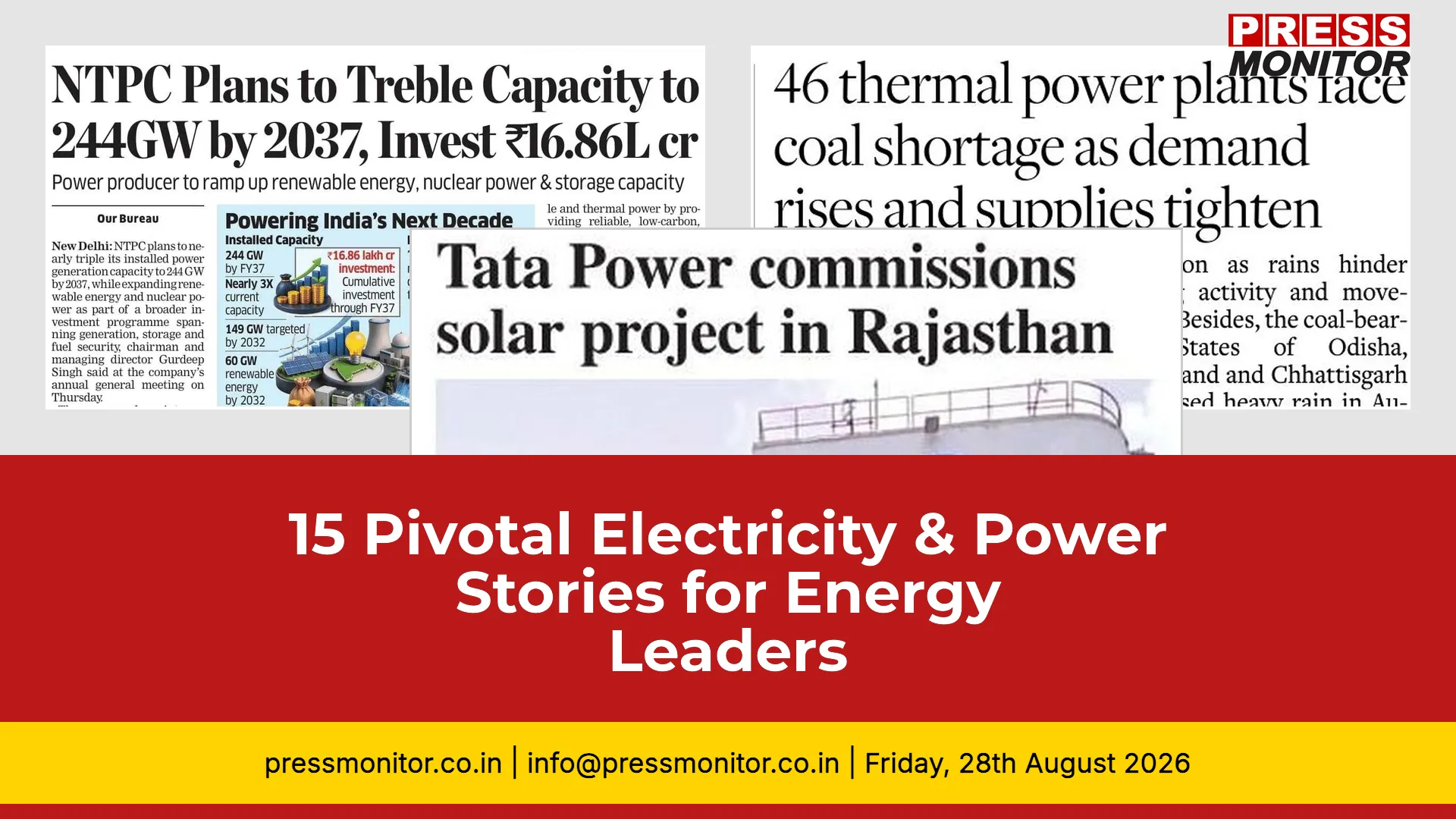
A front-page report in Economic Times says NTPC plans to early triple its installed power generation capacity to 244GW by 2037, while expanding renewable energy and nuclear power as part of a broader investment programme spanning generation, storage and fuel security.
Why it matters: State-backed expansion signals massive capital deployment into generation, storage, and fuel security.
Key detail: Chairman Gurdeep Singh announced a capital expenditure programme spanning 716.86 lakh crore, with nuclear power targeting 100 GW by 2047.
Source: Economic Times
Next step: Track procurement tenders and nuclear licensing updates.
2. 46 Thermal Plants Face Critical Coal Shortages
A front-page report in Business Line says that as of August 26, 46 thermal power plants with a capacity of 63.72 GW have critically low coal stocks ranging from zero to five days.
Why it matters: Monsoon disruptions directly threaten baseload reliability and peak pricing stability.
Key detail: 63.72 GW of thermal capacity holds inventories ranging from zero to five days of operation.
Source: Business Line
Next step: Monitor state-level emergency dispatch protocols.
3. Tata Power Commissioning Rajasthan Solar Facility
A front-page report in The Pioneer says Tata Power Renewable Energy commissioned a 72.5-megawatt solar project in Bikaner, Rajasthan. The energy will be supplied to Tata Steel through TP Vardhman Surya and is expected to generate 166 MUs of green energy annually while offsetting 18,856 tonnes of carbon emissions. This brings TPREL's total renewable utility capacity to 12.3 GW, supporting Tata Steel's decarbonisation efforts and India's renewable energy goals.
Why it matters: Corporate PPAs accelerate decarbonization while stabilizing industrial power costs.
Key detail: The 72.5 MW Bikaner project supplies Tata Steel via TP Vardhman Surya, offsetting 18,856 tonnes of CO2 annually.
Source: The Pioneer
Next step: Follow corporate sustainability reporting cycles.
4. Suzlon Secures Rs 500 Crore Tamil Nadu Investment
A front-page report in New Indian Express says Industries Minister Keerthana clarified that Suzlon's Rs 500 crore investment in Tamil Nadu is not being displaced by larger plans in Andhra Pradesh. The company will set up a control-panel facility in Coimbatore and expand wind-blade capacity in Thoothukudi.
Why it matters: Domestic manufacturing resilience strengthens the wind supply chain amid global headwinds.
Key detail: Control-panel facility in Coimbatore and blade expansion in Thoothukudi proceed alongside Andhra Pradesh plans.
Source: New Indian Express
Next step: Watch for component sourcing announcements.
5. NTPC Launches Standalone Energy Storage Business
“Our objective is to develop storage capabilities not merely as an adjunct to renewable generation, but as an important business in its own right,” NTPC Chairman and Managing Director Gurdeep Singh said. NTPC is building capabilities in Battery Energy Storage Systems (BESS) and Pumped Storage Projects while exploring long-duration technologies, including CO2 storage and redox-flow batteries. Singh said storage would assume greater importance alongside generation and transmission as renewable energy penetration increases. The diversification comes as India’s installed power capacity has crossed 550 GW (gigawatts), with non-fossil sources accounting for more than half. Peak demand crossed 270 GW in the current fiscal and is projected by the Central Electricity Authority to reach around 459 GW by FY36.
Why it matters: Grid-scale storage transitions from adjunct to core revenue stream as renewables penetrate beyond 50%.
Key detail: BESS, pumped hydro, and redox-flow batteries under development alongside 459 GW peak demand projections.
Source: Financial Express
Next step: Review technology partner MOUs.
6. ACME Solar Raises 1,571 Crore for Rajasthan Peak Project
A front-page report in Economic Times says ACME Solar Holdings has raised 1,571 crore from India Infrastructure Finance Company Ltd to develop a 300 MW assured peak power project in Rajasthan. The power purchase agreement has been executed with Solar Energy Corporation of India for 25 years at a tariff of 6.28 per unit.
Why it matters: Dedicated financing vehicles de-risk large-scale solar execution.
Key detail: 300 MW assured peak project secured via IIFCL, with SECI PPA at 6.28 per unit over 25 years.
Source: Economic Times
Next step: Track tariff benchmarking trends.
7. Record 3 GW Solar Added in Q2 2026
A front-page report in Financial Express says India added a record 3 gigawatts (GW) of solar open access capacity in the second quarter of 2026, the highest-ever quarterly addition, as commercial and industrial consumers stepped up renewable power procurement ahead of regulatory and sourcing changes.
Why it matters: Commercial and industrial off-takers are accelerating green procurement ahead of regulatory shifts.
Key detail: Highest quarterly open-access addition ever recorded, driven by cost optimization mandates.
Source: Financial Express
Next step: Analyze corporate procurement pipelines.
8. Nepal Halves Power Exports to India
A front-page report in The Indian Express says that Nepal slashed its power supply to India by half, reducing output from 800 MW to 400 MW following flash floods in Nepal. The disruption affected the 14-MW Devighat hydropower plant supplying electricity to India. Authorities were assessing damage to multiple power plants catering to Nepal’s electricity needs.
Why it matters: Cross-border hydropower dependencies expose transmission routing vulnerabilities.
Key detail: Output slashed from 800 MW to 400 MW following flash floods impacting the Devighat plant.
Source: Indian Express
Next step: Monitor bilateral grid synchronization agreements.
9. Sikkim Community Urges Halt to Himalayan Hydro Projects
“A front-page report in The Hindu says” that a body of two ethnic communities in Sikkim has advised the Centre to learn from the recent flash flood disaster in Nepal and scrap all new and proposed hydroelectric projects in the Himalayan State. Following extensive damage to at least 13 hydropower projects along the Bhotekoshi and Trishuli River corridors in Nepal, including the 113-megawatt Rasuwagadhi Hydropower Plant, the Sikkim Bhutia Lepcha Apex Committee (SIBLAC) has urged Prime Minister Narendra Modi to halt new projects and conduct an independent probe. The group emphasizes the need for a fresh assessment of development activities in the region due to the heightened vulnerability of the Himalayan region.
Why it matters: Climate-induced disaster risk is reshaping environmental clearance timelines.
Key detail: SIBLAC requests independent probes after 13 Nepali projects suffered extensive damage along Bhotekoshi corridors.
Source: The Hindu
Next step: Track EIA revision proposals.
10. Telangana-Karnataka Coal Supply Partnership Expands
A front-page report in Statesman says Telangana Deputy Chief Minister and Energy Minister Bhatti Vikramarka met Karnataka Energy Minister K J George in Bengaluru and discussed coal supply to Karnataka under the existing energy supply agreement between the two states. Why t matter: Inter-state resource sharing mitigates regional generation gaps.
Key detail: Deputy CM Bhatti Vikramarka and Energy Minister K J George formalized supply adjustments under existing agreements.
Source: Statesman
Next step: Watch for interstate tariff arbitration outcomes.
11. Guru Hargobind Thermal Plant Units Offline
A front-page report in Tribune says three of the four units at the Guru Hargobind Thermal Plant in Bathinda have been non-operational for about a fortnight. The shutdown was caused by strikes from outsourced workers demanding direct employment by the Punjab State Power Corporation Limited.
Why it matters: Labor disputes continue to disrupt operational continuity in northern grids.
Key detail: Three of four Bathinda units non-operational due to outsourced worker strikes demanding direct employment.
Source: Tribune
Next step: Monitor PSPCL workforce policy reforms.
12. Tata Power Stock Drops After Singapore Court Ruling
A front-page report in Financial Express says Tata Power stock fell as much as 4.7% in intraday trade after the Singapore International Commercial Court rejected the company’s challenge to the damages awarded to Kleros Capital Partners.
Why it matters: International arbitration outcomes directly impact investor sentiment and balance sheet liquidity.
Key detail: Shares fell 4.7% after the Singapore International Commercial Court upheld damages to Kleros Capital Partners.
Source: Financial Express
Next step: Assess litigation reserve provisions.
13. PDP Protests Electricity Tariff Hike in Kashmir
A front-page report in Tribune says the Peoples Democratic Party on Thursday staged a protest in various districts of the Kashmir valley against the proposed electricity tariff hike.
Why it matters: Regional political pressure could delay or modify JERC rate structures.
Key detail: Peoples Democratic Party staged valley-wide demonstrations against proposed consumer tariff revisions.
Source: Tribune
Next step: Track regulatory consultation feedback loops.
14. Nepal Hydropower Potential Faces Implementation Reality
A front-page report in Statesman says that Nepal’s hydropower potential is often touted as one of the highest per-capita power production in the world boasting a theoretical potential of approximately 83,OOO megawatts, of which around 43,OOO are considered technically and economically feasible. However, with a total installed generation capacity of 4,2OO megawatts and domestic demand hovering around 2,OOO to 2,2OO megawatts, the nation continues to struggle to exploit its potential.
Why it matters: Theoretical capacity vastly exceeds technical execution capabilities.
Key detail: 83,000 MW theoretical potential contrasts with 4,200 MW installed capacity and 2,000-2,200 MW domestic demand.
Source: Statesman
Next step: Evaluate cross-border transmission feasibility studies.
15. Nepal Floods Highlight Brahmaputra Basin Risks
A front-page report in Statesman says the deadly glacier burst in Tibet which triggered a wall of water and mud to drown the narrow gorges of Bhote Kosi river in neighbouring Nepal has intensified scrutiny of China’s construction and dam building activity in the roof of the world. Why it matter: Transboundary water management requires coordinated climate adaptation strategies.
Key detail: Glacial burst triggered mudflows intensifying scrutiny of upstream dam construction in Tibet.
Source: Statesman
Next step: Follow joint river basin commission meetings.
This print media monitoring digest captures the velocity of India's energy transition. Which infrastructure bottleneck will regulators prioritize next quarter? Share your analysis below.