15 Pivotal Logistics Stories for Supply Chain Leaders


Logistics and supply chain leaders face rapid shifts in freight routing, port infrastructure, and domestic manufacturing mandates. Tracked through rigorous print media monitoring, this press review delivers actionable media intelligence on today's developments. Here is your essential briefing on news on logistics, freight, and distribution across India.
1. India Targets Critical Component Self-Reliance
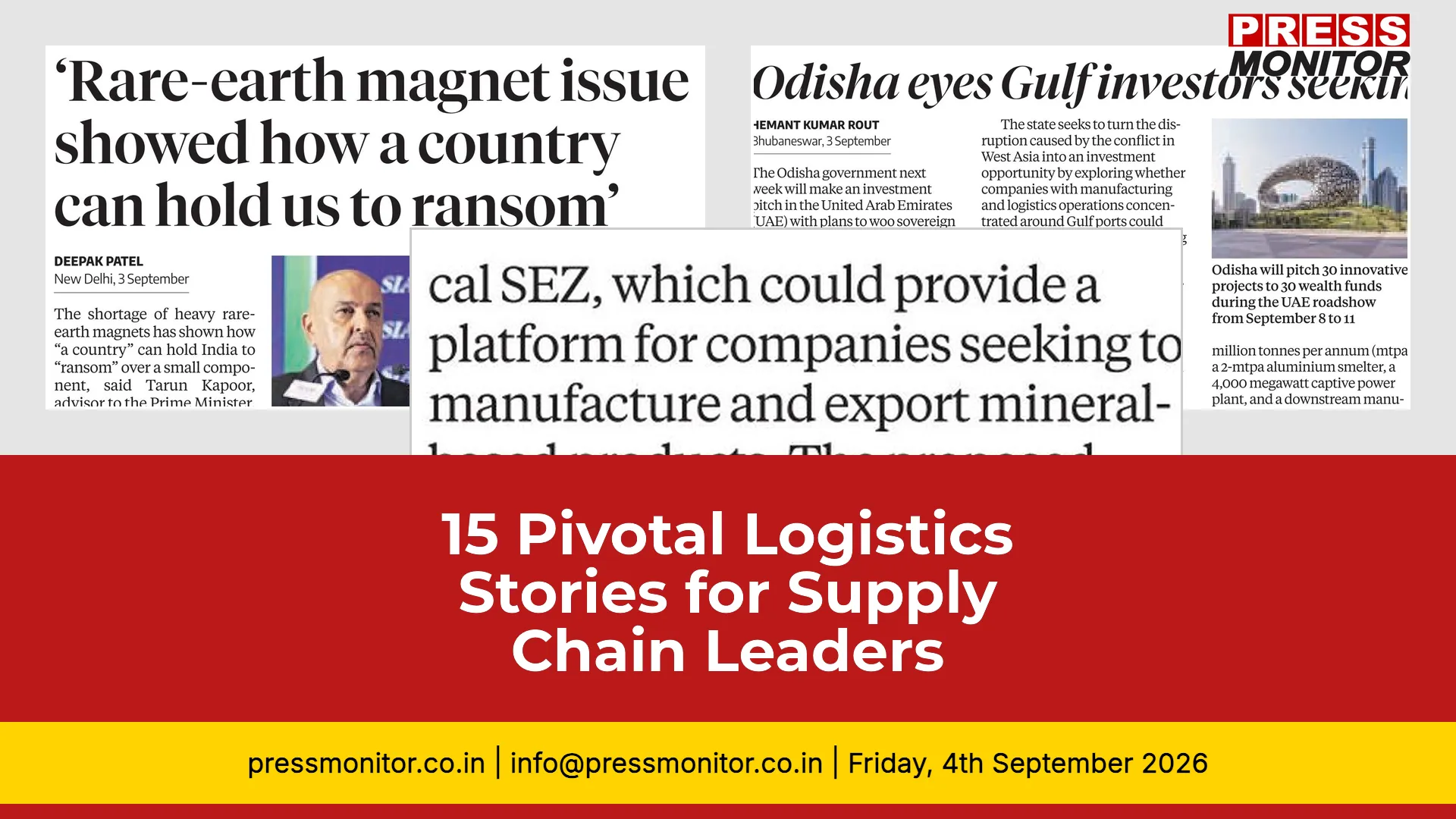
A front-page report in Business Standard says Prime Minister advisor Tarun Kapoor urged the automobile sector to rapidly develop domestic manufacturing for critical components like heavy rare-earth magnets and semiconductors. Speaking at the Society of Indian Automobile Manufacturers convention in New Delhi on Thursday, he warned that reliance on single-source imports, particularly from China, leaves India vulnerable to supply disruptions. The government is backing this localisation drive with a rupees seven thousand two hundred and eighty crore magnet production scheme and a rupees one point two five trillion semiconductor mission, while pushing for faster electric vehicle adoption to bolster energy security.
Why it matters: Reduces vulnerability to single-source import disruptions and strengthens domestic manufacturing resilience.
Key detail: PM advisor Tarun Kapoor highlighted a ₹7,280 crore magnet production scheme and a ₹1.25 trillion semiconductor mission to curb reliance on external suppliers.
Source: Business Standard
Next step: Audit current vendor dependencies and align procurement strategies with new localization incentives.
2. Odisha Targets Gulf Investors
A front-page report in Business Standard says the Odisha government will lead a September 8 to 11 investment roadshow in the United Arab Emirates to pitch 30 projects to nearly 30 wealth funds, led by Chief Minister Mohan Charan Majhi. The state aims to attract sovereign wealth funds, port operators and industrial groups by positioning Odisha as an export-oriented manufacturing and logistics base, including aluminium, metallurgy and critical minerals, as companies assess diversification away from West Asia disruptions.
Why it matters: Positions eastern India as a strategic export hub, directly impacting regional freight demand and port throughput.
Key detail: Chief Minister Mohan Charan Majhi leads a September roadshow to pitch 30 projects to sovereign wealth funds, focusing on aluminium, metallurgy, and logistics infrastructure.
Source: Business Standard
Next step: Engage with state investment boards to secure early-stage warehousing and distribution contracts.
3. Rs 50,000 Crore SEZ For Odisha
A front-page report in Business Standard says a Special Economic Zone in Odisha is planned to go beyond conventional mineral processing by locating export-oriented manufacturing close to the state's ports. The SEZ could attract investments of not less than Rs 50,000 crore if an investor sets up a direct reduced iron-grade iron ore pellet plant for export to West Asian markets.
Why it matters: Creates a dedicated zone for export-oriented manufacturing adjacent to ports, streamlining customs and last-mile delivery.
Key detail: The SEZ aims to attract direct reduced iron-grade iron ore pellet plants targeting West Asian markets, backed by substantial capital commitments.
Source: Business Standard
Next step: Evaluate site selection criteria and assess compliance timelines for cross-border freight operations.
4. 22 Expressways Power Uttar Pradesh
A front-page report in Hindustan Times says Uttar Pradesh's integrated connectivity network across water, land, and air has given new impetus to development. The state now has 22 expressways, 90 national highways, and 17 operational airports including 5 international ones. With 60% of the country's total expressway coverage passing through Uttar Pradesh and improved rankings in the Export Preparedness Index 2024, the state is emerging as a major hub for investment, industry, trade, and employment.
Why it matters: Expands national highway connectivity, drastically reducing transit times for heavy freight and intermodal transfers.
Key detail: Uttar Pradesh now hosts 60% of India's total expressway coverage alongside 17 operational airports, boosting its Export Preparedness Index ranking.
Source: Hindustan Times
Next step: Optimize route planning algorithms to leverage new corridor efficiencies and lower fuel consumption.
5. Wheat Exports Set to Surpass USD 15 Billion
A front-page report in Free Press Journal says India is poised to return to the global wheat market with an export opportunity exceeding USD 15 billion following nearly four years of export restrictions. Record domestic output of 120.7 million tonnes in 2025-26 and central pool stocks of 513 MMT as of May 28, 2026, coupled with tightening global supplies, create a favourable trade window according to ASSOCHAM. Policy changes in 2026 have freed specified wheat varieties and processed products, enabling India to target markets including Bangladesh, Egypt, Indonesia, Algeria, Morocco and the Philippines.
Why it matters: Reopens global grain trade lanes, creating high-volume shipping opportunities and cold-chain demand.
Key detail: Record domestic output of 120.7 million tonnes and relaxed export policies enable shipments to Bangladesh, Egypt, Indonesia, Algeria, Morocco, and the Philippines.
Source: Free Press Journal
Next step: Secure vessel allocations and negotiate forward contracts with international buyers before seasonal rate spikes.
6. Hyundai Motor MD Voices Concern Over Commodity Costs
A front-page report in Free Press Journal says Hyundai Motor India Ltd Managing Director Tarun Garg expressed concern over high commodity prices weighing on the automaker. Garg stated that commodity cost inflation is an impact of geopolitical uncertainty and not a structural issue. He also noted that vessel availability due to the war in West Asia is affecting the company's exports, though demand in export markets has seen minimal impact from the war.
Why it matters: Highlights how geopolitical tensions directly impact freight rates and raw material procurement budgets.
Key detail: MD Tarun Garg noted that vessel availability constraints due to West Asia conflicts are straining export schedules, though end-market demand remains stable.
Source: Free Press Journal
Next step: Diversify carrier portfolios and implement dynamic pricing models to hedge against volatile ocean freight indices.
7. Piyush Goyal Warns Automakers on Indigenisation
A front-page report in Business Standard says Union Commerce and Industry Minister Piyush Goyal, speaking in New Delhi at the sixty-sixth Society of Indian Automobile Manufacturers annual convention on Thursday, warned automobile companies against claiming indigenisation when imports are routed through another Indian entity with only ten to fifteen per cent nominal value addition. He said the government is using import and export statistics and Import Export Code numbers to map company supply chains, assess actual localisation, and ask companies that cannot indigenise certain products to expand exports.
Why it matters: Forces supply chain restructuring as regulators map actual localisation versus nominal value addition.
Key detail: Commerce Minister Piyush Goyal announced the use of Import Export Code data to track genuine domestic manufacturing, pushing non-compliant firms toward export expansion.
Source: Business Standard
Next step: Conduct internal supply chain audits to verify component origin documentation and adjust sourcing accordingly.
8. SIAM Reports Record Automotive Sales
A front-page report in Free Press Journal says the automotive industry remains a key driver of India's economic growth and has made significant strides in aligning with global and national priorities regarding sustainability, decarbonisation, and safety. Society of Indian Automobile Manufacturers President Shailesh Chandra stated at the annual convention that the sector's overall contribution to the Indian economy exceeded 22.75 lakh crore, contributing to about 15% of the country's goods and services tax collections. The industry provides direct and indirect employment to more than 30 million people and supports a vast supply chain network.
Why it matters: Signals robust consumer demand, driving increased inbound parts logistics and outbound finished vehicle distribution.
Key detail: The auto sector contributed over ₹22.75 lakh crore to the economy, supporting 30 million jobs and accounting for 15% of national GST collections.
Source: Free Press Journal
Next step: Scale warehouse capacity and partner with third-party logistics providers to handle peak-season volume surges.
9. ISB Simulation For Sustainable Supply Chain
A front-page report in Deccan Chronicle says the Indian School of Business has published a simulation on the Harvard Business Impact platform that allows students to experience supply chain management decisions in real time. The simulation, developed with the Sim Institute, runs over five years and balances sustainability, quality, and financial performance. It was tested with Post Graduate Programme students and refined based on feedback to provide more personalised artificial intelligence-driven feedback.
Why it matters: Advances industry training methodologies, preparing future leaders to balance ESG goals with financial performance.
Key detail: The Indian School of Business launched a five-year Harvard Business Impact simulation featuring AI-driven feedback on sustainability and quality metrics.
Source: Deccan Chronicle
Next step: Integrate simulation-based training modules into corporate learning programs to improve decision-making accuracy.
10. Modi and Belgium Sign Five Defence Pacts
A front-page report in Deccan Chronicle says Prime Minister Narendra Modi met Belgian Prime Minister Bart De Wever in New Delhi on Thursday to ink five defence cooperation pacts. The two nations agreed to double bilateral trade within five years while expanding collaboration into clean energy, semiconductors, critical minerals, and maritime logistics. De Wever praised India’s seven point eight per cent quarterly economic growth and confirmed that the European Union free trade agreement would be signed in Brussels this December.
Why it matters: Strengthens bilateral trade frameworks, including explicit clauses for maritime logistics and critical mineral transport.
Key detail: Prime Minister Narendra Modi and Belgian PM Bart De Wever agreed to double trade within five years, with EU FTA signing scheduled for December.
Source: Deccan Chronicle
Next step: Align compliance protocols with upcoming European regulatory standards and explore joint venture opportunities in green shipping.
11. India Secures Rs 1.64 Lakh Crore
A front-page report in First India says that India has expanded its semiconductor ecosystem through a 50% fiscal support policy and strategic partnerships with the United States, Taiwan, Japan, Singapore and the European Union. The government has attracted over Rs 1.64 lakh crore in investments, including projects by Micron Technology, Tata Electronics, CG Power, Kaynes Semicon and HCL. The initiative, dubbed ‘chip diplomacy’, aims to position India as a trusted manufacturing and technology partner for global chip producers.
Why it matters: Accelerates semiconductor fabrication, requiring specialized clean-room logistics and hazardous material handling.
Key detail: Strategic partnerships with the US, Taiwan, Japan, Singapore, and the EU attracted investments from Micron, Tata Electronics, and HCL.
Source: First India
Next step: Develop certified cold-chain and ESD-safe transportation networks to support advanced electronics manufacturing.
12. National Fertilizers Seeks Freight Forwarders
A front-page report in Indian Express says National Fertilizers Limited intends to pre-qualify freight forwarders for sea mode import consignments, with the document submission deadline of 12 October 2026. National Law University and Judicial Academy, Assam announces its Fourth Convocation Ceremony on 4 October 2026 at Srimanta Sankaradeva Kalakshetra in Guwahati. International Institute for Population Sciences invites applications for the Chief Administrative Officer post by 5 October 2026. Nirmal Education Society's Subhash Desai College of Law invites applications for principal, assistant law professor and librarian positions for the 2026-27 academic year.
Why it matters: Opens immediate tender opportunities for sea-mode import consignments in the agricultural inputs sector.
Key detail: The public sector undertaking set a document submission deadline of 12 October 2026 for pre-qualified freight partners.
Source: Indian Express
Next step: Prepare compliance dossiers and submit competitive bids before the October cutoff.
13. India Post's Rural Rejuvenation Push
A front-page report in Statesman says India Post has merged Registered Post into Speed Post and launched premium next-day services in six metropolitan cities. The Department of Posts invested Rs 5,785 crore in Advanced Postal Technology (India Post IT 2.0) to improve tracking and UPI payments, yet Speed Post market share remains stagnant. India Post Payments Bank recorded a net profit of Rs 134 crore by leveraging the 1.65 lakh post office network for rural financial inclusion.
Why it matters: Modernizes last-mile delivery infrastructure, integrating digital tracking and UPI payments into remote logistics networks.
Key detail: A ₹5,785 crore IT 2.0 upgrade merged Registered Post into Speed Post, while India Post Payments Bank posted a ₹134 crore net profit.
Source: Statesman
Next step: Leverage expanded postal networks for e-commerce reverse logistics and rural market penetration strategies.
14. Tripura Exports Organic Rice to Europe
A front-page report in Free Press Journal says India dispatched eighteen metric tonnes of NPOP-certified ethnic rice from Tripura to Austria and the Netherlands on September 2, 2026. The consignment, facilitated by APEDA, includes premium varieties such as Aromatic Kali Khasa Rice and Black Rice, and is expected to deliver farmers price realisation up to forty percent above domestic market levels.
Why it matters: Demonstrates successful niche agricultural export routing, achieving premium pricing through certified supply chains.
Key detail: APEDA facilitated 18 metric tonnes of NPOP-certified Kali Khasa and Black Rice to Austria and the Netherlands, boosting farmer margins by 40%.
Source: Free Press Journal
Next step: Partner with certification bodies and establish temperature-controlled air freight corridors for high-value agri-produce.
15. US Capital Goods Imports Surge 11.4 Percent
A front-page report in Economic Times says that United States imports rose by 2.8 percent while exports fell 2.1 percent last week, driven by an 11.4 percent surge in capital goods linked to artificial intelligence investments. The national trade deficit continues to fluctuate amid shifting energy demands following regional conflicts and ongoing supply chain adjustments, whilst tariff debates remain active following recent legal rulings. Concurrently, initial jobless claims remained exceptionally low at 206,000, highlighting continued labour market strength despite broader macroeconomic headwinds.
Why it matters: Reflects global AI-driven infrastructure spending, influencing equipment leasing and cross-border machinery transport.
Key detail: US capital goods imports jumped to their highest advance since 1993, driven by artificial intelligence investments and shifting energy demands.
Source: Economic Times
Next step: Monitor international trade flow data to anticipate demand for heavy-lift cargo services and industrial relocation projects.
How will these infrastructure and policy shifts reshape your Q4 distribution strategy? Share your operational adjustments below.