15 Pivotal Logistics and Supply Chain Stories for Industry Leaders


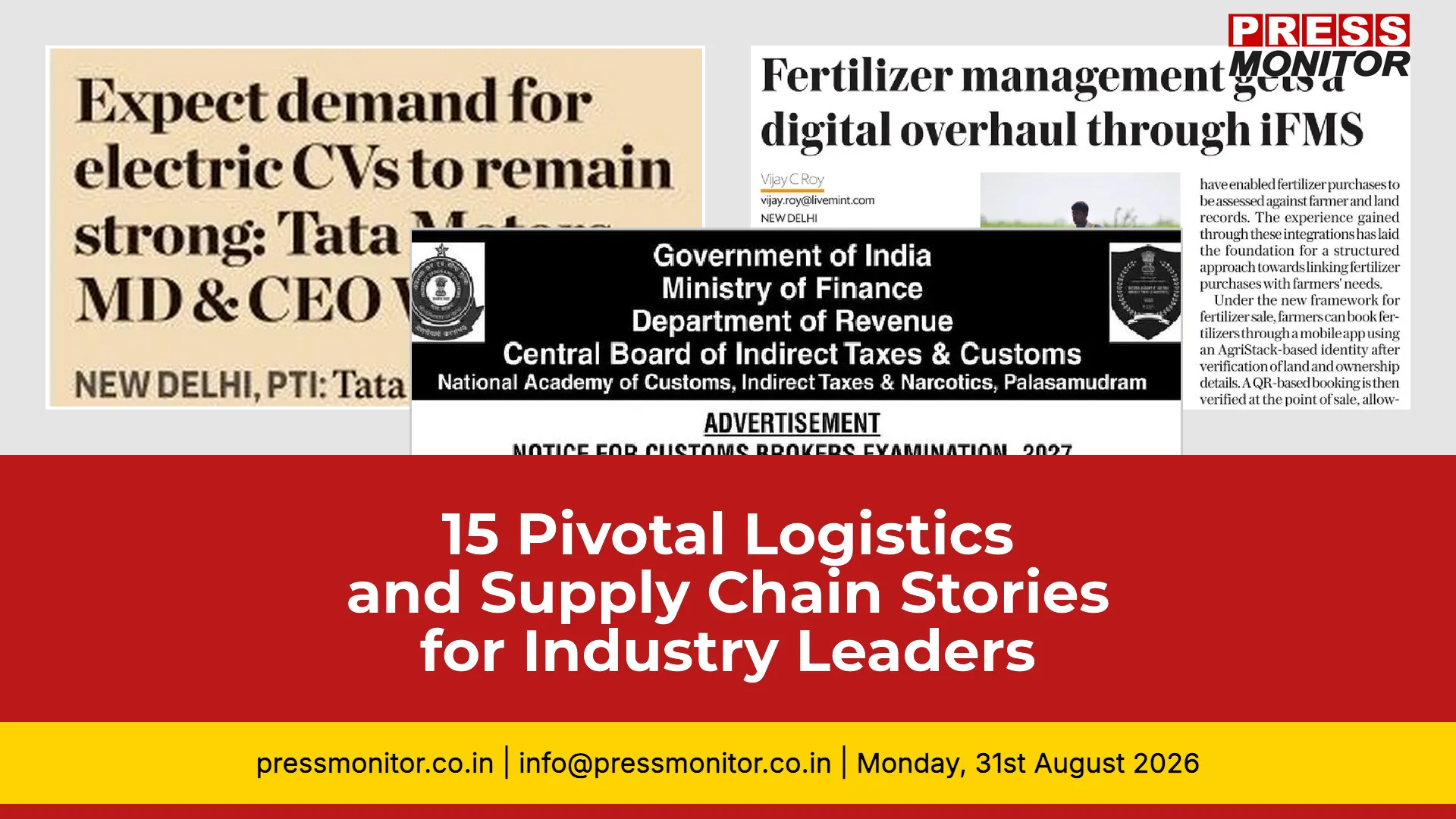
Good morning. India's logistics landscape is shifting fast — from Apple's production shift to Tata Motors' electric vehicle demand surge, and government moves to digitalise fertilizer supply chains. According to Press Monitor's tracking of Indian publications, here are the 15 most impactful stories you need to know today.
1. Tata Motors Sees Strong EV Commercial Vehicle Demand
A front-page report in Deccan Herald says that Tata Motors Ltd expects demand for its electric commercial vehicles to remain strong and continue to grow with a strong order book in place across segments, according to its MD and CEO Girish Wagh.
Why it matters: The electrification of commercial vehicles is a key logistics trend, and Tata Motors' strong order book signals confidence in the segment.
Key detail: MD Girish Wagh confirmed supply chain bottlenecks for cells from China should be resolved by end of Q3 2026.
Source: Deccan Herald (front-page), also covered by Economic Times and Mint.
Next step: Monitor how Tata Motors' EV supply chain resolution impacts fleet electrification timelines.
2. Digital Overhaul for Fertilizer Management
A front-page report in Mint says the government is turning its fertilizer management system into a more data-driven platform, linking sales with farmer, land and crop records and tracking supplies more closely from production to retail.
Why it matters: A data-driven fertilizer supply chain from production to retail can reduce inefficiencies and improve farmer access.
Key detail: The government is linking sales with farmer, land and crop records.
Source: Mint (front-page), also covered by Haribhoomi.
Next step: Assess how digital tracking of fertilizer flows could influence logistics service providers.
3. Customs Broker Examination 2027 Announced
The Central Board of Indirect Taxes & Customs has announced an online written examination for issuing licenses to act as a Customs Broker under the Customs Brokers Licensing Regulations (CBLR), 2018. Applications are invited from Indian citizens to submit online through the CBLMS Portal by November 13, 2026. Applicants must pay a fee of ₹500/- and ensure complete and accurate information on the application.
Why it matters: New licensed customs brokers will shape import-export logistics efficiency.
Key detail: Online applications through CBLMS Portal by November 13, 2026; fee ₹500.
Source: Hindustan Times, also covered by Deccan Herald.
Next step: Logistics firms should encourage staff to apply for the examination.
4. Apple to Shift 30-35% iPhone Production to India
A front-page report in Business Standard says that Apple is expected to shift 30-35% of its global iPhone production to India from 25% currently. The move is part of a broader strategy to diversify supply chains away from China.
Why it matters: This massive supply chain diversification will boost India's manufacturing and export logistics.
Key detail: Currently 25% of global iPhone production is in India; target is 30-35%.
Source: Business Standard (front-page).
Next step: Watch for increased demand for cargo and warehousing near Apple's supplier parks.
5. India Needs Higher Cargo Volumes to Attract Global Sailings
Exporters and importers are facing high ocean freight costs and disruptions in shipping schedules. Shipment costs to the US have risen from $1,500 to $10,000, and to the Gulf, Europe, and East Africa from $300 to $4,000, $1,200 to $5,000, and $1,200 to $3,400 respectively. The rise in transportation costs is pushing up landed costs. India needs sufficient export and import cargo volumes to attract sailings from global shipping lines, which necessitates increased competitiveness and market share. Subsidies or investments in vessels and ports are being considered, but must be weighed against a broader technological transition in the maritime industry.
Why it matters: High ocean freight costs are hurting exporters; attracting more sailings requires higher export-import volumes.
Key detail: Shipment cost to US rose from $1,500 to $10,000; to Gulf from $300 to $4,000.
Source: Business Standard (front-page).
Next step: Exporters should explore aggregating cargo to improve bargaining power.
6. Public Auction of St. John Freight Systems Assets
A front-page report in New Indian Express says that the assets of St. John Freight Systems Limited, under liquidation, will be auctioned as is where is on a non-recourse basis without any warranties and indemnities.
Why it matters: The liquidation of a freight company signals stress in the sector and creates asset acquisition opportunities.
Key detail: Auction on 'as is where is' non-recourse basis.
Source: New Indian Express (front-page).
Next step: Potential buyers should evaluate the assets for fleet or warehouse expansion.
7. Delhivery Hikes Shipping Charges for D2C Brands
A front-page report in Hindustan says that logistics company Delhivery has decided to increase shipping charges for direct-to-consumer brands. The new rates will be effective from September 1, 2026, with an additional fee of four rupees for express shipments and two rupees for surface shipments.
Why it matters: Increased delivery costs will impact e-commerce operations and consumer pricing.
Key detail: Additional ₹4 for express and ₹2 for surface shipments effective September 1.
Source: Hindustan (front-page).
Next step: D2C brands should renegotiate contracts or explore alternative last-mile partners.
8. Alstom Locomotive Factory Boosts India's Engineering Share to 30%
"According to Vivek Garg, managing director of Madhepura Electric Locomotive Pvt Ltd (MELPL), the factory has created a large pool of engineers contributing to 30% of Alstom’s global engineering work now being done in India.", MELPL manufactures India’s most powerful 12,000-horsepower locomotives running on dedicated freight corridors and capable of hauling loads upto 6,000 tonnes. The company, a joint venture between Indian Railways and French major Alstom, with Alstom holding a 74% stake, supplied its 650th locomotive to the Railways on August 15. Garg also discussed Make in India manufacturing, global practices, new suppliers, and future plans for the project, one of the largest foreign direct investments (FDI) in India’s railway sector.
Why it matters: The factory contributes to global engineering work and strengthens rail freight capability.
Key detail: MELPL supplied its 650th locomotive; 12,000 hp engines hauling 6,000 tonnes.
Source: Indian Express (front-page).
Next step: Rail freight operators should track capacity expansion for dedicated freight corridors.
9. India Strengthens Strategic Reserves and Supply Chains
A front-page report in Morning Standard says Professor S. Mahendra Dev, Chairman of the Economic Advisory Council to the Prime Minister, highlighted India's economic resilience during the West Asia conflict. He emphasised the need to diversify critical supply chains and enhance domestic capacity in semiconductors and strategic petroleum reserves.
Why it matters: Diversifying critical supply chains is essential for economic resilience.
Key detail: EAC-PM Chairman S. Mahendra Dev stressed semiconductor and petroleum reserve capacity.
Source: Morning Standard (front-page).
Next step: Policy watchers should monitor government incentives for semiconductor logistics.
10. India's Resilience Amid Global Disruptions
A front-page report in New Indian Express says that while India has managed to absorb the economic fallout from the West Asia conflict better than initially feared, the conflict has highlighted the need to strengthen strategic reserves and diversify critical supply chains beyond traditional sources.
Why it matters: Despite West Asia conflict fallout, India's economy has absorbed shocks, but supply chain vulnerabilities remain.
Key detail: Need to diversify supply chains beyond traditional sources.
Source: New Indian Express (front-page).
Next step: Companies should stress-test their supply chains for geopolitical risks.
11. Rural Commercial Vehicle Sales Outpace Urban
A front-page report in Business Standard says rural commercial vehicle registrations outpaced urban sales every month between April and July 2026. This growth is attributed to the structural diversification of the rural economy and GST-led consumption increases. Data from the Federation of Automobile Dealers Associations shows rural growth hitting 29.37 per cent in July.
Why it matters: Rural demand is driving CV growth, indicating changing logistics patterns.
Key detail: Rural registrations grew 29.37% in July; structural diversification of rural economy cited.
Source: Business Standard (front-page).
Next step: Logistics firms should expand rural distribution networks.
12. Country Delight Plans $200-300 Million IPO
A front-page report in Hindustan Times says Country Delight's parent is preparing an initial public offering (IPO) to raise two hundred to three hundred million dollars, potentially within the next twelve to eighteen months. The company, which operates a direct-to-consumer dairy and fresh produce delivery platform, is gearing up to begin informal pitches to investment bankers for lead managers and evaluating a pre-IPO fundraise to set a valuation benchmark.
Why it matters: The D2C dairy and fresh produce delivery platform's IPO signals confidence in supply chain startups.
Key detail: Pre-IPO fundraise to set valuation benchmark; informal pitches to bankers starting.
Source: Hindustan Times (front-page).
Next step: Investors should watch for the IPO as a barometer for agri-logistics valuations.
13. Flood Fury in Satna-Chitrakoot Disrupts Rail and Road
A front-page report in Free Press Journal says around one thousand people were rescued in flood-hit Satna-Chitrakoot as the Mandakini River overflowed following heavy rainfall. No casualty has been reported so far, though rail traffic has been disrupted and essential supplies are being provided to the affected.
Why it matters: Natural disasters impact supply chains; 1,000 rescued, rail traffic disrupted.
Key detail: Mandakini River overflowed; power restored in 50% of areas.
Source: Free Press Journal (front-page).
Next step: Logistics operators with routes in central India should prepare for delays.
14. Onion Storage Crisis Sparks Demand for Inquiry
A front-page report in Free Press Journal says that in an effort to stabilise onion prices, special freight trains have been transporting onions from Guwahati, Chennai, Kolkata, and Kochi. However, labourers are reportedly forced to work in foul-smelling conditions to separate good onions from rotten stock. This development has raised serious questions over the storage and handling of onions procured by the government, with demands for an immediate inquiry to determine the quantity of damaged onions, precautions taken during storage, and the financial loss suffered by the government.
Why it matters: Poor storage and handling of government-procured onions highlight supply chain infrastructure gaps.
Key detail: Special freight trains used; labourers forced to sort rotten stock.
Source: Free Press Journal (front-page).
Next step: Cold chain and warehousing providers can pitch solutions to FCI.
15. India Doubles Down on Handset Production, Aims for Export Dominance
"Selon Mint, le gouvernement indien a renouvelé les incitations à la production nationale de téléphones portables et a planifié un écosystème d'approvisionnement, ce qui témoigne d'une ambition accrue en matière d'exportations. Malgré un succès notable, qui a conduit à la deuxième place mondiale en fabrication de téléphones portables, à la création d'emplois, en particulier pour les femmes, et à une augmentation des exportations, le plan dépend encore des subventions pour rester compétitif. L'impact du plan est également affecté par l'importation accrue, qui n'a pas eu d'impact majeur sur la stabilité macroéconomique, et par une absence de clarté quant à l'origine de la propriété intellectuelle des appareils. De plus, l'impact global est limité par le fait que la création d'emplois sectoriels est faible par rapport aux autres PLIs, notamment dans l'industrie agroalimentaire."
Why it matters: Handset manufacturing growth creates new logistics demand for components and finished goods.
Key detail: India is now second-largest phone manufacturer; PLI scheme continues.
Source: Mint.
Next step: Logistics firms should target handset supply chains for new business.
Closing: This press review, powered by Press Monitor's media intelligence, gives you a 360° view of today's logistics and supply chain developments. Which story will impact your business most? Let us know in the comments.