15 Pivotal Water & Infrastructure Stories for Utility Leaders


Today’s press review highlights critical shifts in India’s water infrastructure, resource allocation, and urban resilience. According to Press Monitor's tracking of Indian publications, this print media monitoring digest delivers verified, editorially vetted insights for utility executives and policy makers. Here are the 15 defining developments shaping the sector today.
1. Krishna River Management Board Halts Srisailam Releases
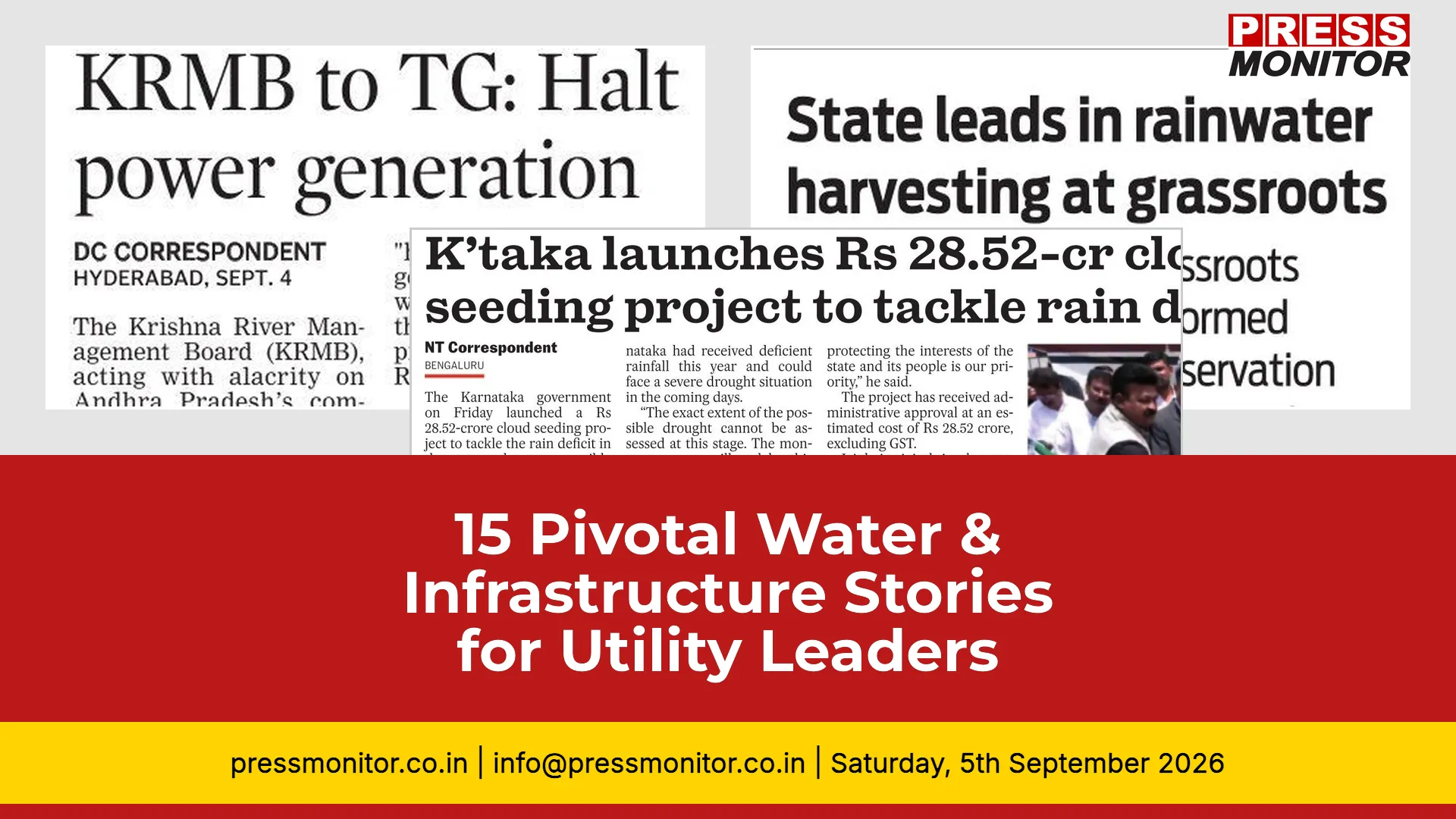
A front-page report in Deccan Chronicle says the Krishna River Management Board has asked Telangana to stop power generation and downstream releases from Srisailam's left bank powerhouse after Andhra Pradesh complained that water was being drawn for electricity. The report, datelined Hyderabad on September 4, says representatives of both states met on Friday and the board urged Telangana to follow the water-sharing principles in the Andhra Pradesh Reorganisation Act, 2014 amid reservoir depletion concerns and predictions of low rainfall from El Nino. Andhra Pradesh's engineer-in-chief, K Narasimha Murthy, said the states could not agree on allocations, with Andhra Pradesh citing the agreed 66 to 34 split and Telangana seeking a 50 to 50 split.
Why it matters: Interstate water disputes directly impact hydropower generation, agricultural irrigation, and regional political stability.
Key detail: The board directed Telangana to stop power generation and downstream releases following an AP complaint over unilateral draws amid El Niño concerns. Negotiations remain stalled between a 66:34 ratio and a 50:50 interim split.
Source: Deccan Chronicle
Next step: Track the upcoming secretary-level meeting for binding arbitration outcomes.
2. Chhattisgarh Leads National Rainwater Harvesting Rankings
A front-page report in Morning Standard says Chhattisgarh has emerged as the best performer in rainwater harvesting under the Ministry of Jal Shakti's 'Jal Sanchay Jan Bhagidari' and 'Catch the Rain' campaigns, with five districts figuring among the national Top 10. The state employed four measures including state-specific plans, State Water Awards, mapping of water structures, and quarterly reviews. Additionally, the state launched the Tribal Incentives on Natural Resources Portal to empower indigenous miners in Bastar by tethering tin collectors' earnings directly to global market valuations through the London Metal Exchange and routing payments via Direct Benefit Transfer.
Why it matters: Demonstrates scalable models for grassroots water conservation and tribal economic integration.
Key detail: Five districts ranked in the national Top 10 under Jal Shakti campaigns. The state also launched a portal tethering Bastar tin collectors’ earnings to London Metal Exchange valuations via DBT.
Source: Morning Standard
Next step: Evaluate replication potential for other central states facing seasonal shortages.
3. Karnataka Launches Rs 28.52 Crore Cloud Seeding Project
A front-page report in Free Press Journal says the Karnataka government launched a Rs 28.52 crore cloud seeding project on Friday to tackle the rain deficit in the state and avert a possible water crisis. Water Resources Minister N Chaluvarayaswamy flagged off a special light aircraft at HAL airport, formally starting the programme. The project is being jointly implemented by Karnataka Neeravari Nigam Limited and the Karnataka State Natural Disaster Monitoring Centre, with the contract awarded to M/s Kyathi Climate Modification Consultants LLP.
Why it matters: Emergency weather modification signals escalating drought response strategies ahead of monsoon transitions.
Key detail: A specially equipped aircraft was flagged off at HAL airport to trigger rainfall across deficit zones. Implemented jointly by Neeravari Nigam Limited and KSNDMC.
Source: Free Press Journal
Next step: Monitor meteorological efficacy reports and environmental compliance audits.
4. India's Water Security Under Threat from Climate Volatility
A front-page report in Free Press Journal says India's water security is increasingly vulnerable due to climate change, with unpredictable rainfall, prolonged dry spells, and extreme weather events straining the country's limited freshwater resources. The report highlights that India, which holds only four per cent of the world's freshwater, faces over-exploitation of groundwater and growing contamination. It also features expert commentary on rainwater harvesting, water treatment, and infrastructure solutions to build a sustainable water future.
Why it matters: Macro-level risk assessment underscores systemic vulnerabilities in groundwater extraction and contamination.
Key detail: Holding just four percent of global freshwater, India faces prolonged dry spells and extreme weather straining limited reserves. Experts advocate accelerated rainwater harvesting and advanced treatment infrastructure.
Source: Free Press Journal
Next step: Integrate climate stress-testing into long-term capital expenditure planning.
5. Haryana Ensures Universal Tap Water Access
A front-page report in Tribune says Haryana Public Health Engineering Minister Ranbir Gangwa announced the government is prioritizing water conservation and sustainability after ensuring clean drinking water supply to every household. Gangwa presented Haryana's initiatives at a two-day Ministry of Jal Shakti summit in New Delhi attended by Prime Minister Narendra Modi and Union Minister CR Patil. The state has installed recharge wells in dark zones and covered 132 villages under the Mahagram Scheme for water supply and sewerage facilities.
Why it matters: Highlights successful state-level execution of rural sanitation and sustainable conservation frameworks.
Key detail: Minister Ranbir Gangwa presented initiatives at the Jal Shakti summit attended by PM Modi. The state installed recharge wells in dark zones and covered 132 villages under the Mahagram Scheme.
Source: Tribune
Next step: Benchmark Haryana’s deployment metrics against neighboring states.
6. Farakka Water Treaty Faces Bihar Renewal Ban
A front-page report in Asian Age says Mr Kumar Kushwaha has stated that the thirty year Farakka water sharing treaty between India and Bangladesh must not be renewed as its term ends. He claims the arrangement damages Bihar by causing silt accumulation and devastating floods near the Farakka Barrage. Kushwaha blamed former Bihar Chief Minister Lalu Prasad and former Prime Minister Deve Gowda for ignoring state interests when the pact was initially signed.
Why it matters: International water sharing agreements face domestic political scrutiny impacting transboundary flow management.
Key detail: MLA Kumar Kushwaha argues the thirty-year pact causes silt accumulation and devastating floods near the barrage, blaming historical leadership for ignoring state interests.
Source: Asian Age
Next step: Assess diplomatic implications and propose sediment management alternatives.
7. Karnataka Minister Urges National Lake Protection Programme
A front-page report in Free Press Journal says Karnataka minister Khandre warned excessive groundwater extraction has lowered the water table. He urged the Centre, in the presence of the prime minister, to formulate a national programme to protect lakes and rivers from pollution and encroachment. Khandre noted that 11,498 of 32,504 lakes under gram panchayat jurisdiction in Karnataka had been encroached upon.
Why it matters: Urban lake encroachment threatens biodiversity and natural aquifer recharge systems.
Key detail: Minister Khandre warned that 11,498 of 32,504 gram panchayat lakes have been encroached upon. He called for a Centre-led initiative to curb pollution and illegal construction.
Source: Free Press Journal
Next step: Push for stricter enforcement of wetland protection acts at municipal levels.
8. West Bengal Issues E-Tender for Murshidabad Water Treatment Plant
A front-page report in Times of India says that the Government of West Bengal has issued an e‑tender for the day‑to‑day operation and maintenance of a four point seven million litre water treatment plant and related distribution works in Murshidabad. The bid deadline is the twenty‑third of September two thousand twenty‑six at two o’clock in the afternoon.
Why it matters: Signals ongoing public-private partnership opportunities in municipal water infrastructure modernization.
Key detail: The government seeks bids for day-to-day O&M of a 4.7 million litre treatment facility. Deadline set for September 23, 2026.
Source: Times of India
Next step: Prepare technical proposals focusing on energy-efficient filtration and smart metering.
9. Naidu Champions Polavaram Canal and Irrigation Expansion
A front-page report in Economic Times says N. Chandrababu Naidu marked his transformation from a technology-focused chief minister to a Water Man by commissioning the Polavaram Left Main Canal and inaugurating the Poola Subbaiah Veligonda Project in Andhra Pradesh. The article notes that Naidu laid the foundation for Veligonda over three decades ago and now aims to complete thirty-six priority irrigation projects by December 2028 as part of a broader water strategy to combat drought and boost farm incomes.
Why it matters: Large-scale hydraulic engineering projects aim to transform agrarian economies and mitigate drought vulnerability.
Key detail: CM Chandrababu Naidu commissioned the Left Main Canal and inaugurated the Veligonda Project, targeting completion of 36 priority irrigation schemes by December 2028.
Source: Economic Times
Next step: Track procurement timelines and contractor performance bonds.
10. MCG Targets Chronic Urban Flood Hotspots in Gurugram
A front-page report in Tribune says MCG Commissioner Pradeep Dahiya announced a shift in the city's flood management approach to address root causes rather than offering band-aid solutions. Three chronic flood hotspots, Rajiv Chowk, Subhash Chowk, and Sheetla Mata Road, were identified for priority intervention with peak water volumes ranging between 5.26 crore and 10.80 crore litres at each site. The study proposed response centres featuring underground detention tanks illustratively sized at 14,000 cubic metres, capturing floodwater for a four-stage treatment process including screening, settling, filtration, and water quality checks before release.
Why it matters: Shifts municipal flood management from reactive relief to engineered root-cause solutions.
Key detail: Commissioner Pradeep Dahiya identified Rajiv Chowk, Subhash Chowk, and Sheetla Mata Road for intervention. Plans include 14,000 cubic metre underground detention tanks with four-stage treatment.
Source: Tribune
Next step: Review civil engineering specifications and drainage capacity upgrades.
11. Three Himachal Dams Classified as High-Hazard
A front-page report in Tribune says twelve of Himachal Pradesh operational dams have been placed in Potential Hazard Category-I, while three have been classified in Category-II following the detection of deficiencies requiring continued monitoring and remedial measures. The findings are part of the Annual Report on Dam Safety 2025-26 of the State Dam Safety Organisation, prepared by the Directorate of Energy under the provisions of the Dam Safety Act, 2021. Giri Jateon barrage and the Malana-I and Malana-II hydel projects were placed in Category-II due to deficiencies requiring sustained monitoring and timely corrective action.
Why it matters: Highlights aging infrastructure risks and the urgent need for structural remediation under the Dam Safety Act 2021.
Key detail: Twelve operational dams placed in Potential Hazard Category-I, while Giri Jateon barrage and Malana-I/II hydel projects require sustained monitoring due to critical deficiencies.
Source: Tribune
Next step: Allocate emergency maintenance budgets and schedule independent safety audits.
12. Andhra Pradesh Rejuvenates 105 Rural Lakes
A front-page report in The Hans India says the state government is modernising and rejuvenating 105 rural lakes across Andhra Pradesh at an estimated cost of nearly Rs 50 crore under the Pradhan Mantri Krishi Sinchayee Yojana. Deputy Chief Minister Pawan Kalyan is spearheading the project, which includes installing open-air gyms, walking tracks, solar lighting, and parks to improve rural health and recreation. 26 lakes have already been completed and opened to the public, with the remaining works scheduled for completion by the end of September to enhance groundwater recharge, irrigation, and local drinking water resources.
Why it matters: Integrates water conservation with rural recreation and renewable energy infrastructure.
Key detail: Deputy CM Pawan Kalyan oversees a Rs 50 crore PMKSY project adding open-air gyms, solar lighting, and walking tracks. 26 lakes already operational.
Source: The Hans India
Next step: Monitor groundwater table recovery rates in surrounding agricultural belts.
13. Uttar Pradesh Invites Bids for Digital Water Level Recorders
A front-page report in Hindustan Times says the Uttar Pradesh Ground Water Department has invited online bids for a Rs 753.40 lakh project to install and maintain 700 digital water level recorders across the state. The tender, issued by Director Dr Rajesh Kumar Prajapati, requires completion within three months, with document access running from 11 September to 5 October 2026. Eligible firms must submit their proposals through the official e-tender portal ahead of the technical bid opening on 5 October.
Why it matters: Accelerates the adoption of IoT-enabled hydrological monitoring for precision groundwater management.
Key detail: The Ground Water Department seeks Rs 753.40 lakh contracts to install 700 digital recorders statewide. Completion mandated within three months.
Source: Hindustan Times
Next step: Verify vendor eligibility for real-time data telemetry and sensor calibration.
14. Karnataka Orders Drought Assessment Across 24 Taluks
A front-page report in Deccan Herald says the Karnataka state government has ordered officials to conduct ground truthing across 24 taluks starting September 5 to assess drought severity following widespread farmer protests. The evaluation will determine whether affected areas fall into moderate or severe crop loss categories based on a final report due by September 11. Preliminary assessments have already flagged over 101 taluks, with seven initially classified as severely impacted.
Why it matters: Direct government intervention responds to widespread farmer protests and impending crop failure.
Key detail: Officials will conduct ground truthing starting September 5. Preliminary flags show over 101 taluks affected, with seven deemed severely impacted. Final report due September 11.
Source: Deccan Herald
Next step: Prepare contingency relief packages and alternative irrigation sourcing.
15. BMC Mandates Root-Cause Fixes for Mumbai Water Pressure Drops
A front-page report in Free Press Journal says that civic authorities directed engineers to address the root cause of inadequate water supply instead of temporary fixes, with Additional Municipal Commissioner Abhijit Bangar reviewing issues and directing officials to maintain full pressure for tail-end and elevated areas. The BMC's 10% water cut since May 15 is disproportionately affecting these areas, while below-average rainfall in August and below-normal rainfall expected in September have left seven lakes needing 14.47 lakh million litres by September 30 for year-round security.
Why it matters: Addresses systemic distribution inefficiencies exacerbated by below-average monsoon rainfall.
Key detail: Additional Municipal Commissioner Abhijit Bangar directed engineers to maintain full pressure for tail-end areas. Seven lakes require 14.47 lakh million litres by September 30 for year-round security.
Source: Free Press Journal
Next step: Audit pipeline networks and upgrade pumping station capacities.
These stories reflect the complex interplay of climate volatility, interstate governance, and municipal innovation. How will your organization align its water resilience strategy with these emerging regulatory and infrastructural shifts?