17 Critical Environment Stories for Sustainability Leaders


Tracking real-time news on environment requires precise media monitoring to cut through noise. This curated press review highlights pivotal developments shaping policy, conservation, and compliance across India. According to Press Monitor's tracking of Indian publications, these stories demand immediate attention from sustainability officers and corporate strategists.
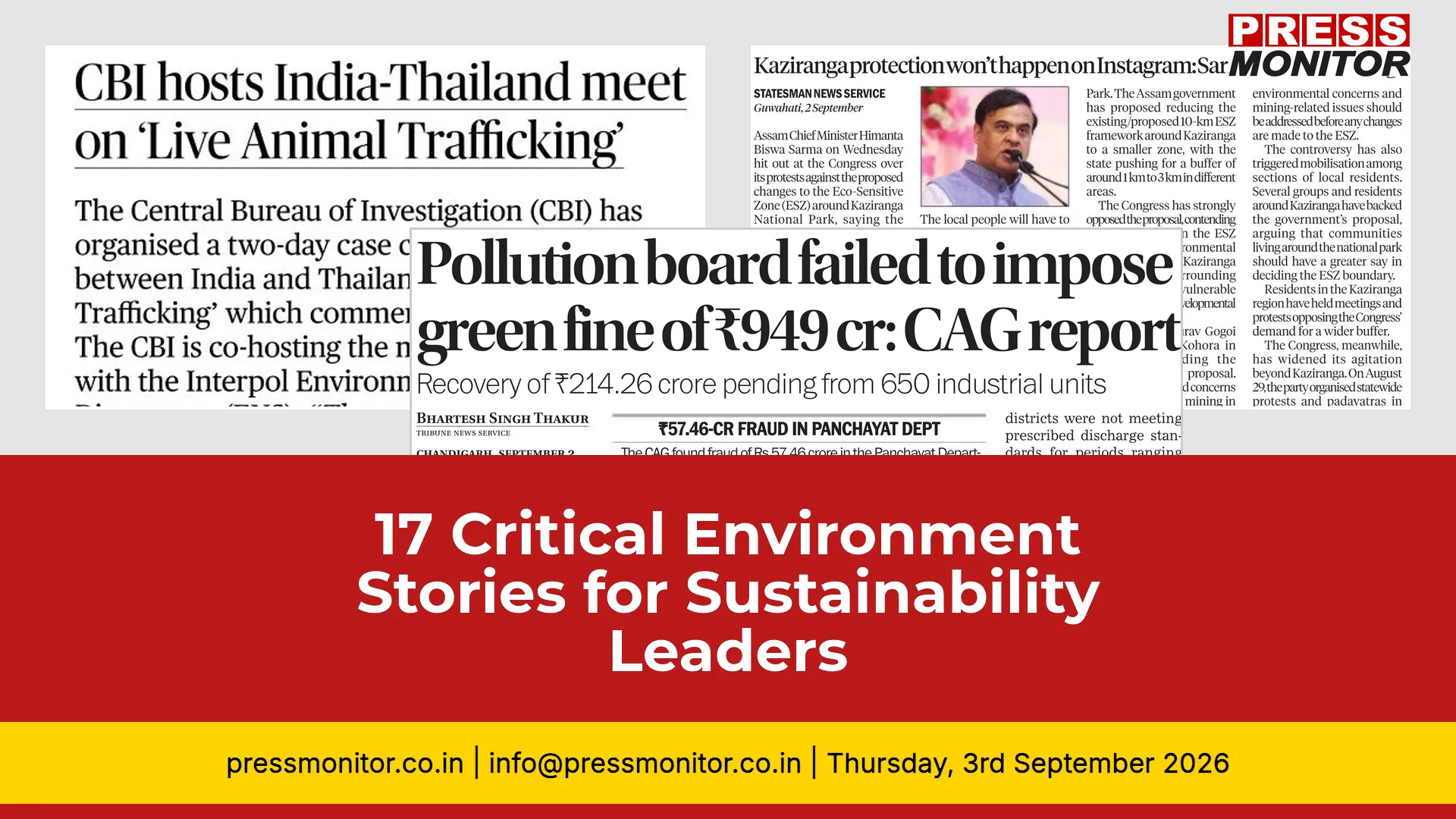
1. CBI Hosts India-Thailand Meet on 'Live Animal Trafficking'
A front-page report in The Hindu says... The Central Bureau of Investigation (CBI) has organised a two-day case coordination meeting between India and Thailand on 'Live Animal Trafficking' which commenced on Wednesday. The CBI is co-hosting the meeting in coordination with the Interpol Environmental Security Sub-Directorate (ENS). The smuggling of exotic live animals and birds for pet trade is a growing trend in Asia. Mainly using air routes, live animals are being trafficked from Thailand, Malaysia, and Indonesia to South Asian countries, including India; Singapore is used as a transit point.
Why it matters: Cross-border wildlife crime threatens biodiversity and strains diplomatic ties.
Key detail: Co-hosted with Interpol ENS, focusing on air-route smuggling from Thailand, Malaysia, Indonesia into South Asia.
Source: The Hindu
Next step: Review import/export compliance protocols for logistics partners.
2. Sarma rebuffs Congress over Kaziranga ESZ
A front-page report in Statesman says Assam Chief Minister Himanta Biswa Sarma has hit out at the Congress over its protests against the proposed reduction of the Eco-Sensitive Zone around Kaziranga National Park, saying the World Heritage Site cannot be protected through social media campaigns or political demonstrations. The Assam government has proposed shrinking the existing 10-km ESZ framework to a buffer of 1-3 km in different areas, which the Congress contends would weaken environmental safeguards. Sarma said Congress leader and Assam Pradesh Congress Committee president Gaurav Gogoi cannot protect Kaziranga, and that local people must safeguard the park.
Why it matters: Buffer zone reductions spark debate on balancing development and heritage protection.
Key detail: Assam proposes shrinking 10km ESZ to 1-3km; Congress warns of weakened safeguards.
Source: Statesman
Next step: Assess state-level regulatory shifts impacting nearby industrial operations.
3. HSPCB Fails to Impose Environmental Fine
A front-page report in Tribune says the Haryana State Pollution Control Board failed to impose environmental compensation of Rs 949.27 crore for untreated sewage discharge. It also did not recover Rs 214 crore from polluting industrial units.
Why it matters: Regulatory enforcement gaps expose companies to reputational and financial risk.
Key detail: Board missed imposing Rs 949.27 crore compensation for untreated sewage and Rs 214 crore from industries.
Source: Tribune
Next step: Audit wastewater discharge permits and engage with state PCB liaisons.
4. Microplastics contaminate Ujh, Chenab rivers
A front-page report in State Times says researchers from the Department of Environmental Sciences at the Central University of Jammu have detected widespread microplastic contamination in the Ujh River in Kathua and the Chenab River in Kishtwar. The studies, conducted by postgraduate students Anshika Sharma and Priti Kumari under Professors Deepak Pathania and Richa Kothari, found microplastics in all water, sediment and fish samples from the Ujh, including the liver, gills and intestine of Labeo rohita, with polyethylene, polypropylene and nylon among the main polymers identified. Vice Chancellor Prof. Sanjeev Jain appreciated the researchers, who called for improved wastewater treatment, plastic-waste management and regular river monitoring.
Why it matters: Rising polymer contamination in freshwater ecosystems impacts public health and fisheries.
Key detail: CUJ researchers found polyethylene, polypropylene, nylon in fish liver, gills, and intestines.
Source: State Times
Next step: Support advanced wastewater treatment initiatives and river monitoring programs.
5. Government to Reassess Barium Use
A front-page report in Times of India says three people were arrested for allegedly threatening a businessman in the name of gangster Neeraj Bawana. The businessman received three threatening calls demanding Rs 10 lakh and threatening him and his family.
Why it matters: Chemical safety regulations are tightening following judicial scrutiny.
Key detail: Additional Solicitor General confirms fresh tests in Delhi, Bhopal, Kolkata, Chennai after stakeholder consultation.
Source: Times of India
Next step: Update chemical handling SOPs and prepare for revised emission standards.
6. Pichavaram Mangroves Valued at 2,485 Crore
A front-page report in The Hindu says the Pichavaram mangrove ecosystem in Tamil Nadu is valued at 2,485.38 crore, providing ecological, economic, and social benefits.
Why it matters: Blue carbon ecosystems demonstrate measurable economic value for ESG reporting.
Key detail: Tamil Nadu mangrove complex delivers ecological, economic, and social benefits worth Rs 2,485.38 crore.
Source: The Hindu
Next step: Integrate blue carbon metrics into sustainability disclosures.
7. Sunnam Cheruvu rejuvenation nears completion
A front-page report in Deccan Chronicle says the rejuvenation of Sunnam Cheruvu lake in Guttala Begumpet, Madhapur, Hyderabad, is progressing and the revived water body will be inaugurated by Chief Minister A. Revanth Reddy by the end of this month. The 13-acre lake, once filled with sewage and partly used as a garbage dump, has grown to 30 acres after encroachments were removed, with the works executed by the Hyderabad Disaster Response and Asset Protection Agency (HYDRAA). The Telangana Pollution Control Board found that lake water, which was being illegally supplied to PG hostels, schools and colleges, contained 12 times the permissible lead and seven times the permissible nickel, both carcinogenic.
Why it matters: Urban lake restoration proves viable for municipal water security and public health.
Key detail: HYDRAA expanded 13-acre lake to 30 acres; removed encroachments and illegal PG supply lines.
Source: Deccan Chronicle
Next step: Benchmark urban water body revival strategies for city planning teams.
8. Yadav: Tiger conservation must balance ecology
A front-page report in First India says Union Environment Minister Bhupender Yadav has called for tiger conservation to balance ecological security with human needs and sustainable livelihoods. Addressing a two-day international workshop on tiger landscapes in New Delhi, he urged a shift from species-centric conservation towards integrated landscape management backed by nature-based solutions, innovative financing and community-based ecotourism. The International Big Cat Alliance and the Asian Development Bank also signed an MoU on landscape conservation, capacity building and nature-positive financing.
Why it matters: Shift from species-centric to landscape management redefines conservation funding.
Key detail: Union Environment Minister advocates nature-based solutions, innovative financing, and community ecotourism.
Source: First India
Next step: Explore partnership opportunities with International Big Cat Alliance.
9. AIKS Protests Evictions in Tamil Nadu Forest Areas
A front-page report in The Pioneer says the All India Kisan Sabha has condemned Tamil Nadu Government and forest bureaucracy for attempting to evict traditional forest dwellers from over 5,072 hectares in Meghamalai-Varusanadu areas. The action is termed as a 'systemic, deliberate violation of the law' that contravenes the Forest Rights Act.
Why it matters: Tension between forest conservation laws and tribal rights requires careful stakeholder mapping.
Key detail: Kisan Sabha condemns eviction attempts across 5,072 hectares in Meghamalai-Varusanadu.
Source: The Pioneer
Next step: Review land acquisition policies and community engagement frameworks.
10. Interstate Committee Formed to Rejuvenate Yamuna
A front-page report in Hindustan Times says the central government has constituted an interstate committee comprising the chief secretaries of five Yamuna basin states to oversee the action plan for rejuvenation of the Yamuna and preventing pollution sources from meeting the river stream.
Why it matters: Centralized oversight signals stricter pollution control along major river basins.
Key detail: Chief secretaries of five basin states tasked with action plans and source prevention.
Source: Hindustan Times
Next step: Align corporate water stewardship goals with interstate basin mandates.
11. Delhi targets 78,000 vehicles in pollution plan
A front-page report in Millennium Post says the Delhi government has begun preparing for the winter pollution season under the Centre's Rs 9,585-crore Parivartan scheme, identifying nearly 78,000 BS-III and BS-IV heavy vehicles for a voluntary switch to BS-VI-compliant vehicles. District administrations have been asked to map pollution hotspots and submit local intervention plans by the end of September, while construction waste collection sites have expanded from 106 to 125 and air-quality equipment has been made mandatory for 80 categories of industries.
Why it matters: Aggressive fleet transition policies will reshape commercial transport economics.
Key detail: Parivartan scheme targets BS-III/IV heavy vehicles for voluntary BS-VI switch; construction waste sites expanded.
Source: Millennium Post
Next step: Evaluate fleet upgrade incentives and green logistics partnerships.
12. Telangana Urges National Water Security
A front-page report in Deccan Chronicle says Telangana has urged the Centre and all states to adopt a unified framework for national water security, calling it a public mission rather than a departmental programme. Irrigation minister N. Uttam Kumar Reddy pitched the idea at the Jal Sanchay Jan Bhagidari summit organised by the ministry of jal shakti in New Delhi, saying every rupee spent must produce a measurable and lasting water benefit. He added that Telangana was ready to share its experience in tank restoration, community participation and reservoir desiltation pilots with other states.
Why it matters: Unified water framework could standardize state-level conservation investments.
Key detail: Irrigation minister pitches public mission approach, sharing tank restoration and desiltation pilots.
Source: Deccan Chronicle
Next step: Monitor central policy alignment for regional infrastructure bidding.
13. Uttar Pradesh Emerges as Ecotourism Hotspot
A front-page report in Times of India says Uttar Pradesh is emerging as a promising destination for ecotourism, with growing focus on nature-based travel, wildlife conservation and sustainable tourism. The state’s diverse landscape, from the forests of Terai region and wetlands to river ecosystems and bird habitats, offers ample opportunities for visitors seeking experiences beyond conventional tourist circuits.
Why it matters: Nature-based travel diversifies rural economies while funding habitat preservation.
Key detail: Terai forests, wetlands, and bird habitats draw sustainable tourism interest.
Source: Times of India
Next step: Identify eco-lodge and conservation finance investment avenues.
14. Madras Crocodile Bank's 50th Anniversary
A front-page report in New Indian Express says the Madras Crocodile Bank Trust has grown into a center for herpetology over the past 50 years, encompassing various reptiles and becoming a refuge for birds and a place of educational importance in Chennai.
Why it matters: Half-century legacy underscores long-term commitment to herpetology and education.
Key detail: Chennai center now houses diverse reptiles, birds, and serves as an educational hub.
Source: New Indian Express
Next step: Partner with heritage conservation trusts for CSR programming.
15. PM for Team India on water security
A front-page report in Deccan Chronicle says Prime Minister Narendra Modi on Wednesday called for greater public participation in water conservation and suggested promoting ‘Jal Utsav’ to create awareness among people. He called for greater adoption of water-saving technologies.
Why it matters: High-level political push amplifies public participation mandates.
Key detail: PM Narendra Modi promotes Jal Utsav awareness campaigns and water-saving tech adoption.
Source: Deccan Chronicle
Next step: Launch internal water conservation challenges aligned with national campaigns.
16. Modi calls for AI-driven water governance
A front-page report in Asian Age says Prime Minister Narendra Modi chaired the valedictory session of a two-day national departmental summit on water organised by the Ministry of Jal Shakti in New Delhi on Wednesday. He called for greater 'jan bhagidari' (public participation) in water conservation, wider adoption of water-saving technologies and artificial intelligence-driven water data governance. The Prime Minister also urged a 'Team India' approach to deepen cooperative federalism between the Centre and the states on water security.
Why it matters: Digital transformation is becoming mandatory for resource management.
Key detail: Valedictory session emphasizes jan bhagidari, AI data governance, and cooperative federalism.
Source: Asian Age
Next step: Pilot smart metering and predictive analytics for facility water usage.
17. NMMC launches tree protection drive
A front-page report in Free Press Journal says the Navi Mumbai Municipal Corporation has launched a drive to protect trees and reduce the risk of uprooting during heavy rain and strong winds. Municipal Commissioner Kailas Shinde has directed departments to remove concrete, asphalt and paver blocks around trees so water and air can reach their roots, with the civic body surveying trees citywide and ensuring one-metre pits around each tree. New plantations should preferably use native species, and tree damage or unauthorised felling could invite legal action under the Maharashtra (Urban Areas) Tree Protection and Conservation Act, 1975.
Why it matters: Municipal canopy preservation directly mitigates urban heat and stormwater runoff.
Key detail: Concrete removal around roots mandated; unauthorized felling triggers legal action under 1975 Act.
Source: Free Press Journal
Next step: Audit corporate campus landscaping for native species compliance.
Closing: These developments illustrate how environmental regulation, conservation finance, and civic action are converging. Which initiative aligns closest with your organization's 2026 sustainability roadmap? Share your perspective below.