17 Essential Children and Youth Stories for Child Welfare Leaders


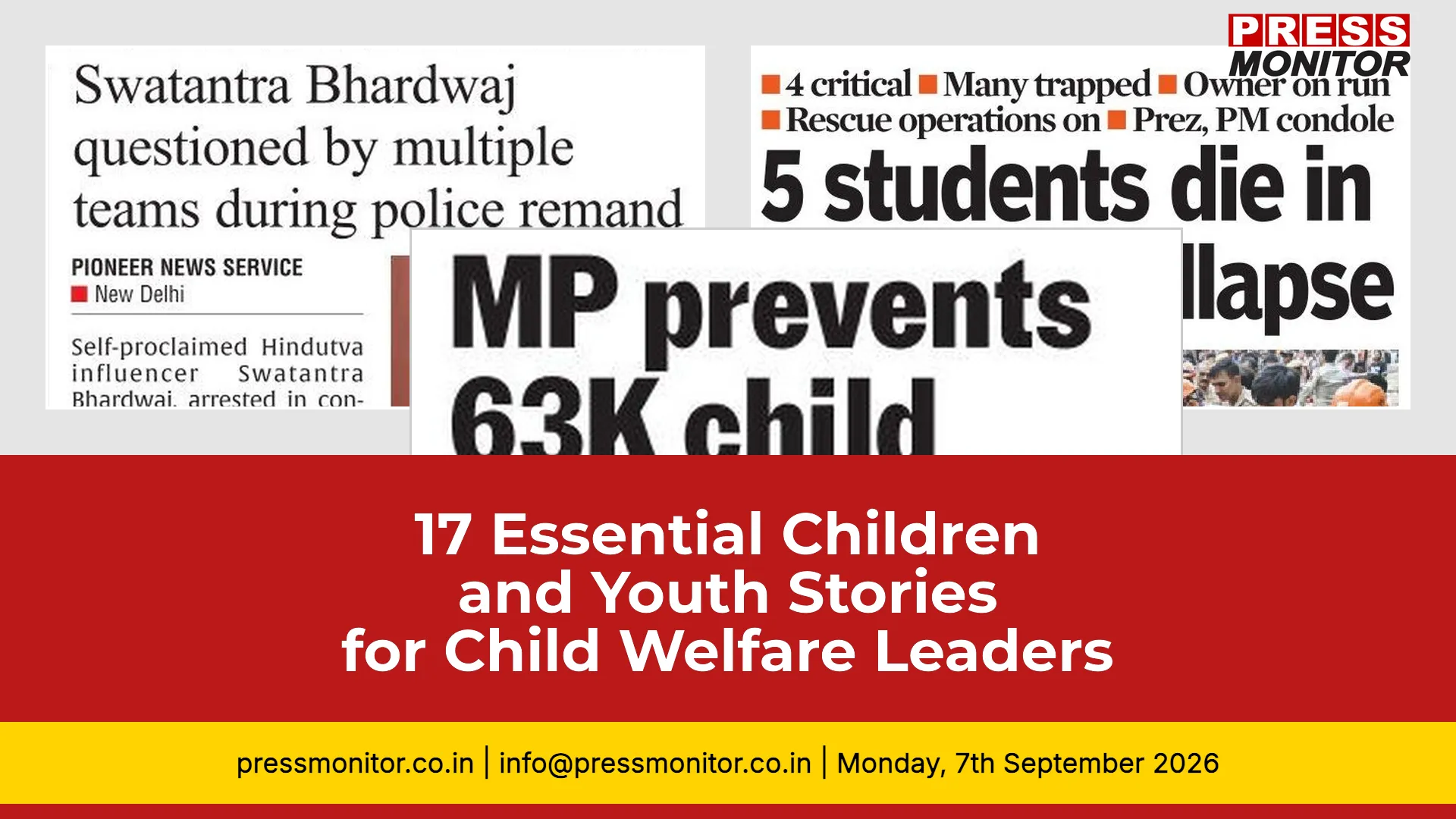
According to Press Monitor's tracking of Indian publications, this media monitoring report covers 17 essential stories on children, minors, and youth — from child rescue operations and trafficking busts to policy milestones and tragic incidents. This press review delivers media intelligence and print media monitoring insights on the news on children and youth in India, spanning rescue operations, policy breakthroughs, and heartbreaking developments that demand attention.
1. Bhardwaj Arrested in Delhi Protest
A front-page report in The Pioneer says that 22‑year‑old Hindutva influencer Swatantra Bhardwaj was arrested following an alleged assault on a student activist’s father during a protest at Delhi’s Jantar Mantar on 17 July 2026. He was detained in Uttar Pradesh’s Bulandshahr, sent to Delhi court custody, and questioned about viral videos and online threats. Police have added charges under the Scheduled Castes and Tribes Act, criminal intimidation, and a fresh FIR under the Protection of Children from Sexual Offences Act.
Why it matters: The arrest of Hindutva influencer Swatantra Bhardwaj following an alleged assault on a student activist's father at Jantar Mantar highlights the intersection of political violence and child safety. A separate POCSO case was registered over online threats, signaling stricter enforcement against those who target minors and activists.
Key detail: Delhi court remanded Bhardwaj to one-day judicial custody; charges include SC/ST Act, criminal intimidation, and POCSO provisions.
Source: The Pioneer, 17 July 2026
Next step: Monitor whether the POCSO charges lead to broader accountability for online harassment targeting minors and activists.
2. 5 Students Killed as Boys PG Building Collapses
A front-page report in Asian Age says at least five students were killed and four others critically injured after a nearly five-decade-old five-storey boys' paying guest accommodation building collapsed in a congested lane of south Delhi's Satya Niketan near Delhi University's South Campus on Sunday afternoon. Rescue operations continued late into the evening as teams searched the rubble for those feared trapped, with the All India Institute of Medical Sciences trauma centre receiving ten injured patients from the collapse. Delhi chief minister Rekha Gupta visited the site and ordered strict action against those responsible, while the BJP, AAP and Congress traded charges over alleged negligence and illegal construction.
Why it matters: The collapse of a nearly five-decade-old paying guest building in South Delhi's Satya Niketan killed five students and exposed systemic failures in building safety and enforcement for student accommodations.
Key detail: Four others critically injured; AIIMS trauma centre received ten patients; owner Hariram booked for culpable homicide.
Source: Asian Age, 6 September 2026
Next step: Authorities must audit all student accommodations near university campuses across Delhi.
3. Madhya Pradesh Prevents 62898 Child Marriages
A front-page report in Free Press Journal says Madhya Pradesh has prevented 62898 child marriages over the last three years, establishing itself as a key front in India's fight against child marriage. The state's child marriage rate among women aged 20 to 24 declined to 20 percent in the latest National Family Health Survey, down from 23.1 percent previously. Just Rights for Children worked with 14 partner organisations across 55 districts to play a major role in preventing these marriages.
Why it matters: Madhya Pradesh's achievement in preventing over 62,000 child marriages in three years demonstrates that coordinated state-level intervention can produce measurable results in child protection.
Key detail: Child marriage rate among women aged 20-24 dropped to 20% from 23.1% in NFHS-6; Just Rights for Children worked with 14 partner organisations across 55 districts.
Source: Free Press Journal, 6 September 2026
Next step: Other states should replicate the Bharat campaign model and expand community-based monitoring.
4. Amit Shah Unveils Drug-Free India Plan by 2029
A front-page report in The Pioneer says Union Home Minister Amit Shah announced a detailed three-year plan to make India drug-free by 2029 during a high-level meeting in Goa. Shah stated that Prime Minister Narendra Modi's objective is to have drug-free youth lead India to Viksit Bharat by 2047, and described the fight against narcotics as a national security priority involving four pillars of enforcement, precursor control, demand reduction, and capacity building.
Why it matters: The Union Home Minister's three-year plan to make India drug-free by 2029 directly targets youth substance abuse, framing narcotics as a national security priority.
Key detail: Four pillars — enforcement, precursor control, demand reduction, and capacity building; PM Modi's vision of drug-free youth leading India to Viksit Bharat by 2047.
Source: The Pioneer, Panaji
Next step: Implementation details and state-level coordination mechanisms need public disclosure.
5. UN Endorses India Child Marriage Campaign
A front-page report in Asian Age says the United Nations has declared November 27 as the International Day for the Elimination of Child, Early and Forced Marriage, endorsing India's campaign against child marriage. The date marks the launch of the government's Bal Vivah Mukt Bharat campaign in 2024, following a UN General Assembly resolution adopted on September 4 led by Sierra Leone and supported by around 50 countries including India. The initiative was spearheaded by Bhuwan Ribhu, founder of Just Rights for Children, who addressed the UN in March with support from Sierra Leone's First Lady Fatima Maada Bio.
Why it matters: The UN's endorsement of India's Bal Vivah Mukt Bharat campaign, designating November 27 as the International Day for the Elimination of Child, Early and Forced Marriage, gives global legitimacy to domestic efforts.
Key detail: Resolution led by Sierra Leone, supported by around 50 countries including India; campaign launched in 2024; spearheaded by Bhuwan Ribhu, founder of Just Rights for Children.
Source: Asian Age, 6 September 2026
Next step: States must align their annual targets with the UN-endorsed framework for accountability.
6. UN Adopts Child Marriage Resolution
A front-page report in Deccan Herald says the UN General Assembly adopted a resolution on November twenty-seven declaring the International Day for the Elimination of Child, Early and Forced Marriage. India was among the co-sponsors of the resolution led by Sierra Leone. The Bal Vivah Mukt Bharat campaign was launched in India on November twenty-seven, twenty twenty-four, aiming to reduce child marriage by ten per cent by twenty twenty-six and make India child marriage free by twenty thirty.
Why it matters: The UN General Assembly's formal adoption of the resolution reinforces the global commitment to ending child marriage, with India as a co-sponsor.
Key detail: Target to reduce child marriage by 10% by 2026 and make India child marriage free by 2030.
Source: Deccan Herald, 6 September 2026
Next step: Civil society organisations should track state-level progress against the 2030 target.
7. Assam Child Marriage Crackdown Gets UN Recognition
A front-page report in First India says Assam Chief Minister Himanta Biswa Sarma welcomed the United Nations General Assembly's decision to designate November 27 as the International Day for the Elimination of Child, Early and Forced Marriage. State government figures show over twelve thousand one hundred ninety-six child marriage cases were registered in the past five years with more than eleven thousand arrests. Assam has combined enforcement with education measures and reported an eighty-one per cent decline in child marriages across eleven hundred thirty-two villages.
Why it matters: Assam's 81% decline in child marriages across 1,132 villages, combined with over 12,000 cases registered and 11,000 arrests, offers a replicable enforcement-and-education model.
Key detail: Chief Minister Himanta Biswa Sarma welcomed the UN resolution; state combined legal action with community education.
Source: First India, Guwahati
Next step: Other states should study Assam's dual approach of enforcement and education for scaling.
8. Arunachal Police Rescue 38 From Trafficking
A front-page report in The Pioneer says Arunachal Pradesh Police have rescued 38 people, including 34 children, from various locations and arrested four persons allegedly involved in human trafficking. The children were rescued from Aalo, Mechuka, Pasighat, Naharlagun, Itanagar, Longding area of Arunachal Pradesh and from Assam. A trafficking case was registered at Namsai Police Station last month and is being investigated by Namsai Deputy Superintendent of Police Kengo Dirchi under the supervision of Superintendent of Police Sangey Thinley, in close coordination with the Child Welfare Committee and the District Child Protection Unit, Namsai.
Why it matters: The rescue of 38 people including 34 children from trafficking networks in Arunachal Pradesh underscores the ongoing threat of child trafficking across northeastern India.
Key detail: Four persons arrested; case registered at Namsai Police Station; investigation led by Namsai DSP Kengo Dirchi under SP Sangey Thinley's supervision, in coordination with Child Welfare Committee and District Child Protection Unit.
Source: The Pioneer, Itanagar, 18 July 2026
Next step: Strengthen border-area surveillance and inter-state coordination to prevent trafficking corridors.
9. Mathura Man Re-Arrested for Rape
A front-page report in Times of India says a man was re-arrested in Mathura for raping a sixteen-year-old Dalit girl and charged under the Protection of Children from Sexual Offences Act. The accused had previously been jailed in 2022 for a dispute in which he gouged out both eyes of a youth with his fingers.
Why it matters: The re-arrest of a Mathura man for raping a 16-year-old Dalit girl — who had previously been jailed for gouging out a youth's eyes — raises questions about recidivism and protection for vulnerable minors.
Key detail: Charged under POCSO Act; prior conviction in 2022 for assault.
Source: Times of India, 18 July 2026
Next step: Review parole and early-release protocols for convicted sex offenders against children.
10. Road Neglect Kills Child Ambulance Delay
A front-page report in Times of India says a six-year-old boy died after his father's motorcycle got stuck in mud on a deteriorated road, delaying access to medical treatment near Pilibhit. Residents had repeatedly pleaded with local authorities for road repairs, but the pleas went unheard until after the tragedy. Officials have promised an investigation and urgent road construction following the incident.
Why it matters: A six-year-old boy died near Pilibhit after his father's motorcycle got stuck in mud on a deteriorated road, delaying emergency medical access — a stark reminder of how infrastructure neglect directly endangers children's lives.
Key detail: Residents had repeatedly pleaded for road repairs; officials promised investigation and urgent construction.
Source: Times of India, Pilibhit
Next step: Prioritise rural road maintenance in child-health emergency corridors.
11. 7-year-old girl dies amid hospital protest
A front-page report in New Indian Express says relatives of a seven-year-old girl who died while undergoing treatment in Puducherry staged a road blockade with her body on the Karur-Namakkal National Highway near Paramathi Velur on Sunday, alleging that improper treatment at a private hospital led to complications and her death. The deceased was identified as K Kaviksha of Poyyeri, a Class 3 student at a government primary school in Kuppuchipalayam. After the protest, police superintendent Girish Ashok held talks with the protesters and assured them that action would be taken against the doctor if the allegations were established, and the body was sent to the Namakkal Government Medical College Hospital for postmortem.
Why it matters: The death of seven-year-old K Kaviksha during treatment at a private hospital in Puducherry, followed by a road blockade protest by her relatives, highlights concerns about medical negligence and accountability in private healthcare for children.
Key detail: Police superintendent Girish Ashok assured action against the doctor if allegations are established; body sent for postmortem at Namakkal Government Medical College Hospital.
Source: New Indian Express, Namakkal
Next step: Strengthen medical grievance redressal mechanisms for pediatric care.
12. Over 100 Children Killed In Minab School Strike
A front-page report in Tribune says that over 100 students were killed in a strike on the Shajareh Tayyebeh school in Minab, Iran, on February 28. The Trump administration has not directly accepted responsibility for the attack or released Pentagon findings. Hormozgan Governor Mohammad Ashouri Taziani said the building will be turned into a war museum and memorial.
Why it matters: The attack on Shajareh Tayyebeh school in Minab, Iran, killing over 100 students — including children — represents one of the deadliest strikes on educational infrastructure, with global implications for child safety in conflict zones.
Key detail: Trump administration has not accepted responsibility; Hormozgan Governor said the building will become a war museum and memorial.
Source: Tribune, Minab, 6 September 2026
Next step: International bodies must establish stronger protections for schools in conflict zones.
13. Every Last Girl Book Review
A front-page report in Business Line says Safeena Husain's book Every Last Girl is a manifesto for systemic change, addressing how deep-seated cultural apathy keeps girls out of school in rural India. The book details her journey scaling Educate Girls from a pilot project in Rajasthan to benefit two point two million children through fifty-five thousand volunteers. It also examines the quality of education and the challenges of bureaucratic roadblocks and hostile communities.
Why it matters: Safeena Husain's book Every Last Girl documents how systemic cultural apathy keeps girls out of school in rural India, offering a roadmap for scaling education interventions from a Rajasthan pilot to 2.2 million children.
Key detail: 55,000 volunteers; Educate Girls scaled from pilot to national impact; examines bureaucratic roadblocks and hostile communities.
Source: Business Line, reviewed by Richa Mishra
Next step: Policymakers should integrate the book's findings into state education reform strategies.
14. Nepal Floods Leave Babies Hungry
A front-page report in The Hans India says that for Nepal's mothers and babies, the August 26 flash floods have created a crisis within a crisis, with thousands struggling for food, privacy and access to healthcare in overcrowded shelters. Sharmila Shrestha, 33, lost her home and was separated from her 14-month-old daughter for days, now sleeping with the toddler on a classroom floor in northwest Kathmandu, while another mother, Pariyar, struggles to breastfeed her newborn in a crowded shelter.
Why it matters: The August 26 flash floods in Nepal created a crisis within a crisis for mothers and babies, with thousands struggling for food, privacy, and healthcare in overcrowded shelters — a reminder that child welfare extends beyond national borders.
Key detail: Sharmila Shrestha, 33, lost her home and was separated from her 14-month-old daughter for days; another mother struggles to breastfeed in crowded shelters.
Source: The Hans India
Next step: Humanitarian agencies must prioritise maternal and infant nutrition in flood relief operations.
15. Bal Asha Trust Finds Children a Family
A front-page report in Free Press Journal says Bal Asha Trust is supporting abandoned and destitute children in Mumbai, with Executive Director Sunil Kumar Arora highlighting rehabilitation, family reunification and adoption as core goals. The organisation says that over the last forty years it has legally adopted more than one thousand children, while in the last year caring for one hundred sixty-five children, reuniting more than one hundred with families and placing fourteen for legal adoption.
Why it matters: Bal Asha Trust's four decades of work in Mumbai — legally adopting over 1,000 children, reuniting more than 100 with families, and placing 14 for legal adoption — demonstrates the impact of sustained child welfare work.
Key detail: Executive Director Sunil Kumar Arora highlighted rehabilitation, family reunification, and adoption as core goals; currently caring for 165 children.
Source: Free Press Journal, Mumbai
Next step: Increase public-private partnerships to scale family reunification programs.
16. Ashwini Pol Tragedy
A front-page report in Times of India says Ashwini Pol died of severe head injuries after pushing her three children into a gorge at Naldurg fort in Maharashtra, forty‑eight hours earlier, before jumping herself. Investigating officer Ravindra Gaikwad said Veera, two, had head injuries and intracranial bleeding. The tragedy was allegedly prompted by relentless dowry harassment and demands for cash and gold.
Why it matters: The death of Ashwini Pol, who pushed her three children into a gorge at Naldurg fort in Maharashtra before jumping herself, allegedly driven by relentless dowry harassment, exposes the deadly intersection of domestic violence and child safety.
Key detail: Two-year-old Veera suffered severe head injuries and intracranial bleeding; investigating officer Ravindra Gaikwad is leading the probe.
Source: Times of India
Next step: Strengthen dowry harassment prevention and child protection in high-risk domestic situations.
17. Rape Suspect Arrested in Churu
A front-page report in First India says a man was arrested within three hours of an FIR registration for allegedly raping an eight‑year‑old girl in Churu on September 4. Police filed the case under BNS, POCSO Act and SC/ST Act, and the accused was remanded to judicial custody after being produced in court.
Why it matters: The arrest of a rape suspect within three hours of FIR registration for the alleged assault of an eight-year-old girl in Churu demonstrates the effectiveness of swift police action in child sexual abuse cases.
Key detail: Case filed under BNS, POCSO Act, and SC/ST Act; accused remanded to judicial custody.
Source: First India, Jaipur
Next step: Ensure rapid-response protocols for child abuse cases are standardised across districts.
Closing: These 17 stories, tracked through print media monitoring, paint a complex picture of children's lives in India — from rescue and rehabilitation to tragedy and systemic reform. Which of these developments will you be tracking most closely in the coming week?