17 Essential Education Stories for Education Leaders


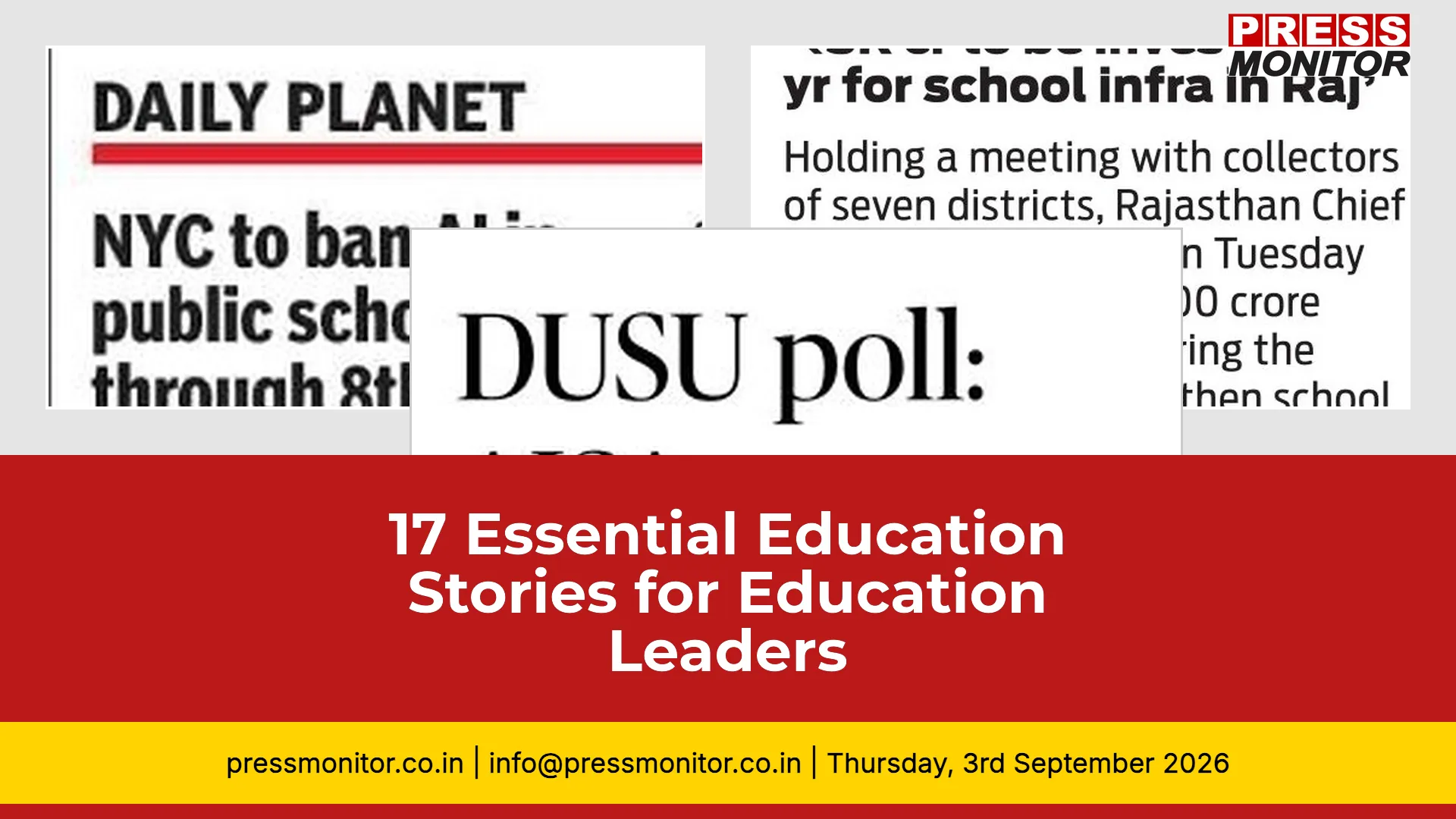
India's education sector is undergoing a transformative year, from AI classroom bans to billion-rupee infrastructure pushes. According to Press Monitor's tracking of Indian publications, this press review covers 17 distinct developments across Indian print media that every education stakeholder should know. These stories reflect the power of media intelligence in tracking policy shifts, institutional changes, and student welfare issues in real time.
1. NYC Bans AI in Public Schools
A front-page report in Times of India says that New York City will ban the use of artificial intelligence for students in public schools through eighth grade, confirming US media reports. Teachers and parents have warned against the use of Al in schools over concerns about harming children’s mental health and cognitive development, as well as environmental damage. Al use will only be allowed in high school, which begins in the ninth.
Why it matters: A landmark decision affecting millions of students, the NYC ban on AI tools through eighth grade signals a global reckoning with technology in early education. Teachers and parents have raised concerns about mental health, cognitive development, and environmental damage.
Key detail: AI use will only be allowed in high school, beginning in ninth grade.
Source: Times of India, front page.
Next step: School districts nationwide are watching this ruling as a template. Will your institution be next?
2. Rajasthan Invests Rs 3,000 Crore in School Infrastructure
A front-page report in New Indian Express says Rajasthan Chief Secretary V Srinivas announced that Rs 3,000 crore would be invested during the current year to strengthen school infrastructure across the state.
Why it matters: Rajasthan Chief Secretary V Srinivas announced a massive investment to strengthen school infrastructure, signaling state-level commitment to foundational education.
Key detail: The full Rs 3,000 crore allocation targets the current fiscal year.
Source: New Indian Express, front page.
Next step: Watch for tender announcements and contractor shortlists in the coming weeks.
3. AISA Challenges DUSU Election Bond Requirement
A front-page report in The Hindu says the All India Students’ Association (AISA) moved the Delhi High Court against the Delhi University’s requirement for candidates to submit an indemnity affidavit and parental surety bond of 1 lakh to contest the university’s students’ union (DUSU) election scheduled for September 18.
Why it matters: The All India Students' Association moved the Delhi High Court against Delhi University's requirement for candidates to submit an indemnity affidavit and parental surety bond of Rs 1 lakh to contest the DUSU election.
Key detail: The DUSU election is scheduled for September 18.
Source: The Hindu, front page.
Next step: The court's ruling could set a precedent for student election transparency across Indian universities.
4. Nilekani Panel Engages States on CBT Exam Reform
A front-page report in Economic Times says state governments have almost unanimously backed the idea of switching to Computer Based Testing (CBT) for entrance exams at a September meeting with the Nandan Nilekani-led High Powered Task Force (HPTF) on exam reforms.
Why it matters: State governments almost unanimously backed switching to Computer Based Testing for entrance exams at a September meeting with the Nandan Nilekani-led High Powered Task Force.
Key detail: The shift to CBT aims to reduce paper leaks and improve exam integrity across India.
Source: Economic Times, front page.
Next step: Implementation timelines and state-level pilot programs will be critical next milestones.
5. Female Reservation Plea in DUSU Elections
A front-page report in Hindustan Times says a plea filed by Shabana Hussain seeks a 50% reservation for females in Delhi University students’ union elections. The plea states that women are disproportionately underrepresented in the DUSU and other unions, and issues concerning female students, including sexual harassment, fail to receive adequate representation with limited presence.
Why it matters: A plea by Shabana Hussain seeks 50% reservation for females in Delhi University students' union elections, citing disproportionate underrepresentation and inadequate attention to issues like sexual harassment.
Key detail: Women remain underrepresented in DUSU and other student unions.
Source: Hindustan Times, front page.
Next step: The Delhi High Court's response will signal India's stance on gender equity in student governance.
6. Four Reforms to Rebuild Exam Trust
A front-page report in Asian Age says CUTS International secretary-general S. Mehta has proposed four reforms to help the Nilekani task force rebuild trust in India's examination system. The recommendations include post-admission competency checks, multiple examination windows to reduce the risk of paper leaks, a federated architecture with blockchain-based verification, and institutional learning from every failure. The authors argue institutional design must come before technology so that examination certificates remain worthy of trust.
Why it matters: CUTS International secretary-general S. Mehta proposed four reforms for the Nilekani task force: post-admission competency checks, multiple examination windows, blockchain-based verification, and institutional learning from failure.
Key detail: The authors argue institutional design must come before technology so examination certificates remain worthy of trust.
Source: Asian Age, front page.
Next step: These recommendations could shape the next phase of India's exam reform agenda.
7. International Students in Canada Need More Reserve Funds
Hindustan Times reports that Canadian immigration authorities have increased the amount of reserve funds required for international students applying for a study permit from this month onward.
Why it matters: Canadian immigration authorities have increased reserve fund requirements for international students applying for study permits, directly affecting Indian students' study abroad plans.
Key detail: The change took effect this month onward.
Source: Hindustan Times.
Next step: Prospective students should factor in additional financial requirements when planning applications.
8. Foreign Campuses Cut Costs by Two-Thirds
A front-page report in Mint says foreign universities can now set up branch campuses in India under the National Education Policy 2020, cutting the cost of an international degree by roughly two-thirds, with a University of Liverpool postgraduate programme in India costing Rs 14-15 lakh against over Rs 60 lakh at its UK campus. However, employer acceptance and career outcomes at these satellite campuses remain untested, with large companies in wait-and-watch mode, while an Emeritus survey found 69% of postgraduate aspirants prefer an India-based international programme to avoid visa uncertainty. Experts advise parents to verify regulatory approval, degree equivalence, faculty ratios and exchange guarantees before enrolling.
Why it matters: Under NEP 2020, foreign universities can now set up branch campuses in India, cutting international degree costs by roughly two-thirds.
Key detail: A University of Liverpool postgraduate programme costs Rs 14-15 lakh in India versus over Rs 60 lakh at its UK campus.
Source: Mint, front page.
Next step: Verify regulatory approval, degree equivalence, faculty ratios, and exchange guarantees before enrolling.
9. Universities Bill Passed in Himachal Pradesh
A front-page report in Tribune says the Himachal Pradesh Vidhan Sabha on Wednesday passed the Himachal Pradesh State Universities (Amendment) Bill, 2026, amid strong objections from Opposition legislators who alleged that the proposed changes would undermine the autonomy of state universities.
Why it matters: The Himachal Pradesh Vidhan Sabha passed the State Universities (Amendment) Bill, 2026, amid strong opposition objections about undermining university autonomy.
Key detail: The bill proposes changes to state university governance structures.
Source: Tribune, front page.
Next step: Watch for presidential assent and implementation timelines.
10. CET Cell Tightens College Admissions
A front-page report in Free Press Journal says the Common Entrance Test (CET) Cell has announced measures to make institution-level admissions to technical education courses for 2026-27 more transparent and merit-based. Selected private colleges will have observers from nearby government colleges overseeing document verification, merit-list preparation and seat allotment, which must be conducted under CCTV surveillance with recordings preserved for inspection and audit. Students have been cautioned against agents promising seats before the Centralised Admission Process rounds conclude, and violating colleges may face legal and administrative action.
Why it matters: The Common Entrance Test Cell announced measures to make institution-level admissions to technical education courses more transparent and merit-based.
Key detail: Selected private colleges will have observers from nearby government colleges overseeing document verification under CCTV surveillance.
Source: Free Press Journal, front page.
Next step: Students should be cautious of agents promising seats before CAP rounds conclude.
11. CAP Merit Guidelines Issued
A front-page report in Free Press Journal says that vacant seats must be allotted strictly on the basis of inter-se merit after CAP rounds. Students have been cautioned against agents, intermediaries and misleading admission information. Colleges must consider both direct applications and candidate lists provided by the CET Cell while preparing category-wise merit lists.
Why it matters: Vacant seats must now be allotted strictly on the basis of inter-se merit after CAP rounds, with students cautioned against agents and misleading admission information.
Key detail: Colleges must consider both direct applications and candidate lists provided by the CET Cell.
Source: Free Press Journal, front page.
Next step: Admission committees must update their processes to comply with the new guidelines.
12. Student Dies by Suicide Over School Punishment
A front-page report in The Pioneer says a 16-year-old Class XI student allegedly died by suicide after jumping from the third-floor terrace of a private school in Faridabad's NIT area on Tuesday afternoon.
Why it matters: A 16-year-old Class XI student allegedly died by suicide after jumping from the third-floor terrace of a private school in Faridabad's NIT area, reigniting the debate on school punishment and student mental health.
Key detail: The incident occurred on Tuesday afternoon in Faridabad.
Source: The Pioneer, front page.
Next step: Schools must urgently review their disciplinary policies and provide mental health support.
13. NTA Exam Ruled Not Free and Fair
A front-page report in Times of India says the Delhi High Court held that an exam by National Testing Agency for Delhi University’s non-teaching staff wasn’t conducted in free, fair and transparent manner.
Why it matters: The Delhi High Court held that an NTA exam for Delhi University's non-teaching staff was not conducted in a free, fair, and transparent manner.
Key detail: The ruling raises questions about recruitment integrity in public universities.
Source: Times of India.
Next step: Affected candidates may seek retrial or alternative recruitment processes.
14. Class IX Maths Textbooks Delayed in CBSE Schools
A front-page report in Times of India says parents of Class IX students studying in CBSE schools in the city have alleged that their wards are yet to receive Part 2 mathematics and social science textbooks for the second semester, raising concerns over disruption to teaching and learning.
Why it matters: Parents of Class IX students in CBSE schools reported that their children have not received Part 2 mathematics and social science textbooks for the second semester.
Key detail: The delay raises concerns over disruption to teaching and learning.
Source: Times of India.
Next step: CBSE must issue a timeline for textbook distribution to prevent academic setbacks.
15. NTA Identifies Testing Centres for NEET-UG
A front-page report in Indian Express says the National Testing Agency (NTA) is seeking help from the All India Council for Technical Education (AICTE) to identify and develop testing centres for computer-based examinations for NEET-UG next year.
Why it matters: The National Testing Agency is seeking help from AICTE to identify and develop testing centres for computer-based NEET-UG examinations next year.
Key detail: This marks a significant shift toward digital exam infrastructure for India's most competitive medical entrance test.
Source: Indian Express.
Next step: AICTE and NTA must finalize centre locations and technology readiness timelines.
16. IIT Madras Launches 100-Hour Multicloud Training Program
A front-page report in New Indian Express says IIT Madras Pravartak Technologies Foundation has launched a 100-hour multicloud training program with SWAYAM Plus to build industry-ready talent in cloud computing and cybersecurity. The program covers Amazon Web Services, Microsoft Azure, and Google Cloud Platform, and includes cloud security concepts.
Why it matters: IIT Madras Pravartak Technologies Foundation launched a 100-hour multicloud training program with SWAYAM Plus to build industry-ready talent in cloud computing and cybersecurity.
Key detail: The program covers Amazon Web Services, Microsoft Azure, and Google Cloud Platform.
Source: New Indian Express.
Next step: Enrollment details and eligibility criteria should be monitored closely by aspiring tech professionals.
17. Haryana CM Saini Calls for Action Plan for Less-Educated Youth
A front-page report in Millennium Post says Haryana Chief Minister Nayab Singh Saini said a detailed survey should be conducted to understand the background of less-educated youth and an effective action plan should be implemented for their holistic development.
Why it matters: Haryana Chief Minister Nayab Singh Saini directed a detailed survey of less-educated youth and an effective action plan for their holistic development.
Key detail: The directive includes skill development and educational pathways for underserved youth.
Source: Millennium Post, front page.
Next step: The survey results will shape Haryana's education and skill development budget for the next fiscal year.
Closing: These 17 stories, tracked through print media monitoring by Press Monitor, reveal an education sector in transition. From AI bans to infrastructure investments, from exam reforms to student welfare, the print media remains the most reliable source of editorial-vetted intelligence. Which of these developments will have the greatest impact on your institution or career? Follow Press Monitor for continuous news on education and media monitoring updates.